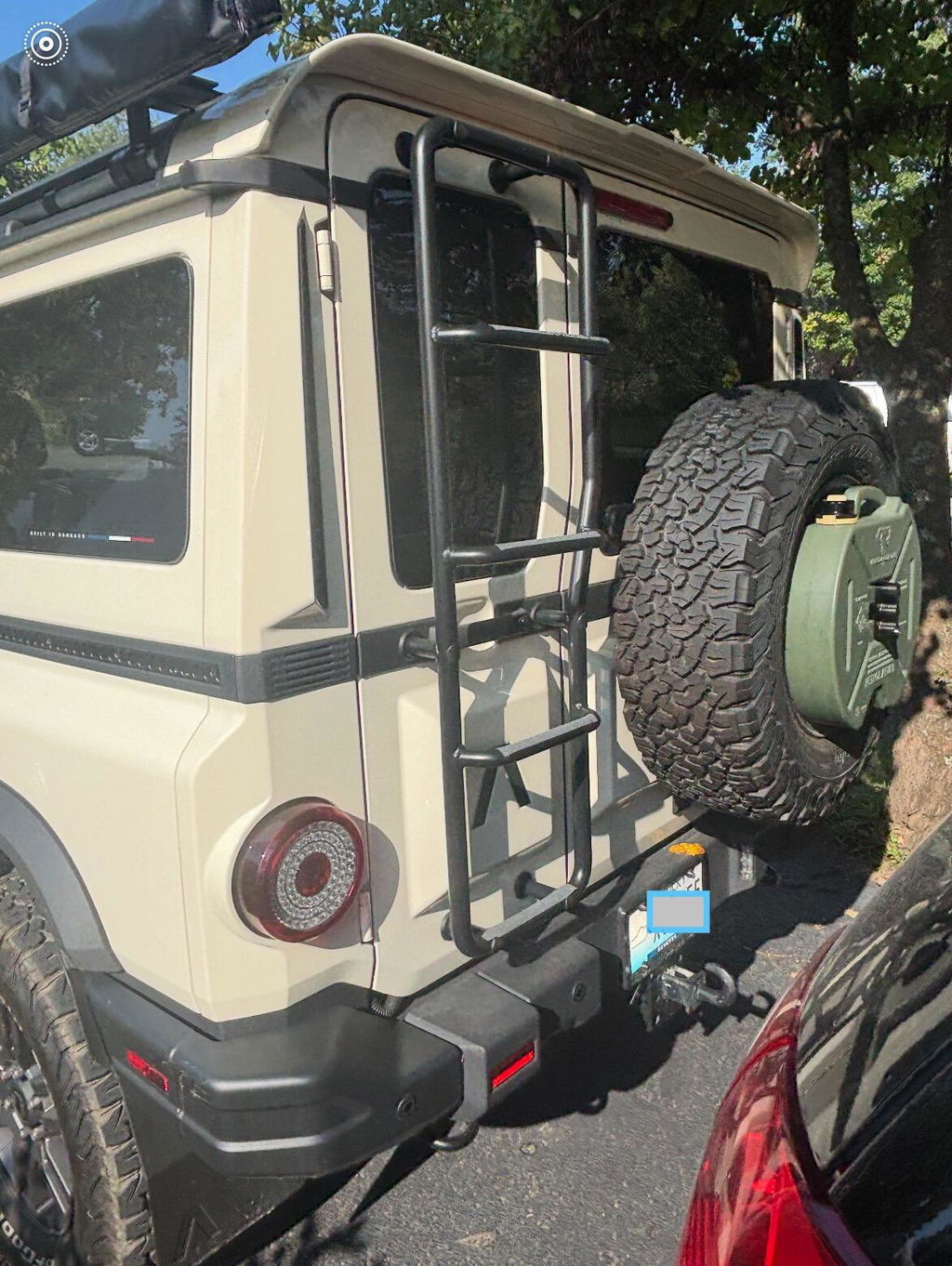
The most common INEOS Grenadier modifications in 2026 follow a recognizable pattern. Side steps come first — the stock step is narrow and most owners regret skipping aftermarket ones. The roof platform comes second because it unlocks every gear-carrying modification that follows. By the time an owner hits month three, the exterior utility belt, bumper lighting, and ladder carrier are usually all in play. Interior cargo rails and a towing upgrade close out the platform build. Most owners complete the core modification sequence in three to six months of ownership.
That sequence isn't arbitrary. It reflects the order in which modifications solve the most pressing daily-use friction points. This guide covers the eight modifications owners install first — what each actually changes, what the install involves, and where DVA's hardware fits into each step. For a full catalog of every Grenadier accessory category, see the Grenadier Accessories Hub.
"Honestly I'd wait and use the truck for a while before deciding what you need and don't need. I've actually done very little to mine despite originally thinking I'd do loads of things to it. The base vehicle just works well for what I need."
— baron-von-teuchter, TheGrenadierForum, "New Owner. What mods to consider?" thread, Jul 30, 2024
That's a legitimate approach. The Grenadier is competent out of the box. But for owners who know they'll be camping, overlanding, or carrying gear, the eight modifications below are consistently where the build starts.
1. Side Steps — Entry-Level Access That Changes Daily Usability
The Grenadier sits 217mm off the ground at its lowest body point. The OEM step bar is functional but narrow — roughly 100mm of standing surface — which makes loading rear cargo with hands full more awkward than it needs to be. Most owners who skip aftermarket steps early report wishing they hadn't.
The decision splits between fixed steps and electric power steps. Fixed steps are simpler, lighter, and cheaper. Electric steps retract when not in use, which preserves departure angles and gives a cleaner look on the road. The trade-off is complexity — power steps have motors, sensors, and wiring that fixed steps don't.
DVA's fixed Side Steps mount to the factory rocker bolts — no drilling, no welding — and sit lower than the OEM bar for easier entry. The DVA Electric Power Side Steps with LED deploy automatically on door open and retract on close, with integrated LEDs for night-time step visibility. Both sets fit Wagon and Quartermaster.


2. Roof Platform — Crossbars That Turn the Roof Into a System
The factory roof rails run front-to-rear along the Grenadier's roof. They're rated for 150 kg dynamic (driving) and 420 kg static (parked) — plenty of margin for a roof box, a rooftop tent, awning mount, satellite dish, or a combination of gear. The modification that unlocks all of it is crossbars.
Without crossbars, the factory rails are effectively aesthetic. With the right crossbar setup, the roof becomes a structured cargo platform with load-rated attachment points across the full width of the vehicle.
"A lot of us have done the Fox steering damper from Agile as a first step. Also, QUICKLY protect that windshield — Exoshield. After that, sky is the limit. It's so easy to work on and modify — so there are so many great ideas and aftermarket products. You literally have years of fun mods ahead of you."
— TheGrenadierForum member, "New Owner. What mods to consider?" thread, Jul 30, 2024
The DVA DualTrack-T™ MAX replaces standard crossbar rails with a dual-channel system: a 25mm T-slot channel along the top (accepts standard accessories) and a full-length L-Track channel on the underside (for tie-downs, gear hooks, and sliding mounts). The crossbars bolt directly to the factory roof rail attachments — no drilling, no modifications to the factory rail system.
Where standard crossbars give you four discrete attachment points, the DualTrack-T™ MAX gives you continuous adjustment across the full rail span. Awning mounts, tent mounts, Starlink mounts, and light bars all slide and lock anywhere along the T-slot. The L-Track underside handles gear that needs to hang — recovery boards, fuel cans, and long cargo that rides below the main surface.

3. Exterior Utility Belt — Side Panel Mounting Points Without Welding
The Grenadier's exterior side panels have a factory attachment system — a series of threaded inserts and body attachment points running along the sides that INEOS uses for OEM accessory mounting. Most owners don't realize these points exist until they start looking at aftermarket side storage options.
The exterior utility belt concept takes those factory attachment points and builds a modular exoskeleton around them. The result is an exterior carry system — for recovery boards, jerry cans, side bags, and tool rolls — that bolts directly to the body without drilling or welding.
"Steering damper, an absolute necessity in my opinion... Off-road lights, again I like the agile offroad kit... Roof rack. Leitner is solid. Side molle from bison gear because I have the roof rack and they integrate... Under carriage protection. Gas tank, engine bay and transmission."
— parb, TheGrenadierForum, "New Owner. What mods to consider?" thread, Jul 29, 2024
The DVA Exterior Utility Belt Full Set covers front and rear side sections in one kit. The rails are extruded aluminum with L-Track channels — which means anything that mounts to L-Track (gear hooks, bottle openers, tool mounts, recovery board brackets) mounts directly to the belt without additional hardware. The front section, rear section, or full set can be configured separately depending on use case.
The utility belt integrates with the DualTrack-T™ MAX roof system — both use L-Track as the attachment standard, so accessories that mount to the roof crossbars also mount to the side belt rails. One hardware ecosystem across the whole vehicle.

4. Auxiliary Lighting — Bumper-Mounted Lights That Don't Require Roof Wiring
The Grenadier's factory headlight output is adequate for road use but falls short for unlit tracks, forest roads, and reversing in dark campsites. Most owners who spend time off-road add auxiliary lighting within the first six months. The debate is usually between bumper-mounted and roof-mounted.
Bumper-mounted lighting illuminates the road directly ahead at vehicle level — less prone to glare off dust or rain than roof lights, and more effective for low-obstacle detection. Roof-mounted lighting casts further but at an angle that can lose definition at close range.
The DVA Front Bumper 32" LED Light Bar integrates with the Grenadier's front bumper cutout — the factory bumper has a designed space for auxiliary lighting that most owners don't use. The light bar occupies that space cleanly, without the bracket-and-spacer look of a universal mount. Wiring connects to the DTP accessory circuit — no relay splicing required if the vehicle has the DTP front prep.

5. Rear Ladder Carrier — Gear That Mounts to the Ladder, Not the Roof
The Grenadier's rear ladder is OEM on most spec levels and handles a significant amount of aftermarket carry load. The ladder's rungs and side rails are rated well beyond what most owners ask of them — and multiple aftermarket systems use the ladder as the primary mount point for recovery gear, jerry cans, and hi-lift jacks.
The modification logic here is weight distribution. Every kilogram that mounts to the ladder instead of the roof keeps the center of gravity lower, which is meaningful for off-road handling. Recovery boards on the ladder rather than the roof rail save roughly 800mm of height and lower the payload's effective CoG.
"Made my first modification — GP Factor Bull Bar. It comes in two packages and five pieces. It was pretty easy to install and it's pretty sturdy. In total, it took me about an hour and a half to install. Next I plan to upgrade to a set of 275/70R18 BFGoodrich All-Terrain T/A KO3s and then probably some rock sliders."
— barakka, TheGrenadierForum, "Modifications" thread, Oct 21, 2025
The DVA Ladder-Mounted Accessory Carrier is a modular bracket system that clamps to the rear ladder rails without any drilling or permanent modification to the ladder. MaxTrax MKII and Lite recovery boards mount in a flush vertical position. A separate Hi-Lift Jack Carrier attaches to the same ladder section and positions the jack vertically alongside the recovery boards.

6. Interior Utility Rails — L-Track in the Cargo Area
The Grenadier's rear cargo area is usable stock, but it has no tie-down system beyond the factory lashing hooks on the floor. For owners who carry hard cases, fridges, compressors, or anything that needs to be secured from shifting, the factory hooks are too few and too widely spaced to be useful.
L-Track cargo rails installed on the cargo area side walls solve this. They give continuously adjustable tie-down points across the full length of the cargo space, rated for substantially more load than the factory floor hooks. Pelican cases can be secured with L-Track stud fittings at any position along the rail. A portable fridge with an L-Track-compatible bracket doesn't slide in acceleration or braking.
The DVA Interior Utility Rails bolt to the Grenadier's existing cargo area attachment points — no drilling into body panels. The rails run the full usable length of the cargo side walls. The same L-Track fittings used on the exterior utility belt and DualTrack-T™ MAX roof system work on the interior rails, so the hardware ecosystem extends inside the vehicle.

7. Towing Upgrade — A Proper 2" Receiver That Doesn't Fight the Spare Tire
Many Grenadier deliveries come without a tow hitch or with the OEM European-style ball mount. For US owners who need to tow trailers, utility carts, or boat trailers — all of which use 2" receiver hitch equipment — the OEM solution doesn't connect to standard US hitch accessories.
The DVA Rear 2" Hitch Receiver bolts to the Grenadier's factory rear cross-member — the same structural member INEOS uses for the OEM tow attachment. No cutting of the rear bumper, no drilling of new holes. The receiver is positioned to clear the spare tire carrier in its full range of motion and accept standard US hitch accessories (ball mounts, bike racks, cargo carriers, receiver tubes).
"I currently get about 35mm (1.5") of rear suspension sag when I hook up the camper. On long downhills the camper leans hard on the towbar and the front end of the Grenadier becomes lighter than I like. The only capability modification I am contemplating is to fit airbags or higher rating standard height springs on the rear to offset some of the weight."
— clark-kent, TheGrenadierForum, "Modifying or keeping your Grenadier mostly stock?" thread, Jan 30, 2025
That's a realistic towing scenario that highlights why the hitch upgrade matters: the Grenadier's rear payload capacity is 1,841 lbs total, which includes occupants, cargo, and tongue weight. Getting the hitch geometry right — receiver height, tongue weight position — affects how the front axle loads in a loaded tow situation.

8. The Modification Sequence in Practice
Most owners don't install all seven preceding modifications in one go. The realistic sequence, based on what owners report in build threads, runs roughly like this:
| Phase | Modification | Typical Timing | Why It Comes First |
|---|---|---|---|
| 1 | Side Steps | Week 1–2 of ownership | Daily use friction — noticed immediately |
| 2 | DualTrack-T™ MAX Crossbars | Month 1–2 | Unlocks all roof gear; needed before awning, tent, or roof lights |
| 3 | Exterior Utility Belt | Month 2–3 | Side storage — recovery boards, jerry cans — before first serious trip |
| 4 | Bumper Lighting | Month 2–4 | First off-road night driving exposes the factory headlight gap |
| 5 | Ladder Accessory Carrier | Month 3–4 | Recovery gear needs a permanent mount before overlanding trips |
| 6 | Interior Utility Rails | Month 3–5 | Fridge and hard-case organization — once cargo volume becomes an issue |
| 7 | Rear 2" Hitch Receiver | Month 4–6 | Added when towing need becomes clear — trailer, bike rack, or cargo carrier |
One pattern that shows up consistently: owners who skip the roof platform modification early and try to add roof gear later end up reinstalling or rerouting wiring and mounts. The crossbar system is foundational — everything else in the roof ecosystem (awning mounts, tent adapters, satellite dishes, light bars) is designed around having a rail-and-slot attachment point to work with.
What This Guide Doesn't Cover
These eight modifications are the most common platform-level changes that owners make in the first six months. They're all bolt-on, reversible, and don't affect the factory warranty position on the modified components.
Suspension modifications — lift springs, shock upgrades, tire size changes — are a separate category entirely. They affect the Grenadier's handling behavior, GVWR calculations, and in some cases the ESP calibration. INEOS has published guidance on what suspension modifications can be made without a clearance certificate; any owner planning lift or larger tires should read that documentation before proceeding.
Similarly, electrical modifications beyond DTP circuit accessories — dual battery systems, shore power, inverters — require understanding the Grenadier's 80A total accessory current budget and how the factory dual-battery system (where fitted) is managed. The vehicle's CAN bus architecture means some electrical modifications that work on other platforms don't translate cleanly here.
For the full catalog of INEOS Grenadier accessories and modifications available through DVA, see the DVA Grenadier accessories collection.
Start the Build
Ready to Build Out Your Grenadier?
Every modification on this list is available through DVA — bolt-on, no drilling required, ships to the US. The DualTrack-T™ MAX crossbar system is where most owners start: it turns the factory roof rails into a platform that supports everything else.
Shop DualTrack-T™ MAX → All Grenadier AccessoriesGo Deeper — Dedicated Guides
- Grenadier Crossbars: OEM vs DualTrack-T™ MAX — Complete Guide
- Grenadier Utility Belt: Load Ratings, L-Track Fittings & What Owners Mount
- Grenadier Rear Ladder: 5 Options, Prices & Install Guide
- Grenadier Roof Rack: What Fits, What Mounts & How DualTrack Works
- Grenadier Hitch Receiver: Bolt-On 2" Install & What Owners Learned
- INEOS Grenadier Accessories: 2026 Build Guide by Category