Short answer: Five rear ladders fit the INEOS Grenadier: the OEM (~$900), Front Runner (~$280), LeTech Multifunctional (~$350+), Westcott Designs full-length, and Overland Kitted steel unit. For owners who use their roof rack regularly, the OEM is the right call — it's the only option with full DVA accessory compatibility, factory warranty, and a clean fit for the 77-inch roof. Budget-constrained? Front Runner is the aftermarket consensus pick at roughly one-third the cost. Jump to the full comparison table or read on for the complete breakdown.
Five rear ladders fit the INEOS Grenadier. Best value: Front Runner (~$280) — same mount points as OEM at one-third the price. Full DVA ecosystem: OEM (~$900). Choose based on roof access frequency and whether you run DVA accessories. DVA's ladder-mounted accessories — the Recovery Board Carrier, Jerry Can Rig, and Gen 2 Accessory Carrier — are engineered for the OEM ladder and turn it into a multi-function expedition platform.
| Ladder | Price | Material | DVA Compatible | Best For |
|---|---|---|---|---|
| INEOS OEM | ~$900 | Aluminum | ✅ Full ecosystem | DVA builds, roof access daily |
| Front Runner | ~$280 | Aluminum | Partial | Budget-conscious, OEM mounts |
| LeTech Multifunctional | ~$350+ | Aluminum | Partial | Built-in can + ski holder |
| Westcott Designs | ~$375 | Aluminum | Partial | Full-length, 2024–2026 specific |
| Overland Kitted | ~$299 | Steel | Partial | Budget steel option |
The INEOS Grenadier's 77-inch roof height means access without a ladder requires stepping on the tyre and swing-arm — workable once, awkward every time you load gear. Two years of real-world ownership data across The INEOS Forum and DVA's 400+ Grenadier builds show a consistent pattern: owners who use their roof rack at least monthly call the ladder essential; those who keep the roof empty skip it. This guide gives you the exact decision criteria, the OEM vs aftermarket spec comparison with real prices, and how DVA's ladder-mounted accessories turn a simple rung system into a multi-function expedition platform.
We spent weeks digging through The INEOS Forum, owner build threads, and real-world feedback to separate the genuine consensus from the noise. This guide covers all five ladder options — OEM, Front Runner, LeTech, Westcott Designs, and Overland Kitted — with prices, DVA mount compatibility, install notes, and what 400+ Grenadier builders actually chose. Jump to the comparison table or read on for the full breakdown.
OEM Ladder (~$900): The Full-Ecosystem Choice — What 400+ Builders Say
When the Grenadier configurator first went live, a reasonable question surfaced almost immediately: is the rear access ladder actually worth it, or is it just visual clutter on the tailgate? The forum consensus, after thousands of real-world miles, lands firmly on "must-have" — but with important caveats.
Only the Toorak/Chelsea/Park Av tractor crowd would consider a delete. It's in the right location for anyone who wants an offroader/tourer. I find I struggle to safely and comfortably get stuff on and off my roofracks on my current vehicle without a ladder. For me, it's a great addition.
— MarkH, The INEOS Forum, "Is the rear access ladder a must have" thread
That sentiment echoes across nearly every build thread. The Grenadier stands tall — roughly 77 inches at the roof rail — and accessing anything up top without a permanent ladder means improvising with portable step stools, standing on the rear wheel, or awkward gymnastics from the side steps. None of those options feel safe with 40 pounds of gear in your hands.
And absolutely practical when you wash the car. In my Defender I had to perform acrobatics to clean the roof.
— Forum member, The INEOS Forum
The practical reality is that the ladder earns its keep not through one dramatic use case, but through the accumulation of small ones: loading the roof rack before a trip, checking tie-downs at a fuel stop, cleaning road grime off the roof, adjusting an awning, or simply getting a better vantage point at camp.
Ladder will come in handy to get a better vantage point, or just sitting up there with a sunset drink.
— Alvan, The INEOS Forum
The Resale Argument
Multiple forum members raised an underappreciated point: the ladder significantly impacts resale perception. As one owner put it, "I would be surprised to see many builds without the ladder. Even if you don't think you need it, might as well get it to ensure resale value. Visibility out the back is going to be bad in any event." With the Grenadier still in its early ownership cycle, maintaining a complete-looking build matters when it comes time to sell.
The Known Design Flaw — And How Owners Work Around It
The OEM ladder isn't perfect. Forum veterans have identified one consistent design complaint that INEOS never addressed between prototypes and production.
The ladder is great but still has one design flaw — the first rung is not offset like the intermediate ones are. They realised this compromised the rear door when people with big boots/feet used it and so offset the intermediate rungs. I can't believe they didn't do the same for the lower rung — the issue persists. It's impossible to use without your toecap scraping the underhang.
— dcpu, The INEOS Forum
The history here matters. Early Grenadier prototypes had no offset rungs at all. INEOS recognized that boot soles were contacting the rear door panel and pushed the middle and upper rungs outward. But the bottom rung — the one you step on first, carrying the most weight, wearing the dirtiest boots — stayed flush. The result is that every climb starts with a toe scrape against the bodywork unless you consciously angle your foot.
Owner Workarounds
- Protective film or clear bra on the panel below the bottom rung — cheap insurance against scuff marks
- Approaching from the side and stepping onto the bottom rung at an angle rather than head-on
- DVA's ladder-mounted carriers with integrated step platforms that solve the offset problem while adding function
- Rubber edge guards on the toecap contact zone — a five-dollar fix some owners swear by
The Visibility Question — Settled
The most common reason owners hesitate on the ladder is rear visibility. The concern is understandable: you're bolting a metal frame directly across your rear window. But the actual impact is less than most people assume.
I recall the rear view was not compromised by the ladder but by two things: the spare tyre and the frames of both doors as they join in the middle.
— And3rew, The INEOS Forum
Multiple owners confirmed this independently. The Grenadier's rear visibility is inherently limited by three factors that exist whether or not the ladder is installed: the spare tyre, the centre pillar where the 70/30 doors meet, and (when touring) whatever gear is packed in the rear cargo area. The ladder rungs add minimal additional obstruction, and the rung spacing is wide enough that your eye naturally looks through rather than at them.
Its a must have. Visibility is actually very good through it and with the spare wheel where it is.
— acwiltshire, The INEOS Forum (Fieldmaster owner)
One experienced owner summed it up bluntly: "I cannot remember ever been able to see through the rear window when travelling." Between the spare, the door frames, and packed gear, the rear camera and mirrors do the real work regardless.
Who Should Skip the Ladder
Not everyone needs it. The forum data reveals a clear profile of owners who legitimately skip the ladder and don't regret it.
Had one on my Discovery. Very rarely used it. Would stand on side step or on top of the rear wheels so long as wheels weren't tucked up into the arch. Once your rear awning is out or your 270 awning the ladder is also useless, so it's literally for a pack/unpack situation. Being 6ft6 allows me to have great reach too.
— DaveB, The INEOS Forum
The skip-it profile includes:
- Tall owners (6'2"+) who can reach the roof rails from the side step or rear wheel
- Primarily urban users who rarely load the roof rack
- 270° awning owners whose awning blocks ladder access when deployed (the exact moment you'd want to be on the roof)
- Budget-conscious builders who want to allocate funds elsewhere — the ladder can always be added later using the same four bolt points
One owner who skipped it noted: "I passed on it as it can always be added later. But also may do a bracket that utilises the bottom four bolt holes to hold a mini gas bottle." Those four rear-door bolt points are valuable real estate whether or not a ladder occupies them.
The OEM ladder mounts to the narrow (30%) side of the rear door. This means you can open the wide (70%) door for full cargo access while the ladder side stays closed — a smart design detail that keeps the ladder usable as a step even during loading and unloading.
Walking on the Grenadier's Roof — What You Need to Know
Getting up the ladder is one thing. What you do once you're on top matters more. The Grenadier's roof has a static load rating, but the roof panels themselves aren't designed to bear concentrated weight.
The loads are taken by the rubbing strips and the gutters/grab handles if you mount bars or a rack. The panels are thin, to save weight!
— Tazzieman, The INEOS Forum
This is a critical distinction. The roof's structural load path runs through the longitudinal rubbing strips (the black raised strips running front-to-back) and the rain gutter/grab handle assemblies. The painted metal panels between those structural members are thin-gauge sheet metal that will dimple under concentrated foot pressure.
The issue is "distributed" vs "point" loading. I secured a sheet of 1800mm x 1200mm x 17mm ply on the loading strips. No problem walking within the bounds of the plywood sheet.
— DenisM, The INEOS Forum
Safe Roof Access Rules
- Step only on the black rubbing strips or on mounted DVA roof rail systems — never on the painted panels between them
- If you need to stand broadly, lay a plywood sheet or rigid platform across two strips to distribute your weight
- With a roof rack installed, walk on the rack platform itself — that's what it's engineered for
- Avoid the painted roof skin entirely — even moderate weight can leave dimples that are expensive to repair
One owner reported a small dimple after sitting on the roof panel with feet on the spare wheel. The lesson: keep all weight on structural members, and the Grenadier's roof is perfectly capable of supporting you. Put weight on the panels, and you're testing thin sheet metal that was never designed for it.
DVA's Ladder-Mounted Solutions — Proven by 400+ Builds
The OEM ladder's round-tube construction and rear-door mounting create a natural attachment framework. DVA Mechanics has engineered a complete ecosystem of ladder-mounted accessories specifically for this platform, tested across 400+ Grenadier builds since 2023.
Every DVA ladder accessory mounts directly to the factory rungs without drilling, welding, or modifications. Quick-release pins allow instant deployment for recovery situations, while anti-rattle isolation prevents noise during highway driving.
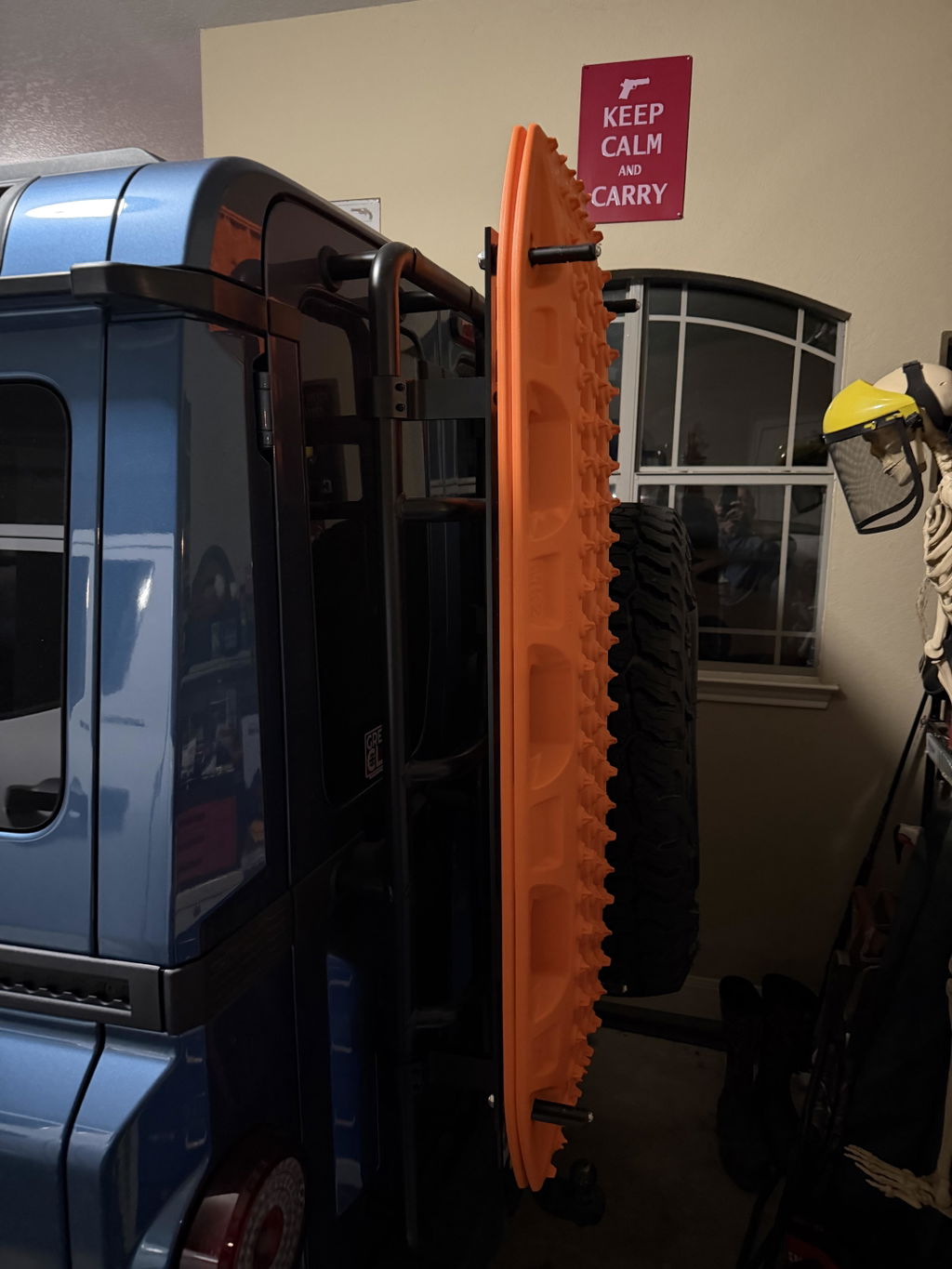
DVA Recovery Board Carrier — Instant Access When You Need It
The DVA Recovery Board Carrier solves the fundamental problem with roof-mounted recovery boards: when you're stuck, you need them fast. Climbing onto the roof, untying straps, and lowering boards takes precious time when you're buried in sand or mud.
I'm pretty happy with my mount on my ladder using the DVA Mechanics bracket. Going up to Lake Tahoe this weekend and will be out bouncing in the mountains, I'll let you all know how it holds up.
— parb, The INEOS Forum, "Accessories Mounted on Rear Ladder" thread
The follow-up from that owner confirmed no issues — the bracket held through aggressive mountain terrain without rattling or loosening. Key features:
- Quick-release pins — deploy boards in under 10 seconds without tools
- Universal sizing — fits MaxTrax MKII, Tred Pro, ActionTrax, and most major recovery board brands
- Anti-rattle design — rubber isolation prevents noise and vibration during highway driving
- Maintains climb access — boards mount to the side, keeping the ladder rungs clear for roof access

DVA Jerry Can Rig — 20L Fuel Extension Without the Weight Penalty
Mounting a jerry can on the ladder is the single most-requested upgrade in the Grenadier community. The challenge is that a loaded 20L jerry can weighs roughly 40–45 pounds, and all that mass hangs on a door-mounted ladder. DVA's Jerry Can Rig addresses both the weight distribution and access problems.
- Swing-out design — can pivots away from the ladder for full climbing access
- NATO standard compatibility — works with genuine NATO jerry cans and high-quality replicas
- Lockable mount — security lock prevents theft in high-risk areas
- Load distribution — spreads weight across multiple ladder mounting points rather than concentrating it


| DVA Ladder Accessory | Weight Capacity | Install Time | Key Feature |
|---|---|---|---|
| Recovery Board Carrier | ~20 lb (pair of boards) | 10 minutes | Quick-release pins for emergency access |
| Jerry Can Rig | 45 lb (loaded 20L can) | 15 minutes | Swing-out preserves ladder climbing |
| Gen 2 Accessory Carrier | 25 lb per rail | 20 minutes | Modular MOLLE compatibility |
Gen 2 Accessory Carrier — Modular System for Mixed Gear
The DVA Gen 2 Accessory Carrier creates a vertical mounting surface on the ladder for smaller gear that doesn't warrant dedicated brackets. MOLLE panels, tube clamps, and tie-down points turn the ladder into a full accessory management system.
- MOLLE panel integration — standard military webbing for pouches, tools, and small gear
- Hi-lift jack compatibility — dedicated mount points for high-lift jacks
- Shovel and axe clips — quick-access mounting for recovery tools
- Extruded aluminum construction — lightweight but strong enough for 25 lb per rail

A common concern with ladder-mounted accessories: will they trigger the parking sensors? Forum testing with DVA accessories confirms that properly mounted ladder gear does not interfere with the rear ultrasonic sensors. The sensors are positioned low enough on the bumper that ladder-mounted gear sits well above their detection cone.
OEM vs Aftermarket Ladder — The Full Comparison
The factory INEOS ladder isn't the only option. Five manufacturers produce Grenadier-specific rear ladders. The table below compares all current options — including the three most popular aftermarket choices — with specific callouts on DVA compatibility and bottom-rung offset, the Grenadier's most discussed design flaw.
| Ladder | Price | Material | Bottom Rung | DVA Mounts | Warranty |
|---|---|---|---|---|---|
| INEOS OEM | ~$900 dealer | Aluminum | Flush (known scraping at bottom) | Full ecosystem (Recovery Board, Jerry Can, Gen 2) | INEOS factory warranty |
| Front Runner | ~$280 direct | Aluminum | Offset — no scraping | Partial (tube clamp compatible) | Front Runner mfr warranty |
| LeTech Multifunctional | ~$350+ | Aluminum | Straight — shoe-contact reported | Partial (integrated can + ski holder) | LeTech mfr warranty |
| Westcott Designs | ~$375 | Aluminum | Offset — full-length design | Partial | Westcott Designs warranty |
| Overland Kitted | ~$299 | Steel (powder-coated) | Offset — OEM mount points | Partial | Mfr warranty only |
DVA note on aftermarket compatibility: DVA's Recovery Board Carrier, Gen 2 Accessory Carrier, and Hi-Lift mount are engineered to the OEM ladder's rung spacing and diameter. Some DVA accessories will tube-clamp to aftermarket ladders, but full fit and quick-release pin engagement is only guaranteed on the factory unit. If you plan to build out with DVA mounts, the OEM ladder is the right base.
DVA's philosophy: the OEM ladder's aluminum construction and warranty coverage make it worth keeping. Rather than replace the entire ladder, DVA's accessories add function while preserving the original ladder's benefits. This approach also means DVA roof rail systems and L-Track solutions integrate seamlessly with the ladder mounting ecosystem.
Installation Considerations
Whether you're adding the OEM ladder post-purchase or installing DVA accessories, the process is straightforward. The Grenadier's rear door has four pre-drilled bolt points on the 30% (narrow) side specifically designed for ladder mounting. DVA accessories use the ladder rungs themselves — no drilling required.
Key Installation Notes
- DVA accessories install tool-free — quick-release pins and tube clamps mean field installation and removal
- Thread locker is recommended on ladder bolts — vibration from off-road driving can back them out over time
- Check door seal compression after install — the ladder shouldn't affect the door's weatherseal
- INEOS publishes fitting instructions on their accessories page — follow them for the base ladder installation
Most owners report a 20–30 minute installation for the base ladder. DVA accessories add 10-20 minutes each but require no permanent modifications. Everything can be removed for washing, garage clearance, or reconfiguration.
The Decision Framework
Should You Get the Grenadier Ladder?
- You have or plan a roof rack — Yes. You'll need roof access regularly for loading, tie-down checks, and maintenance. DVA's roof rail systems work perfectly with the ladder for a complete roof access solution.
- You're building for overlanding/expedition — Absolutely yes. The ladder becomes the backbone of DVA's rear-door accessory system: recovery boards, jerry cans, and modular carriers all mount seamlessly.
- You're primarily road-touring — Probably yes. Roof washing, occasional cargo loading, and resale value all favor installing it. The visibility cost is minimal.
- You're tall (6'2"+), budget-tight, and don't use the roof — Skip it for now. The four bolt points will be there when you change your mind. Allocate funds to L-Track protection or suspension instead.
- You run a 270° awning on the ladder side — Consider carefully. The awning blocks ladder access when deployed, reducing utility to pack/unpack situations only.
The overwhelming forum consensus: if you're uncertain, install it. The cost of adding it later is the same, but you lose time without roof access in the interim. And the Grenadier looks, as one owner put it, "really naked without it — especially on the contrasting white."
The Grenadier's rear ladder is one of those accessories that seems simple until you start optimizing it. Getting the ladder is the easy decision. What you mount on it, how you protect the bodywork around it, and how you use it to build out your rear-door accessory system — that's where DVA's proven solutions make the difference between a functional setup and a professional expedition platform.
Already have a ladder and want detailed installation steps? Our INEOS Grenadier Rear Ladder: Complete Installation & Accessory Guide covers OEM mounting torque specs, DVA quick-release pin installation, and how to position Recovery Board and Jerry Can carriers for center-of-gravity compliance. The two guides complement each other — this one helps you choose; that one helps you install.