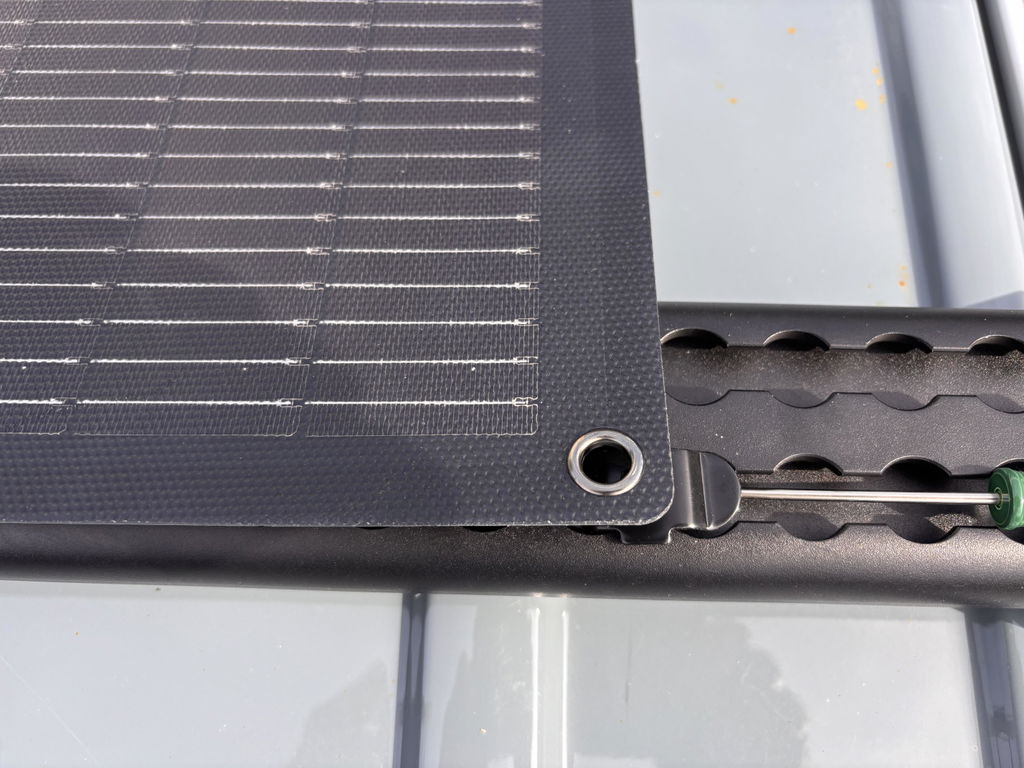
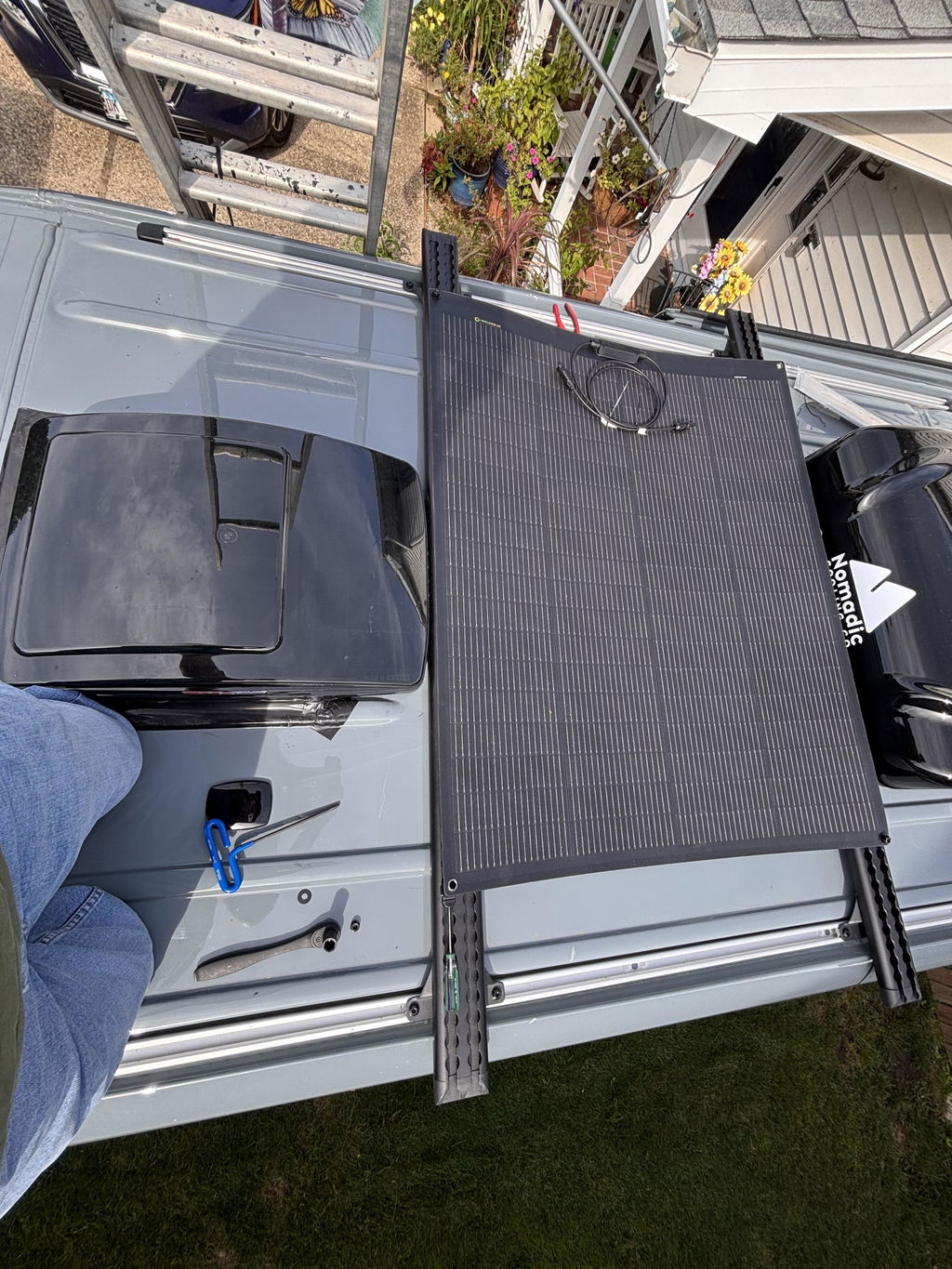
The phrase "roof track" gets used loosely in the Sprinter community — sometimes meaning factory rails, sometimes meaning any aluminum channel on the roof. Engineers use it to describe one specific thing: the extruded aluminum C-channel with a trapezoidal T-slot profile that Mercedes installs as part of the D13 factory rail option. If you plan to mount crossbars, a roof rack, or a solar array using that track as the foundation, you need to understand what this channel actually is — and what hardware it will and won't accept.
This guide covers the factory roof track system, the hardware that fits it, and why the DVA DualTrack-T crossbar kit was engineered specifically around the OEM track profile. If your Sprinter doesn't have factory tracks, we cover the VS30 hard-point alternative with LoadSpan-T as well.
What Is the Sprinter Factory Roof Track?
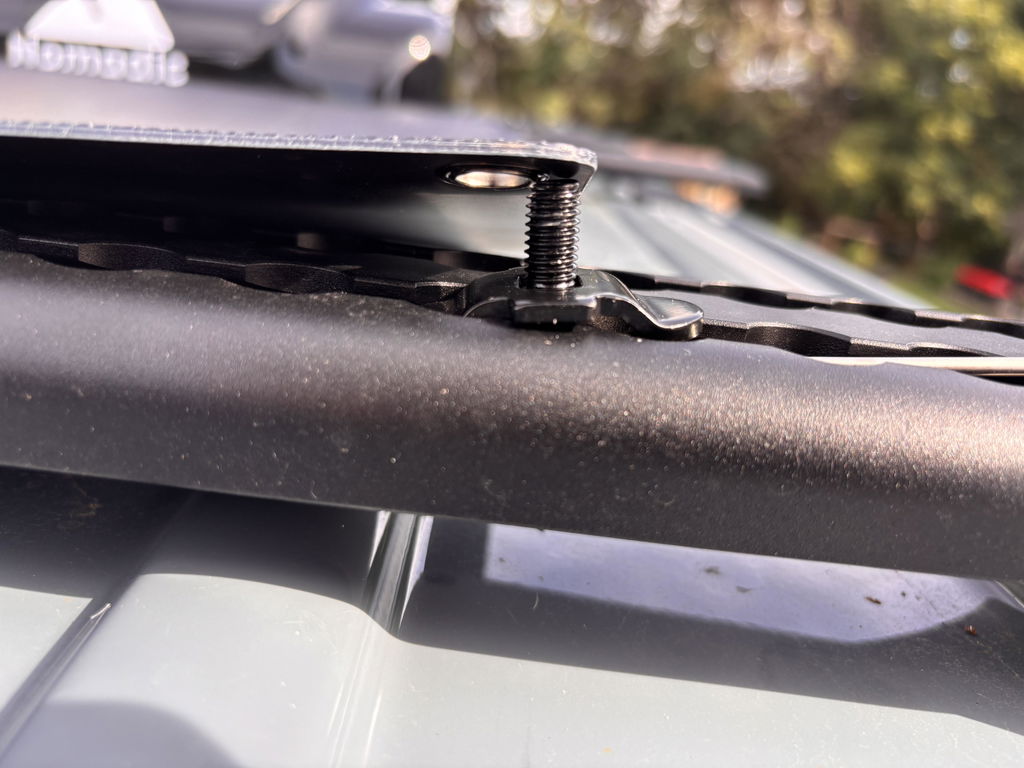
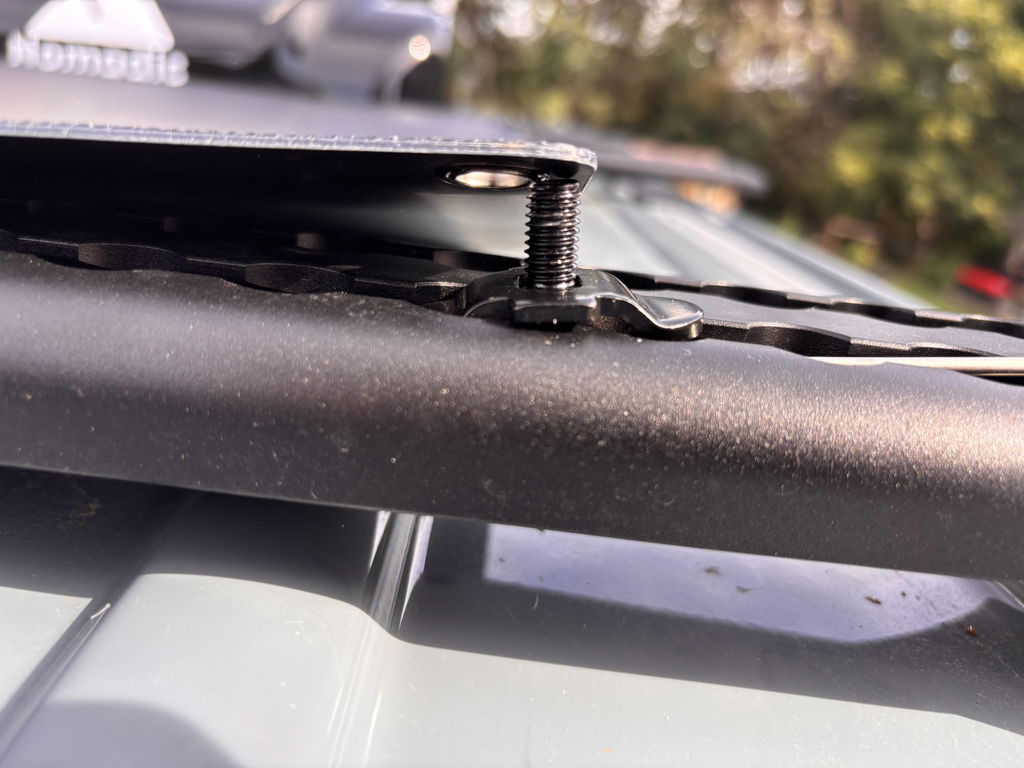
The factory Sprinter roof track is an extruded aluminum rail with a C-channel profile. Run your hand along the outer edge of the rail and you'll find a slot opening on the underside — this is the T-slot that accepts mounting hardware. But unlike standard 80/20-type aluminum extrusions common in workshop setups, the Sprinter track uses a trapezoidal T-slot profile, not a rectangular one.
The distinction matters because standard M6 or M8 T-nuts from a hardware store — the kind that fit industrial extrusions — will not properly engage the Sprinter track slot. The trapezoidal geometry means the backing plate that sits inside the channel needs a specific shape to lock in place when the bolt is tightened. Use the wrong hardware and you'll either strip the slot or create a mounting point that's held by friction rather than mechanical lock.
Two rails run parallel along the length of the roof — one on each side, positioned inboard from the rain gutter. The rails are fixed at the factory using bolts that thread into the roof structure at multiple points along the length. The T-slot faces inward and downward, allowing T-bolt hardware to slide along the rail and be positioned anywhere along its length.
Hardware must be slid into the T-slot from the open end of the rail — typically the front or rear, after removing the plastic end cap. You cannot drop T-bolts in from the top. This is a practical constraint that affects any mid-rail accessory mounting — including awning brackets, solar panel clamps, and crossbars.
NCV3 (2007–2018) vs VS30 (2019+): What Changed
The factory roof track system evolved between van generations in ways that significantly affect your mounting options.
NCV3 Sprinter (2007–2018)
NCV3 Sprinters leave the factory with roof track rails only when the vehicle was ordered with the D13 prep code — a dealer-installed option that added the aluminum C-channel rails to the roof. Vans without D13 prep have no factory roof rails and no T-slot track. On a van without D13, the only options are sourcing used OEM rails from dealer inventory or installing aftermarket rails.
On NCV3 vans with D13, the factory track profile is the same trapezoidal T-slot that defines what hardware will fit. DVA's DualTrack-T crossbars and the DVA T-Bolt Mounting Kit ($19) are compatible with D13 NCV3 tracks.
VS30 Sprinter (2019–Present)
The VS30 introduced a key structural change: every VS30 comes with factory-punched hard points in the roof, regardless of whether factory rails were ordered. These pre-threaded inserts are covered by plastic plugs in the roof panel. Remove a plug and you'll find a threaded mounting point that accepts M6 hardware.
VS30 vans with factory rails also have the T-slot track running on top of those hard points. VS30 vans without factory rails have only the hard points — no T-slot track at all. This distinction determines which DVA product is the right fit:
| Configuration | Factory Roof Track | Factory Hard Points | DVA Product |
|---|---|---|---|
| NCV3 with D13 rails | ✓ T-slot track | ✗ Not pre-punched | DualTrack-T + T-Bolt Kit |
| NCV3 without D13 | ✗ No rails | ✗ Not pre-punched | OEM D13 rails (source separately) + DualTrack-T |
| VS30 with factory rails | ✓ T-slot track | ✓ Pre-punched | DualTrack-T + T-Bolt Kit |
| VS30 without factory rails | ✗ No rails | ✓ Pre-punched | LoadSpan-T ($349) |
What Actually Fits in the Factory Track
The forum record on this question is long and occasionally frustrating. Builders who assume standard industrial T-nuts will fit the Sprinter track regularly discover they don't — the trapezoidal profile rejects square-backed hardware.
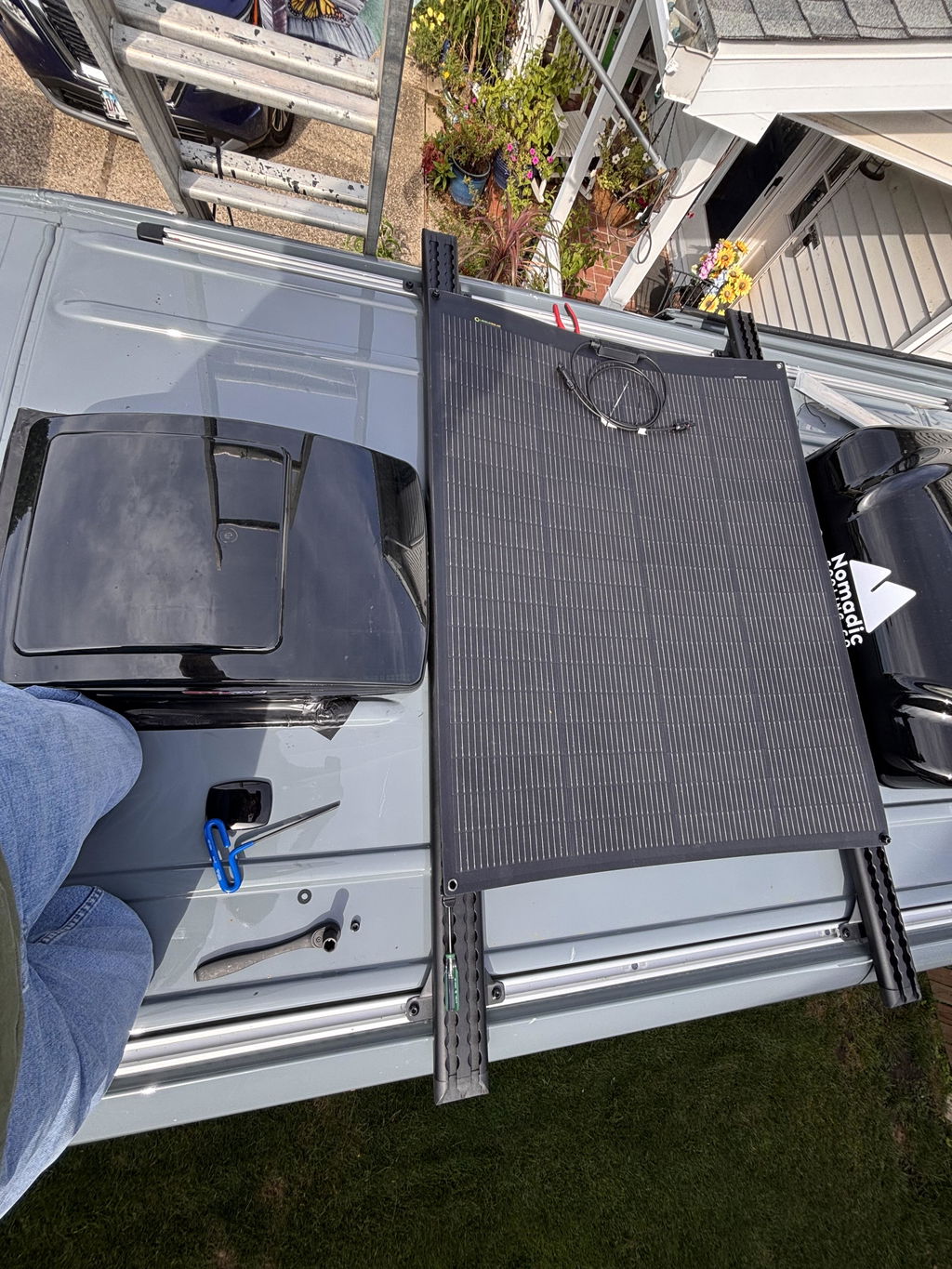
Where/what can I source for mounting stuff to my factory high roof VS30 roof rails? I've got to mount a solar panel in between the mounts for my Fiama awning. So I can't just slide some t nuts in from the open end.
— Sprinter-Source member, 2025 Custom 3500XD AWD 144" | Sprinter-Source #112749
The challenge this builder ran into — needing hardware that drops into the rail mid-span rather than sliding in from the end — is a real constraint of the factory track system. The end-cap must come off to slide any T-bolt hardware in from the rail end. If you have a Fiama awning bracket already installed at one end, the track segment between the bracket and the endcap is accessible. The segment beyond the bracket requires the bracket to come off first.
Hein's brackets are nice but they won't drop into the rail. They have to be slid in from the open end.
— Sprinter-Source member | Sprinter-Source #112749
This is why installation sequence matters on roof systems that combine a factory-track crossbar setup with awning mounts or solar clamps. DVA recommends installing DualTrack-T crossbars before awning mounts — get the T-bolts in the track, position the crossbars, then add the awning bracket using the L-Track channel in the crossbar (not the OEM track). The OEM T-slot doesn't need to be accessible for anything else once the crossbars are set.
Hardware That Fits: The Trapezoidal T-Bolt Profile
The backing plate that sits inside the Sprinter track channel needs a trapezoidal cross-section that matches the channel geometry. Wider at the back than at the slot opening, it locks in place when the bolt is tightened — the tapered sides pull the backing plate against the underside of the channel flanges.
McMaster-Carr stocks a range of T-slot hardware, but the Sprinter track's trapezoidal profile means it requires specific purpose-built hardware. DVA's T-Bolt Mounting Kit ($19) is machined to match the OEM channel geometry and is included in DualTrack-T orders as the crossbar-to-track interface.

DVA DualTrack-T: Crossbars Built for the OEM Track
The DVA DualTrack-T™ Cross Bar Kit ($299) is a 2-rail crossbar system designed specifically to use the factory Sprinter roof track as its mounting foundation. Each crossbar spans the full roof width and is positioned along the track by sliding the T-bolt hardware into the rail, then clamping the crossbar foot at the chosen position.
Once set, the crossbars add two new mounting channels across the roof: an L-Track channel for sliding L-Track accessories (cargo rings, tie-down anchors, bike mounts), and a 25mm T-slot channel for standard crossbar accessories. Neither of these channels existed in the factory rail — the OEM T-slot only runs front-to-back along the roof, not side-to-side across it. DualTrack-T adds the lateral mounting infrastructure that the factory track doesn't provide.
I have the awning, factory roof tracks, and Hein's DIYvan.com 3 point mounting kit for the awning. I'd like a full length rack like the Aluminess, but ultimately I want to use the rack for seating occasionally and mostly for a cargo box and eventually solar.
— Sprinter-Source member, 2019 4x4 144" | Sprinter-Source #94438
This is the typical use case: a Sprinter with factory tracks, an awning, and the need to add crossbars for cargo and solar without a full platform rack. DualTrack-T drops into the existing track alongside whatever awning hardware is already there, and the L-Track channel in each crossbar becomes the attachment point for everything mounted above.
What Can Mount to DualTrack-T Crossbars
Because each DualTrack-T crossbar runs both L-Track and 25mm T-slot the full width of the van, any L-Track accessory or standard T-slot crossbar mount works with it. Common applications across the 200+ DVA builds that have used DualTrack-T on Sprinter:
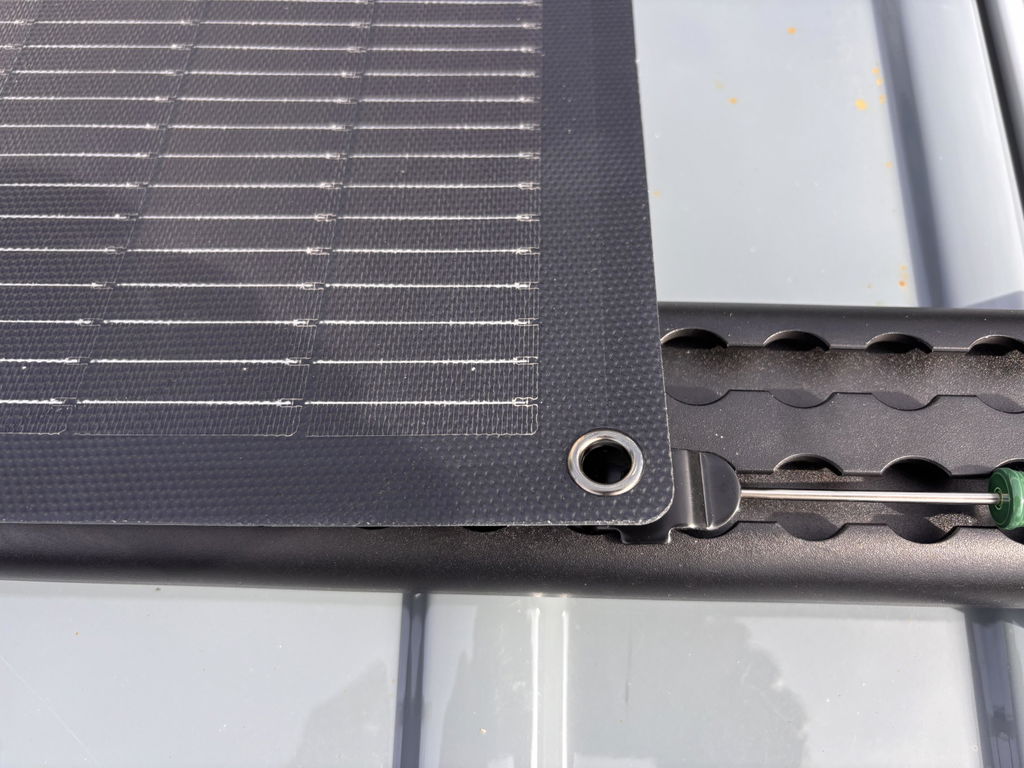
- Solar panels — L-Track solar feet slide along the crossbar channel for precise positioning, no drilling into the panel frame required
- Awning brackets — L-Track awning mounts slide to the passenger side of the crossbar; awning hardware installs without touching the factory roof track
- Cargo boxes — Thule and Yakima boxes with T-slot feet attach directly to the 25mm channel
- Bike mounts — fork mounts and tray systems with L-Track feet work across the crossbar width
- Antenna and comms — satellite dome mounts, CB antenna bases, weather stations using standard T-slot hardware
The crossbar system also enables a modular approach to roof building: start with two crossbars, add accessories as the build evolves, and reposition everything without modifying the factory track. If the van gets sold, the DualTrack-T crossbars pull out of the factory track — no permanent modification to the vehicle.

When You Don't Have a Roof Track: DVA LoadSpan-T
VS30 Sprinters ordered without factory rails — and all NCV3 vans without D13 prep — don't have the T-slot track. If you're looking at a van with plastic plugs in the roof but no aluminum rail, you're working with hard points, not track.
On VS30 vans, these are factory-punched and threaded. The DVA LoadSpan-T™ Roof Rails ($349) bolt directly into these factory inserts from the outside, no headliner access required. The rail provides the same dual-channel system as DualTrack-T — L-Track and 25mm T-slot — but the mounting philosophy is completely different: hard-point bolt-in rather than T-bolt slider.
LoadSpan-T rails run the full length of the roof and create a permanent aluminum rail pair that functions identically to the factory track for crossbar and accessory mounting. DualTrack-T crossbars can then be used with LoadSpan-T rails using the same T-bolt kit — or you can mount accessories directly to the LoadSpan-T L-Track channel without crossbars at all.
Have factory roof track (D13 NCV3 or VS30 with factory rails)? → DualTrack-T + T-Bolt Kit. Slides into existing track, no new holes.
No factory track, VS30 hard points? → LoadSpan-T. Bolts to factory inserts, adds full-length dual-channel rails from outside only.
NCV3 without D13? → Source OEM D13 rails first, then add DualTrack-T. Or contact DVA for a custom fitment assessment.

Common Questions About the Sprinter Roof Track
Does my Sprinter have the factory roof track?
Look at the outer edge of the roof from outside the van. If you see a silver aluminum rail running along the roofline on each side — that's the factory track. If you see only the painted metal roof with small plastic plugs at regular intervals — those are the VS30 factory hard points, not a track.
On NCV3 vans, open the driver's door and check the door jamb label for the D13 option code. D13 = factory rails ordered at the plant. No D13 code on a NCV3 means the rail was either dealer-added later or not present at all — inspect the roof visually to confirm.
Can I add a factory-style roof track to a van without one?
Yes, with caveats. OEM D13 rails can be sourced from dealers or salvage. They bolt into the same hard points used by the factory. The rail profile is identical to what the factory installs, so DualTrack-T crossbars will fit afterward. Aftermarket C-channel roof rails from suppliers like Vantech and EuroCampers replicate the factory profile and accept the same T-bolt hardware.
For VS30 vans, DVA LoadSpan-T provides a first-party option that includes the dual-channel rail system without needing to source OEM or aftermarket C-channel. LoadSpan-T creates the equivalent mounting infrastructure as the factory track, purpose-built for DVA accessories.
What's the weight limit for the Sprinter roof, regardless of track or hard point mounting?
Mercedes rates the Sprinter roof at 330 lb dynamic — that's the limit for the total weight of all gear mounted to the roof while the vehicle is in motion, including racks, solar panels, antennas, cargo, and accessories. This limit applies to the roof structure itself and doesn't change based on mounting method. T-bolt track mounting and hard-point mounting distribute load through the same roof structure. See the full Sprinter roof weight budget guide for how to allocate this across solar, solar panels, and accessory systems.
Will DualTrack-T crossbars work with existing awning brackets already in the factory track?
Yes, as long as there's clearance in the track for the DualTrack-T T-bolt hardware. If your awning bracket occupies a section of the track, slide the DualTrack-T T-bolts in from the rail end before the bracket position and set the crossbar forward of the awning mount. On a 144" van with a driver-side awning, this typically allows one crossbar in front of and one behind the awning mount without conflict. On 170" and EXT vans, clearance is generally not an issue — the track is long enough to accommodate both crossbars and an awning mount at non-conflicting positions.
Sprinter Roof Track: The Short Version
- The factory track is specific hardware. Trapezoidal T-slot, not standard industrial profile. Purpose-built hardware required.
- T-bolts go in from the end. Remove the endcap, slide hardware in before positioning awning mounts or other mid-rail fixtures.
- DualTrack-T is the DVA system for vans with tracks. Slides in, no drilling, adds L-Track + T-slot crossbar channels across the roof. $299 + $19 T-Bolt Kit.
- LoadSpan-T is the DVA system for vans without tracks. Bolts to VS30 hard points, provides equivalent dual-channel functionality. $349.
- 330 lb is the limit regardless. Mounting method doesn't change the roof structure's weight rating.
For a complete look at the DVA roof rail ecosystem across all Sprinter configurations — including the LoadSpan standard rails and the full roof deck option — see the Sprinter Roof Rails Guide and the Sprinter Roof Rack Buyers Guide. If you've confirmed your van has factory track and want to jump to installation, the DualTrack-T product page includes the step-by-step installation sequence.