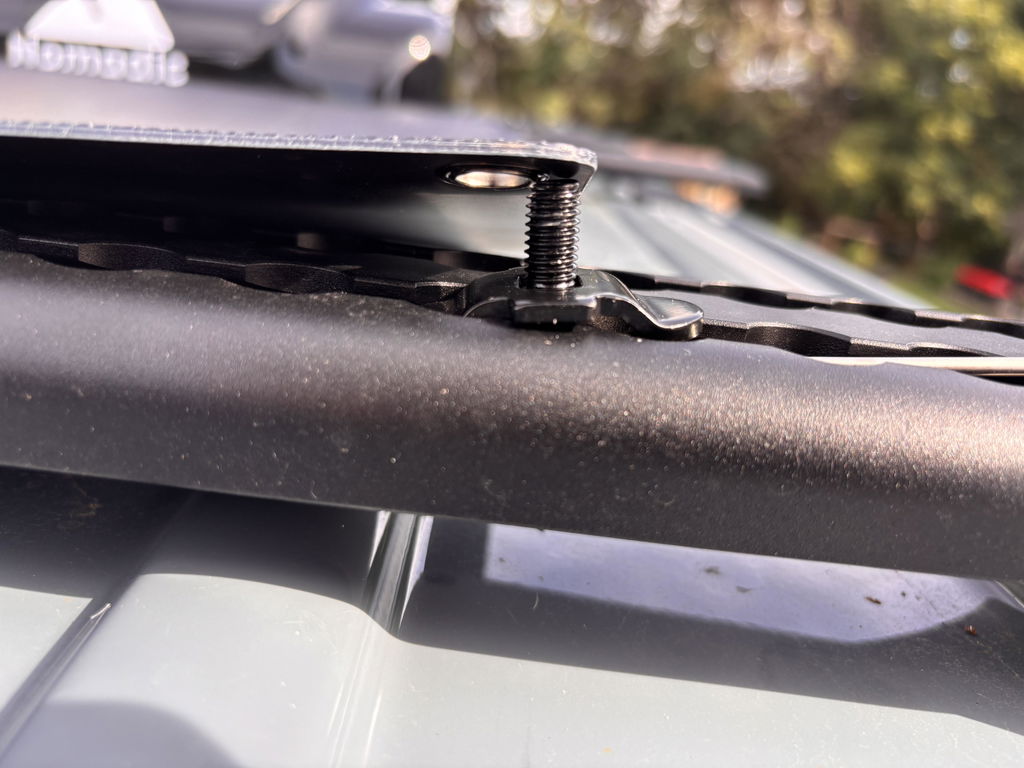
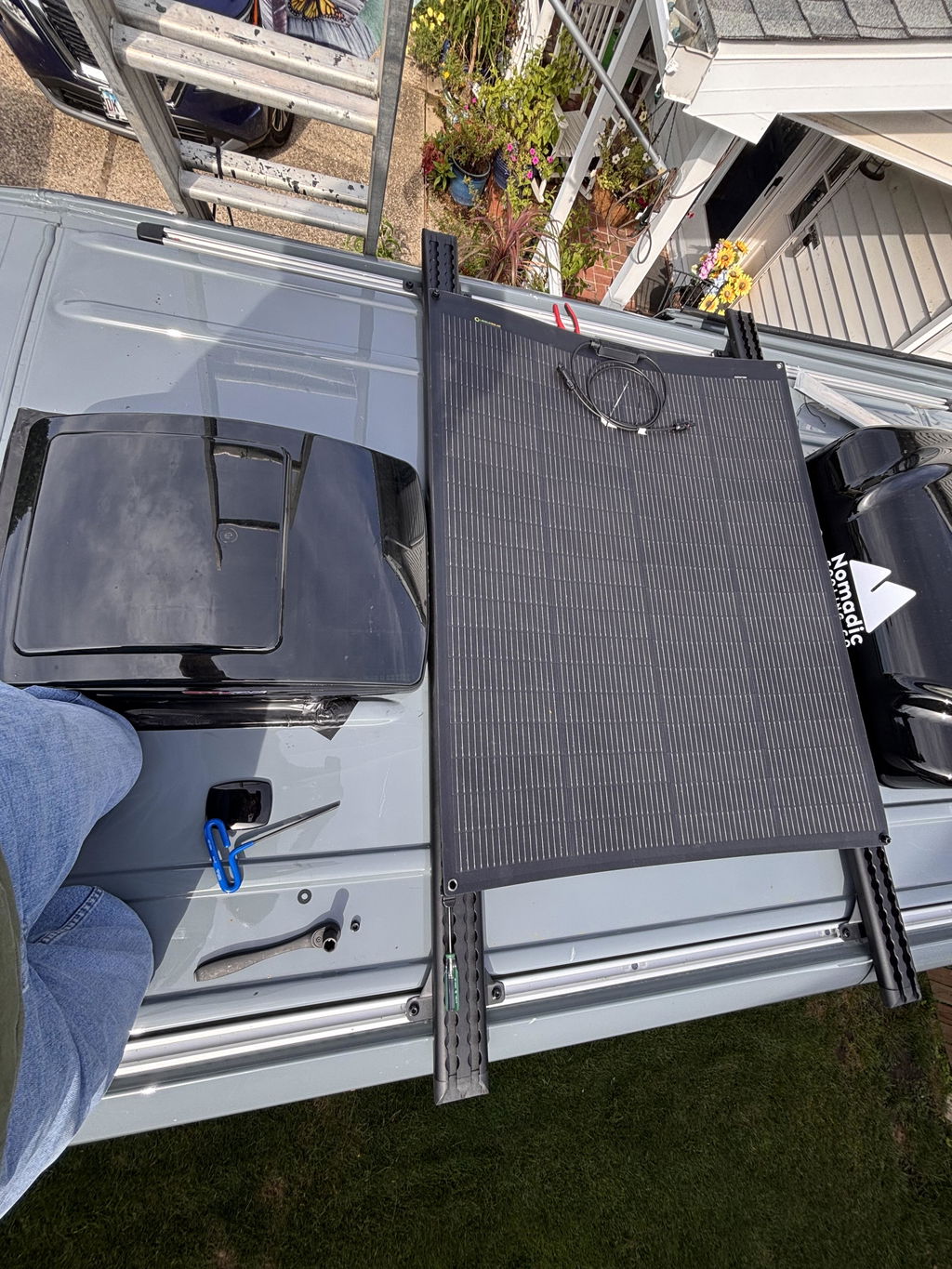
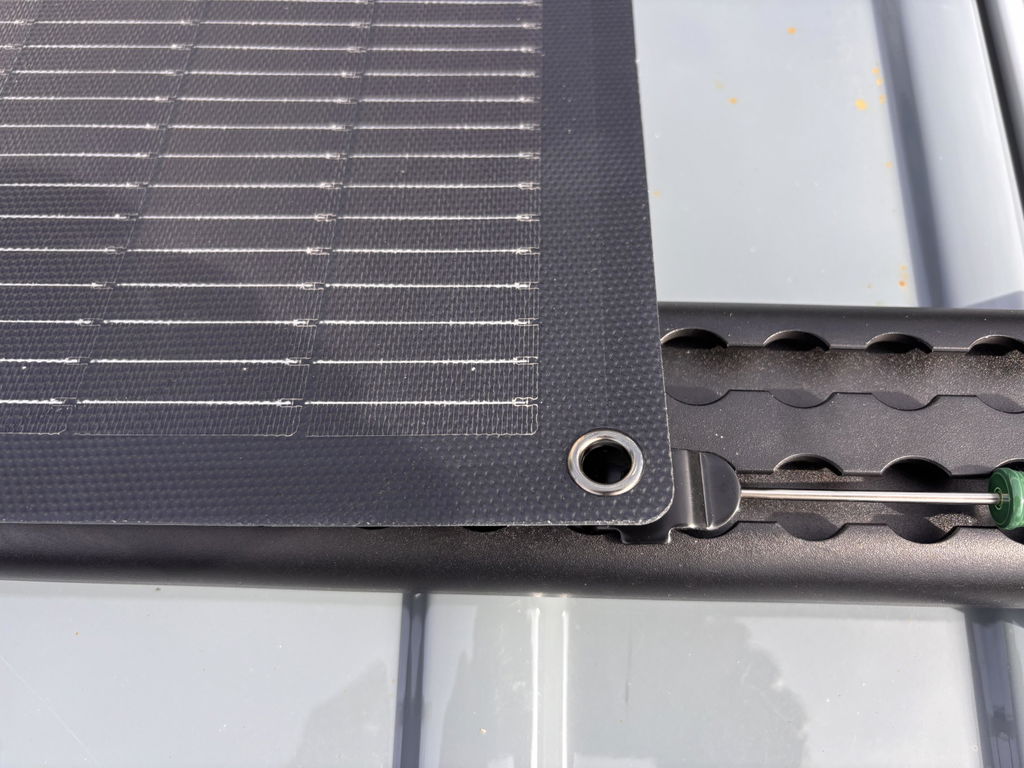
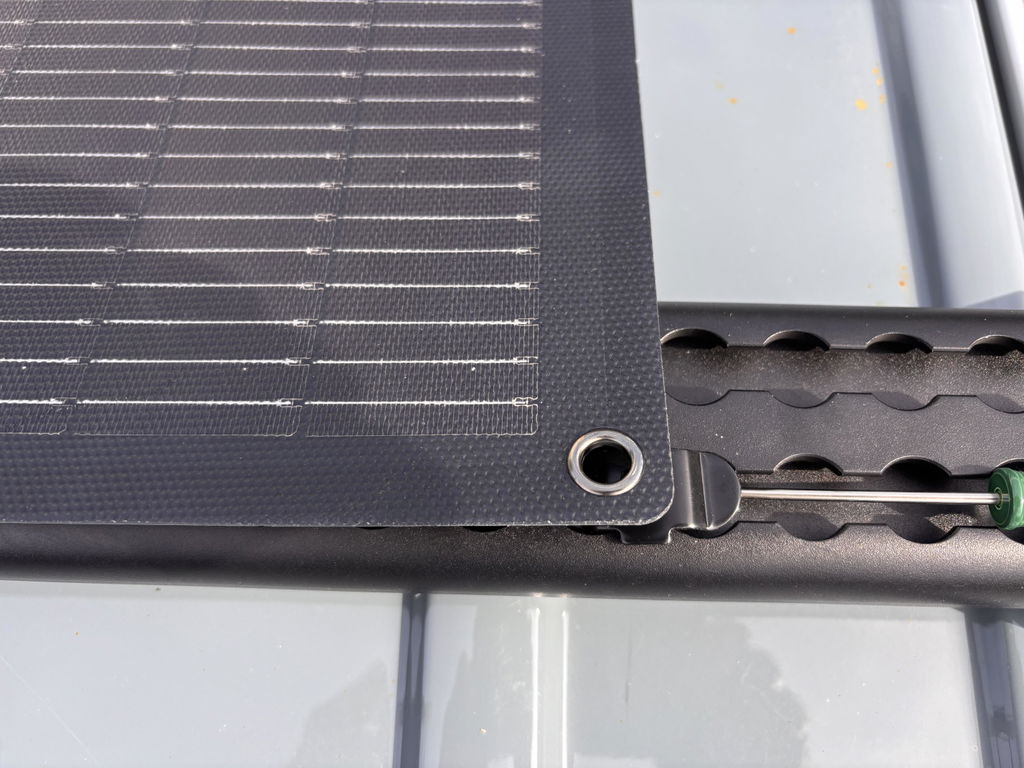
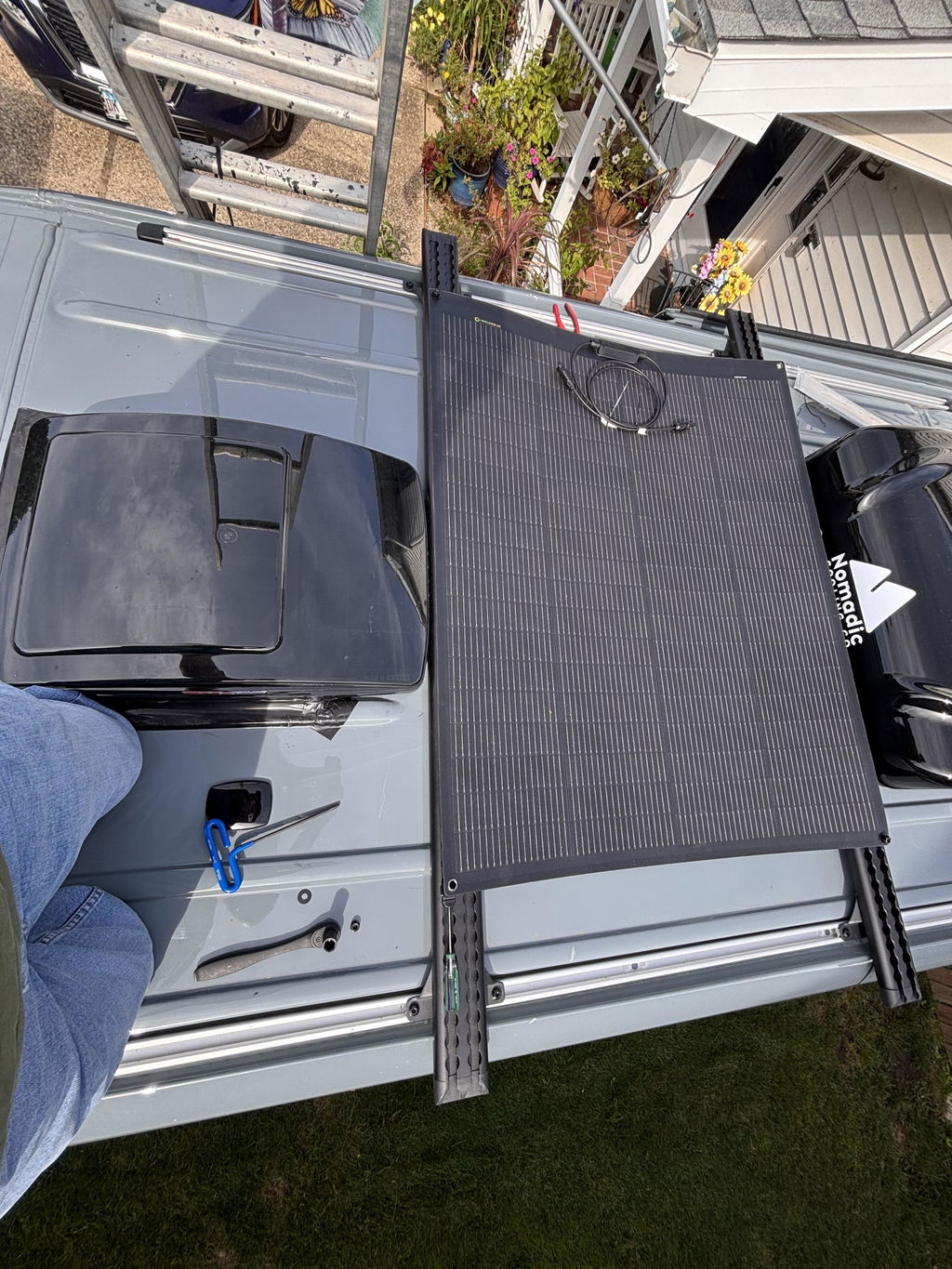
L-Track is not new technology. It comes from the aviation cargo industry — the same sliding channel system used in aircraft to secure cargo pallets and baggage containers. What makes it relevant to Sprinter builders is that it can handle the sliding fitting hardware that makes roof accessories repositionable. One rail, adjusted in seconds, handles any fitting that accepts L-Track hardware. On a Sprinter roof, that changes how you plan and build.
What it is: A continuous extruded aluminum channel rail with a recessed slot that accepts sliding tie-down fittings and track nuts. Fittings can be moved and repositioned without removing the rail.
What builders mount on it: Solar panel brackets, awning arm mounts, cargo tie-down rings, crossbar end fittings, antenna bases, lighting mounts, and gear carrier brackets — all adjustable without drilling new holes.
DVA options: LoadSpan-T™ ($349, dual-channel: L-Track + 25mm T-Slot) or LoadSpan™ ($199, L-Track only). Both mount to VS30 factory inserts — no drilling into the Sprinter roof.
Weight limit: 330 lb dynamic total roof load (van in motion). Both rail systems rated within this budget.
Why L-Track on a Van Roof — Not Just Cargo Holds
Most L-Track conversation in the van build community focuses on floor and wall interior mounting — securing drawers, seats, or gear inside the van. The roof application is less discussed but often more valuable. The reason: Sprinter builders face a lot of conflicting demands on the roof real estate.
A high-roof Sprinter has roughly 60 to 70 square feet of roof surface depending on wheelbase. In that space, a fully built-out van typically needs solar panel mounts, at least one vent fan cutout, an awning attachment point on the driver's side, possibly a light bar or pod lights toward the front, and some form of crossbar or cargo rail for strapping gear boxes. Builders who use fixed mounting holes — drilling into the roof at specific points — lock in that layout permanently.
L-Track changes that constraint. With a rail running the full length of the Sprinter roof on both sides, any accessory with L-Track-compatible fittings can be moved to wherever it makes sense. Add a 200W solar panel now, and later shift it 14 inches rearward to accommodate a new vent fan position. The rail stays; only the fittings slide.
“The real advantage of L track is its quick and easy to reconfigure. I don't think many are reconfiguring their roof mounted equipment frequently — but the option is there, and it means you don't have to commit every mounting decision upfront.”
— r/SprinterVans user, January 2026L-Track vs T-Track vs Standard Roof Rail Channels — What's the Actual Difference
The Sprinter van accessory market has at least three distinct channel profiles, and builders regularly confuse them:
- L-Track (L-channel): Aviation cargo standard. Recessed slot with flanges that accept twist-to-lock tie-down fittings. High load rating, widely available compatible hardware.
- T-Slot (25mm T-Track): Standard European track profile used in modular framing systems. Accepts hex-head T-bolts and T-nuts for structural accessories — crossbars, frames, and fixed mounting hardware. Not the same as L-Track.
- OEM D13 groove: Sprinter factory rail profile. Narrow C-channel that accepts Mercedes OEM rail accessories. Not compatible with generic L-Track or T-Slot hardware.
DVA's LoadSpan-T includes both L-Track and 25mm T-Slot in a single dual-channel extrusion — the only Sprinter rail system that handles both hardware types without separate rails.
Why does this matter practically? A solar panel bracket that's designed for L-Track will not work in a T-Slot rail, and vice versa. Before purchasing any roof rail system, verify which profile your accessories require. Most commercial awning mounts (ARB, Front Runner, Rhino Rack) are designed for T-Slot. Most aviation cargo tie-down rings and adjustable strap fittings are designed for L-Track.
What Sprinter Builders Mount on Roof L-Track Rails
Based on build documentation from Sprinter-Source, r/SprinterVans, r/vandwellers, and 300+ builder surveys, here are the most common applications:
1. Solar Panel Brackets
The most common L-Track roof application. Standard Z-bracket or low-profile tilt mounts use L-Track sliding nuts to attach to the rail. A 400W solar array (four 100W panels at roughly 22" × 47" each) typically requires 6–8 bracket attachment points. With fixed holes, each panel position is permanent. With L-Track, individual brackets slide to align with the panel's actual footprint — useful when panels from different manufacturers have different dimensions.
2. Awning Arm Mounts
Awning arms mount to the side of the Sprinter roof, typically 12–18" from the edge. A driver's side awning using L-Track fittings can be positioned at exactly the right height and fore/aft position to clear the sliding door opening and retract properly. The sliding fit also lets owners reposition the awning when they add additional roof accessories that conflict with the original mount point.
3. Cargo Tie-Down Points
Rooftop cargo — gear boxes, dry bags, equipment cases — gets secured with tie-down straps. With fixed anchor points, straps go where the anchor is. With L-Track, the anchor point moves to match the cargo. This is particularly useful for irregularly-shaped loads or varying cargo volumes.
“I used one large 325 watt panel and attached the curved 8020 around its edges. Plenty of airflow underneath and easy removal if need be. I did not want full rails down the length of the roof. I added more of the same L track at ribs further back for future use. I sealed the mounts using strong double sided tape and butyl rubber at mounting holes.”
— Sprinter-Source forum user, UV panel build thread4. Crossbar End Fittings
Crossbars span the Sprinter roof laterally (driver's side to passenger's side) and create a mounting platform for load baskets, bike carriers, kayak mounts, and more. In a dual-channel rail like DVA's LoadSpan-T, crossbar ends mount using the T-Slot channel while L-Track handles sliding accessories within each panel bay. The crossbar spacing is adjustable — slide the T-Slot end fittings fore or aft to match whatever cargo geometry you're working with.
The 330 lb Roof Budget — Where L-Track Rails Fit
Mercedes' stated dynamic load limit for a Sprinter high-roof van is 330 lb (150 kg) total roof load — meaning the van in motion, including rails, accessories, and cargo. This is not a static weight limit (which is higher); it's the load-in-motion rating that governs what you can safely carry at highway speed.
How do L-Track rails fit into that 330 lb budget?
- Rail system weight: DVA LoadSpan-T (pair): approximately 14–16 lb. LoadSpan basic (pair): approximately 10–12 lb. This is roughly 4–5% of the total 330 lb budget.
- Fittings and brackets: Typically 4–8 lb for a full accessory set.
- Solar panels: 400W array at ~2.5 lb/100W = ~10 lb total. Three 100W panels: ~7.5 lb.
- Awning: ARB Awning 2500mm: ~17 lb. Dometic 180° Awning: ~25 lb.
A fully loaded Sprinter roof with rails, two crossbars, a 300W solar array, and a 2500mm awning comes in at approximately 60–80 lb — well within the 330 lb budget. The limit is relevant primarily for builders adding heavy cargo boxes, spare tire carriers, rooftop tents, or water tanks. For standard expedition or van life equipment, the rails consume a small fraction of the available budget.
- DVA LoadSpan-T pair: ~15 lb
- 400W solar array (4 panels): ~10 lb
- ARB 2500mm Awning: ~17 lb
- Rooftop cargo box (empty): ~45–65 lb
- MaxxFan 7500K vent fan: ~5 lb
- Roof tent (2-person): ~130–160 lb
- Starlink Mini: ~2.4 lb
The VS30 Roof Insert Question — How Sprinter Builders Mount Without Drilling
The Mercedes Sprinter VS30 (2019+) has factory-installed rivnuts in the roof structure at fixed intervals — the VS30 roof inserts. These are M8 threaded inserts placed during manufacturing specifically to allow aftermarket accessory mounting without drilling new holes into the roof sheet metal.
DVA's LoadSpan and LoadSpan-T systems are engineered to mount directly to these VS30 inserts. No hole drilling. No rivnut installation. The rail aligns with the factory insert pattern and bolts through using the existing threaded points. For a VS30 Sprinter owner, this means a clean, warranty-preserving install that takes 45–90 minutes depending on wheelbase.
The NCV3 (2007–2018) Sprinter has a different roof structure. The factory D13 prep code provided OEM rail channels on some NCV3 units; non-D13 NCV3s require rivnut installation or a different mount approach. DVA's LoadSpan-T is engineered primarily for VS30, though the rail profile is physically compatible with NCV3 builds that have proper insert preparation.
“The issue is when the interior of the van is already finished — there's no easy way to reach the nuts. The Sprinter roof has through-holes, they're not threaded or tapped. The best way to attach the roof rails without needing to dismantle the interior ceiling is to use factory VS30 inserts or pre-install backing plates before liner goes in.”
— r/SprinterVans engineering guide discussion, March 2026DVA LoadSpan-T vs LoadSpan — Which System to Choose
DVA builds two versions of the Sprinter roof rail system. Here's how to choose:
Choose LoadSpan™ ($199) if: You primarily need L-Track for cargo tie-downs and adjustable solar mounts. Your crossbars are sourced separately or you plan to use L-Track-compatible crossbar fittings. You want the lightest rail with the smallest profile.
Choose LoadSpan-T™ ($349) if: You want crossbar capability without a separate rail. The 25mm T-Slot channel handles standard DualTrack-T™ crossbar end fittings, awning arm T-bolt mounts, and other T-Slot accessories — all on the same rail that handles L-Track cargo fittings. If you're building a complete Sprinter roof system, the dual-channel version eliminates the need for a second rail.
The practical difference: most builders who start with LoadSpan eventually wish they had the T-Slot channel when they add their first awning or crossbar. For a complete first build, LoadSpan-T is the correct choice unless you have a specific reason for the L-Track-only version.


The Install Process — What VS30 Owners Actually Do
Both LoadSpan systems install the same way on VS30 Sprinters:
- Locate the VS30 roof inserts. On a clean VS30, the factory rivnuts are covered by plastic caps at regular intervals along the roofline. Pop the caps with a flathead to expose the M8 threads.
- Test-fit the rail. DVA's LoadSpan rails are cut to length for the 144", 170", and 170 EXT wheelbase Sprinters. Lay the rail on the roofline and verify insert alignment before applying any hardware.
- Install mounting brackets. DVA's system uses precision-machined aluminum brackets that bridge the gap between rail and roof contour. The bracket set is engineered for the specific VS30 roof radius — no shimming or adapters needed.
- Torque bolts to spec. M8 fasteners into factory rivnuts. DVA specifies a torque value in the install documentation. Don't guess or overtighten — the rivnuts are factory-installed with a defined thread depth and overtorquing strips them.
- Verify alignment and load rail accessories. Once rails are torqued, install L-Track fittings and verify they slide freely the full rail length.
Total install time on a VS30 with no interior modifications: 45–60 minutes with two people, 60–90 minutes solo. The most common mistake is skipping the test-fit step and discovering a misalignment after bolts are partially torqued.
What the Forums Say About L-Track vs Fixed Roof Mounts
After pulling from Sprinter-Source, r/SprinterVans, and r/vandwellers, the owner consensus on L-Track vs fixed point mounting consistently comes to the same point:
“...knowing what I know now and if I had to do it over again, I would have just bolted aluminum Unistrut to the roof instead of the overpriced factory roof rails. You get the same mounting flexibility and you can find standard fittings everywhere.”
— Sprinter-Source forum, OEM rail discussion threadThe critique here is really about overpriced OEM rails — not about L-Track as a concept. The same builder would likely appreciate a purpose-built aftermarket rail at a reasonable price point. The complaint is about cost-to-value on factory systems; the underlying argument for adjustable channels is universally supported.
Builders who regret choosing fixed-point mounts typically ran into one of two scenarios: they upgraded solar equipment and the new panels had different dimensions, or they added an awning and found the fixed mount position conflicted with the door swing. L-Track eliminates both regret scenarios.
DualTrack-T Crossbars and LoadSpan-T — the Complete Roof System
For builders who want both lateral crossbars and full L-Track flexibility, the DVA combination is LoadSpan-T rails (running fore-aft along the roofline) paired with DualTrack-T™ crossbars (spanning driver-to-passenger side). The crossbar end fittings seat into the LoadSpan-T's T-Slot channel; the L-Track handles fore-aft accessories on each rail.
This combination gives a Sprinter roof four mounting axes: L-Track sliding on both rails fore-aft, crossbar positioning adjustable via T-Slot, and T-Slot on the crossbars for accessories mounted perpendicular to the vehicle. Most expedition builds stop here — the combination handles every accessory category without adding weight from a full cargo basket or fixed frame system.
DVA Sprinter Roof Systems
Build on rails that work with everything you mount
LoadSpan-T ($349) handles solar, awnings, crossbars, and cargo tie-downs on a single dual-channel rail. Mounts to VS30 factory inserts — no drilling, no interior disassembly. Ships from the USA.
Shop LoadSpan-T → LoadSpan L-Track Only →