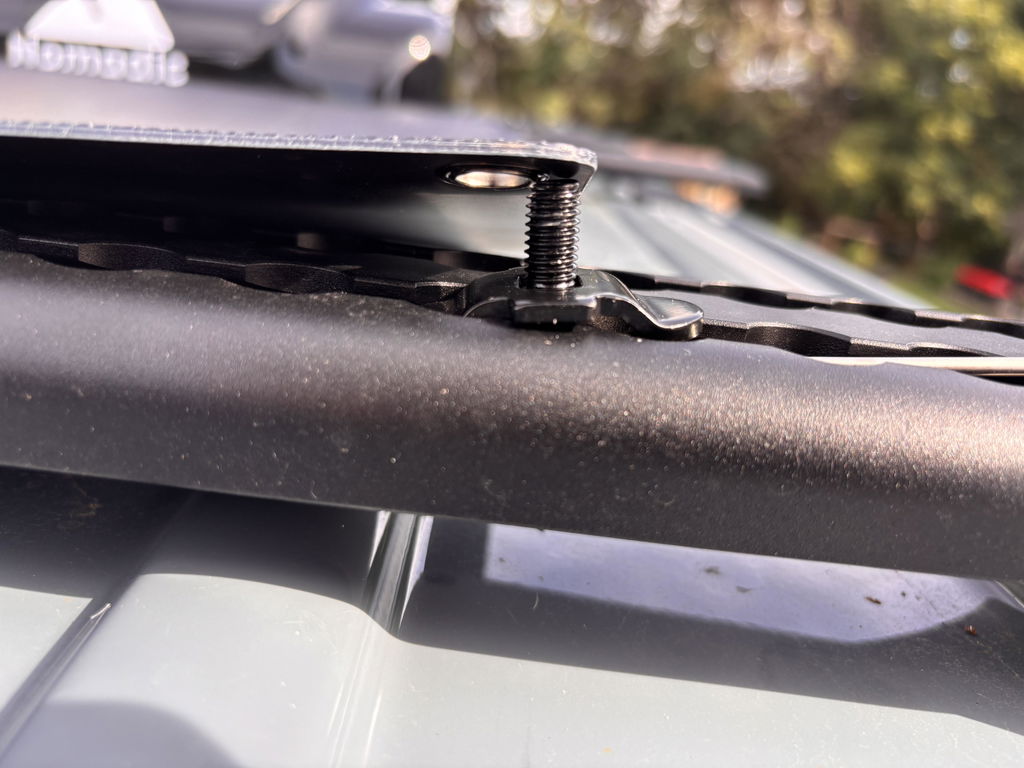
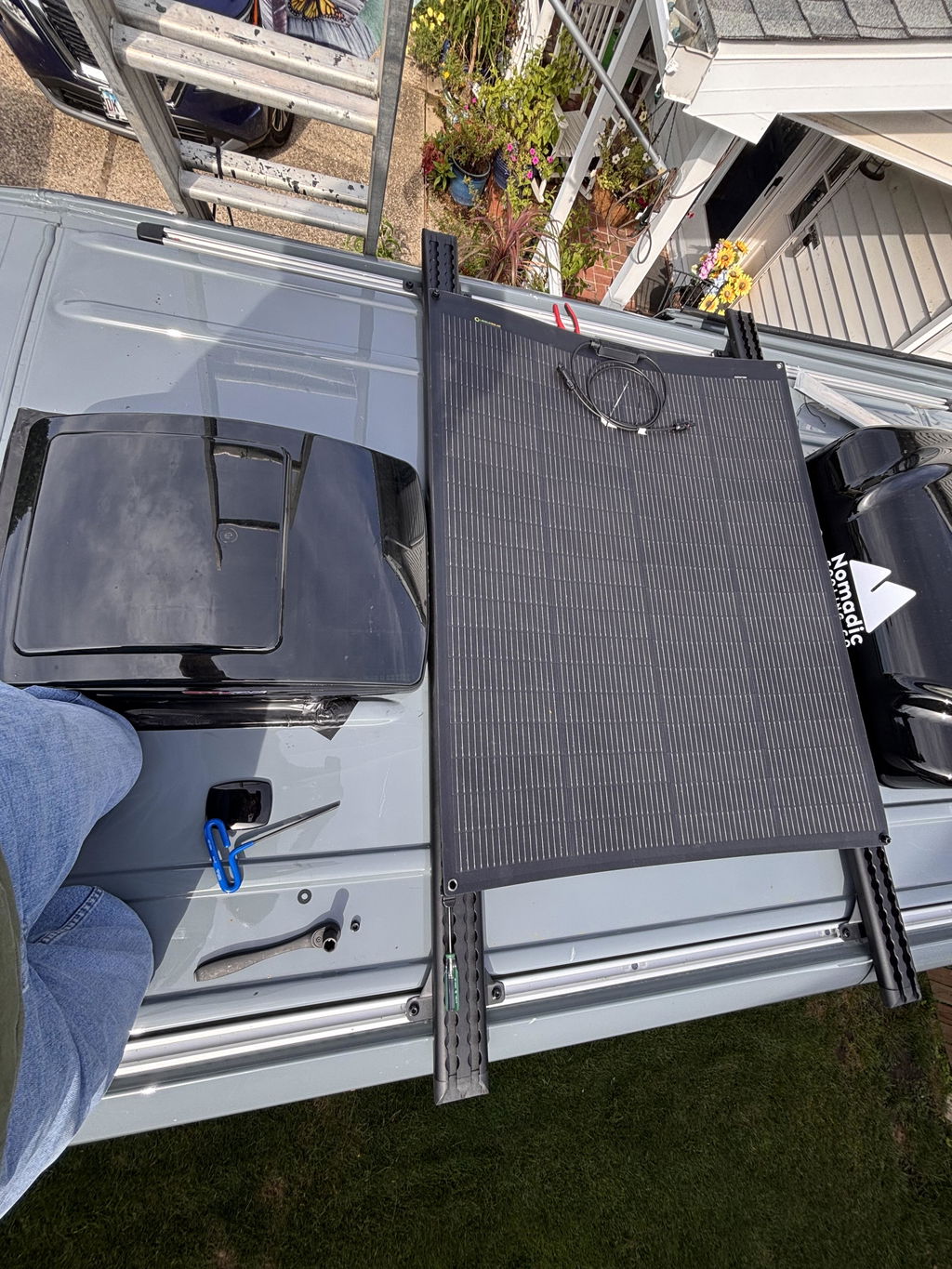
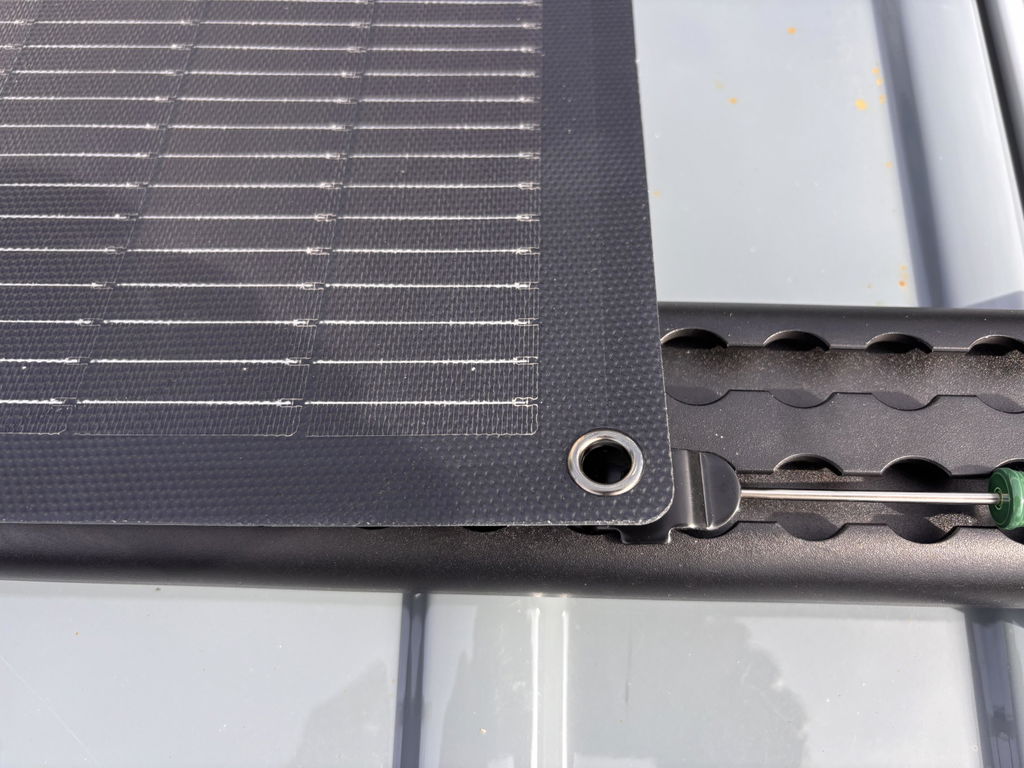
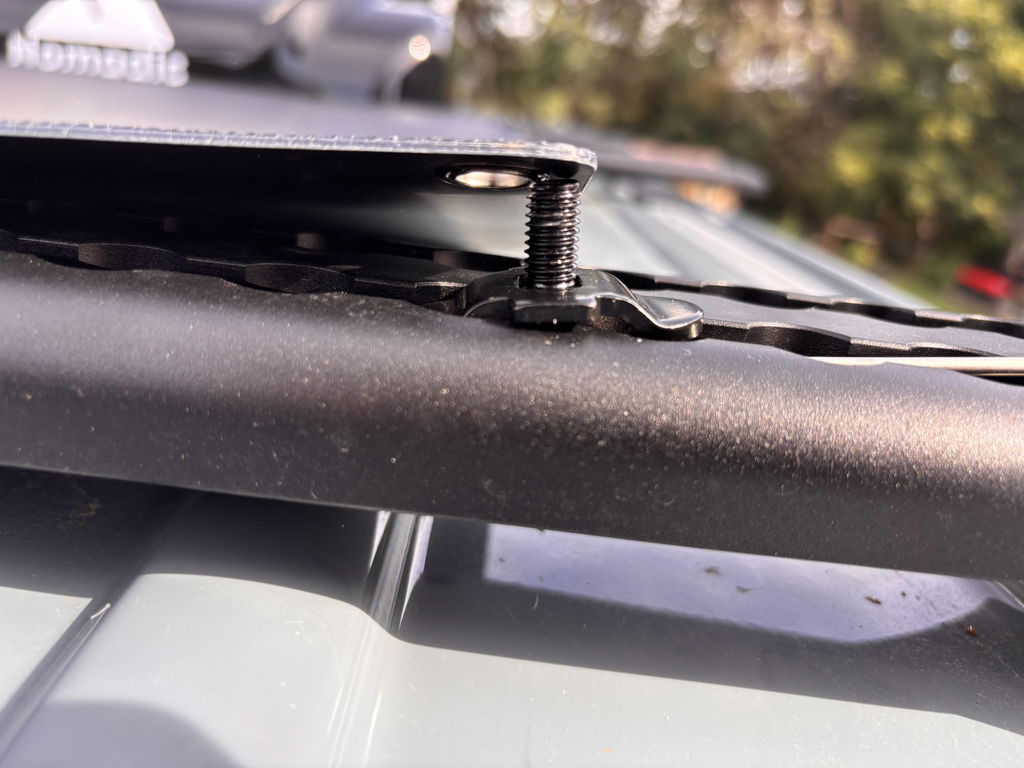
A properly sealed Sprinter roof penetration uses three barriers: a mechanical gasket (butyl tape or EPDM washer) compressed under the mounting hardware, a flexible sealant cap (polyurethane like Sikaflex 221) applied over the assembly, and corrosion protection (primer or zinc-rich paint) on any exposed bare metal. Silicone alone fails within 1-3 years on a van roof because it cannot bond to galvanized steel and tears under thermal cycling. The Sprinter roof panel expands and contracts roughly 2-3 mm across a full temperature swing, and any sealant that cannot stretch with that movement will crack and admit water.
DVA's DVA L-Track collection offers aviation-grade cargo management hardware designed specifically for van builds.
The math is straightforward. A typical Sprinter camper conversion has somewhere between 20 and 60 holes through the roof. Solar panels need four to eight mounting bolts each. A ventilation fan requires a 14" square cutout. Roof rails, antennas, cable glands, running lights. Every one of those penetrations is a potential water entry point, and water inside a vehicle structure is patient and destructive.
For Sprinter builds requiring a purpose-built roof rail system, the DVA LoadSpan-T Dual-Channel Roof Rails provide a direct-mount solution using factory pre-punched holes.
Forum threads about roof leaks follow a pattern. Someone installed a MaxxFan two years ago, sealed it with silicone, and now has water dripping onto their bed when it rains. The silicone pulled away from the metal. Or the self-tapping screws holding their solar panel mounts corroded and loosened. Or water wicked along a bolt thread into the headliner cavity.
The frustrating part is that most of these failures are predictable. The sealant chemistry was wrong for the substrate. The fastener wasn't torqued properly. Nobody accounted for thermal expansion. This article covers the engineering behind roof penetrations that actually last.
1. The Sprinter Roof: What You're Drilling Into
Before you put a hole saw through the roof, it helps to know what you're cutting. The Sprinter uses a stamped steel roof panel, hot-dip galvanized with a zinc coating thickness of approximately 7-10 micrometers per side. On VS30 models (2019+), the roof panel is roughly 0.8-1.0 mm thick sheet steel. Earlier NCV3 models (2007-2018) are similar.
The galvanizing is the roof's primary corrosion defense. When you drill through it, you expose raw steel at the hole edge. That bare metal will begin oxidizing within hours in humid conditions. This is why corrosion protection at every drilled hole is not optional.
Roof Panel Construction by Generation
The T1N (2001-2006), NCV3 (2007-2018), and VS30 (2019+) all use stamped galvanized steel roof panels, but the ribbing pattern and internal bracing differ. The VS30 has wider, flatter sections between ribs, which gives you more usable mounting area but also means longer unsupported spans of thin sheet metal.
The critical detail for mounting: factory cage nuts (also called weld nuts) are installed at specific locations during manufacturing, primarily for OEM roof rail mounting (prep code D13 on VS30 models). These pre-installed nuts provide threaded attachment points without drilling new holes. If your van has them, use them. They're stronger than anything you'll add after the fact, and the galvanizing around them is intact.
Mercedes installs cage nuts at predetermined roof locations for OEM roof rail packages. On VS30 models with prep code D13, these nuts are already welded in place under rubber plugs. Before drilling any new holes, check whether factory mounting points exist at the locations you need. See our complete roof rails guide for D13 mounting point locations.
2. Why Roof Penetrations Fail
Roof leaks are not random events. They follow from a small number of failure mechanisms, and understanding those mechanisms is the difference between a repair that lasts a season and one that lasts a decade.
Thermal Cycling
A Sprinter roof panel sitting in direct sun can reach 70-80°C (158-176°F). At night, or in winter, that same panel drops to ambient, potentially -20°C (-4°F) in northern climates. The coefficient of thermal expansion for steel is approximately 12 × 10⁻⁶ per °C. Over a 1-meter span with a 90°C temperature swing, that works out to about 1.1 mm of movement.
ΔL = 1000 mm × 12×10⁻⁶/°C × 90°C
ΔL ≈ 1.08 mm per meter of panel length
Across the full length of a high-roof Sprinter (roughly 5.9 m roof surface on a 170" wheelbase), that's over 6 mm of total expansion. The fastener holes themselves don't grow, but the panel shifts around them. Any sealant bridging between the fastener and the panel surface must accommodate that differential movement every single day. A rigid sealant will crack. A sealant with poor adhesion will peel. And the failure happens slowly enough that you don't notice until water is already inside the structure.
"I just put solar panels on my roof and the weight caused the seam to leak. I can see minor rust. I would climb on the roof and silkaflex it but the panels I just installed are silkaflexed heavily even over the screws."
— Sprinter-Source, thread #59782: Factory roof seal leaking and solar panels tough to remove (Sep 2017)
UV Degradation
Ultraviolet radiation breaks polymer chains. Every sealant exposed to direct sunlight degrades over time, but the rate depends on the chemistry. Silicone has good UV resistance. Polyurethane is moderate. Butyl rubber, when exposed, degrades relatively quickly. This is why butyl tape works as a gasket (protected under the mounting hardware) but fails when used as a surface sealant.
Galvanic Corrosion
Stainless steel bolts in a galvanized steel panel create a galvanic couple. The zinc coating acts as the anode and corrodes preferentially, which is actually what it's designed to do. But at a bolt hole, where the zinc is already compromised by drilling, the corrosion concentrated around the fastener can eat through the thin roof panel faster than you'd expect. Using a nylon washer or isolating bushing between dissimilar metals stops the galvanic circuit.
Capillary Action
Water doesn't need a visible gap to enter. Thread engagement creates a spiral capillary path that can wick water through a bolt hole even when the surface appears sealed. This is why sealant applied only to the head of a bolt often fails. The water doesn't come through the sealant, it comes through the threads.
A bolt threaded into a cage nut or rivnut creates a helical channel roughly 0.1-0.2 mm wide. Surface tension will draw water upward through this channel against gravity. The fix: apply sealant to the bolt threads before installation, or use a compressed gasket that seals around the bolt shank below the head.
3. Sealant Chemistry: What Works on Galvanized Steel
This is where most Sprinter builders go wrong. They grab whatever tube is in the garage and squeeze it around the bolt head. The sealant choice matters enormously, and the wrong one will fail in a way that's worse than no sealant at all, because it gives you false confidence that the joint is sealed while water quietly enters.
"I applied self-leveling lap sealer to the existing seam sealant... I noticed it had a lot of small bubble-looking bumps that appear to have created holes through the seal. Pulled the sealant off and found a lot of rust underneath. My guess is the black roof and black sealant got too hot in the sun and bubbled, causing a hole in the sealant."
— Sprinter-Source, thread #85059: Rusted Roof Seam Sealant Question (May 2020)
The Four Categories
| Sealant Type | Bonds to Galv. Steel? | Flexibility | UV Resistance | Service Life |
|---|---|---|---|---|
| Silicone (acetic cure) | Poor. Releases acetic acid during cure, corrodes zinc | High | Excellent | 1-3 years on galv. steel |
| Silicone (neutral cure) | Moderate. Better than acetic, still weak on zinc | High | Excellent | 3-5 years |
| Polyurethane (Sikaflex 221, moisture-cure formulas) | Strong. Chemical bond to galvanized surfaces | High | Moderate (paintable) | 7-15+ years |
| Butyl rubber (tape or caulk) | Good adhesion under compression | Very high | Poor when exposed | 10+ years under hardware, 2-3 exposed |
| MS Polymer (Sikaflex 291i, 3M 4200) | Strong | High | Good | 10+ years |
Why Silicone Fails on Sprinter Roofs
Silicone is the most commonly used sealant in DIY van builds, and it's also the worst choice for galvanized steel. The cheap stuff (acetic cure, the kind that smells like vinegar) actively corrodes zinc as it cures. Even neutral-cure silicone has weak adhesive strength on galvanized surfaces. It seals by sitting on the surface rather than bonding to it, which means thermal cycling peels it away within a few seasons.
The one exception: if the silicone is fully captured under compression (like between a fan shroud and the roof, with mechanical fasteners providing clamping force), it can work. But if any edge is exposed and relying on adhesion alone, expect failure.
Polyurethane: The Right Chemistry
Polyurethane sealants (Sikaflex 221 and commercial moisture-cure formulations) form a chemical bond with galvanized steel. Sikaflex 221 is the sealant Mercedes-Benz uses in their own factory for body panel sealing. It cures by absorbing atmospheric moisture, remains flexible through a service temperature range of -40°C to +90°C, and can accommodate the thermal movement of a van roof without cracking or peeling.
Sikaflex 221 has one significant limitation: UV resistance. Direct sun exposure will degrade it over several years. The fix is straightforward. Paint over it, or use it underneath mounting hardware where it's shielded from direct UV. For exposed applications, Sikaflex 252 or an MS polymer sealant handles UV better.
Cure time: Skin forms in approximately 60 minutes at 23°C/50% RH. Full cure in 2-5 days depending on bead thickness.
Service temp: -40°C to +90°C
Elongation at break: ~600% (can stretch to six times its thickness before tearing)
Shore A hardness: ~35 (soft and flexible when cured)
Key advantage: Bonds chemically to galvanized steel, which most silicones cannot do
Butyl: The Gasket, Not the Sealant
Butyl rubber tape (the thick, sticky, non-curing type) is the right material between a mounting plate and the roof surface. Under compression from bolts, it conforms to surface irregularities and creates a seal that actually improves as it's compressed. It never fully cures, which means it stays flexible indefinitely. And because it's sandwiched between metal surfaces, UV never touches it.
The mistake is using butyl tape as a surface sealant. Without compression, it slowly creeps and separates. Exposed to sun, it degrades within a couple of years. Butyl belongs under things, not on top of them.
4. The Three-Barrier System
Professional upfitters and commercial van conversion shops don't rely on a single sealant bead. They use a layered approach where each barrier addresses a different failure mode. If one layer fails, the next catches it.
Corrosion Protection
Before any hardware goes in, treat every drilled hole. Wire brush loose debris, apply zinc-rich primer (cold galvanizing spray) or a rust-inhibiting primer to the exposed steel edge. Let it dry fully. This restores the corrosion barrier that drilling removed.
Mechanical Gasket
Apply butyl tape or an EPDM rubber gasket between the mounting hardware and the roof surface. This is the primary water barrier. When the bolts are torqued, the gasket compresses and seals around each fastener hole. The mechanical compression is what keeps water out, not adhesion.
Sealant Cap
Apply polyurethane sealant (Sikaflex 221 or equivalent) over the bolt heads and around the edges of the mounting hardware. This protects the butyl gasket from UV, adds a secondary water barrier, and seals any thread capillary paths. Let it skin over before driving.
This layered approach is how commercial vehicle upfitters do it. The butyl handles the daily thermal cycling. The polyurethane handles UV protection and edge sealing. The zinc primer handles corrosion on any exposed steel. No single material has to do everything.
5. Fastener Engineering for Roof Penetrations
The bolt holding your solar panel to the roof isn't just a fastener. It's a sealed penetration through a corrosion-protected barrier, under constant thermal cycling, vibration, and wind load. The choice of fastener type determines both the mechanical strength and the sealing reliability of the joint.
Self-Tapping Screws: The Problem
Self-tapping sheet metal screws are the most common fastener in DIY roof installations, and they're the most common cause of long-term failure. The issue is simple: a self-tapping screw creates its own thread in thin sheet metal. That thread has minimal engagement depth (0.8-1.0 mm in a Sprinter roof panel). Under vibration, the screw loosens. Once it loosens even slightly, water enters the thread path. Once water enters, corrosion attacks the thin thread flanks, which further loosens the screw. It's a positive feedback loop.
Through-Bolts with Backing Plates
A bolt passing through the roof panel into a nut or backing plate on the interior side distributes the clamping force and provides full thread engagement. The backing plate (minimum 3 mm steel or 5 mm aluminum) spreads the load across a wider area of roof panel, preventing the dimpling and cracking that single-point fasteners cause in thin sheet metal.
| Fastener Type | Thread Engagement | Pull-Out Strength | Seal Reliability | Vibration Resistance |
|---|---|---|---|---|
| Through-bolt + backing plate | Full nut engagement | Very high | Best (clamped gasket) | Excellent with lock nut |
| Rivnut (M5/M6) | 4-8 mm | Good | Good (compresses gasket) | Good |
| Factory cage nut | 6-10 mm | High | Best (OEM sealed) | Excellent |
| Self-tapping screw | 0.8-1.0 mm | Low | Poor (loosens over time) | Poor |
Rivnuts: The Middle Ground
A rivnut (also called a nutsert or threaded insert) installs from the exterior and creates a permanently bonded threaded receptacle in the sheet metal. For Sprinter roof mounting, M5 or M6 rivnuts in steel or stainless provide enough thread engagement for accessory mounting without requiring interior access. The installation process also compresses the rivnut body against the interior side of the panel, which adds sealing at the hole perimeter.
Apply sealant to the rivnut body before installation. The compression during setting squeezes the sealant around the hole edge, creating a sealed interface before any mounting hardware is attached.
Overtorquing bolts into rivnuts or through thin sheet metal deforms the panel, breaking the seal. Undertorquing doesn't compress the gasket enough to prevent water entry. For M6 bolts with a butyl gasket on 0.8-1.0 mm galvanized steel, forum consensus and upfitter guidance typically falls in the 8-12 Nm range. Use a torque wrench. Use a torque wrench every time.
6. Application-Specific Guidance
Ventilation Fan Cutouts
A 14" × 14" fan cutout is the largest penetration you'll make in the roof. The structural opening weakens the panel, so the fan adapter or shroud must distribute the clamping load around the full perimeter. Use a continuous bead of butyl tape around the opening, then mechanical fasteners every 75-100 mm around the perimeter. Run a bead of Sikaflex 221 around the exterior edge after the fan is secured.
The cutout edge is the most vulnerable point for corrosion. Apply zinc-rich primer to the entire cut edge before installing the fan. Some builders use POR-15 or a similar rust-encapsulating paint for added protection.
Solar Panel Mounts
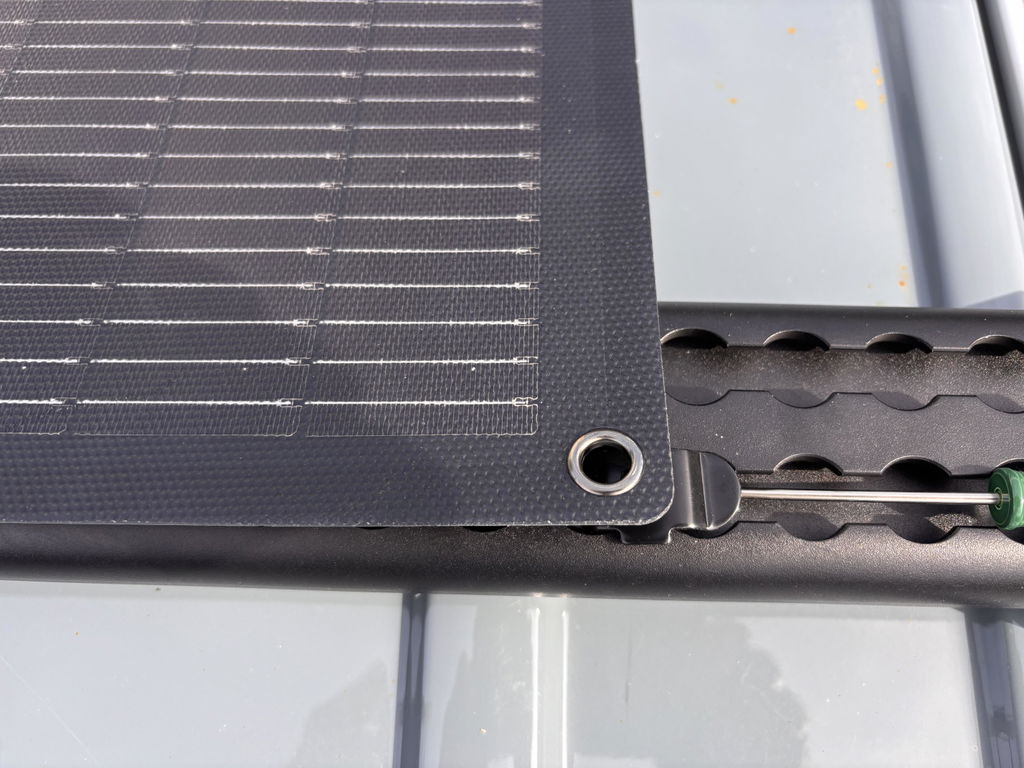
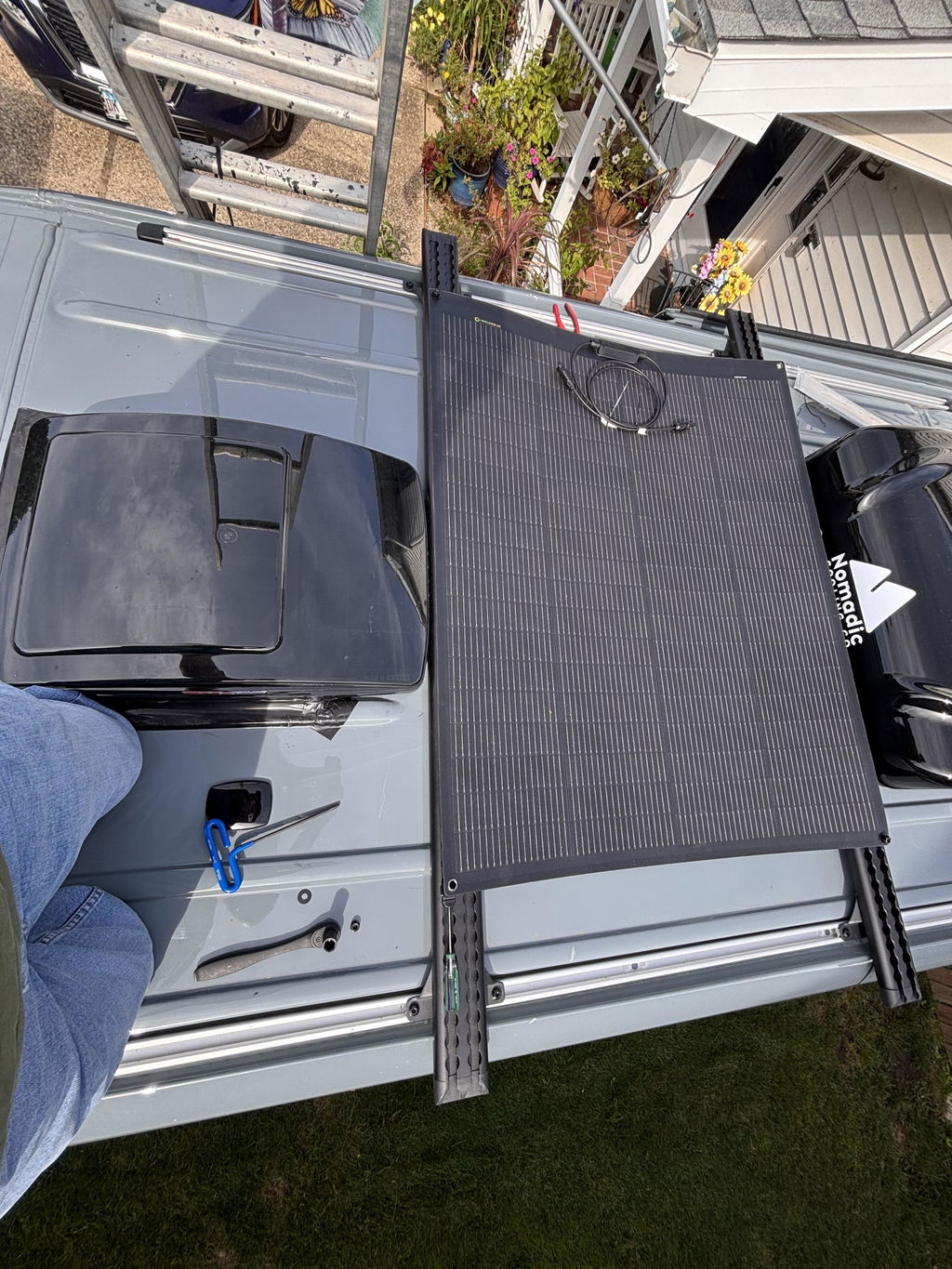
Solar panels create specific challenges: high wind load (especially on a high-roof Sprinter at highway speed), vibration transmission, and a large footprint that must accommodate thermal expansion across multiple mounting points.
Use slotted mounting holes on at least two of the four mounting feet per panel. This allows the panel frame to shift with thermal expansion without shearing the bolts or cracking the sealant. Fix one end rigidly and let the other end float.
For more detail on solar panel roof mounting, see our complete solar mounting guide.
Roof Rails and Cross Bars
Roof rail systems have a different load profile than solar panels. Dynamic loads from cargo at highway speed, lateral forces during cornering, and cyclic stress from road vibration. The Sprinter's 330 lb (150 kg) dynamic roof load rating applies regardless of roof height, and the mounting system must be able to handle that full load without loosening.
Rail mounting systems that use the factory cage nuts (prep code D13) have an inherent advantage: the nuts are welded in place during manufacturing, the zinc coating around them is intact, and the bolt engagement depth is adequate for the load. Aftermarket rail systems that require new holes should use through-bolts with interior backing plates, not self-tapping screws.
For a full breakdown of Sprinter roof rail options and mounting approaches, see our roof rails guide.
"Personally I would never mount something to roof on just adhesive alone, especially if airflow can get under the panels while underway."
— Sprinter-Source, thread #74026: Solar panel roof mount (Mar 2019)
DVA's Sprinter roof rail system uses factory prep-code D13 cage nuts — no new holes required, and the zinc coating stays intact around every mounting point.
Cable Glands and Wire Penetrations
Wiring for solar panels, antennas, and roof-mounted accessories needs to pass through the roof. A proper cable gland (waterproof cable entry plate) is far better than drilling a hole and stuffing sealant around the cable. The gland provides mechanical compression on the cable jacket, creating a water-tight seal that doesn't rely on adhesion.
Mount the cable gland on a small raised platform (even 3-5 mm) to prevent water pooling around the entry point. Water that sits on a flat surface will eventually find a way through any sealant joint. Give it a path to run off instead.
7. Inspection and Maintenance Schedule
Even properly sealed penetrations need periodic inspection. Sealants age, gaskets compress, and fasteners can loosen over time from vibration. A 30-minute inspection twice a year prevents the kind of hidden water damage that costs thousands to repair.
The Inspection Protocol
- Visual exterior check — Look for cracked, peeling, or missing sealant around every penetration. Check for rust staining around bolt heads (indicates corrosion underneath).
- Fastener torque check — With a torque wrench set to the original spec, check that each bolt still holds torque. If it clicks immediately, the bolt hasn't loosened. If it turns, re-torque and note which ones moved.
- Interior inspection — Look for water stains, rust streaks, or dampness around any penetration point on the interior ceiling. Check behind wall panels near the roofline if accessible.
- Water test — Run water from a hose over the roof, starting low and working upward. Have someone inside watching for drips. This catches leaks that only appear under direct water flow.
Every 6 months: Visual inspection of all exterior sealant. Retorque fasteners.
Annually: Full water test. Inspect interior around all penetration points.
Every 3-5 years: Consider reapplying exterior polyurethane sealant cap on exposed joints. Butyl gaskets under hardware typically do not need replacement unless fasteners were removed.
After any fastener removal: Replace butyl gasket and reseal. Never reinstall on compressed butyl.
8. When Water Gets In: The Damage Cascade
A roof leak in a Sprinter doesn't just drip on your pillow. The water follows the interior structure, wicking along ribs, pooling in low spots, and saturating insulation. By the time you see a visible drip, the water has often traveled a meter or more from the actual entry point.
The damage progression is predictable:
- Week 1-4: Water saturates insulation, which loses thermal performance and holds moisture against the steel panel
- Month 1-3: Mold begins growing in the warm, damp insulation. You may smell it before you see it
- Month 3-12: Corrosion attacks the bare steel where the zinc has been compromised, spreading under the paint surface
- Year 1-3: Structural steel begins thinning. In severe cases, pinhole perforation of the roof panel
Insulation removal, mold remediation, and rust repair on a finished conversion can easily run $3,000-8,000 at a shop. The butyl tape and Sikaflex 221 to properly seal every penetration on the entire roof costs under $100.
Key Takeaways
- Never use silicone on galvanized steel. It doesn't bond to zinc. Use polyurethane (Sikaflex 221) or MS polymer for any Sprinter roof application.
- Three barriers, not one. Zinc primer on bare metal, butyl gasket under compression, polyurethane cap over the assembly.
- Account for thermal expansion. The Sprinter roof moves over 1 mm per meter with temperature changes. Use slotted mounting holes and flexible sealants.
- Avoid self-tapping screws for permanent mounts. Through-bolts with backing plates or rivnuts provide far better pull-out strength and sealing reliability.
- Seal the threads. Water wicks through bolt threads by capillary action. Apply sealant to threads before installation, or use a compressed gasket that seals around the bolt shank.
- Inspect every 6 months. Retorque fasteners, check for cracked sealant, and look for interior moisture. Catching a failing seal early costs nothing. Catching it late costs thousands.
- Use factory mounting points when available. Pre-installed cage nuts (D13 prep code) are stronger and better sealed than anything you add afterward.
Related Sprinter Guides
- Sprinter Roof Rails: Factory Mounting Points, Prep Codes, and Aftermarket Options
- Sprinter Solar Panel Roof Mounting: Layout, Wiring, and Structural Considerations
- Sprinter Roof Load Budget: Understanding the 330 lb Dynamic Rating
- Sprinter Rooftop Tent Mounting: Weight Distribution and Structural Requirements
- Sprinter Ventilation Engineering: Fan Placement and Moisture Control
- Sprinter Insulation and Condensation: Vapor Barriers and Dew Point Management
Ready to Upgrade Your Sprinter?
DVA Mechanics engineers purpose-built Sprinter accessories — designed, tested, and backed by real-world data.
Browse All DVA Products →