DVA's DVA L-Track collection offers aviation-grade cargo management hardware designed specifically for van builds.
A sprinter solar panel roof mount needs more than Z-brackets and self-tappers. The Sprinter's 330 lb dynamic roof load limit is shared across rails, crossbars, panels, wiring, and every other gram bolted up top. Direct-to-sheet-metal mounting concentrates force at a few tiny contact points, leading to fatigue cracking, water intrusion, and the kind of highway panel separation that fills forum threads with regret. The solution: full-length load-distributing rails that spread force across every structural rib, provide integrated wire routing, and give you infinitely adjustable mounting positions along their entire length.
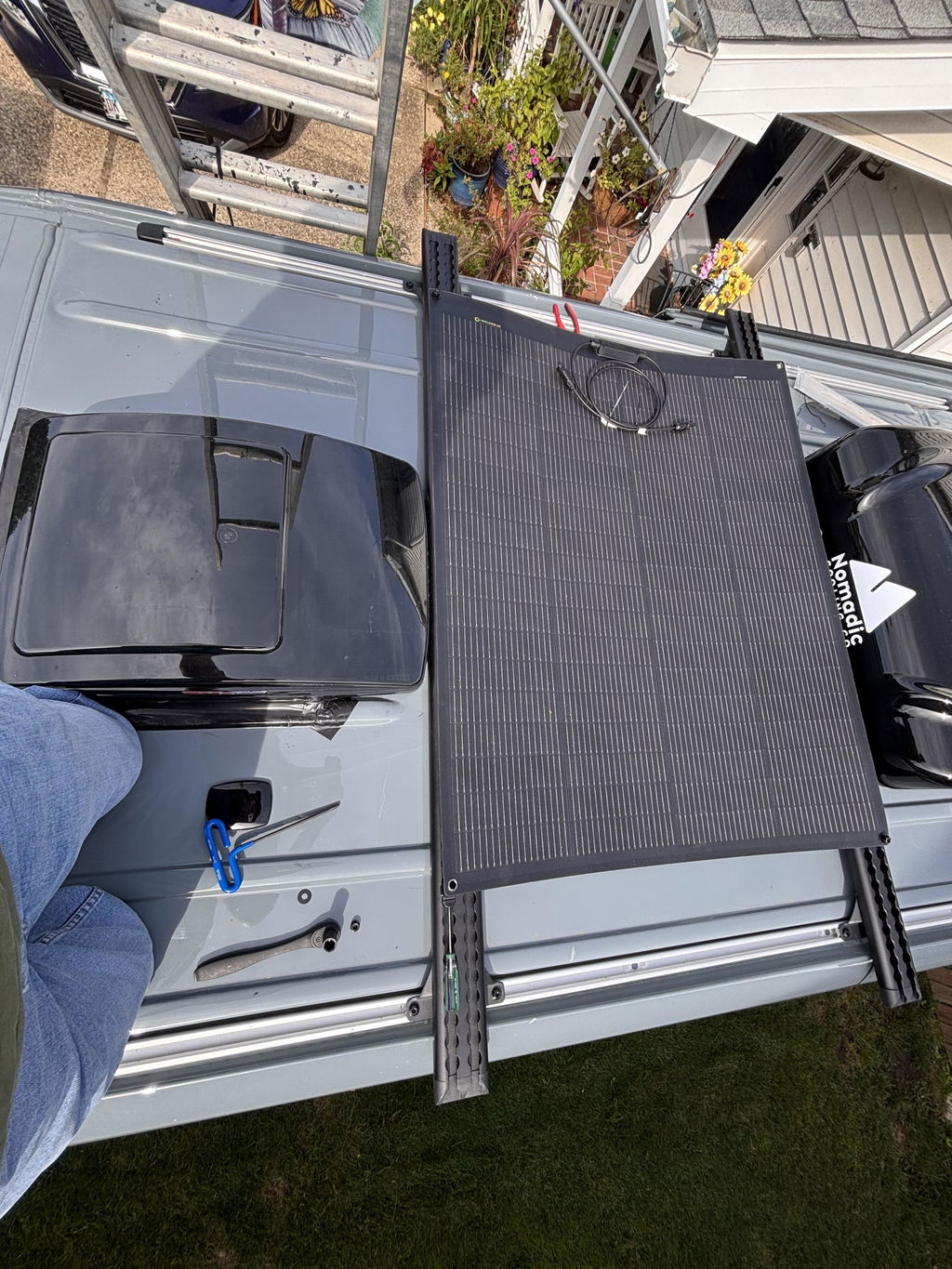
The DVA DualTrack-T™ Cross Bars mount directly to DVA roof rails, creating a modular platform for accessories without permanent roof modifications.
Every Sprinter solar installation starts the same way: someone buys panels, holds them up on the roof, and immediately confronts the question that determines whether the system lasts ten years or ten months. How do I attach these?
The panel selection is straightforward. The electrical design is well-documented. But the mounting — the structural interface between photovoltaic glass and a moving vehicle — is where most builds go wrong. Not because owners lack information, but because the most common mounting approaches ignore the structural reality of the Sprinter roof.
This is a sprinter solar panel mounting guide written from the foundation up. Not which panels to buy. How to build the structure underneath them so they stay put, produce power efficiently, and don't consume your entire roof load budget before you've mounted anything else.
1. Why Bolting Directly to Sheet Metal Fails
The Sprinter roof is a thin-gauge steel panel — roughly 0.8–1.0 mm thick in the flat sections between structural ribs. That's about the thickness of a credit card and a half. It's engineered to maintain its shape under aerodynamic pressure and resist weather, not to serve as a structural mounting platform for 50+ pounds of solar panels travelling at highway speed.
The most common DIY approach — Z-brackets or L-brackets screwed directly into the roof skin — creates a mechanical problem that compounds with every mile driven.
The Point-Load Problem
A typical rigid solar panel mounted with four Z-brackets contacts the roof at four points, each roughly 1–2 square inches. That's 4–8 square inches of total contact area supporting a panel that weighs 25–50 lbs and generates significant aerodynamic lift at highway speed. Under dynamic loading (rough roads, braking, cornering), the effective force at each bracket can spike to 2–3× the static weight.
The sheet metal around each fastener hole becomes a stress riser. Over thousands of miles of vibration, the hole elongates. The sealant cracks. Water gets in. And then you get the forum posts.
This isn't a story about cheap hardware. It's a story about insufficient load distribution. The bolt didn't fail — the sheet metal around it did, because the contact area was too small to spread the force.
The Adhesive Gamble
The alternative to drilling — VHB tape or structural adhesive like Sikaflex — avoids penetrating the roof but introduces a different failure mode. The bond is only as strong as the paint's adhesion to the metal underneath it. On older Sprinters especially, that paint bond degrades with heat cycling, UV exposure, and the constant flexing of the roof panel.
VHB tape is extraordinary in shear strength. In tension — the force vector created by wind getting under a panel at 70 mph — it's far less forgiving. And when it lets go, it lets go completely. No partial failure warning. Just a panel on the interstate behind you.
The Seam Vulnerability
Sprinter roofs have horizontal seams — pressed joints where sheet metal panels overlap. These seams are factory-sealed, but they're a known weak point on older vans (particularly the T1N generation). Drilling through or near a seam dramatically increases the risk of water intrusion that's nearly impossible to trace from inside the van.
2. The 330 lb Roof Load Budget: Shared, Not Dedicated
Before you choose panels, before you choose a mounting system, you need to internalize one number: 330 lbs (150 kg). That's the Mercedes-Benz dynamic roof load rating for the Sprinter, and it's the hard ceiling for everything that goes on top while the vehicle is moving.
The critical detail most builders miss: that 330 lbs is shared across everything on the roof. Rails, crossbars, solar panels, mounting hardware, wiring, an awning, a fan shroud, a light bar — all of it comes out of the same budget.
Weight Math for a Solar Build
Here's what a typical sprinter roof mount solar panel installation actually weighs, component by component:
| Component | Typical Weight | Notes |
|---|---|---|
| Full-length aluminum rails (pair) | 30–50 lb | Varies with profile and length |
| Crossbars (3–4) | 15–25 lb | Aluminum T-slot or round bar |
| Mounting hardware (bolts, clamps, brackets) | 5–10 lb | Often underestimated |
| Rigid panels (2× 200W) | 50–60 lb | ~25–30 lb each for glass-face panels |
| Wiring, conduit, MC4 connectors | 3–5 lb | 10 AWG adds up over long runs |
| Roof penetration glands/cable entry | 1–2 lb | Waterproof cable entry boxes |
| Total (typical 400W rigid setup) | 104–152 lb | 31–46% of budget consumed |
At the heavy end, a 400W rigid panel installation with a full rail system consumes nearly half the roof load budget before you've added an awning (40–60 lb), a rooftop vent fan (~10 lb), or a light bar. The weight math gets tight fast.
− Rails + crossbars (45–75 lb)
− Solar panels + hardware (55–72 lb)
− Wiring + entry glands (4–7 lb)
─────────────────────────
= Remaining for awning, fan, lights, cargo: 176–226 lb
With awning (55 lb) + fan (10 lb):
111–161 lb remaining
This is why mounting system weight matters as much as panel weight. A rail system that weighs 50 lbs leaves you significantly less headroom than one weighing 30 lbs — and the lighter system needs to distribute load just as effectively.
3. Load-Distributing Rails: The Structural Foundation
The engineering argument for full-length roof rails isn't aesthetic. It's mechanical. A continuous rail transforms the Sprinter roof from a series of discrete bolt holes into a unified structural system.
For Sprinter builds requiring a purpose-built roof rail system, the DVA LoadSpan™ Roof Rails provide a direct-mount solution using factory pre-punched holes.
How Distribution Works
The Sprinter roof has structural ribs — pressed corrugations that run laterally across the roof panel at regular intervals. These ribs are the load-bearing members. The flat sheet metal between ribs is not structural; it's a skin.
A full-length rail sits on top of those ribs (or bolts through to them via the factory-punched holes), creating a continuous beam that bridges from rib to rib. Any point load applied to the rail — from a crossbar foot, a panel bracket, a tie-down — gets distributed along the rail's length and transmitted to multiple ribs simultaneously rather than concentrated at a single point.
🔴 Direct / Z-Bracket Mount
- Load at 4 points (4–8 sq in total)
- Each hole is a stress riser
- Sheet metal bears the full load
- No path redistribution on failure
- Fixed panel position — no adjustment
- Each penetration is a leak vector
🟢 Full-Length Rail System
- Load across entire rail span
- Force transmitted to every rib crossed
- Rail is the structural member, not the skin
- Redundant load paths if one bolt loosens
- Infinite mounting positions along the rail
- Fewer or zero additional roof penetrations
L-Track Integration: Mounting Points Everywhere
Standard crossbar systems give you fixed mounting positions — wherever the crossbar happens to sit. If your panel's mounting holes don't align with the crossbar position, you're shimming, drilling adapter plates, or compromising.
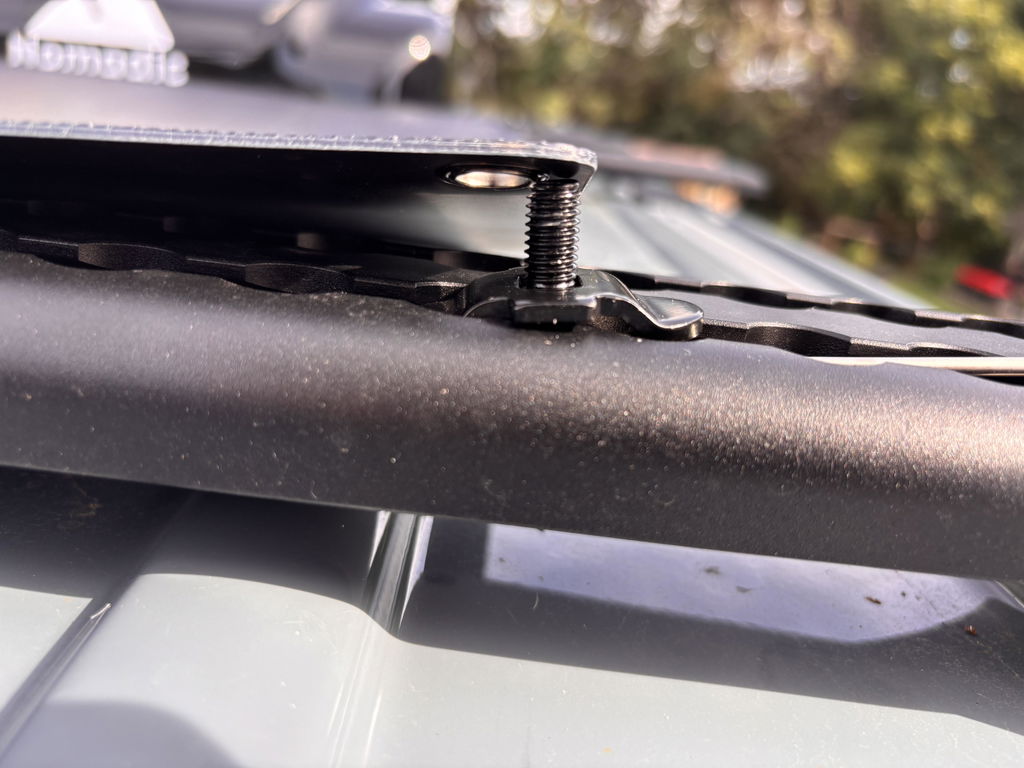
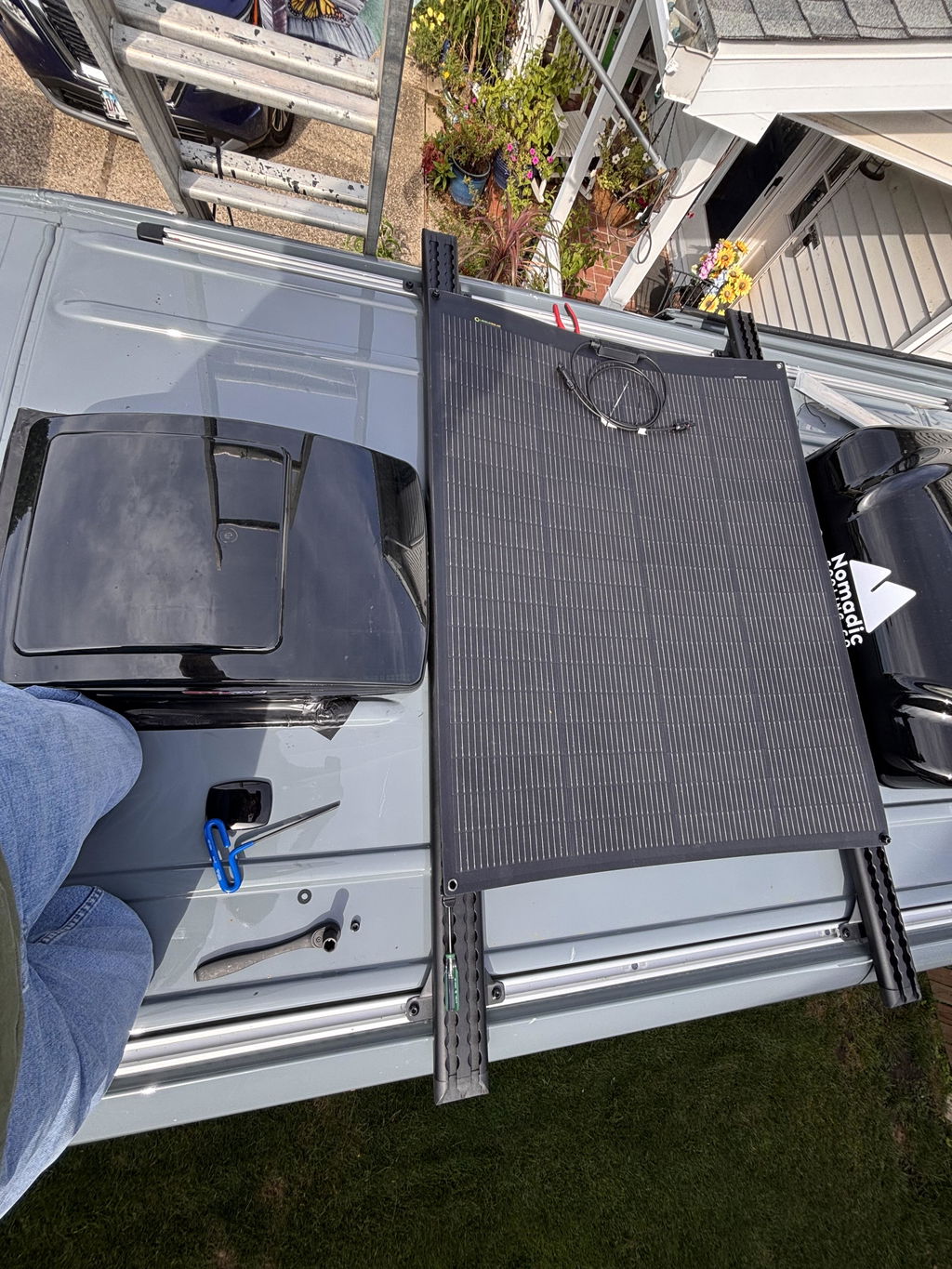
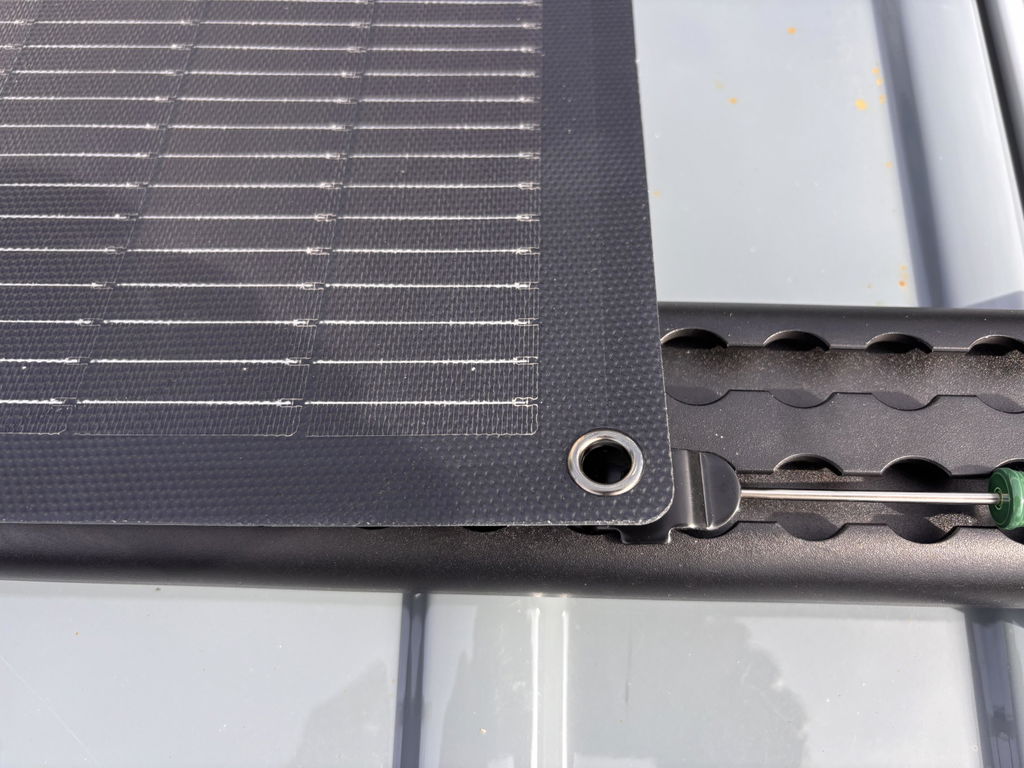
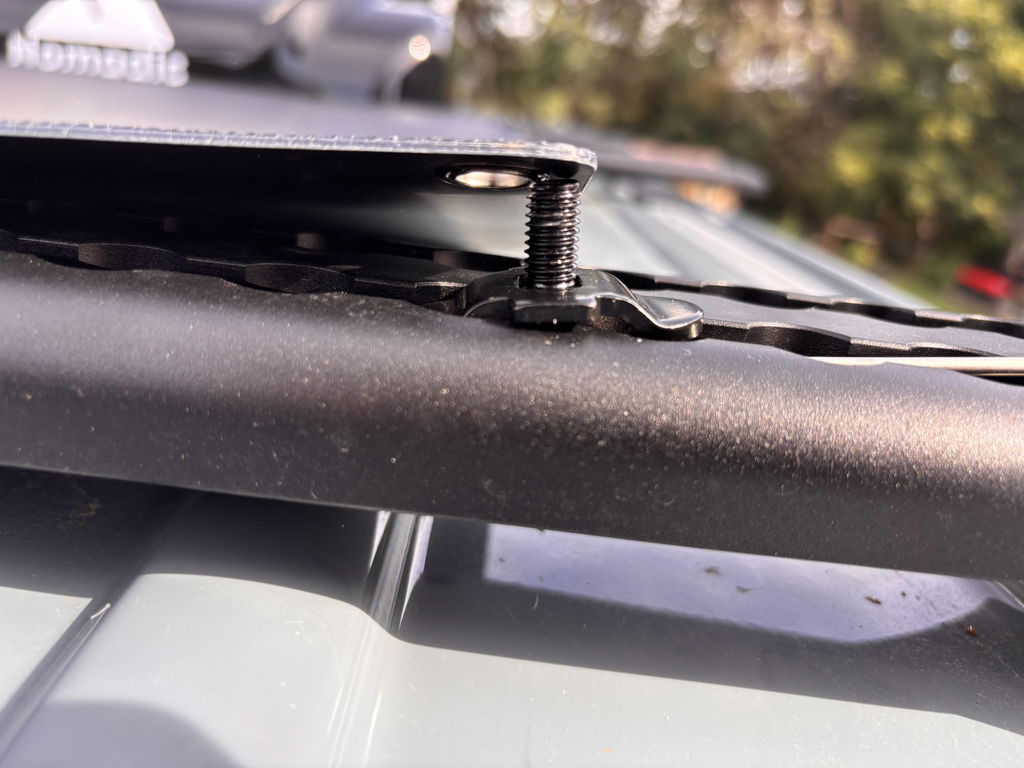
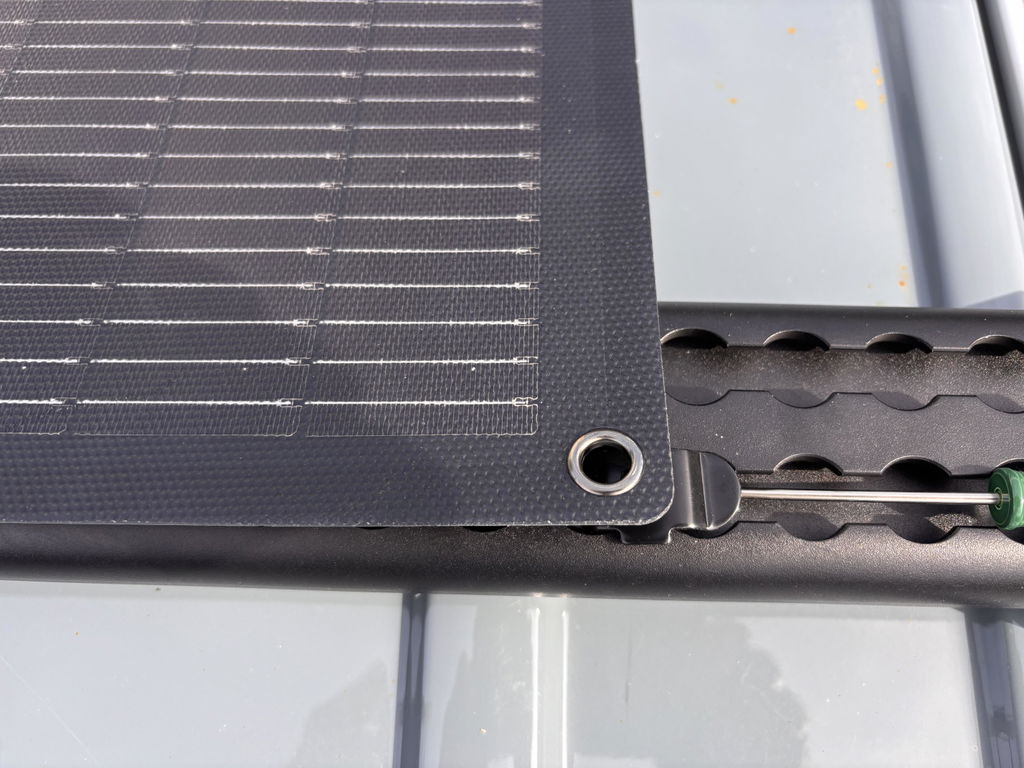
Rails with integrated L-Track (also called airline track or logistic track) solve this differently. The L-Track channel runs the full length of the rail, accepting spring-loaded studs, single studs, or sliding hardware at any position along its length. That means solar panel mounting points every inch along the entire rail — no measuring, no drilling, no "close enough" alignment.
This matters for solar specifically because panel dimensions vary by manufacturer, and most builds evolve over time. A 200W panel from one manufacturer won't have the same mounting hole spacing as a 200W panel from another. With L-Track rails, you slide the mounting hardware to wherever the panel needs it, tighten, and you're done.
L-Track originated in aviation cargo systems and medical transport, where mounting positions change with every load configuration and failure isn't an option. The same keyhole-slot profile that secures stretchers in ambulances and cargo pallets in military aircraft provides the adjustment range and load capacity that solar panel mounting demands — without the single-purpose limitations of traditional crossbar clamps.
4. Rigid vs. Flexible Panels: The Mounting Trade-Off
The panel type you choose dictates the mounting system you need. And each type brings trade-offs that go well beyond wattage per dollar.
Rigid (Glass-Face) Panels
Rigid panels — the same monocrystalline or polycrystalline cells used in residential rooftop installations — deliver the highest efficiency per square foot and the longest service life (25+ year rated lifespan is standard). They need an air gap beneath them for thermal management, and they need a structural frame to support their weight and distribute wind loads.
- Weight: 25–30 lbs each for a typical 200W panel (approximately 45″ × 27″)
- Mounting: Requires crossbars or rail-mounted brackets with ≥1″ standoff for airflow
- Durability: Glass face resists UV degradation, hail impact (rated for 1″ hailstones at ~50 mph in most certifications), and surface abrasion
- Thermal performance: Better than flexible panels because the air gap allows passive cooling. Solar cells lose approximately 0.3–0.5% efficiency per degree Celsius above 25°C (77°F). On a hot roof with no airflow, surface temperatures can exceed 70°C (158°F) — a 15–22% efficiency loss compared to a panel with adequate ventilation.
Flexible (Thin-Film / ETFE) Panels
Flexible panels bond directly to the roof surface, eliminating the need for crossbars or standoff brackets. They're lighter (typically 5–8 lbs per 200W panel), lower profile, and simpler to install. The trade-offs are significant:
- Thermal penalty: With no air gap, the panel runs at roof-surface temperature. In direct sun, that's dramatically hotter than a ventilated rigid panel. Expect 10–20% less real-world output than the nameplate rating suggests, depending on climate.
- Lifespan: Flexible panels typically degrade faster than rigid panels. ETFE coatings yellow over time, and the thin cell substrate is more vulnerable to micro-cracking from repeated thermal cycling. Budget for replacement every 5–10 years rather than 20+.
- Adhesion risk: The panel is bonded to the roof paint, creating the same failure mode discussed in Section 1. If the paint delaminates, the panel goes with it.
- Weight advantage: At 5–8 lbs per 200W, flexible panels free up significant roof load budget — potentially 40–50 lbs saved compared to rigid equivalents.
If your roof load budget is already consumed by other equipment (awning, rack, cargo), or if your van has a standard or low roof where aerodynamic profile matters, flexible panels may be the right trade-off. Just go in knowing you're trading longevity and thermal efficiency for weight savings and simplicity. And plan for replacement costs in your long-term budget.
Panel Sizing vs. Available Roof Real Estate
The usable roof area on a Sprinter depends on wheelbase and what else lives up there. A rough planning guide:
| Wheelbase | Approx. Usable Roof Area | Practical Solar Capacity |
|---|---|---|
| 144″ WB | ~8.5′ × 4.5′ (after fan, clearances) | 400–600W rigid, 600–800W flexible |
| 170″ WB | ~10.5′ × 4.5′ (after fan, clearances) | 600–900W rigid, 800–1,200W flexible |
These numbers assume one roof vent fan (14″ × 14″ cutout) and 2–3 inches of clearance around the panel edges for airflow and mounting access. If you're also mounting an awning bracket, a light bar, or MaxTrax, subtract that footprint from the available area.
5. Wire Routing: The Overlooked Engineering Problem
Solar panel mounting guides tend to stop at the mechanical attachment. But the wiring that connects rooftop panels to interior charge controllers is an engineering problem in its own right — one that gets harder the more you improvise.
The Routing Challenge
Solar panel leads need to travel from the panel junction boxes (typically on the panel's underside or rear edge) across the roof, through a weather-sealed penetration, and down to the charge controller — usually a run of 10–20 feet depending on van length and controller placement. That wire is exposed to:
- UV degradation — standard PV wire (USE-2/PV wire) is UV-rated, but MC4 connectors and cable ties are not always. Cheap zip ties become brittle within a year of roof exposure.
- Abrasion — wire draped across the roof and held down with adhesive clips will rub against the roof surface with every vibration cycle. Over thousands of miles, insulation wears through.
- Wind loading — unsecured cable loops act as sails. At highway speed, even a small loop generates enough drag to fatigue the cable jacket or pull a clip loose.
- Heat — wire running across a dark roof surface in direct sun can reach temperatures well above the standard 30°C ambient assumed in wire ampacity tables.
Rail Channels as Wire Conduit
Full-length rails with an enclosed channel profile solve the routing problem structurally. The wire runs inside the rail channel — protected from UV, abrasion, and wind — from the panel all the way to the rear or side of the van where it enters through a sealed gland. No adhesive clips. No exposed cable runs. No degradation vectors.
This is one of the less-discussed advantages of a rail-based sprinter van solar installation. The rail isn't just holding your panels — it's also serving as conduit, wire protection, and routing structure for the electrical system.
Wire Gauge Math
Solar panels on a Sprinter roof typically operate at 18–45V (depending on panel configuration and whether panels are wired in series or parallel). The wire gauge needs to limit voltage drop to ≤3% — the standard threshold for PV circuits per most electrical codes and best practices.
| System Config | Typical Current | 10 ft Run | 15 ft Run | 20 ft Run |
|---|---|---|---|---|
| 200W @ ~18V (parallel) | ~11A | 12 AWG | 10 AWG | 10 AWG |
| 400W @ ~18V (parallel) | ~22A | 10 AWG | 8 AWG | 6 AWG |
| 400W @ ~36V (series) | ~11A | 12 AWG | 10 AWG | 10 AWG |
| 600W @ ~54V (series) | ~11A | 12 AWG | 10 AWG | 10 AWG |
| 600W @ ~18V (parallel) | ~33A | 8 AWG | 6 AWG | 4 AWG |
Keep Vdrop / Vsystem ≤ 0.03 (3%)
At 18V system voltage, 3% = 0.54V max drop
At 36V system voltage, 3% = 1.08V max drop
The takeaway: wiring panels in series (higher voltage, lower current) dramatically reduces the wire gauge required and the associated weight. A 600W array wired in series at ~54V needs only 10 AWG for a 20-foot run. The same array wired in parallel at ~18V needs 4 AWG — heavier, stiffer, harder to route, and more expensive. Series wiring is almost always the better choice for roof-mounted van solar, unless shading conditions require parallel operation with individual panel optimization.
The Roof Penetration
Every wire has to get from the roof to the interior. The cleanest approach: a dedicated waterproof cable entry gland (sometimes called a "solar entry plate") mounted on a flat section of the roof away from any seams. These are purpose-built fittings with compression glands that seal around the wire jacket. Apply butyl tape underneath, bolt or bond the plate to the roof, and run the wires through the gland.
Some builders route wires through existing factory openings — the refrigerant line penetration, rear light housing cavities, or hatch seal channels. These can work but introduce waterproofing risks at points you may not be able to inspect later.
6. Thermal Engineering: The Air Gap You Can't Skip
Solar panels convert roughly 20–22% of incoming sunlight into electricity (for modern monocrystalline cells). The remaining ~80% becomes heat. On a vehicle roof with no air gap, that heat has nowhere to go but into the panel itself and the roof skin beneath it.
Temperature and Efficiency
The temperature coefficient for most monocrystalline silicon cells is approximately −0.3% to −0.5% per °C above the standard test condition of 25°C (77°F). In practice:
- A panel flat on a dark roof in Arizona summer can reach 70–80°C (158–176°F)
- That's 45–55°C above STC — a 13–27% efficiency loss
- The same panel on a rail-mounted system with 1.5–3″ of air gap typically runs 10–20°C cooler — recovering roughly half that loss
This is the hidden efficiency argument for rail-mounted rigid panels over adhesive-bonded flexible panels. The 5–15% real-world efficiency difference between a ventilated rigid panel and a roof-bonded flexible panel means that 400W of ventilated rigid panels can produce as much power as 460–480W of flexible panels in hot conditions. That gap compounds over years of ownership.
Standoff Height Recommendations
For thermal management, the minimum practical air gap between the panel underside and the roof surface is 1 inch. Better is 1.5–3 inches, which allows passive convective airflow when the vehicle is parked and forced airflow when driving. Standard crossbar profiles on rails naturally create 2–4 inches of standoff — adequate for thermal purposes without adding unnecessary aerodynamic drag.
7. Mounting Approaches Compared
There are fundamentally three ways to mount solar panels on a Sprinter roof. Here's how they compare on the dimensions that actually matter for long-term durability.
| Criteria | Direct (Z-Bracket) | Crossbar Only | Full-Length Rails |
|---|---|---|---|
| Load distribution | Poor — 4 point loads | Moderate — 4–8 points | Excellent — continuous |
| Roof penetrations | 4–8 per panel | 4–8 total for crossbar feet | Uses factory holes (5–7 per side) |
| Panel position adjustability | Fixed (drill once) | Fore/aft only | Infinite along rail length |
| Wire routing | External clips/tape | Along crossbar, then external | Inside rail channel |
| Future reconfiguration | New holes required | Limited to crossbar positions | Slide and re-tighten |
| Weight | ~2–5 lb (brackets only) | ~15–25 lb (bars + feet) | ~30–50 lb (rails + hardware) |
| Additional use (awning, lights, cargo) | None | Limited to bar positions | Full L-Track accessory ecosystem |
Direct mounting is lightest but most fragile. Crossbars provide decent structural support but limit your layout options. Full-length rails cost the most in weight budget but create a platform that serves solar, cargo, lighting, awning, and recovery gear from a single integrated system.
For most sprinter van solar installations where the roof also needs to carry other equipment, the rail system wins on total value even though it costs more in weight — because it eliminates the need for separate mounting solutions for every accessory.
8. Installation Sequence: Rails First, Panels Last
The order of operations matters. Getting it wrong means pulling panels off to fix wire routing, or discovering your crossbar spacing doesn't match your panel frames after everything is sealed.
Plan the Layout on Paper
Measure available roof area. Subtract the vent fan footprint, front/rear clearances (3–4″ minimum from roof edges for aerodynamics), and any planned awning brackets. Map remaining space to your chosen panel dimensions. Confirm total weight against the 330 lb budget.
Install Rails
Mount full-length rails to factory-punched holes using appropriate hardware (typically riv-nuts or plus-nuts for unthreaded holes). Seal every penetration with butyl tape under the rail foot and sealant over the hardware. Rails should be installed before any headliner or ceiling material is final — interior access is almost always needed.
Route Wiring
Run PV wire through the rail channel from the planned panel position to the cable entry point. Leave service loops at both ends. Install the waterproof cable entry gland and seal it. Test wire continuity before covering anything up.
Mount Crossbars
Position crossbars on the rails at the spacing required by your panel frames. Use the L-Track channel to fine-tune position. Tighten to spec and verify they're parallel — a misaligned crossbar creates a twist load on the panel frame.
Attach Panels
Set panels on crossbars, connect MC4 cables, and bolt panels to crossbars using stainless hardware with lock nuts (not lock washers — lock washers are not considered reliable vibration-resistant fasteners in vehicle applications). Verify all electrical connections before finalizing mechanical fastening.
Commission and Test
Measure open-circuit voltage at the cable entry to confirm panel output. Connect to charge controller. Monitor for 24 hours including a drive cycle to verify no rattles, no loose connections, and no water intrusion at penetration points.
9. Mistakes That Fill Forum Threads
After reviewing hundreds of posts across Sprinter-Source, r/vandwellers, r/Sprinters, and r/VanLife, the same failure patterns emerge repeatedly. Here's the condensed version.
Mistake 1: Undersized Fastener Contact Area
Bolts without fender washers. Self-tappers into thin sheet metal. Hardware that's barely larger than the hole it passes through. The fix is simple: every fastener that touches sheet metal needs a washer or backing plate that spreads load across a minimum of 1 square inch.
Mistake 2: Ignoring Vibration
Van roofs vibrate constantly. Lock washers are not adequate vibration resistance for vehicle applications (aviation maintenance has known this for decades). Use nylon-insert lock nuts (Nyloc), double nuts with thread locker, or properly torqued flange-head fasteners.
Mistake 3: Wire Runs as an Afterthought
Panels go on, look great. Then the builder realizes the wire needs to get inside. Now they're drilling a hole through the roof next to a panel they can't easily remove, trying to seal it blind. Route wiring before panels are mounted, and route it through protected channels — not across the roof surface under zip ties.
Mistake 4: Not Accounting for the Full Weight Stack
The panels weigh 55 lbs. But the rails weigh 45 lbs, the crossbars weigh 20 lbs, the hardware weighs 8 lbs, and the awning you're adding next month weighs 55 lbs. Total: 183 lbs, which sounds fine until you want to add a cargo box or recovery boards next year and discover you've only got 147 lbs left. Plan for the complete system on day one.
Mistake 5: Flexible Panels on a Curved Roof Without Conformity Testing
Sprinter roofs have compound curves. Flexible panels can bend, but they have minimum bend radius specifications. Forcing a flexible panel to conform to a tighter curve than it's rated for creates micro-cracks in the solar cells that degrade output over time — damage that's invisible from the surface but measurable with a multimeter.
Key Takeaways
- The 330 lb dynamic roof load is a shared budget. Rails + panels + crossbars + hardware + everything else. Weight every component before you start. The.
- Direct-to-sheet-metal mounting is a long-term failure mode. The roof skin is ~1 mm of steel. It's not a structural platform. Distribute loads through rails that engage the structural ribs.
- The air gap is non-negotiable for rigid panels. Minimum 1″ standoff for thermal management. The 10–20°C temperature reduction from passive ventilation recovers 5–15% of panel efficiency.
- Wire in series, not parallel. Higher voltage = lower current = thinner wire = less weight = easier routing. Unless you have partial-shading concerns, series wiring is the correct default.
- L-Track rails serve triple duty. Structural mounting, infinite panel positioning, and wire conduit in a single system. This is why rail weight, while higher than bracket-only solutions, pays back across every accessory that mounts to the roof.
- Plan for the complete rooftop system, not just solar. Map every component — awning, vent fan, lights, recovery boards, antenna — against the 330 lb budget before you commit to panel count and rail selection.
Ready to Upgrade Your Sprinter?
DVA Mechanics engineers purpose-built Sprinter accessories — designed, tested, and backed by real-world data.
- DVA LoadSpan™ Roof Rails
- DVA LoadSpan-T™ Roof Rails
- DVA DualTrack-T™ Cross Bars
- DVA L-Track collection