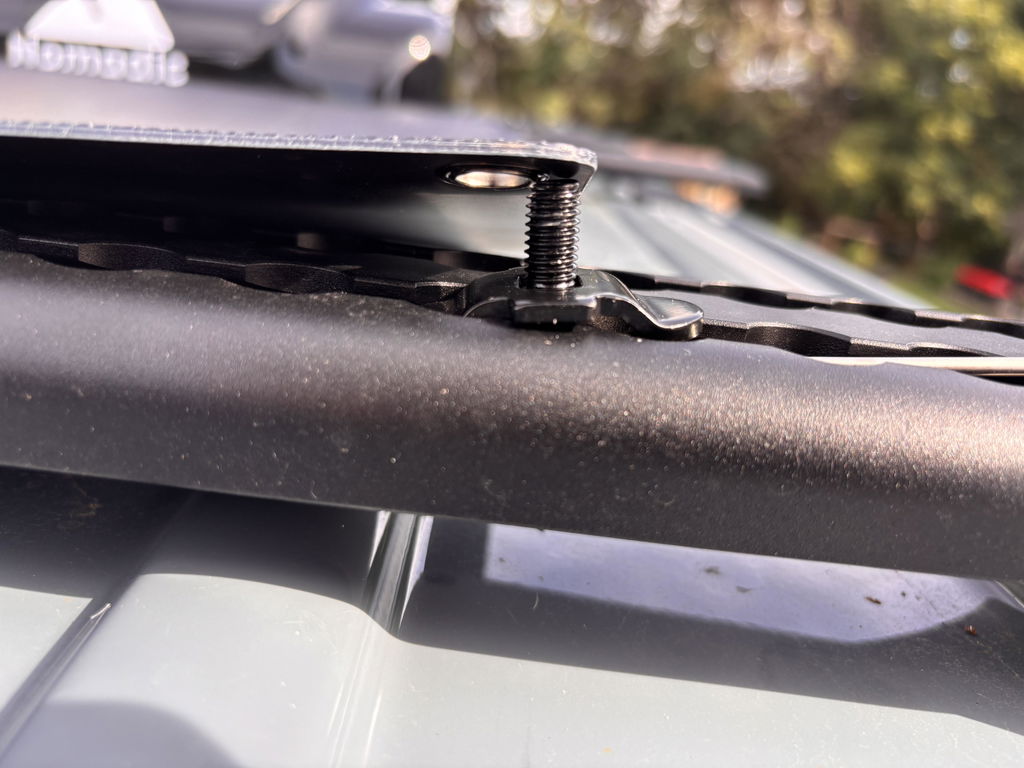
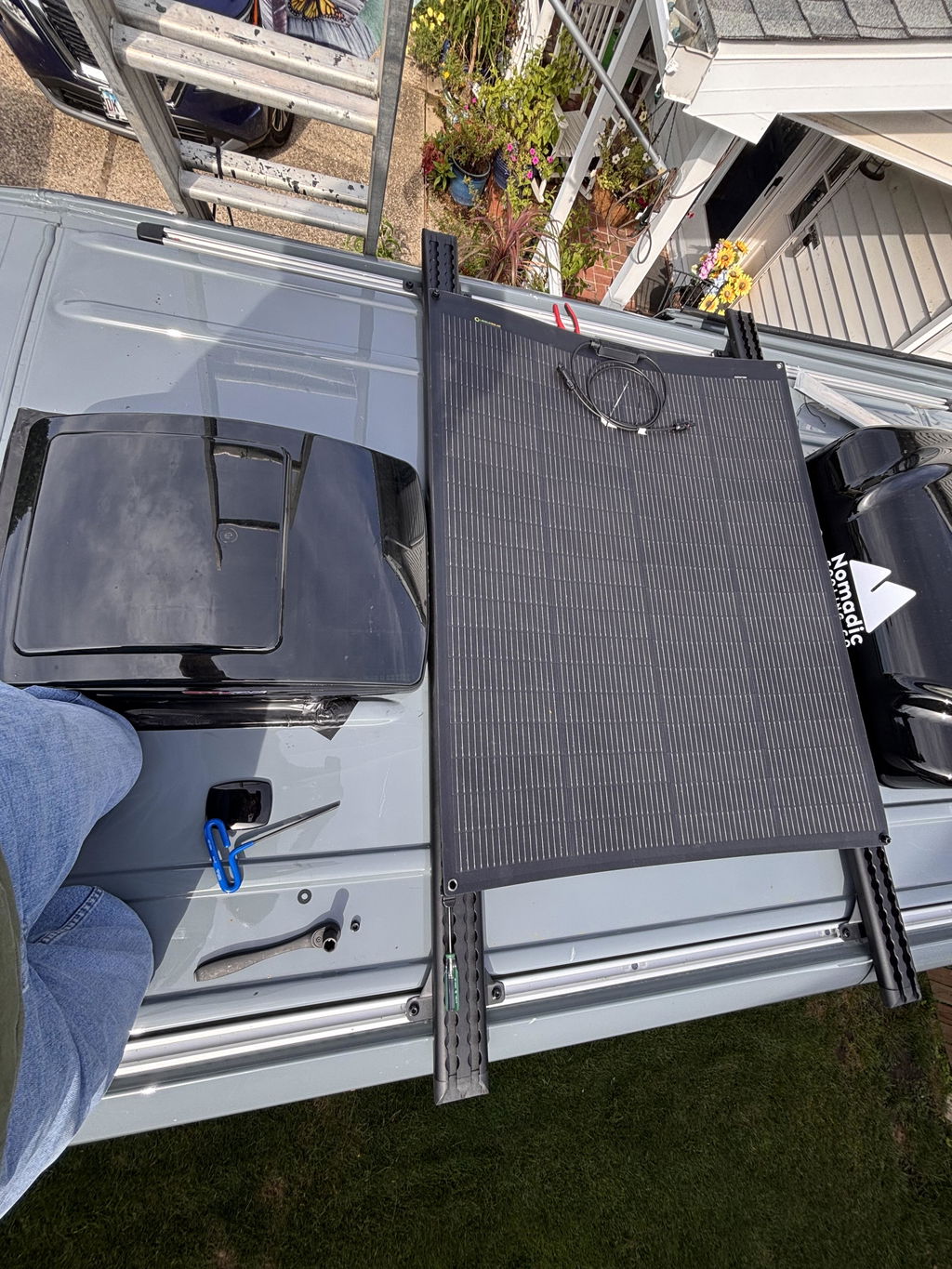
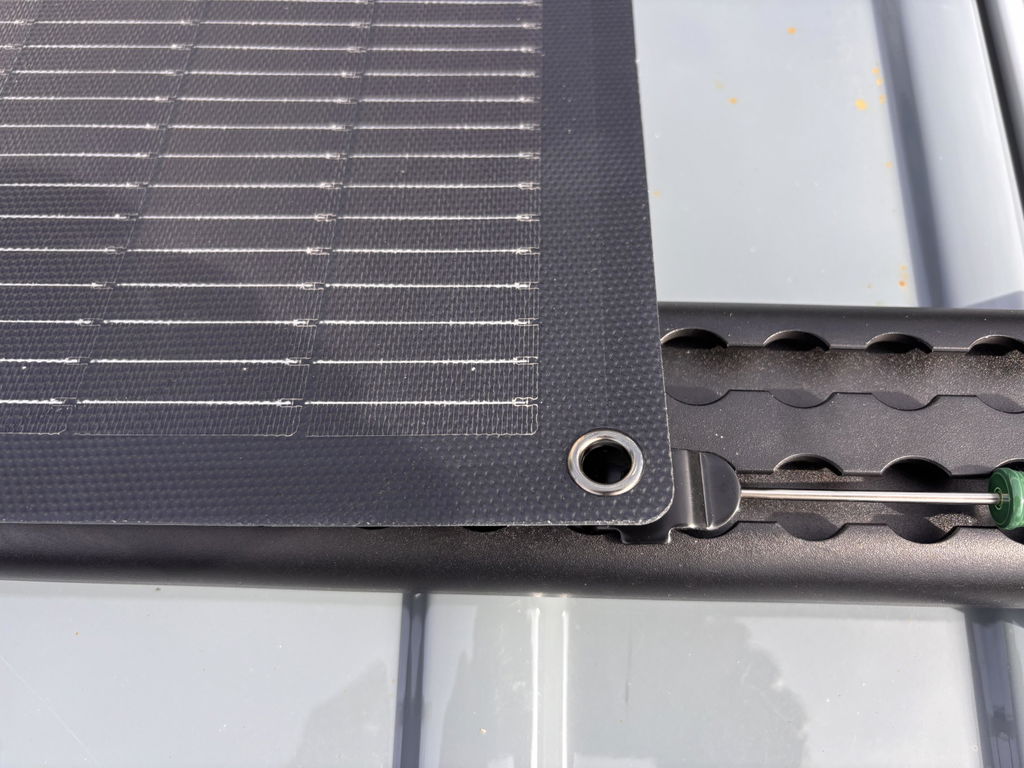
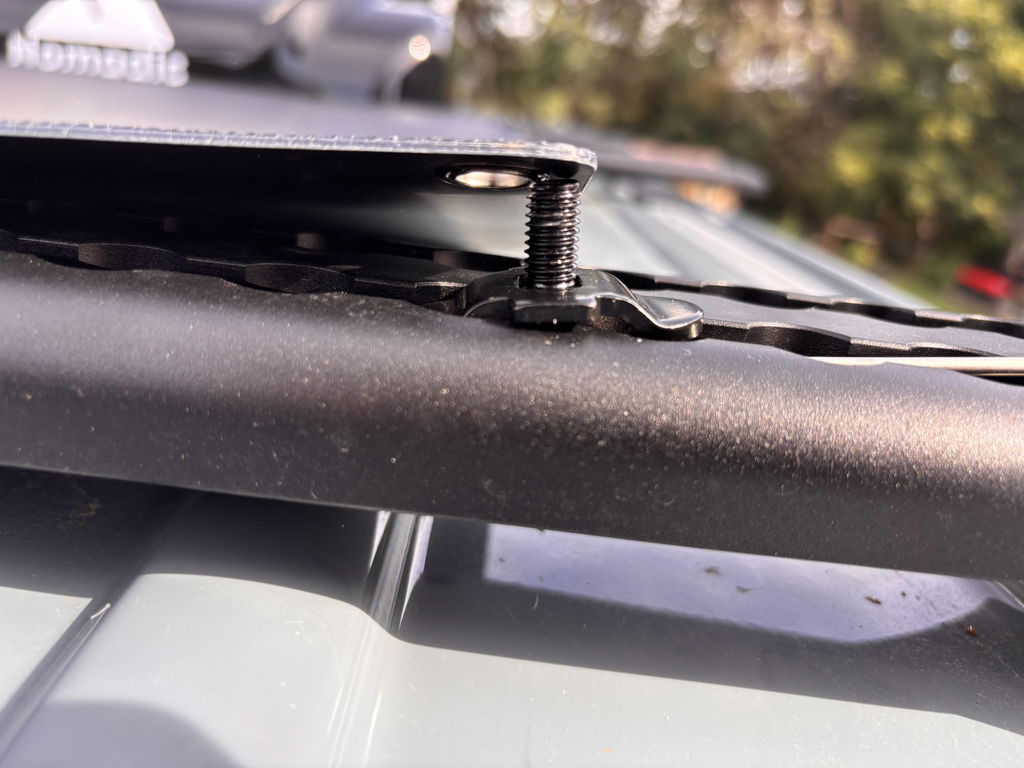
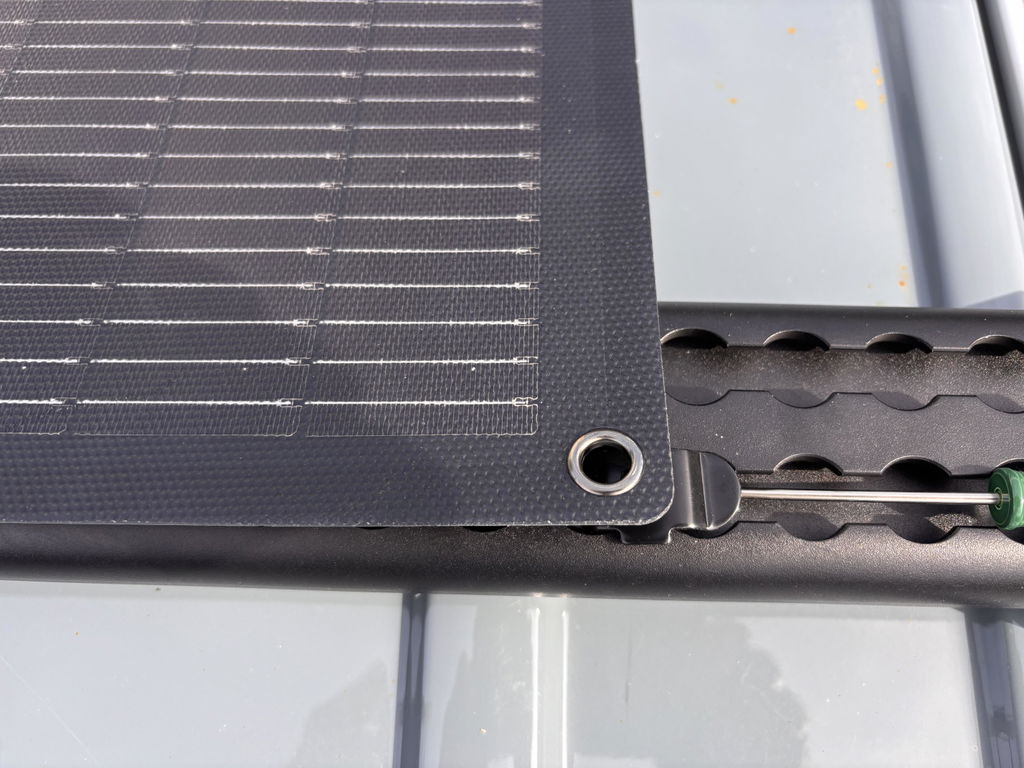
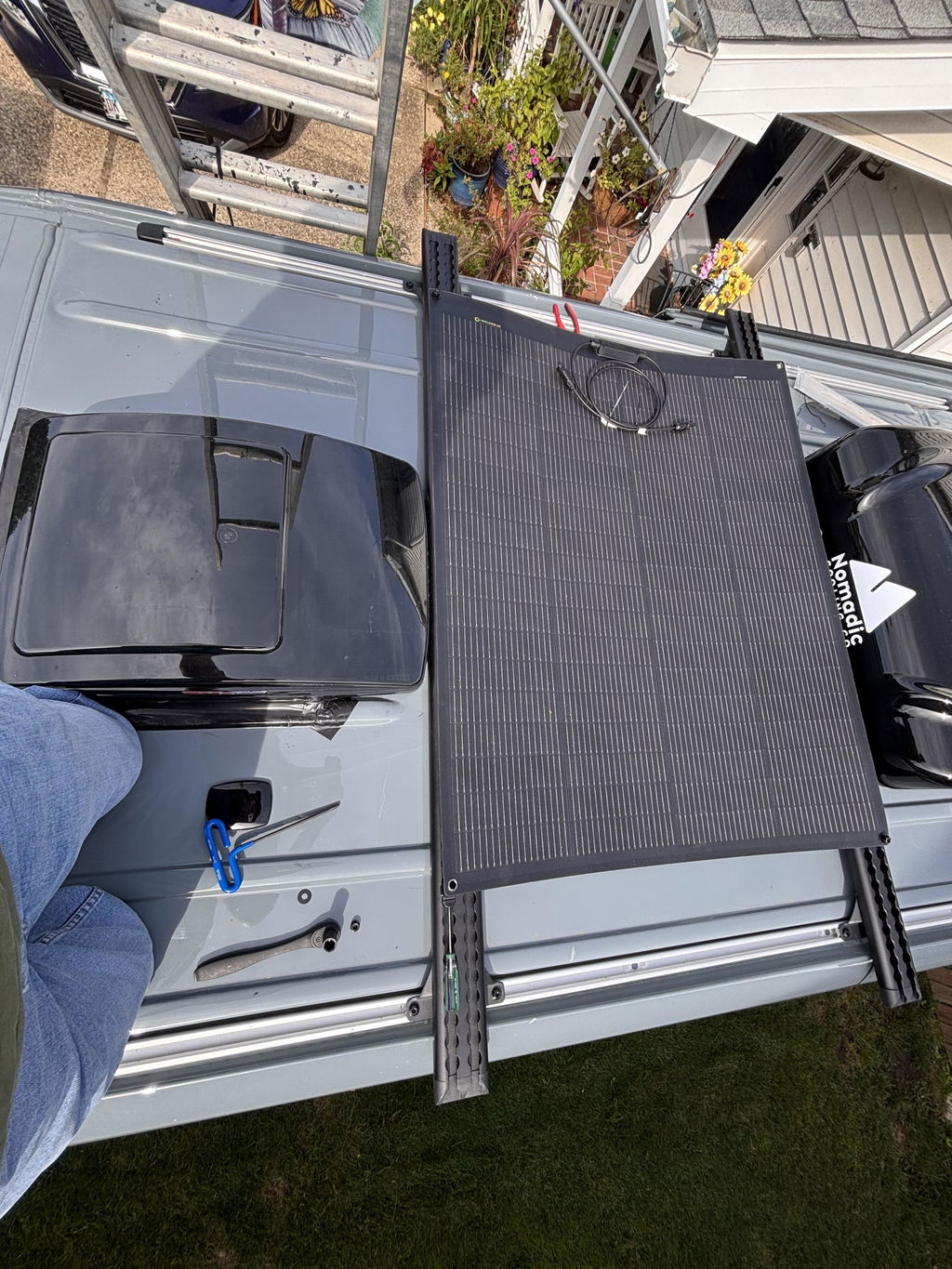
- Sprinter roof load limit: 330 lb dynamic (while driving) on all roof heights — standard and high roof. Do not exceed this across all roof-mounted gear combined.
- Factory holes: Pre-punched at the plant on every VS30. The plastic plugs in your roof cover threaded factory hard points — no new holes needed for rails that bolt to these.
- Headliner removal: Required for traditional through-bolt installs. Not required for the rivnut method — rails go on from outside only.
- OEM vs. aftermarket: OEM rails use captive bolts that thread in from inside; they require headliner access. Aftermarket rails using M6 rivnuts can be installed in an afternoon without disturbing the interior.
- Channel type matters: Standard OEM rails provide a single T-slot. DVA's LoadSpan-T™ rails run simultaneous L-Track + T-Bolt channels the full length of the van — the only Sprinter rail that does both.
Every Sprinter van rolls off the line with a row of plastic plugs running along each side of the roof. Pull one out and you'll find a factory-punched hole in the sheet metal. That hole is the starting point for every sprinter roof rail installation — and how you use it determines whether your build is rock-solid at 100,000 miles or leaking and flexing at 30,000.
This guide covers the engineering behind Sprinter roof rails: what the factory provides, how load distributes across the roof structure, the three real mounting methods with their tradeoffs, and what rail channel profile you should choose based on what you're building. Whether you're mounting a pair of solar panels or a full roof platform with awning, crossbars, and a rooftop tent — the foundation decisions you make at the rail stage affect everything that follows.
What the Factory Actually Gave You
The VS30 Sprinter (2019–present) comes with a specific set of pre-punched mounting holes along the roof — the same holes used to install factory roof rails at the dealership. On vans ordered without the factory rail option, those holes are covered by plastic plugs. On vans that came with rails from the factory, they're already threaded with captive bolts that the OEM rails bolt down onto.
These aren't arbitrary holes. They align with the van's structural roof ribs — the stamped cross-members that carry load from the roof skin down into the body structure. Rail systems that span these ribs distribute weight across multiple structural members rather than concentrating it at just two or four fastener points.
That observation from a Sprinter-Source member with firsthand experience still holds. The roof skin on a Sprinter is thin sheet steel — typically around 0.8–1.0 mm. It's not designed to carry point loads. A properly installed full-length rail spreads the same load across 8–12 bolt points instead of 2–4, which is why the load rating is the same whether you're using a pair of OEM rails or a platform rack with individual feet — it's the roof structure and the vehicle's own GVW limits that set the ceiling, not the rail itself.
The 330 lb Load Limit: What It Really Means
The Mercedes-Benz Sprinter VS30 has a documented roof load limit of 330 lb (150 kg) dynamic — meaning with the vehicle in motion. The static limit (vehicle parked) is 661 lb (300 kg). These are total numbers across everything on the roof: rails, crossbars, solar panels, awning, rooftop tent, and any gear loaded onto a platform.
This applies to both standard and high roof configurations. The roof height doesn't change the structural load limit — the body construction is the same. What changes is the center of gravity, which affects handling. A high-roof Sprinter loaded at 330 lb on the roof already has a meaningfully higher CG than an empty van. Add a Starlink, a full-size awning, and a rooftop tent and you're not just at the load limit — you're changing the vehicle's handling characteristics in ways that demand adjusted driving habits.
| Configuration | Dynamic (moving) | Static (parked) | Max per support pair |
|---|---|---|---|
| All VS30 Sprinters (144", 170", high roof, standard roof) | 330 lb / 150 kg | 661 lb / 300 kg | 110 lb / 50 kg |
The 110 lb per support pair limit matters when you're using crossbars. If you have three crossbars spanning your rails, the 330 lb total doesn't distribute evenly — loads concentrated at a single crossbar (like a rooftop tent mounted on two bars) need to stay under 110 lb at each bar's mounting point. This is where full-length load-distributing rails earn their engineering value: a rail that spans from the front mounting point to the rear distributes the load along the continuous rail body, not just at the crossbar saddle.
Three Installation Methods: Tradeoffs Every Builder Should Know
Factory OEM Through-Bolt (Headliner Access Required)
OEM rails use captive bolts that are inserted from inside the van and tightened from outside. This means pulling back the headliner to access the bolt heads. On the VS30, that's a full interior headliner pull on cargo vans — or removal of the styrofoam insulation panels and headliner sections on passenger models.
Load rating: Full factory spec — rated to the vehicle's 330 lb dynamic limit when properly installed.
Rust risk: Low — captive bolts seal against a factory-applied butyl gasket, and the OEM rail includes a rubber channel seal along the bottom edge.
Best for: Vans without a finished interior, or owners who were planning to pull the headliner anyway.
Rivnut Method (No Headliner Removal)
M6 rivnuts (also called rivet nuts or plusnuts) are threaded inserts that expand inside the factory hole when installed from outside, creating a threaded anchor in the roof skin. Rails bolt down onto these using M6 bolts. No interior access needed.
This is the most popular approach for van converters with finished interiors — or anyone who doesn't want to disturb an existing headliner installation.
Load rating: Properly installed M6 rivnuts in 0.8 mm steel provide ~400 lb pull-out strength each. At 8 rivnuts per rail, total shear capacity comfortably exceeds the vehicle's load limit — the vehicle GVW ceiling, not the rivnuts, is the constraint.
Rust risk: Moderate — the factory hole is not galvanized steel. Primer and sealant (butyl tape or Sikaflex under the rail) are essential. Skipping this step is the #1 cause of premature rust on otherwise clean builds.
Best for: Finished interior builds, passenger vans, owners who want no interior disruption.
Self-Tapping Screw (Not Recommended)
Some budget rail kits use self-tapping sheet metal screws directly into the factory holes. This creates a nominal thread in thin-gauge steel that has minimal pull-out resistance and no corrosion sealing. Not recommended for any roof-mounted load that will see road vibration.
Load rating: Unpredictable — self-tapping screws in thin sheet metal walk and loosen over time.
Rust risk: High — no sealing, thread damage exposes bare metal.
Best for: Nothing above a light decorative trim piece.
A commenter on the r/SprinterVans engineering guide thread (March 2026) flagged something critical: "The roof is not galvanized. Drill it at your own peril. Sprinters are known for having poor quality paint and rusting. If you don't believe me, look for 5–10 year old Sprinters for sale on the northern east coast." This is firsthand observation, not theory. Every hole you drill or enlarge in the Sprinter roof creates a bare metal edge. Seal every penetration — butyl tape under the rail, Sikaflex 221 on every bolt hole — before the rails go on. Not after. Under the rails where you can't see it later.
Rail Channel Profiles: Why T-Slot vs. L-Track Changes Everything
Not all sprinter roof rails are equivalent channels. The channel profile cut into the top of the rail determines what accessories you can mount and how — and whether you'll need adapters six months into your build.
The two dominant standards in van builds are T-Bolt/T-Slot (25mm European standard, used by OEM Mercedes rails) and L-Track (aviation cargo standard, used in aircraft and commercial vehicles). They're not interchangeable without adapters, and the adapters add stack height and create wear points.
| Channel Type | Common Uses | Accessory Ecosystem | Stack Height |
|---|---|---|---|
| T-Bolt / 25mm T-Slot | Crossbars, awning mounts, OEM accessories | Large — most aftermarket Sprinter accessories use this standard | Low — direct bolt without adapter |
| L-Track | Cargo fittings, cargo nets, tie-down anchors, adjustable mounts | Aviation-grade — standardized, extremely wide ecosystem | Low — direct engagement |
| Both (DVA DualTrack-T™) | Full-spectrum — crossbars, cargo, awnings, adjustable hardware | Universal — both standards simultaneously | Low — no adapters |
If you're building out a van that will eventually carry crossbars and cargo management hardware, starting with a rail that only offers one channel standard locks you into adapters or rail replacement later. This is one of the more expensive mid-build corrections a Sprinter converter can make — pulling installed rails from a finished van is a headliner job.
The DVA LoadSpan-T™: Engineered for the Full-Build Sprinter
DVA's LoadSpan-T™ Roof Rails are the only Sprinter rail system with the patent-pending DualTrack-T™ channel — a single extrusion that runs both L-Track and 25mm T-Bolt simultaneously, the full length of the rail. No channel switching, no adapters, no choosing your accessory ecosystem before you know what your build will need.
The rails are machined from 6061-T6 aluminum — the same alloy used in aircraft structural members — and bolt directly to the VS30's factory hard points. No drilling. No new holes. The anodized finish won't fade, peel, or corrode in the same conditions that destroy painted steel.
330 lb Dynamic Rating
Full vehicle load limit. Rail strength is never the constraint — the VS30 GVW ceiling is.
Dual Channel — No Adapters
L-Track + T-Bolt simultaneously. Mount crossbars and cargo fittings on the same rail, no adapters needed.
Bolt-On Install
Direct mount to factory VS30 hard points. No drilling, no headliner removal on clean-interior vans.
6061-T6 Aluminum
Aircraft-grade alloy. Anodized finish. Fits 144", 170", and 170" Extended wheelbases.
Available for VS30 Sprinter (2019–present) in 144" and 170" configurations. View LoadSpan-T™ specs and pricing →

What Comes After the Rails: Crossbars, Cargo, and the Build Stack
Roof rails are the foundation layer. What you build on top of them determines whether the foundation choice was right. Here's how the build stack typically works:
Step 1: Rails. Full-length load-distributing rails bolt to the factory hard points and create the longitudinal mounting channel running the length of the van. This is the layer that sets your channel standard (T-Bolt, L-Track, or both).
Step 2: Crossbars. Transverse bars that span the two rails and create attachment points for solar panels, awnings, rooftop tents, platform decks, and other accessories. DVA's DualTrack-T™ Cross Bars mount directly to the LoadSpan-T™ rail channel without tools or modifications — position them anywhere along the rail, tighten, done. Each crossbar also carries its own L-Track channel, so accessories can be positioned along the bar's length as well.
Step 3: Accessories. Solar panels bracket to the crossbar L-Track. Awning mounts slide into the rail channel at any position. Roof lights mount via L-Track fittings. Cargo nets and tie-down anchors engage the L-Track directly. This is where having the right channel standard at Step 1 pays off — or costs you in adapters if you got it wrong.
The DVA L-Track ecosystem extends from the roof rails through the crossbars and into the van interior. DVA's full L-Track collection includes interior cargo anchors, adjustable mounts, and panel systems that use the same aviation-standard fittings as the roof channel — meaning your cargo management hardware works identically inside and outside the van.

Headliner Removal: When It's Worth It, When It's Not
One of the most common questions in the Sprinter build community is whether to pull the headliner for rail installation. There's no universal right answer — it depends on your van's configuration and interior state.
For owners in this situation — finished interior, professional build-out, formica-covered ceiling — the rivnut method isn't just a convenience, it's the only viable path that doesn't require demolishing an expensive interior. M6 rivnuts, properly installed with a rivnut tool (not an improvised driver), and sealed with butyl tape under the rail, are a legitimate permanent installation method.
For owners starting a fresh conversion with no headliner yet installed, through-bolt is the preferred method. You have access, you can visually verify every fastener, and you can apply sealant from both sides. If you're planning a high-load installation — rooftop tent, heavy platform deck, four+ crossbars — through-bolt with professional torque specs is the foundation that will last the life of the van.
Headliner Removal: Less Scary Than It Looks
For owners who are going the OEM route, the VS30 headliner is documented and reversible. The Sprinter-Source forum has multiple step-by-step removal walkthroughs. The forward-most mounting point is the trickiest on full headliner models — you may need to remove styrofoam insulation blocks just behind the corners to access it. But it's a several-hour job, not a specialist task, and the headliner reinstalls cleanly.
As one Sprinter-Source member noted on the headliner question (thread #69453): "The headliner is not difficult to remove and reinstall if you follow the Orton DIY steps in this forum."
The Four Things That Cause Early Rail Failures
After reviewing dozens of Sprinter builder posts and forum threads, the same failure modes come up repeatedly. They're all preventable.
- Unsealed penetrations. Every hole in the Sprinter roof that isn't sealed is a rust origin point. Butyl tape under the rail, Sikaflex on every bolt hole. Do not skip this.
- Over-torquing rivnuts. Rivnuts in thin sheet metal fail by spinning when over-tightened. Set the rivnut with a proper rivnut tool to the specified mandrel pull force — do not improvise. Once a rivnut spins, the repair is a larger-diameter helicoil or a patch plate from inside, which means headliner removal anyway.
- Point-loading the roof skin. A rail that only contacts the roof at two or four points concentrates load rather than distributing it. Full-length rails that span multiple factory hard points are the correct solution for any installation heavier than a light antenna or decorative trim strip.
- Wrong channel standard for the build. Discovering mid-build that your rails don't accept your awning's T-bolt head, or that your solar brackets won't engage the L-Track, is an expensive problem. Choose your channel standard at the rail stage, before anything else goes on.