A Sprinter camper van needs active ventilation, not just a cracked window. Two people sleeping overnight produce roughly 800 mL of water vapor through breathing alone. Add cooking, wet gear, and a propane heater, and you can hit 3 liters of moisture injected into a space smaller than a walk-in closet. A single 14" x 14" roof fan running in exhaust mode at low speed, paired with a dedicated low intake (cracked window or floor vent), creates the airflow path that removes that moisture before it condenses on cold surfaces. The fan choice matters less than the system design: exhaust high, intake low, and enough gap between them that air actually moves through the full volume of the van.
Every Sprinter conversion forum has the same thread. Someone posts photos of water streaming down windows, mold growing behind wall panels, or rust forming on the ceiling above the headliner. The responses follow a familiar pattern: run your fan more, crack a window, buy a dehumidifier.
The advice is usually directionally correct but misses the actual problem. Ventilation in a converted Sprinter is an engineering system, not a single product. A fan without an intake path can't move air. An intake without an exhaust just lets cold air in. And the most common setup people build, a single roof fan with no planned intake, leaves the fan fighting against the pressure inside the sealed box it's trying to ventilate.
This article covers the physics of how air and moisture move through a Sprinter, how to size and place ventilation components, and the mistakes that turn well-insulated vans into humidity traps.
1. Where the water comes from
A converted Sprinter is a small, insulated metal box with humans living inside it. Those humans generate moisture constantly, and so does most of what they do in the van. Here's how it adds up.
Ready to Upgrade Your Sprinter?
DVA Mechanics engineers purpose-built Sprinter accessories — designed, tested, and backed by real-world data.
Browse All DVA Products →Moisture sources, quantified
| Source | Water produced | Notes |
|---|---|---|
| Breathing (per person, at rest) | ~50 mL/hour | ~400 mL per person overnight |
| Cooking (one meal) | ~250 mL | Boiling water, steam from pots |
| Propane burner (10,000 BTU) | ~370 mL/hour | Water vapor is a combustion byproduct |
| Drying clothes, towels, boots | ~250+ mL/day | Varies widely by conditions |
| Showering (indoor wet bath) | ~300-500 mL | Steam and residual surface water |
| Total (two people, one full day) | 1,500 - 3,000 mL | 1.5 to 3 liters of water into the air |
That's up to three liters of water pumped into a space that, after conversion, holds roughly 250 to 350 cubic feet of air. (Moisture production data sourced from FarOutRide's condensation and moisture engineering analysis.) For context, a bathroom exhaust fan is sized to remove moisture from a room that's typically 300+ cubic feet and only experiences humidity spikes during a 10-minute shower. Your van experiences sustained moisture loading for hours at a time, every day.
The propane problem
This surprises people: propane combustion produces water vapor as a direct chemical byproduct. The reaction is straightforward.
For every molecule of propane burned,
four molecules of water vapor are released.
A 10,000 BTU/hr burner produces ~370 mL
of water per hour of operation.
A diesel-fired heater (Webasto, Espar) draws combustion air from outside and exhausts outside. The moisture from burning diesel never enters the living space. An unvented propane burner dumps all of its combustion moisture directly into the van. That makes propane cooking one of the single largest moisture sources in a conversion, and it makes ventilation during cooking non-optional. [Stoichiometric calculation: 10,000 BTU/hr ÷ 2,043 kJ/mol (LHV) = 5.16 mol propane/hr; × 4 mol H₂O = 20.6 mol/hr = ~370 mL/hr.]
Beyond moisture, propane combustion consumes oxygen and can produce carbon monoxide (CO) if combustion is incomplete. A CO detector is mandatory in any van with propane appliances, and your roof fan should be running in exhaust mode during any propane cooking or heating. This is a safety requirement, not a preference.
2. How condensation actually forms
Condensation isn't random. It follows simple physics that, once understood, make the entire ventilation problem predictable.
Relative humidity and dew point
Warm air holds more water vapor than cold air. When warm, humid air contacts a cold surface, the air temperature at that surface drops. If it drops below the dew point, the air can no longer hold all its water vapor, and the excess condenses into liquid water on the surface.
A practical example: your van interior is 68°F (20°C) with 50% relative humidity. At those conditions, the dew point is about 48°F (9°C). Any surface inside the van that's colder than 48°F will collect condensation. On a cold night, the inside surface of uninsulated sheet metal can easily hit 35-40°F. That's well below the dew point, and you wake up to water running down the walls.
Relative humidity: 50%
Dew point: ~48°F (9°C)
Any surface below 48°F will collect condensation.
Uninsulated Sprinter sheet metal on a
30°F night: ~35-40°F surface temp
= condensation guaranteed
Boeing figured this out decades ago
An aircraft is, structurally, a large metal tube with humans breathing inside it. Boeing's engineers spent significant R&D budget studying this exact problem and arrived at a blunt conclusion:
"Because moist air will inevitably come in contact with cold structure, condensation cannot be eliminated. As a result, Boeing chose to evaluate potential moisture-control systems that can help minimize condensation, minimize dripping onto equipment and into the passenger cabin, maximize liquid drainage, optimize evaporative drying from wet surfaces and insulation blankets."
— Boeing, "Controlling Nuisance Moisture in Commercial Airplanes" (via FarOutRide condensation analysis)
Read that again: condensation cannot be eliminated. Boeing, with billions in engineering resources, chose to manage it rather than prevent it. Your van conversion should take the same approach. The goal is not zero condensation. The goal is controlling where condensation forms, how much forms, and how quickly it dries.
The two-part solution
Managing condensation in a van requires two things working together:
- Insulation keeps interior surface temperatures above the dew point so condensation forms inside the insulation layer (if at all) rather than on surfaces you can see and touch. This is covered in our insulation and condensation engineering guide.
- Ventilation removes moisture-laden air from the van and replaces it with drier outside air, lowering the absolute humidity (total water content) inside the living space.
Neither works well alone. Perfect insulation with no ventilation still leaves you in a humid box. Perfect ventilation with no insulation means you're pumping heated air outside and freezing. The system is insulation plus ventilation, working together.
3. Airflow physics in a metal box
A converted Sprinter high-roof van has roughly 250 to 350 cubic feet of free air volume after the build is in (bed, cabinets, appliances, etc.). That's smaller than most bathrooms. The air volume is small, which is actually good news: you don't need much airflow to turn over the entire volume frequently.
Air changes per hour
Ventilation engineers measure effectiveness in ACH (air changes per hour): how many times per hour the entire air volume of a space is replaced with fresh air.
Example: 300 cu ft van, fan at 200 CFM
ACH = (200 × 60) / 300 = 40 air changes/hour
For reference:
Residential minimum (ASHRAE): 0.35 ACH
Restaurant kitchen: 15-30 ACH
Hospital operating room: 15-20 ACH
Even a roof fan running at moderate speed (200 CFM, roughly speed 4-5 on a 10-speed fan) delivers 40 ACH in a 300 cu ft van. That's more air exchange than a restaurant kitchen gets. At max speed (~920 CFM), you're above 180 ACH, which is frankly absurd for a space this size.
The practical takeaway: you don't need your fan on max to ventilate. Low to moderate speed (speeds 2-4) provides more than enough air exchange for sleeping, general living, and light cooking. Max speed is for active propane cooking, post-shower moisture purge, or summer heat when you want maximum airflow for evaporative cooling on your skin.
The intake problem nobody talks about
Here is where most van ventilation systems fail, and it has nothing to do with the fan itself.
A roof fan in exhaust mode creates negative pressure inside the van. It pulls air out through the roof opening. But the volume of air removed must be replaced by the same volume of fresh air entering from somewhere else. If the van is reasonably well-sealed (as most insulated conversions are), the fan fights against its own negative pressure. Airflow drops. The fan runs harder but moves less air. You can hear it laboring.
This is why "just run the fan" isn't a complete answer. Without a planned intake path, the fan can only pull air through whatever gaps exist in the van's structure: door seals, window gaskets, panel joints. That trickle of intake air limits the entire system's capacity.
Intake options
| Intake method | Airflow capacity | Rain protection | Security |
|---|---|---|---|
| Cab windows cracked 1-2" | Moderate | Poor (rain enters) | Reduced (visible gap) |
| Sliding door cracked 2-3" | High | Poor | Low |
| Window rain guards + cracked windows | Moderate | Good (deflects most rain) | Moderate |
| Dedicated floor vent (screened) | Moderate to High | Excellent (below van body) | High (not visible) |
| Rear door vent fan (e.g. Pikavo RVF) | High | Good (cowled design) | Moderate |
| Second roof fan set to intake | Very High | Good (if covered model) | High |
A dedicated floor vent is the most elegant solution because it puts the intake at the lowest point of the living space. Cold fresh air enters low, gets warmed by the van's heat sources, rises as it absorbs moisture, and exits through the roof fan at the highest point. That full-column airflow path moves air through the entire volume of the van rather than short-circuiting across the ceiling.
4. Exhaust mode vs. intake mode
Every reversible roof fan can blow air in (positive pressure) or pull air out (negative pressure). The question of which direction to run it generates a lot of forum debate. The physics makes it straightforward.
Why exhaust is the default
Hot air rises. In a van, the warmest, most moisture-laden air collects at the ceiling. Running the roof fan in exhaust mode catches that warm humid air at the highest point of the van and pushes it outside. Fresh air enters through lower openings (windows, floor vents) and takes a longer path through the living space before reaching the fan.
Exhaust mode (pulling air out)
- Catches warmest, most humid air at ceiling
- Creates negative pressure: air enters through low gaps
- Full-column airflow from low intake to high exhaust
- Pulls cooking fumes, CO, and moisture directly out
- Slightly lower power draw at most speeds
Intake mode (pushing air in)
- Pushes outside air down from ceiling
- Creates positive pressure: air exits through gaps
- Humid air pushed into wall cavities and seams
- In winter, pushes cold air directly onto occupants
- Can force moisture into insulation through gaps
That last point in the intake column matters more than people realize. Positive pressure pushes interior air (which is humid) outward through every gap in your walls, panels, and ceiling. When that humid air passes through gaps in the insulation and contacts cold sheet metal, it condenses inside your wall assembly where you can't see it, can't dry it, and can't clean the mold that follows.
When intake mode makes sense
There are two scenarios where running the fan in intake mode is the better choice:
- Summer cooling: When the goal is moving air across your body for evaporative cooling, intake mode blows outside air directly down into the living space. If humidity isn't your concern and you want a breeze, intake works.
- Smoke and dust: Positive pressure keeps outside contaminants from entering through gaps. If you're parked near a wildfire smoke zone or dusty conditions, intake mode with a filter over the fan can pressurize the van with cleaner air.
For moisture management, which is the primary ventilation concern in most seasons and climates, exhaust mode is the correct default.
5. One fan or two?
The natural instinct is that two fans must be better than one. One exhausting, one intaking, perfect airflow. The physics is more nuanced than that.
The ceiling short-circuit
Two 14" x 14" roof fans both mounted on the ceiling create a problem: the airflow path between them runs along the ceiling. The shortest distance between two ceiling openings is... across the ceiling. Air takes the path of least resistance, which means fresh air from the intake fan flows across the top of the van and straight out the exhaust fan without ever reaching the lower areas of the living space where you sleep, cook, and store gear.
DVA's L-Track collection offers aviation-grade cargo management hardware designed specifically for van builds.
The air near the floor, where CO from propane settles and where damp gear and shoes release moisture, gets very little exchange. You've doubled your roof penetrations, doubled your power draw, consumed more of your roof real estate, and created a less effective ventilation pattern than a single fan with a proper low intake.
When a second fan works
A second roof fan works well when it serves a different zone rather than creating an intake/exhaust pair. If you have a 170" wheelbase Sprinter and your kitchen is at the midpoint while your bed is at the rear, a fan over each zone can exhaust independently. Both run in exhaust mode. Intake comes from low openings (windows, floor vents, door gaps). Each fan serves its zone rather than trying to create cross-flow with each other.
The better two-fan configuration: one roof fan (exhaust) plus one low fan (intake) at the opposite end of the van. A rear door vent fan, a floor vent with an inline blower, or even a screened opening behind the rear license plate with a small DC fan can serve as the low intake. This creates genuine floor-to-ceiling airflow through the full volume of the van.
On a 144" wheelbase Sprinter, one roof fan is typically sufficient. The living space is compact enough that a single fan at moderate speed provides adequate air exchange, assuming you have a low intake. On a 170" wheelbase, the longer cabin benefits from either a second zone fan or a dedicated rear intake fan to prevent stagnant air pockets at the far end from the roof fan.
6. Where to cut the hole
Fan placement on a Sprinter roof is constrained by the roof structure. You can't just cut a 14" x 14" hole wherever you want. The roof has lateral ribs (corrugations) at regular intervals, and the fan opening must fit between them.
Sprinter roof structure
The Sprinter roof is divided into "bays" between the structural cross-members. Within each bay, the sheet metal has corrugations that stiffen the panel. The 14" x 14" opening for a standard roof fan must be positioned between ribs, in one of a few locations where the roof is flat enough (or has a small enough corrugation) to accommodate the fan adapter.
For NCV3 (2007-2018) and VS30 (2019+) Sprinters, aftermarket roof vent adapters solve the corrugation problem by providing a flat mounting surface that bridges over the roof's contours. These adapters typically add 6-10mm of height and are bonded with structural adhesive (3M Window-Weld is the common recommendation).
Placement trade-offs
| Location | Best for | Trade-offs |
|---|---|---|
| Front/mid (over galley) | Cooking exhaust, moisture from galley | Fan noise closer to sleeping area (if bed is rear) |
| Rear (over sleeping area) | Overnight moisture, direct breeze on bed | Farther from cooking zone, longer airflow path |
| Center | Compromise position, serves both zones | Not optimal for either cooking or sleeping |
If you're installing only one fan and you cook with propane, placing it over or near the galley is the stronger choice. Cooking produces the highest concentration of moisture, CO2, and potential CO in the shortest time. Having the exhaust fan directly above the cooking surface gives you the most effective extraction where you need it most.
If you have the budget and roof space for two fans, the standard approach is one over the galley and one over the sleeping area. Both in exhaust mode. Intake from cracked cab windows or a dedicated low vent.
7. Roof fan specifications compared
The two dominant 14" x 14" roof fans in the van conversion market are the MaxxFan Deluxe and the Fantastic Fan. They both fit the same opening and move similar volumes of air. The differences are in features, noise, and one important detail about rain.
| Spec | MaxxFan Deluxe 7500K | Fantastic Fan 7350 |
|---|---|---|
| Max airflow | ~920 CFM | ~900 CFM |
| Speed settings | 10 speeds | 3 speeds |
| Reversible | Yes (intake and exhaust) | Yes (intake and exhaust) |
| Power draw | 1-5A @ 12V (12-60W) | 1-4A @ 12V (12-48W) |
| Built-in rain cover | Yes (operates in rain) | No (auto-close rain sensor) |
| Thermostat | Yes (auto speed) | Yes (on some models) |
| Remote control | Yes (7500K model) | No |
| Profile height above roof | ~5.5" | ~3.5" (flat lid option) |
| Weight | 12 lbs | ~9 lbs |
| Street price | $280-350 | $100-250 (model dependent) |
The rain question
The single biggest functional difference between these two fans is what happens when it rains. The MaxxFan has an integrated rain shroud that allows the fan to run at all speeds in rain without water entering the van. The Fantastic Fan has a flat or domed lid that must close when it rains. Some models have an automatic rain sensor that closes the lid when water is detected.
Think about when you need ventilation most: cold, wet conditions. That's when condensation is worst, when humidity is highest, and when you're most likely sealed inside the van. A fan that shuts itself off in rain is a fan that stops working precisely when you need it.
Profile height and solar panels
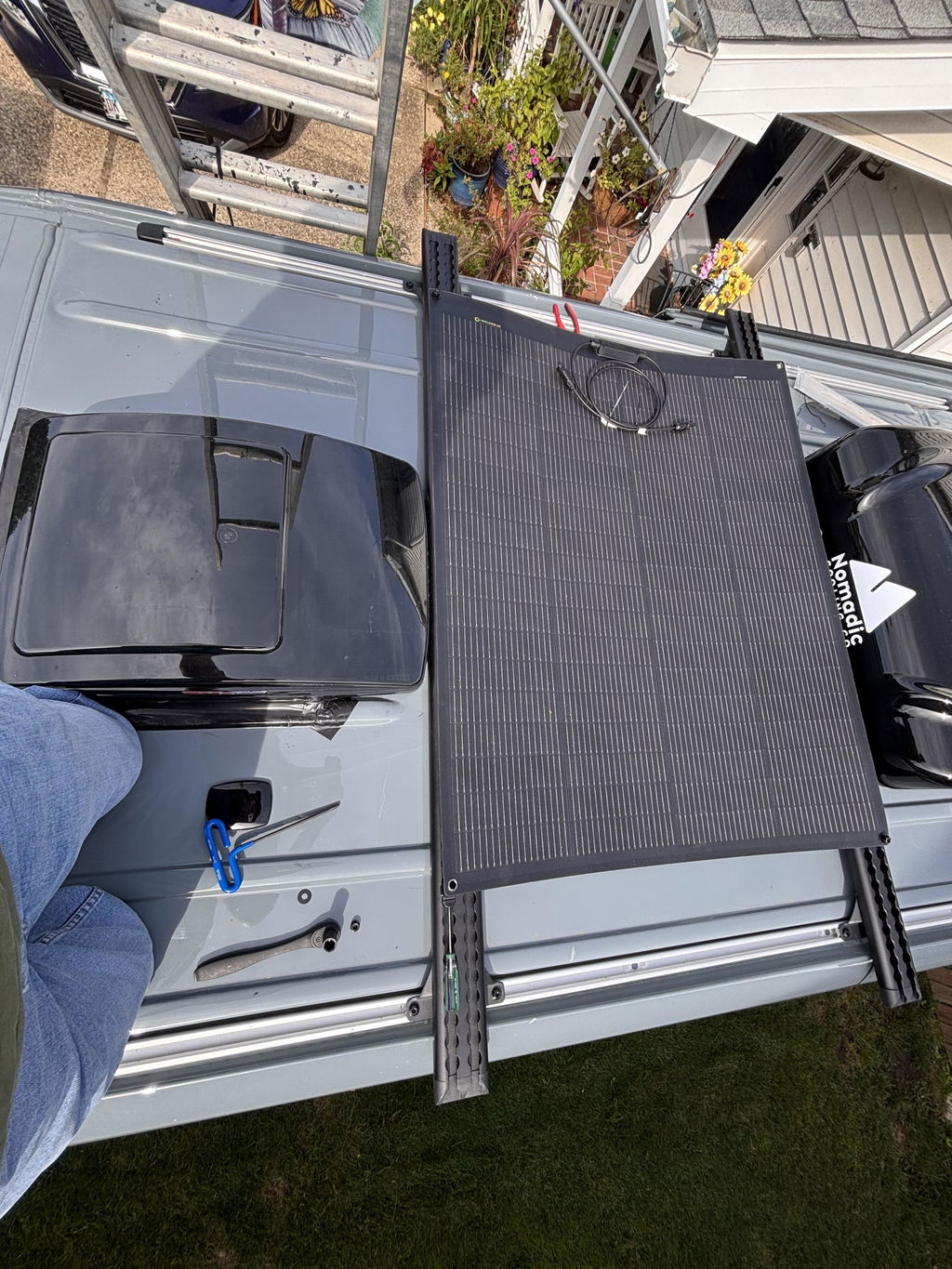
The MaxxFan's taller profile (~5.5" above the roof surface) can interfere with roof-mounted solar panels on low-profile crossbar setups. If your solar panels are mounted on rails with 2-3" of standoff, the MaxxFan shroud will sit above the panel plane, and you'll need to plan a gap in your solar array around the fan. The Fantastic Fan's lower profile (especially with the flat lid) fits under most rail-mounted panel setups more easily.
For builds where roof real estate is at a premium and solar coverage is the priority, there are also low-profile alternatives like the Le Mans rooftop ventilator (64mm/2.5" profile, 52 dB noise) that trade raw CFM for a smaller footprint. These work better as a secondary vent or sleeping vent than as a primary cooking exhaust.
8. The power budget
Ventilation fans run more hours per day than almost any other electrical system in a conversion. A fan that runs all night, every night, plus during cooking and whenever the van feels stuffy, might log 12-18 hours per day. The power draw matters.
Real-world consumption
On a MaxxFan Deluxe 7500K, power draw scales with speed. At speeds 1-3 (the typical overnight setting), the fan draws 1-2 amps at 12V, or 12-24 watts. Over an 8-hour night, that's roughly 8-16 amp-hours from your battery bank.
| Usage scenario | Typical speed | Draw | Duration | Total consumption |
|---|---|---|---|---|
| Overnight sleeping ventilation | Speed 2-3 | ~1.5A | 8 hours | 12 Ah |
| Cooking exhaust | Speed 7-10 | ~3-5A | 1 hour | 3-5 Ah |
| Daytime background ventilation | Speed 2-4 | ~1.5-2A | 6 hours | 9-12 Ah |
| Total daily | ~15 hours | 24-29 Ah |
On a typical 200Ah lithium battery bank (usable capacity ~190 Ah), the fan consumes roughly 13-15% of your daily battery budget. That's significant but manageable, and it's one of the reasons 200Ah is considered the minimum practical battery size for a lived-in conversion.
Running a second fan doubles the consumption. If you can achieve the same ventilation effectiveness with one fan and a passive intake (cracked window, floor vent), you save 24-29 Ah/day, which is roughly the output of a 100W solar panel on a decent sun day.
9. Designing the complete system
Stop thinking about ventilation as "which fan do I buy" and start thinking about it as a system with four components.
Exhaust: roof fan in exhaust mode
This is your primary moisture and heat removal. Place it over or near the galley for cooking exhaust. Run it in exhaust mode for all moisture-management tasks. A MaxxFan Deluxe is the standard recommendation because it operates in rain.
Intake: dedicated low opening
Without a planned intake, your fan fights against the sealed van. Options from simplest to most engineered: window rain guards with cracked cab windows; a screened floor vent (faroutride.com has detailed plans); a rear door vent; or a second fan at the opposite end from your primary exhaust. The intake should be as low and as far from the exhaust as possible.
Heat source: dry heat
A diesel-fired heater (Webasto, Espar) warms air without adding moisture. Warm air + ventilation = a drying machine. The heater raises the interior temperature, lowering relative humidity; the fan exchanges the now-drier-feeling but moisture-laden air with fresh outside air. If you're using propane heat, you're working against yourself: the heater adds moisture faster than it lowers relative humidity.
Insulation: keep surfaces above dew point
Insulation prevents the coldest surfaces from reaching the dew point temperature. This doesn't stop moisture production, but it prevents visible condensation on walls and ceiling. Combined with ventilation removing moisture from the air, insulated surfaces stay dry.
The system in action
On a cold, rainy night with two people sleeping:
- Diesel heater runs at low output, warming interior air to ~60-65°F
- Roof fan runs at speed 2-3 in exhaust mode, pulling warm humid air out through the roof
- Fresh air enters through a cracked cab window or floor vent, replacing exhausted air
- Insulation keeps wall surfaces above 48°F (the dew point at 60°F and 50% RH)
- Moisture from breathing exits the van through the exhaust fan before it can condense
That's 12-24 watts for the fan and whatever your diesel heater consumes (typically 10-30W electrical for the controller/glow plug cycling plus diesel fuel). The combined system keeps the van dry, warm, and ventilated through the night.
10. Mistakes that fill forums with mold photos
Mistake 1: No planned intake
The most common ventilation failure. Fan installed, running on exhaust, van sealed up tight. The fan strains against negative pressure, moves a fraction of its rated airflow, and the van stays humid. Solution: plan your intake at the same time you plan your exhaust. A $20 window rain guard set from an auto parts store can be the difference between a working system and a fan spinning uselessly.
Mistake 2: Running the fan in intake mode during cold weather
Positive pressure in cold weather pushes warm, humid interior air into wall cavities through every gap in your paneling. That air hits cold sheet metal inside the walls and condenses where you can't see it. Months later, you pull a panel off and find mold. Run exhaust mode for moisture management. Save intake mode for hot-weather cooling.
Mistake 3: Closing the fan during rain
Rain is when you need ventilation most: the van is sealed, humidity is high, temperatures are dropping. If your fan model closes automatically in rain (Fantastic Fan rain sensor), you lose ventilation at the worst possible time. This is the strongest argument for a covered fan like the MaxxFan that can operate continuously regardless of weather.
Mistake 4: Propane cooking without exhaust running
A 10,000 BTU propane burner produces ~370 mL of water per hour of operation, plus CO2 and potential CO. Cooking a meal without the exhaust fan running dumps all of that directly into your living space. The moisture alone can spike relative humidity above 80% in minutes. Run the fan on medium-high or high during all propane cooking, and keep running it for 10-15 minutes after you finish.
Mistake 5: Relying on moisture absorbers
Cat litter, DampRid, silica gel packets. Forums recommend these constantly. The math doesn't work. The best moisture absorbers hold 10-40% of their weight in water. A 1 kg container absorbs 400 mL maximum. Your van produces 1-3 liters of moisture per day. You'd need to replace or regenerate multiple kilograms of absorber material daily. Mechanical ventilation (a fan) is the only practical solution at this scale.
Mistake 6: Insulating without a vapor barrier, then sealing the van
If warm moist air can reach the cold outer sheet metal through your insulation, condensation forms inside the wall assembly. Ventilation helps by reducing overall humidity, but it can't dry out water that's already trapped behind panels. Vapor barriers on the warm side of insulation, combined with ventilation, are the correct approach. (See our insulation and condensation guide for detailed vapor barrier engineering.)
11. Ventilation and roof real estate
Every roof fan competes with solar panels for the same limited roof space. A standard 14" x 14" fan with its adapter plate consumes roughly 16" x 16" of roof area, plus clearance for the shroud (another 2-3" on each side for the MaxxFan). That's about 1.5 square feet of roof gone, plus the exclusion zone around the shroud that prevents panel placement.
Integrating fans with a roof rack system
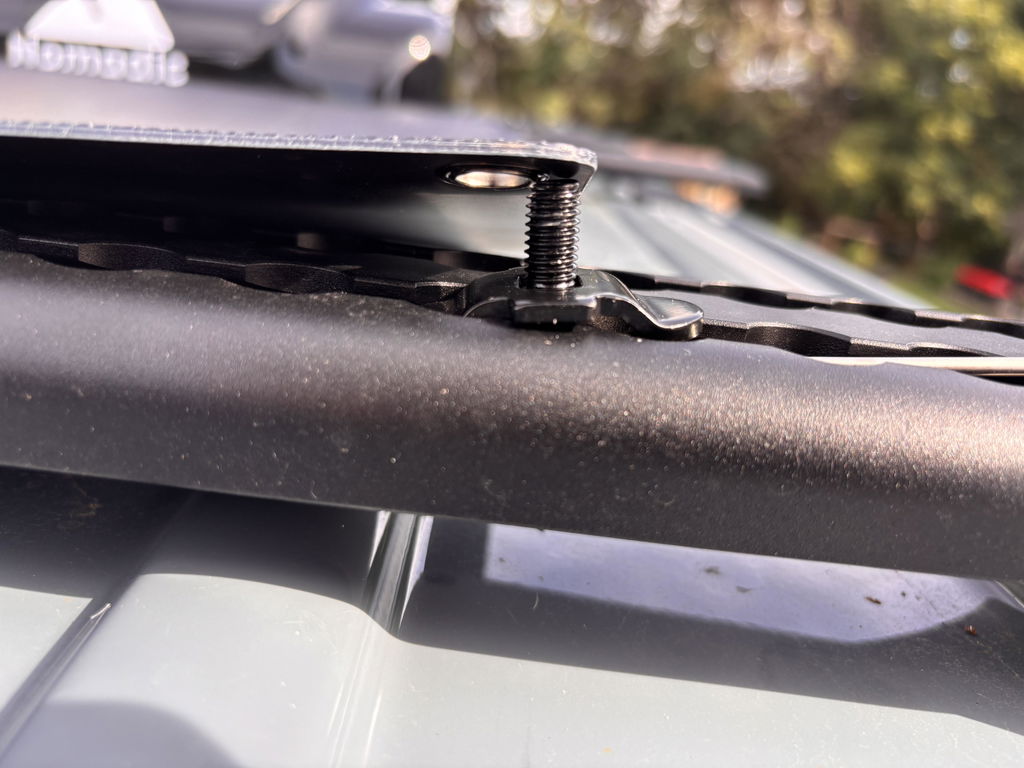
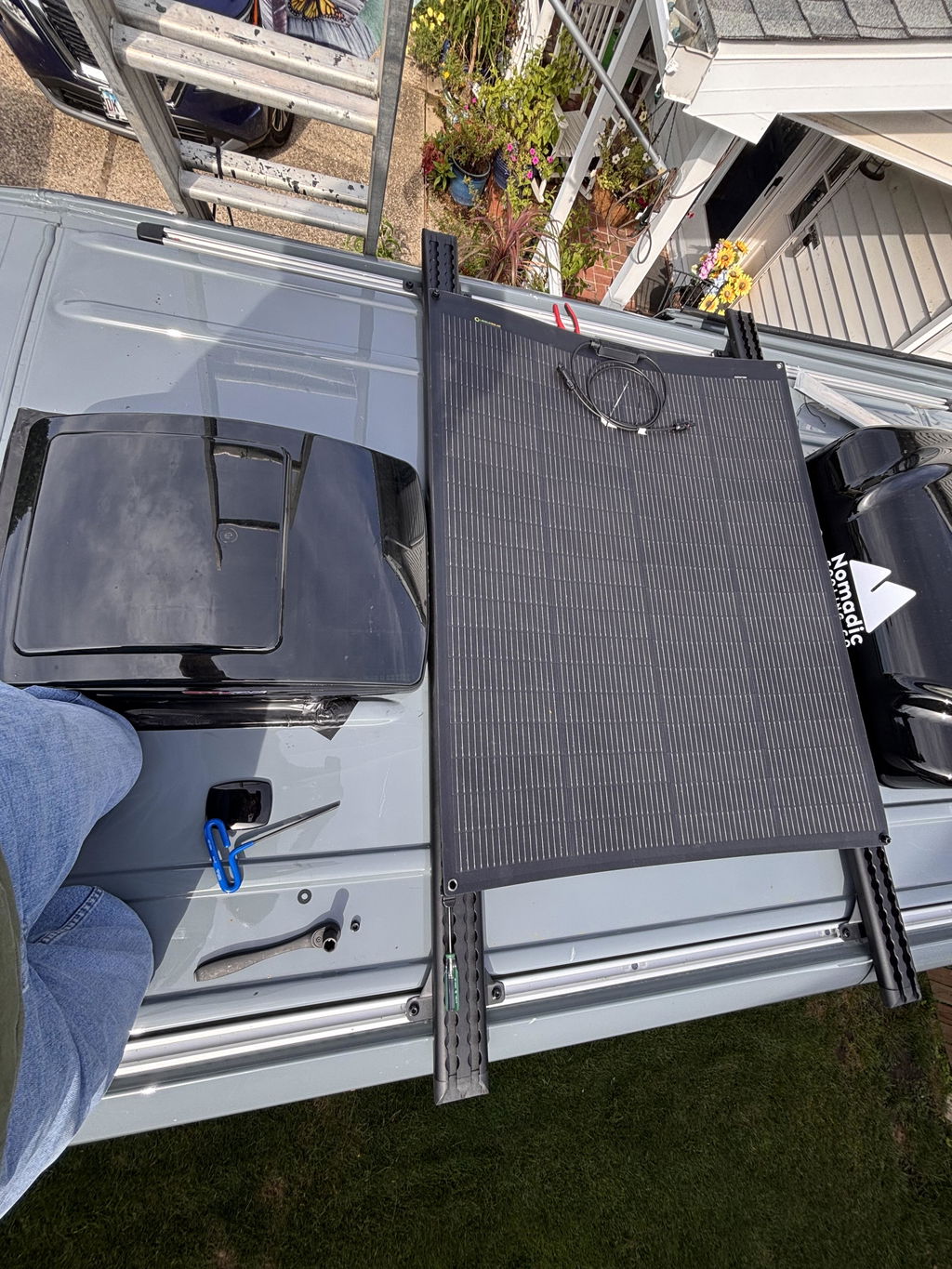
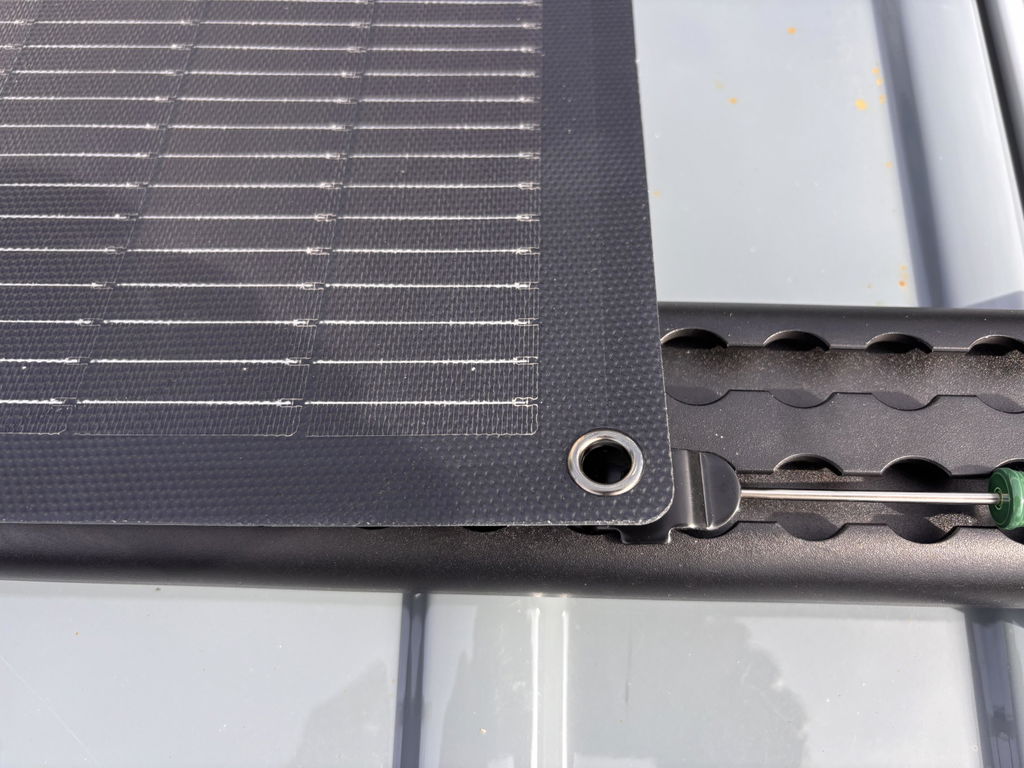
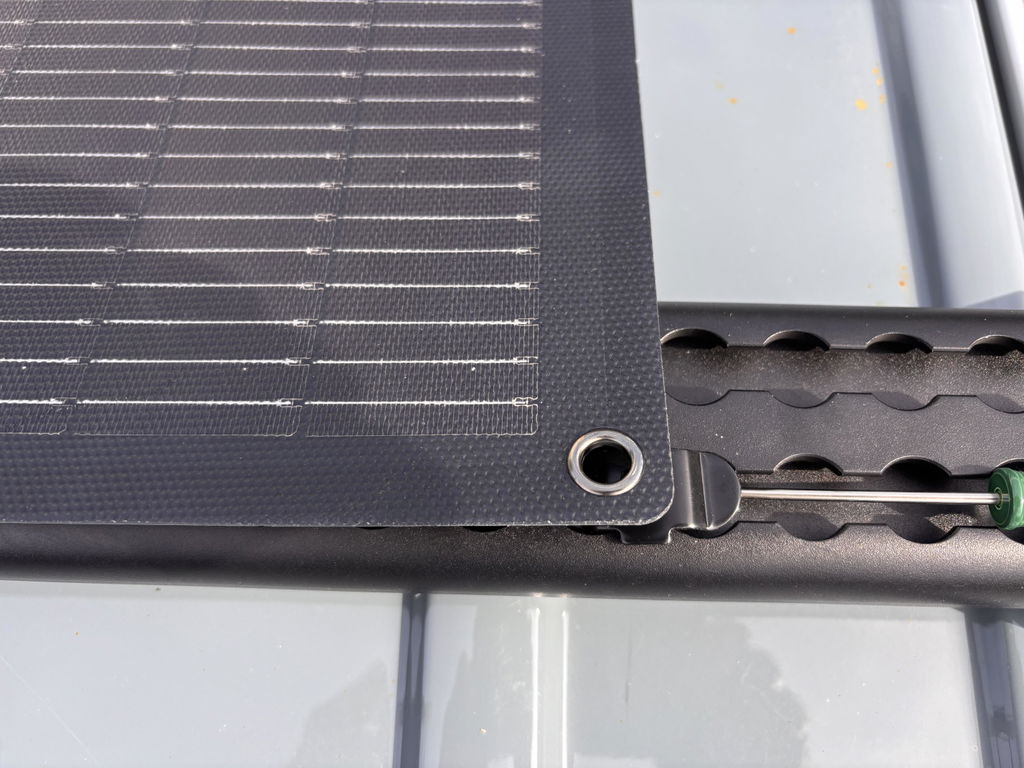
If your build includes full-length roof rails and crossbar-mounted solar panels, the fan position needs to be planned during the rail layout. The fan typically sits between two crossbars in a gap in the solar array. On a 144" WB, this means sacrificing one panel position (roughly 200W of solar capacity) for ventilation. On a 170" WB, the extra roof length makes the trade-off less painful.
For Sprinter builds requiring a purpose-built roof rail system, the DVA LoadSpan™ Roof Rails provide a direct-mount solution using factory pre-punched holes.
Low-profile fan alternatives (Le Mans, MaxxFan Dome) can sometimes fit under elevated solar panels if your crossbar height provides enough clearance. Standard 14" x 14" fans with covers cannot fit under panels in any typical rail-mount configuration.
Plan fan placement before finalizing your rail and solar layout. The fan hole is a permanent roof modification. Solar panel positions on rails can be adjusted later. Decide where ventilation lives first, then fit panels around it.
Key takeaways
- A converted Sprinter produces 1-3 liters of moisture per day. Breathing, cooking, propane combustion, and drying gear all pump water vapor into a space smaller than most bathrooms. Without active ventilation, that water condenses on cold surfaces.
- Exhaust mode is the correct default for moisture control. Pulling warm humid air out through the ceiling is more effective than pushing cold air in. Save intake mode for summer cooling.
- Your fan needs an intake to work. A roof fan without a planned low intake path fights against the sealed van's pressure. A cracked window, floor vent, or rear door vent completes the system.
- One roof fan with a proper low intake beats two roof fans. Dual roof fans short-circuit airflow across the ceiling. A single exhaust fan with a low intake creates full-column airflow through the entire living space.
- A fan that closes in rain fails when you need it most. Cold, wet conditions produce the worst condensation. The MaxxFan's integrated rain cover is the strongest argument in its favor over the Fantastic Fan.
- Ventilation is a system, not a product. Exhaust (roof fan) + intake (low opening) + dry heat (diesel heater) + insulation (surfaces above dew point) = a dry van. Remove any one component and the system degrades.
- Plan the fan hole before solar panels. The fan is a permanent roof modification. Panel positions on rails can be adjusted. Ventilation placement comes first.