The Short Answer
Most Sprinter van builds develop mold within two years because builders treat insulation as a thermal problem when it's actually a moisture management problem. Warm, humid interior air reaches cold metal surfaces and condenses — regardless of what insulation you chose. The fix isn't a better material. It's understanding dew point physics, installing a continuous vapor barrier on the warm side, eliminating thermal bridges at structural ribs, and ventilating enough to remove the 1–3 liters of moisture two occupants add every day. Get those four things right, and the material almost doesn't matter. Get any one wrong, and you'll find mold behind your wall panels within a year.
The Condensation Problem: Dew Point Physics on Metal
Every Sprinter van is a steel box. Steel conducts heat roughly 1,500 times faster than still air. When you park overnight in 40°F weather, the interior skin of that steel drops to within a few degrees of ambient within minutes. Meanwhile, you're inside — breathing, cooking, existing — pumping moisture into a sealed 480-cubic-foot space.
This is not an insulation problem. It's a phase-change problem.
Td = (b × α) / (a − α)
where α = (a × T) / (b + T) + ln(RH/100)
Constants: a = 17.27, b = 237.7°C
Practical result: At 70°F interior and 70% relative humidity, the dew point is 60°F. Any surface below 60°F will collect liquid water.
That 60°F dew point is the number that ruins builds. The interior skin of an uninsulated Sprinter in 40°F weather drops well below 60°F. Even an insulated van will have structural ribs, window frames, and door seams that sit below dew point. Water forms on those surfaces. It runs down behind your wall panels. It pools in the bottom channel of the body. And it stays there, invisible, feeding mold colonies for months before you smell them.
Boeing — the aircraft manufacturer — studied this exact problem in pressurized aluminum fuselages. Their conclusion applies directly to van conversions:
Read that again. Cannot be eliminated. Not "hard to eliminate" or "usually manageable." Boeing, with functionally unlimited engineering resources, says you cannot stop condensation from forming in an insulated metal shell. You can only manage where it forms and remove it before it causes damage.
That reframe — from prevention to management — is the foundation of every decision that follows.
Material Comparison: R-Values, Vapor Permeability, and the Mold Question
The internet turns insulation into a tribal war: closed-cell foam vs. Thinsulate vs. wool vs. spray foam. Each camp has its loyalists. Most of the arguments miss the point — the material matters less than the system. But materials do differ in measurable ways, and those differences matter in a van where you have 1.5–2 inches of wall cavity to work with.
R-Value Per Inch: The Thermal Performance Ranking
| Material | R-Value / Inch | Vapor Permeability | Moisture Absorption | Practical Notes |
|---|---|---|---|---|
| Closed-cell spray foam | ~6.5 | Very low (0.8–1.5 perms at 1″) | Negligible | Bonds to metal, acts as own vapor barrier |
| Polyisocyanurate (polyiso) | ~5.8 | Low with foil facer | +1 g in 15 hrs (tested) | Rigid board; foil face reflects radiant heat |
| XPS rigid foam | ~5.0 | Low (~1.0 perms at 1″) | Low | Easier to cut than polyiso; no foil facer |
| Sheep's wool insulation | ~3.5–3.8 | High (breathable) | +36 g in 15 hrs (tested) | Absorbs and releases moisture; slow drying |
| 3M Thinsulate SM600L | ~3.3 | High (breathable) | +11 g in 15 hrs (tested) | Marketed as hydrophobic — still condenses |
| Rockwool | ~3.3 | High (breathable) | Moderate | Fire-resistant; fiber irritant during install |
| Fiberglass batts | ~3.0 | Very high | High | Cheapest; worst performance in van applications |
The numbers reveal a clear split: closed-cell materials (spray foam, polyiso, XPS) deliver higher R-values per inch and resist moisture penetration. Fibrous materials (Thinsulate, wool, rockwool) deliver lower R-values and allow moisture to pass through to the cold metal surface behind them.
The BuildAGreenRV Test: What Actually Happens Behind the Wall
Gary at BuildAGreenRV ran one of the only controlled insulation tests in the van conversion space. The setup: 70°F interior, 70% relative humidity, 39–45°F exterior. Three materials tested side by side under identical conditions. The results should have ended the Thinsulate-vs-foam debate years ago.
Wool absorbers will point out that their material showed no visible condensation until 9.5 hours — longer than Thinsulate's 4 hours. That's true, but misleading. The wool absorbed 36 grams of water. It was holding that moisture inside itself, creating exactly the conditions mold needs. When drying was tested, polyiso dried fastest, Thinsulate second, wool last — because wool held the most water to begin with.
Thermal camera imaging showed all three materials provided similar surface temperatures on the interior side — meaning the thermal performance was comparable. The difference was entirely in moisture behavior. Polyiso kept the metal dry. Thinsulate and wool did not.
The Wool Defense (And Why It's Partially Valid)
Wool advocates make a coherent argument: wool's hygroscopic nature means it manages moisture rather than blocking it. It absorbs condensation, distributes it through its fibers, and releases it when conditions allow evaporation.
This argument works — in theory and in mild climates with good ventilation. Where it breaks down: multi-day cold snaps where evaporation can't keep up with absorption. Park your Sprinter in 30°F weather for a week with two people living inside, and wool's absorption capacity gets overwhelmed. The moisture has nowhere to go. And once wool gets truly saturated, it's extremely slow to dry.
Material choice isn't absolute — it's climate-dependent. Wool and Thinsulate can work in mild, dry climates (Southwest US, Mediterranean) where overnight temperature drops are moderate and daytime ventilation can dry things out. In the Pacific Northwest, upper Midwest, or anywhere with sustained cold and high humidity, closed-cell materials have a measurable advantage in preventing moisture accumulation.
Vapor Barriers: Where They Go and Why Placement Matters
A vapor barrier is a material with a water vapor permeance below 1.0 perms. Its job is simple: stop water vapor from reaching cold surfaces where it would condense. In a van, that means stopping warm, humid interior air from contacting the cold steel shell.
The placement rule is absolute: the vapor barrier goes on the warm side of the insulation. In a Sprinter, that's the interior face — between the insulation and your wall panels.
Interior (warm) → Vapor Barrier → Insulation → Metal Skin (cold)
The barrier prevents warm, humid air from reaching the cold metal. Put it on the wrong side and you trap moisture inside the wall cavity with no escape path.
Why Closed-Cell Foam Changes the Equation
Closed-cell spray foam and foil-faced polyiso act as their own vapor barriers. When closed-cell foam bonds directly to the metal skin, there's no air gap between insulation and metal — which means there's no space for condensation to form. This is the single biggest advantage of closed-cell materials in van applications.
When using fibrous insulation (Thinsulate, wool, rockwool), a separate vapor barrier is mandatory. Common options:
| Vapor Barrier Material | Permeance (perms) | Application Method | Practical Considerations |
|---|---|---|---|
| 6-mil polyethylene sheeting | 0.06 | Stapled/taped to furring strips | Cheapest; hardest to seal completely |
| Foil-faced polyiso (as barrier layer) | <0.05 (foil face) | Cut-to-fit panels, seams taped with foil tape | Adds R-value; rigid = easier to seal |
| Closed-cell spray foam (thin coat) | ~0.8–1.5 at 1″ | Sprayed directly onto metal | Eliminates air gap entirely; best seal |
| Aluminum foil tape (seam sealing) | <0.01 | Over joints and seams | Not a standalone barrier; for gap sealing only |
A vapor barrier with unsealed seams isn't a vapor barrier — it's a funnel. Water vapor follows pressure differentials and will find every gap, staple hole, and untaped joint. If you're using sheet barriers, overlap seams by 6 inches minimum and seal every edge with tape rated for the application. One missed seam can channel moisture to a single point, concentrating damage rather than distributing it.
The "Breathable Wall" Philosophy (And Its Limits)
Some builders intentionally skip vapor barriers, using breathable insulation (wool or Thinsulate) with breathable wall panels, arguing that the entire assembly should be able to dry in both directions. This approach works only if:
- Ventilation is continuous and sufficient to carry away all absorbed moisture
- Temperature drops are moderate (the insulation never saturates faster than it can dry)
- The metal surface behind the insulation can also dry — meaning no impermeable coatings or materials blocking the cold side
In practice, condition #2 fails in cold climates, and condition #3 is difficult to guarantee in a production vehicle with factory coatings and sealants. The breathable approach is valid in specific climates but risky as a universal strategy.
The Thermal Bridge Problem: Ribs, Structural Members, and Uninsulated Paths
A perfectly insulated wall panel means nothing if the structural rib next to it conducts heat straight from interior to exterior. Thermal bridges are the uninsulated metal paths that bypass your insulation entirely — and in a Sprinter, they're everywhere.
Common Thermal Bridges in a Sprinter
Each thermal bridge creates a cold spot on the interior surface. At that cold spot, the surface temperature drops below the dew point. Water condenses. You get a drip line that follows every rib, every roof bow, every window frame. Builders who insulate only the flat panels between ribs often wake up to water streaks running down the wall at each rib location — perfectly spaced, undeniable evidence of thermal bridging.
Breaking Thermal Bridges
The goal is to prevent interior air from contacting any metal surface that could be below the dew point. Two proven methods:
✓ Continuous Interior Insulation Layer
- Thin (½–¾″) polyiso or XPS board over the entire interior surface — ribs included
- Foil-faced polyiso provides radiant barrier bonus
- Seams taped with foil tape to maintain vapor barrier continuity
- Reduces usable interior space by ~1.5″ total (¾″ each side)
- Wall panels mount to furring strips over this continuous layer
✗ Insulating Only Between Ribs
- Leaves every rib fully exposed as a thermal bridge
- Condensation forms on ribs and runs down behind panels
- Even closed-cell foam between ribs doesn't solve the rib itself
- "I insulated everything" — but the ribs still sweat
- Most common approach and most common source of mold reports
The continuous layer approach is worth the lost space. A ¾-inch polyiso board over the ribs adds R-4.4 at the thermal bridges and prevents interior air from ever contacting the metal. Combined with cavity insulation between ribs, total wall R-value reaches R-9 to R-11 — significantly more than the Sprinter's factory insulation option.
The Spray Foam Advantage at Thermal Bridges
Professional spray foam has one advantage no cut-and-fit material can match: it covers ribs, cavities, and irregular surfaces in a single application. A 2-inch closed-cell spray foam application across the entire interior — ribs included — creates a continuous insulation layer and vapor barrier simultaneously. No seams, no gaps, no thermal bridges.
The downsides are real: cost ($1,500–3,000 professional application), permanence (it doesn't come off without grinding), and the requirement for professional application — DIY spray foam kits rarely achieve the consistent density needed for reliable vapor barrier performance.
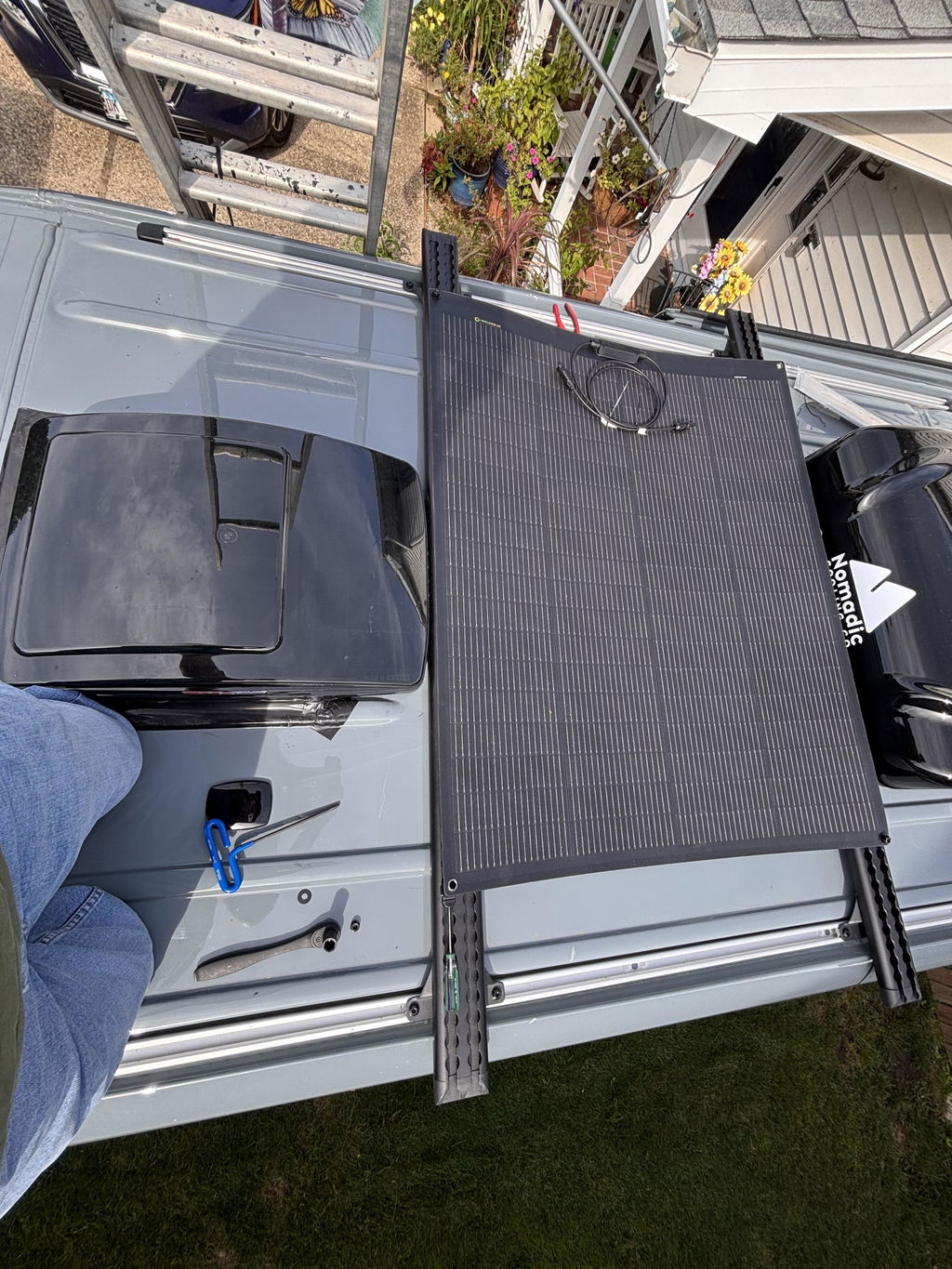
Roof planning note: If your build will include exterior crossbars or a roof rail system, plan the attachment points before your ceiling insulation goes in. DVA's DualTrack-T dual-channel cross bar kit uses the Sprinter's factory D13 prep holes, avoiding new penetrations through your insulated roof panels and keeping the ceiling vapor barrier intact.
Ventilation: Why Insulation Alone Is Never Enough
Even perfect insulation with perfect vapor barriers will fail without ventilation. The reason is arithmetic: two people add 1–3 liters of water to the air every day. Cooking with propane adds another 450 mL per hour of burner time. A 480-cubic-foot Sprinter only needs about 185 grams of water vapor to jump from 40% to 70% relative humidity. You can blow past that threshold in an hour of cooking dinner.
Breathing: ~800 mL/day (two people)
Cooking (propane, 1 hr/day): ~450 mL
Drying clothes/towels: ~200–500 mL
Showering (if equipped): ~300–600 mL
Total: 1,750–2,350 mL/day — every drop must leave the van or condense somewhere
That moisture has exactly two exit paths: ventilation (carried out as water vapor in moving air) or condensation (deposited as liquid water on cold surfaces). There's no third option. If ventilation doesn't remove it, physics will deposit it on the coldest surface available.
The Ventilation + Heat Equation
FarOutRide's engineering analysis identifies the core mechanism: warm air holds more moisture than cold air. When you heat interior air and then vent it outside, each cubic foot of expelled air carries away more water vapor than cold air would. The combination of heating and ventilating is functionally a drying machine.
Run your heater to raise interior temperature (warm air absorbs moisture from surfaces and insulation). Then crack a vent or run a fan to exchange that moisture-laden warm air with dry outside air. Repeat. This cycle is the single most effective moisture management tool in a van — more effective than any insulation choice. A 10-minute fan run after cooking can remove more moisture than an hour of passive ventilation.
Ventilation Methods
| Method | Airflow (CFM) | Power Draw | Effectiveness |
|---|---|---|---|
| Powered roof vent fan (aftermarket) | 100–900 | 1–5A at 12V | Best — active exhaust + rain cover |
| Cracked windows (cross-ventilation) | Variable (wind-dependent) | None | Good in mild weather; poor in rain/cold |
| Passive roof vent (no fan) | ~10–30 (convection only) | None | Marginal — insufficient for cooking/sleeping |
| Diesel heater intake/exhaust | Varies by model | Included in heater draw | Supplemental — not designed for moisture removal |
A powered roof vent is non-negotiable for any van used as a living space. Running it on low (1–2A draw) overnight in cold weather is the single most effective anti-condensation measure available. It costs about the same energy as an LED light strip and removes more moisture than any insulation strategy.
When routing roof fan wiring and mounting the fan base itself, DVA's LoadSpan-T™ Dual-Channel Roof Rails route hardware through the factory rail channels — eliminating new metal penetrations that would otherwise become both moisture entry points and additional thermal bridges in the roof system.
Installation Sequence: The Correct Order of Operations
Order matters more than most builders realize. Each layer depends on the one below it, and retrofitting a missed step means tearing out finished work. Here's the engineering-correct sequence for a Sprinter insulation build:
Surface Preparation
Clean all metal surfaces with isopropyl alcohol or degreaser. Remove factory wax coating, road grime, and any surface contaminants. Adhesives and spray foam bond to clean metal — they fail on oily surfaces. Treat any existing rust with a rust converter before covering it permanently. This is your last chance to see bare metal.
Wiring and Plumbing Rough-In
Run all wiring and plumbing before insulation. Anything that needs to pass through wall or ceiling cavities gets installed now. Use split loom or conduit to protect wires — you won't be able to access them after insulation goes in. Label every wire at both ends. Document the routing with photos. Future-you will be grateful.
Cavity Insulation (Between Ribs)
Fill the cavities between structural ribs with your chosen insulation. For closed-cell materials: cut polyiso or XPS panels to friction-fit each cavity, then seal edges with spray foam from a can. For spray foam: have the entire interior sprayed professionally. For fibrous materials: press Thinsulate or wool into cavities, filling completely without compressing (compression reduces R-value).
Thermal Bridge Treatment
Apply a continuous layer of thin insulation (½–¾″ polyiso or XPS) over the ribs and structural members. This layer breaks every thermal bridge. Seal all seams with foil tape (for polyiso) or housewrap tape (for XPS). If using spray foam, this step was handled in Step 3 — spray foam covers ribs and cavities in one pass.
Vapor Barrier Installation
If using fibrous insulation: install a continuous vapor barrier over the entire insulated surface. Overlap seams by 6 inches. Seal all edges and penetrations with appropriate tape. If using foil-faced polyiso as the thermal bridge layer (Step 4), it serves as the vapor barrier — tape every seam with foil tape. If using closed-cell spray foam at 1.5″+ thickness, it acts as its own vapor barrier — skip this step.
Furring Strips / Mounting Framework
Install furring strips or a mounting framework for wall and ceiling panels. These create an air gap between the vapor barrier and the finished panels — which helps with drying if any moisture gets in. Furring strips also provide mounting points for panels, L-track, and accessories without penetrating the vapor barrier with random screws.
DVA's DVA L-Track collection offers aviation-grade cargo management hardware designed specifically for van builds. For securing insulation batts and panel sub-frames, DVA L-Track Tie-Down Rings slot directly into the track profile without any drilling through your finished vapor barrier.
Floor Insulation
Insulate the floor ribs with XPS or polyiso cut to fit. The floor doesn't need as much R-value as walls and ceiling (ground temperature is more moderate than air temperature), but leaving floor ribs empty creates condensation channels. A ¾″ layer of rigid foam under plywood subfloor is sufficient for most climates. Seal the plywood edges with polyurethane to prevent moisture wicking.
Wall and Ceiling Panels
Install finished panels. Leave a small gap (⅛–¼″) at the bottom of wall panels for drainage — if any moisture does get behind the wall, it needs a path out rather than pooling behind panels. This gap is invisible once the floor trim is installed but can save you from hidden mold.
Many builders install flooring first and then wall panels on top. This traps the floor edge behind the wall, preventing drainage. If you install wall panels first with that ⅛″ gap at the bottom, then lay flooring up to the wall base, any condensation that runs down behind the wall can escape at the floor line and evaporate. Floor trim covers the gap aesthetically.
Common Mistakes: What the Forums Teach Us
The van conversion community has collectively made every possible insulation mistake. The patterns are clear and predictable — and almost all of them stem from the same root cause: treating insulation as a thermal problem instead of a moisture management system.
Mistake #1: Thinsulate Everywhere, Vapor Barrier Nowhere
The most common build approach — and the most common source of mold reports. Thinsulate is easy to install, looks clean, and is marketed as hydrophobic. Builders stuff it into every cavity, slap wall panels over it, and declare victory. Six months later:
Thinsulate is not hydrophobic in the way builders assume. It resists liquid water (you can pour water on it and it beads off), but it does not resist water vapor. Warm, humid air passes through Thinsulate freely, reaches the cold metal behind it, and condenses. The BuildAGreenRV test showed visible condensation on the metal behind Thinsulate at just 4 hours. The material itself stays dry-ish — but the metal behind it is soaking wet.
Mistake #2: Insulating Between Ribs Only
Even builders who choose closed-cell foam often make this mistake. They carefully cut polyiso panels to fit between every rib, seal the edges with canned spray foam, and leave the ribs themselves exposed. The ribs — which are solid steel from interior to exterior — become condensation highways. Water forms on each rib surface, runs down, and pools at the bottom.
Mistake #3: Relying on a Single Material Solution
No single material solves the insulation, vapor barrier, thermal bridge, and ventilation requirements simultaneously. Closed-cell spray foam comes closest (it insulates, acts as a vapor barrier, and covers thermal bridges), but even spray foam can't remove the 1–3 liters of daily moisture. Every material needs a ventilation strategy to work alongside it.
Mistake #4: Sealing the Van Too Tight Without Ventilation
Builders who do excellent insulation and vapor barrier work sometimes create a new problem: a van so well-sealed that interior humidity skyrockets. All that human moisture with no exit path. They wake up to wet windows, wet ceiling panels, and water dripping from every surface — not because the insulation failed, but because there's no path for moisture to leave.
Mistake #5: Ignoring the Floor
Floor ribs in a VS30 Sprinter are roughly 1 inch deep. Many builders lay plywood directly over the ribs and call it a floor. Those uninsulated rib channels collect condensation that runs down the walls, creating long troughs of standing water under the subfloor. The plywood wicks it up from below. Mold follows. Insulating floor ribs with rigid foam — even ½-inch XPS — breaks this condensation path.
Mistake #6: Propane Without Ventilation
A 10,000 BTU propane burner produces 450 mL of water vapor per hour. Cooking dinner for 30 minutes adds a cup of water to your van's air. Most builders know propane produces CO (hence the CO detectors), but fewer realize it produces water in larger quantities. Running a propane stove or heater without cracking a vent is like running a humidifier.
Climate-Specific Strategies: One System Doesn't Fit All
The right insulation system depends on where you'll spend most of your time. A full-timer in Arizona has different physics than a weekend warrior in the Pacific Northwest.
Hot/Dry Climates (Southwest, Desert)
- Primary concern: radiant heat, not condensation
- Foil-faced polyiso excels — reflects radiant heat
- Wool or Thinsulate viable — low humidity = low condensation risk
- Vapor barrier less critical (small temperature differential overnight)
- Ventilation through cracked windows often sufficient
- Floor insulation less important; ceiling insulation most important
Cold/Humid Climates (PNW, Northeast, Mountains)
- Primary concern: condensation on cold metal surfaces
- Closed-cell materials strongly preferred
- Continuous vapor barrier mandatory
- Thermal bridge treatment at every rib and roof bow
- Powered ventilation required — passive won't cut it
- Floor insulation critical — ground temps can drop below dew point
Full-timers who move between climates should build for the worst case. A van insulated for the Pacific Northwest will perform well in Arizona, but a van insulated for Arizona will grow mold in Oregon.
The Engineering Approach: Putting It All Together
Strip away the forum debates and material tribalism, and the engineering approach to Sprinter insulation reduces to four principles applied in order:
| Priority | Principle | Implementation | Failure Mode If Skipped |
|---|---|---|---|
| 1 | Vapor control | Continuous vapor barrier on warm side, or closed-cell foam bonded to metal | Condensation behind insulation → mold + rust |
| 2 | Thermal bridge elimination | Continuous insulation layer covering all structural members | Cold spots at ribs → drip lines → localized mold |
| 3 | Moisture removal | Powered ventilation + heat-ventilate cycling | Interior humidity exceeds material capacity → system-wide failure |
| 4 | Thermal resistance | R-9 to R-11 walls, R-12+ ceiling, R-5+ floor | Comfort issues but not structural damage |
Notice the order. Thermal resistance — the thing most builders optimize first — is actually the last priority. A van with R-7 walls and perfect vapor control will outperform a van with R-13 walls and no vapor management. The R-13 van will grow mold. The R-7 van won't.
Walls: 1.5″ closed-cell spray foam in cavities (R-9.75) + ¾″ foil-faced polyiso over ribs (R-4.4). Total: R-14.
Ceiling: 2″ closed-cell spray foam between roof bows (R-13) + ¾″ polyiso continuous layer (R-4.4). Total: R-17.4.
Floor: ¾″ XPS in rib channels (R-3.75) + ½″ polyiso under subfloor (R-2.9). Total: R-6.65.
Ventilation: Powered roof vent on low overnight, active exhaust during cooking.
This system provides vapor control, thermal bridge elimination, and sufficient R-value for sustained cold weather occupation.
Key Takeaways
- It's a moisture problem, not a thermal problem. Every material choice and installation decision should optimize for condensation management first, thermal resistance second.
- Dew point is the number that matters. At 70°F and 70% RH, any surface below 60°F will collect water. That includes every untreated thermal bridge in your Sprinter.
- Closed-cell beats fibrous in cold climates. Polyiso, XPS, and closed-cell spray foam resist moisture penetration. Thinsulate and wool allow vapor through to the cold metal. The BuildAGreenRV test proved this with controlled data.
- The vapor barrier goes on the warm side. Between your insulation and your interior panels. If using closed-cell foam bonded to metal, the foam is the barrier. If using fibrous materials, add a separate continuous barrier and seal every seam.
- Thermal bridges defeat insulation. Insulating between ribs while leaving the ribs exposed creates condensation highways. Cover the ribs with a continuous insulation layer.
- Ventilation is mandatory. Two occupants produce 1–3 liters of moisture daily. A powered roof vent on low overnight removes more moisture than any insulation strategy. Run it.
- Build for your worst climate. A van built for PNW winters works everywhere. A van built for Arizona summers fails in any cold, humid environment.
- Boeing couldn't prevent condensation. Neither can you. Design for management, not elimination. Control where moisture goes, and provide paths for it to leave.

DVA Mechanics — Engineered upgrades for the Mercedes-Benz Sprinter platform.
OEM-grade, bolt-on components designed for builders who measure twice. Browse the full Sprinter catalog at dvamechanics.com.
Ready to Upgrade Your Sprinter?
DVA Mechanics engineers purpose-built Sprinter accessories — designed, tested, and backed by real-world data.
Browse All DVA Products →