A rooftop tent on a Sprinter van is one of the most practical overlanding setups available — instant shelter at elevation, no campsite required, and all your gear stays locked in the van below. But the Sprinter's roof load limit requires careful planning: the 330 lb dynamic figure Mercedes publishes governs everything on your roof while the van is moving — rail hardware, crossbars, the tent shell, and any gear stored inside the closed tent during transit. Occupants sleeping in the tent only count against a separate, higher. Get the dynamic budget wrong and you're overloaded on the highway; understand it correctly and the math works cleanly for two-person builds.
This guide covers the full picture: what the 330 lb limit actually means, how tent weights compare across the most common RTT types, what mounting hardware your Sprinter needs first, and how builders deal with the unique access challenge of a high-roof van that puts your sleeping platform over 9 feet off the ground.
The 330 lb Limit: What Mercedes Actually Specifies
Mercedes-Benz publishes a static roof load of 661 lb (300 kg) for the Sprinter across all roof heights — standard and high. But the dynamic limit — the figure that governs what you can carry while the van is in motion — is 330 lb (150 kg) for the high roof, identical to the standard roof. That surprises builders who assume the larger high-roof structure means more capacity. It doesn't. The 330 lb dynamic ceiling applies to every NCV3 and VS30 Sprinter regardless of height.
What the 330 lb includes is equally important. As one experienced Sprinter-Source member broke it down clearly after reading the specification directly:
330 lbs for the high roof [same 330 lb dynamic applies to the standard roof — the published spec makes no distinction between roof heights for the dynamic limit — Ed.]. You can find these figures in the technical specs section at the end of the manual. That is total weight, spread over 3 or more bars, and including the weight of the bars themselves and the tent.
— Sprinter-Source.com, Thread #65163
That breakdown is important: the bars themselves count against the dynamic budget. A 2-bar DualTrack-T™ cross bar kit weighs approximately 14 lbs. A pair of LoadSpan-T™ roof rails (170" wheelbase) adds around 11 lbs. Before the tent goes on, you've already used roughly 25 lbs of the 330 lb driving budget. That's fine — but it's why planning from the actual weight data matters more than working backward from a tent catalog.
Dynamic (330 lb) — while driving: covers all weight permanently on the roof: rails, crossbars, tent shell, and any gear stored inside the closed tent during transit. No occupants — nobody is in the tent while the van is moving.
. This is the figure that governs your actual sleeping setup. Two adults at camp is a static-load question, not a dynamic one.
RTT Weight by Type: Hard Shell vs. Soft Shell vs. Carbon Fiber
The tent weight figures published by RTT manufacturers are typically the closed tent weight — the shell you're carrying on the road. Bedding, pillows, and personal gear stored inside the tent adds to that number. For Sprinter planning purposes, assume the tent weight plus 10–20 lbs of stored gear as your in-motion RTT load.
| RTT Type | Typical Weight | Setup Time | Price Range | Sprinter Notes |
|---|---|---|---|---|
| Soft shell (canvas fold-out) | 85–120 lb | 3–5 min | $1,400–$2,200 | Lower cost, bulkier profile when closed, good budget pick |
| Hard shell (clamshell) | 75–110 lb | 30–60 sec | $2,200–$3,800 | Faster setup, lower aerodynamic drag, lighter options available |
| Hard shell (wedge/flip) | 90–130 lb | 60–90 sec | $2,800–$4,500 | More interior volume, popular with van builds |
| Carbon fiber shell (2026) | ~150 lb | 60 sec | $6,000–$7,500 | Fixed mattress, premium finish, heavier than standard hard shell |
The carbon fiber category gained momentum in 2026 with new options targeting van conversion builders. As one early adopter on Sprinter-Source noted when evaluating a new carbon fiber RTT at 150 lbs:
Interesting option at 150 lbs and a decent price (1/2 the $12K CloudCap price before install). Nice that it's a fixed mattress too vs. the ones that require inflatables.
— Sprinter-Source.com, Thread #144466 (2026)
At 150 lbs of tent alone, a carbon fiber RTT consumes nearly half the 330 lb dynamic budget before you add hardware and occupants — which is workable if you're a solo traveler but tight for two adults. For most two-person Sprinter builds, a hard shell in the 85–110 lb range leaves enough margin for two adults in sleeping gear without exceeding the dynamic limit.


Mounting Platform: What Your Sprinter Needs Before the Tent Goes On
Every RTT manufacturer specifies a minimum crossbar span and a dynamic load rating for the bars the tent will attach to. For Sprinter RTT builds, the mounting stack has three layers: factory roof tracks (or equivalent load-distributing rails), crossbars spanning side to side, and the RTT clamping to those crossbars.
Factory Roof Tracks or Load-Distributing Rails
VS30 Sprinters (2019–present) come with factory OEM T-slot rails embedded in the roof. NCV3 vans (2007–2018) often have factory tracks but fitment varies by trim level and market. If your van has factory OEM tracks, crossbars can mount directly to them. If it doesn't — or if you want full-length load distribution rather than point loading on OEM track ends — a pair of front-to-back rails like the LoadSpan-T™ or LoadSpan™ Gen 1 are the correct foundation. These bolt directly into factory hard points with no drilling and spread the RTT load across the full roof structure rather than concentrating it at two or three OEM track anchors.
Crossbars with T-Bolt Channel
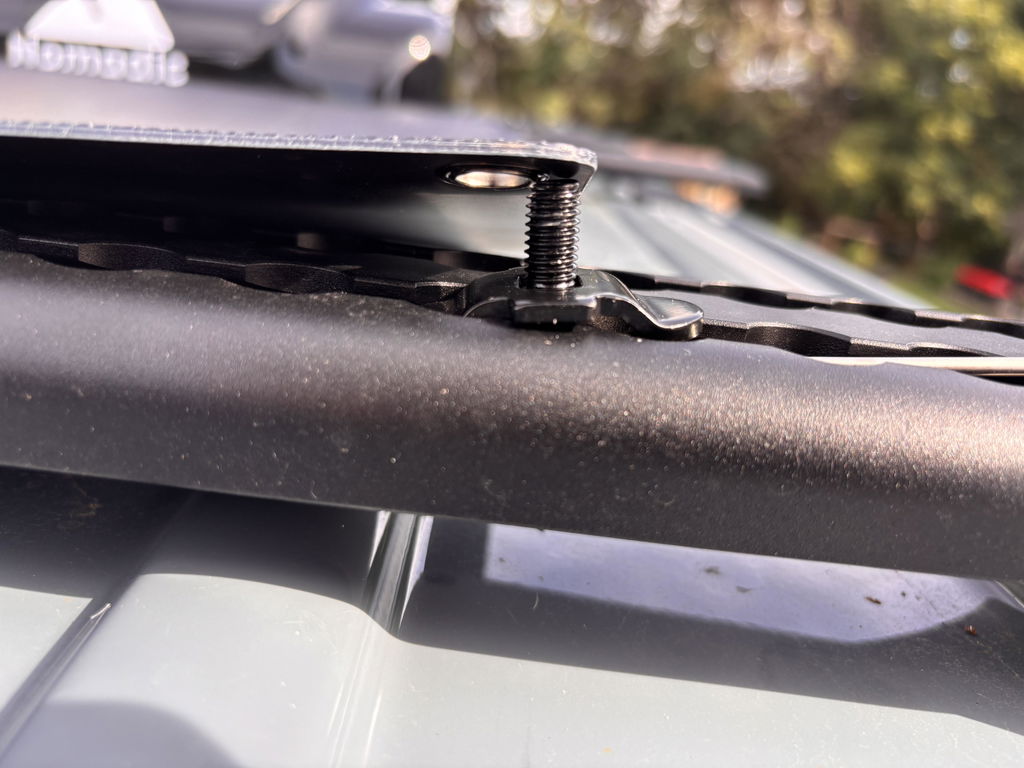
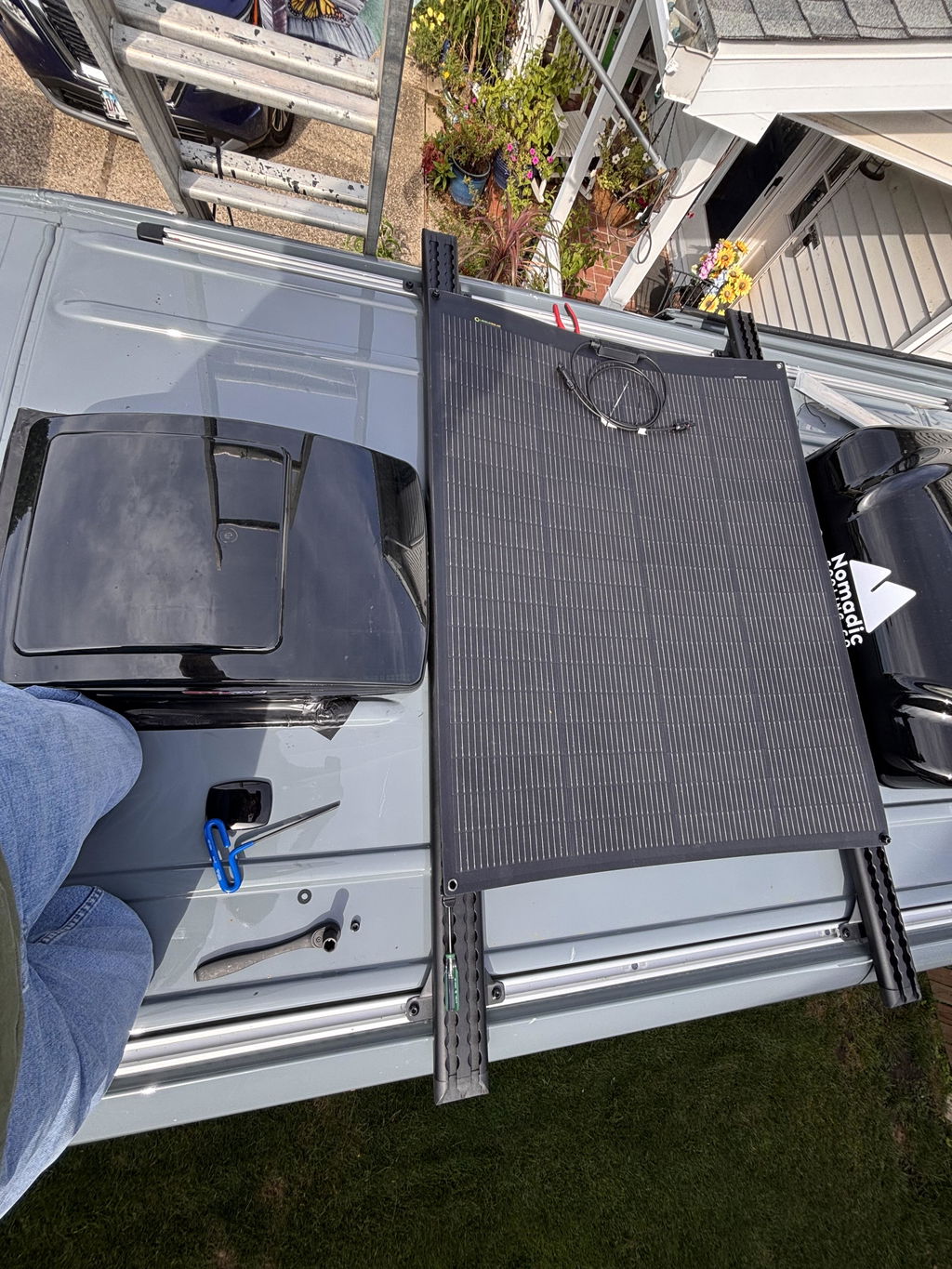
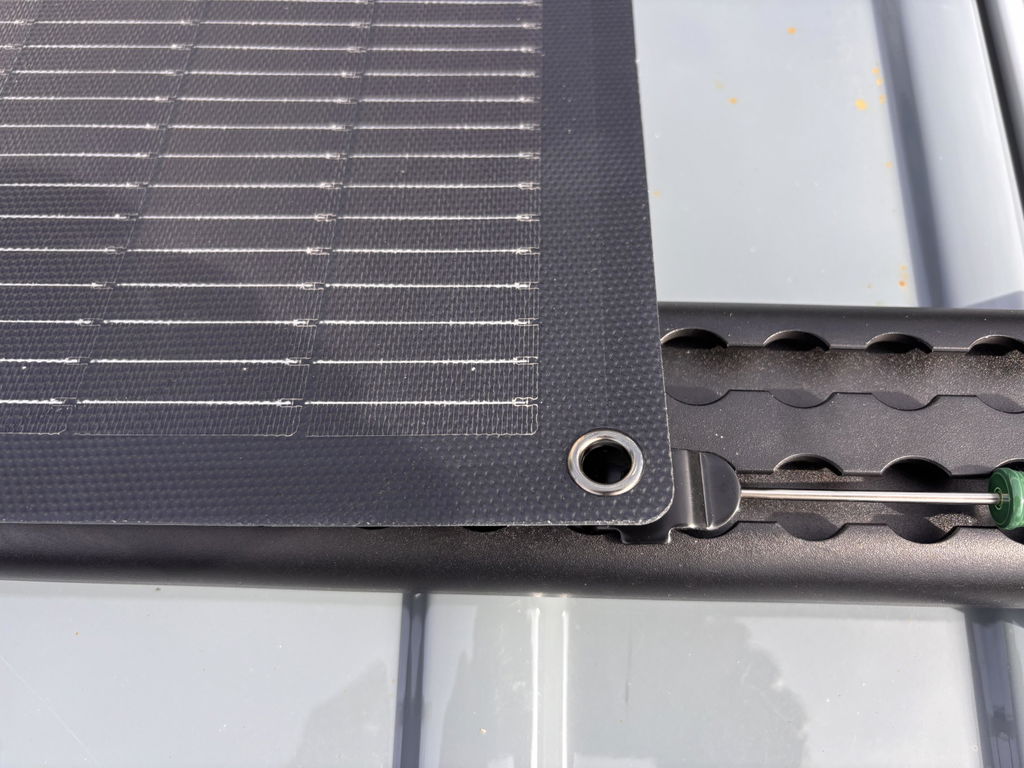
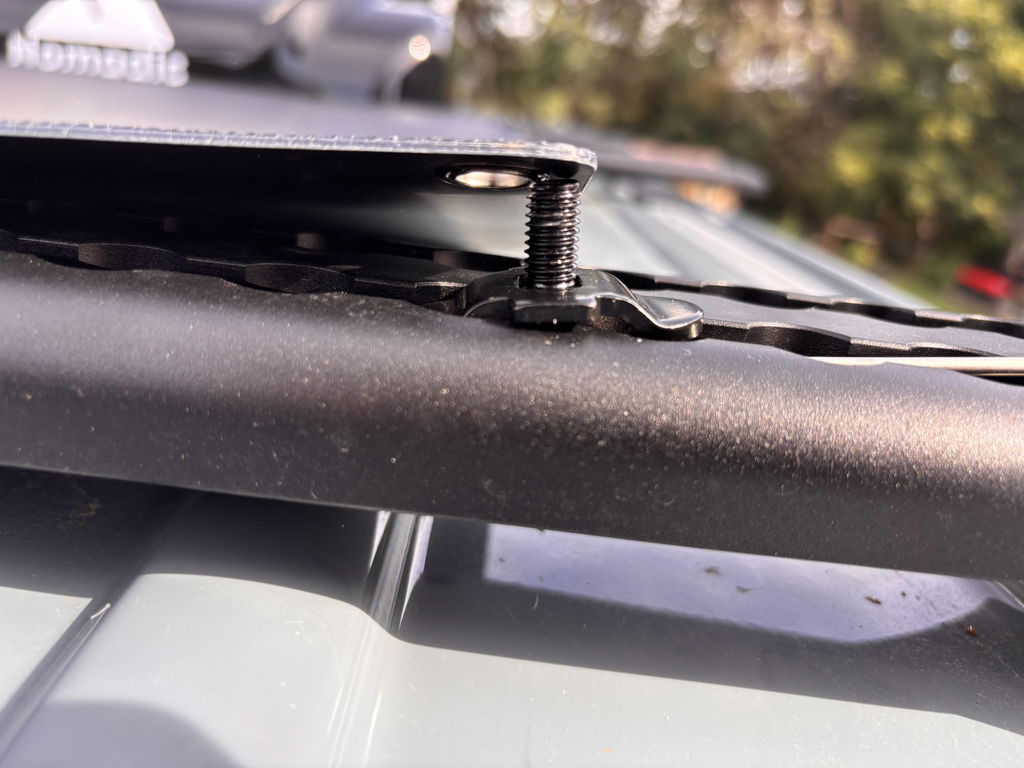
RTT T-bolt mounting hardware requires a crossbar with a compatible T-slot channel — typically 25mm width, the industry standard. The DualTrack-T™ cross bars provide that 25mm T-slot channel on one face (L-Track on the other), so RTT mounts slide in, position anywhere along the bar, and tighten in place without drilling the crossbar. The 61¾" length spans the full Sprinter roof width with proper overhang clearance on both sides.
For RTT use, the minimum is a 2-bar kit — but the Mercedes specification requires a minimum of 3 pairs of supports for the roof load to be counted toward the 330 lb rating. For most van RTT builds, 3 crossbars evenly spaced across the roof provides both the structural spread Mercedes requires and a rigid mounting platform the RTT manufacturer needs.
RTT T-Bolt Mount to Crossbar
The RTT manufacturer's mounting feet use standard T-bolts that drop into the crossbar's T-slot channel. Position the tent fore-aft along the bars to balance the weight toward the center of the roof, tighten the T-bolt hardware to spec, and the install is complete. No drilling into the van required at any stage.
Working the Weight Budget: A Real Build Example
Here's how the math looks for a common two-person overlanding build — LoadSpan-T rails, DualTrack-T crossbars (3-bar kit), a mid-weight hard shell RTT, and two adults in sleeping gear:
That 142 lb figure is your driving load. It leaves 188 lb of the 330 lb dynamic budget for other permanent roof accessories — solar panels typically weigh 15–45 lbs, an awning 15–25 lbs, a roof fan 5–8 lbs. A fully equipped build can carry the RTT, crossbars, rails, solar, awning, and fan comfortably within the dynamic ceiling.
This is the math most two-person RTT Sprinter builds are built on: the driving load (hardware + tent + gear) stays well inside 330 lb dynamic, and two adults sleeping at camp stay inside. Both conditions are satisfied simultaneously — as long as you're not adding 200 lbs of other permanent roof hardware on top of the tent.
One Sprinter-Source forum member with significant roof rack experience confirmed this dynamic-vs-static framework from their own build:
I could be wrong, but I feel the weight specs for the roof are a dynamic spec for when the vehicle is moving. I don't think it's a problem putting more weight up there when parked. I mounted my roof rack with five mounts on each roof rail. It's rock solid and I'm pretty sure the rack, myself, and the solar panels are probably 330 lbs or more and it handles that easily.
— Sprinter-Source.com, Thread #65163
That confirms the real-world framework: the 330 lb figure governs driving loads, not camping loads. Design your permanent roof hardware (rails, bars, tent, solar, awning) to stay under 330 lb combined while driving. Your two-person sleeping setup at camp is a.
The High Roof Reality: 9+ Feet Off the Ground
Standard-roof Sprinter RTT builds are challenging enough. High-roof Sprinters add a meaningful access problem: the sleeping platform sits at roughly 9.5 to 10.5 feet off the ground. The RTT's integrated ladder — typically 8–9 feet when deployed — barely reaches, and ascending a near-vertical ladder with bare feet at 2 AM in the dark gets uncomfortable quickly.
Builders who've done it consistently recommend two things. First, choose an RTT with a longer or adjustable ladder rather than the shortest available option. Second, build a secondary step at the van's rear or side — whether a rear bumper step, a side-step hinge mount at door level, or a step that attaches to the roof rails themselves — to give yourself an intermediate platform before committing to the full ladder climb.
The tent opening orientation matters too. RTTs that open to the rear of the van align better with a rear-access ladder approach, while side-opening tents work better with the sliding door side step. Plan the RTT positioning on the roof (fore vs. aft, ladder side vs. passenger side) based on how you'll actually access it before you commit to a tent model.
A closed hard shell RTT adds roughly 8–12 inches of height to whatever roof profile you start with. A high-roof Sprinter stands approximately 9'2" before any roof accessories. With a closed RTT on top, total vehicle height can approach 10+ feet. This clears most campsite tree overhangs and open-air parking but eliminates standard parking structures (typically 7'–8' clearance). Check your regular parking spots before committing to an RTT build.
RTT vs. Pop-Top: How Builders Compare Them
Among high-roof Sprinter van conversion builders, the RTT vs. pop-top decision comes up constantly. Pop-tops add significant cost ($6,000–$15,000 installed) and require cutting the roof — a permanent modification that affects resale, insurance, and structural integrity. RTTs are reversible and cost a fraction of a pop-top, but they sacrifice interior headroom while camping (you're sleeping on top of the van, not inside it) and require weather management at 10 feet off the ground.
For frequent travelers who camp in varied conditions, the pop-top's interior sleeping — dry, at van temperature, with no ladder access — is the clear winner. For weekend overland use where cost and reversibility matter, the RTT on a proper roof rail and crossbar system delivers the same functional result at significantly lower total investment.
For full weight budget planning across your entire Sprinter roof build — solar, awning, fan, and RTT together — see the Sprinter Roof Rack Weight Limit Guide. For the crossbar system that serves as the universal mounting platform for all of these: Sprinter Roof Track & T-Slot System Guide. For the load-distributing rail foundation: Sprinter L-Track Roof Rails Guide.
What to Check Before You Buy
Sprinter RTT Pre-Purchase Checklist
- Weigh your current roof hardware — crossbars, rails, any existing accessories — before selecting a tent. Subtract from 330 lb to know your actual remaining tent + occupant budget.
- Confirm crossbar T-slot width — standard RTT mounts use 25mm T-bolt hardware. The DualTrack-T™ cross bars provide a 25mm T-slot channel as one of their two channels, compatible with all major RTT brands.
- Verify the 3-crossbar minimum — spread RTT weight across at least 3 bars. A 2-bar kit underspreads the load for most RTT footprints and may not satisfy the Mercedes spec for rated dynamic load.
- Plan your ladder access before choosing tent orientation — rear-opening vs. side-opening, ladder side passenger vs. driver, affects your entire access setup on a high-roof van.
- Check closed height vs. your parking structures — add RTT closed height (8–12") to your current roof height and verify clearance at your regular spots.
- Consider the driving load separately from the camping load — design so two adults sleeping (static) doesn't require both occupants to be on the roof while the van is in motion (dynamic).
A rooftop tent on a Sprinter works — but it rewards builders who plan from the weight data outward rather than backward from the tent catalog. Start with your hardware weight, know your remaining tent budget, verify 3-bar minimum crossbar coverage, and match the tent type to how you'll actually camp. The 330 lb figure is a real constraint, not a scare number. Work within it and the platform performs exactly as intended.