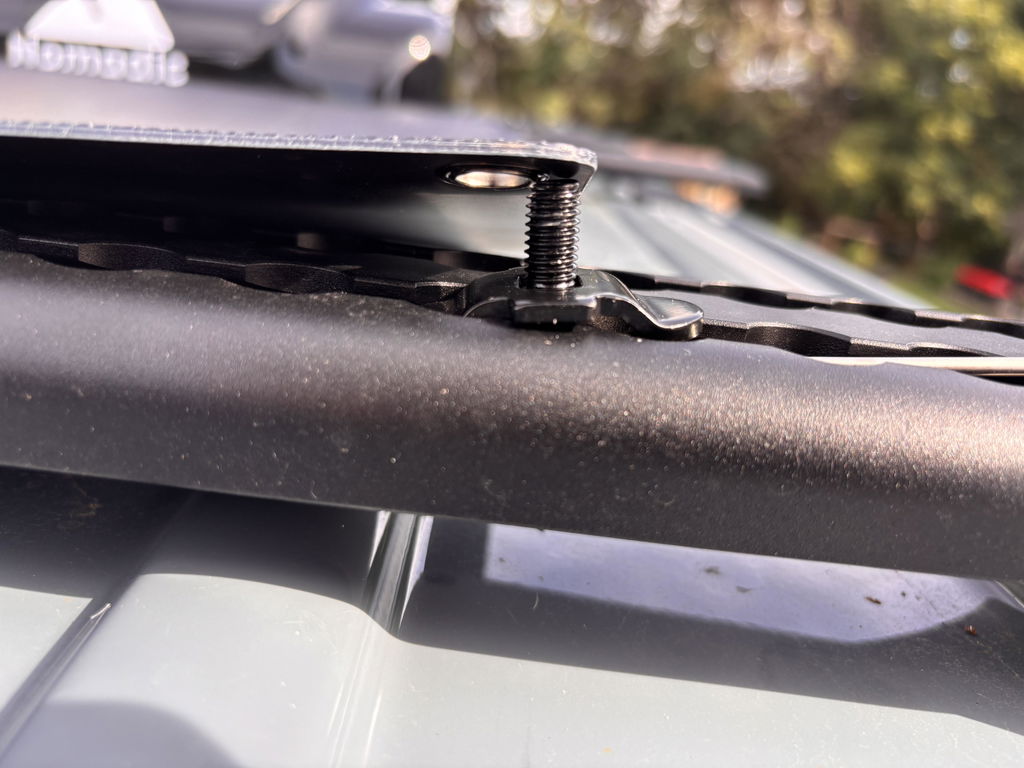
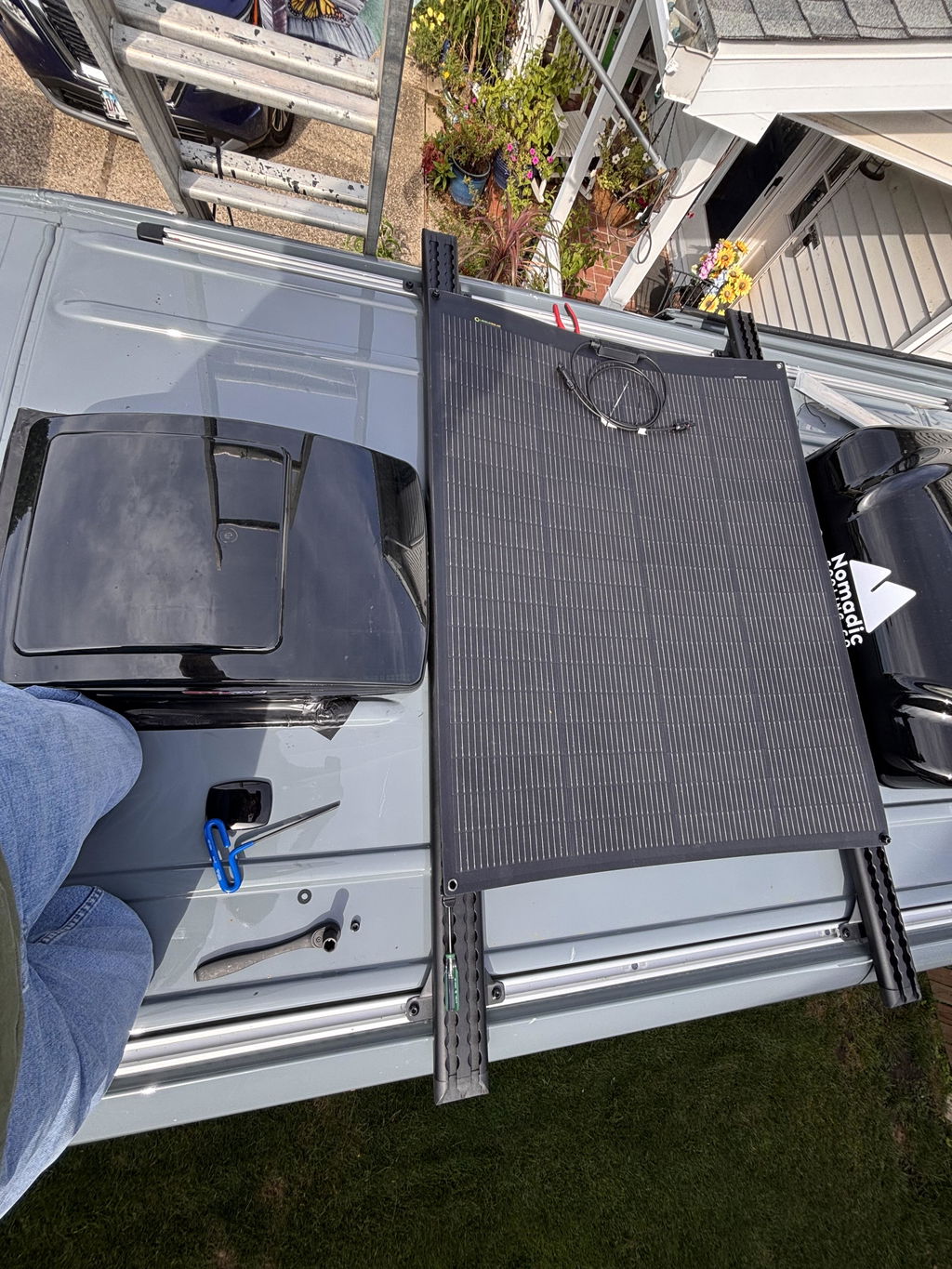
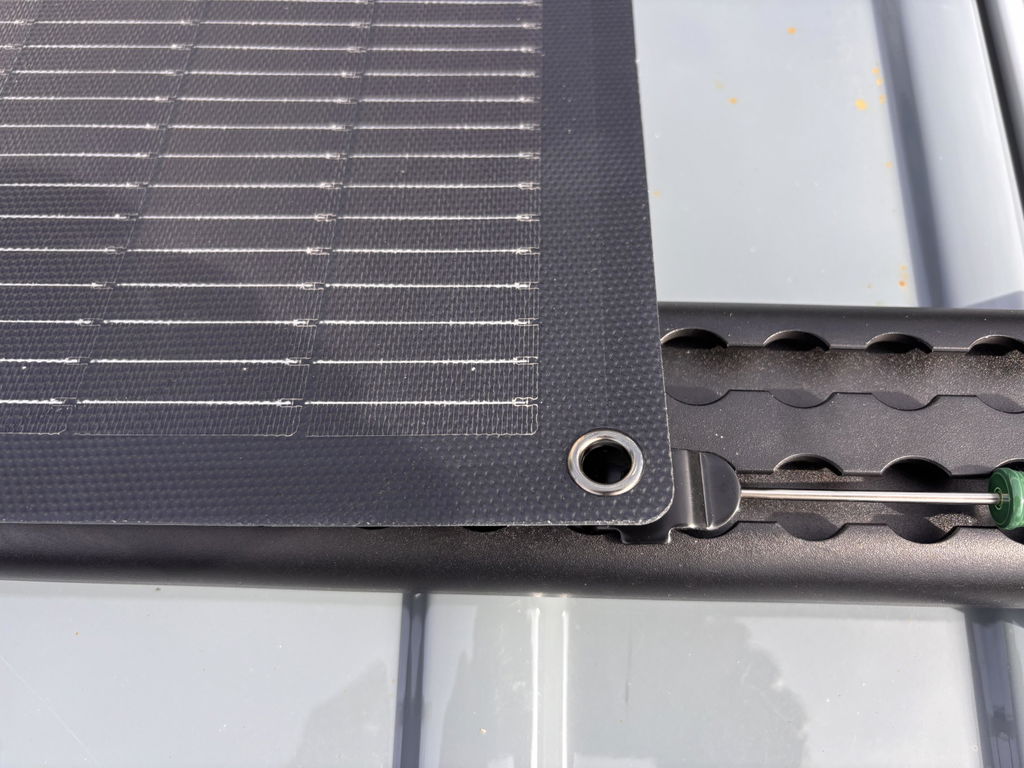
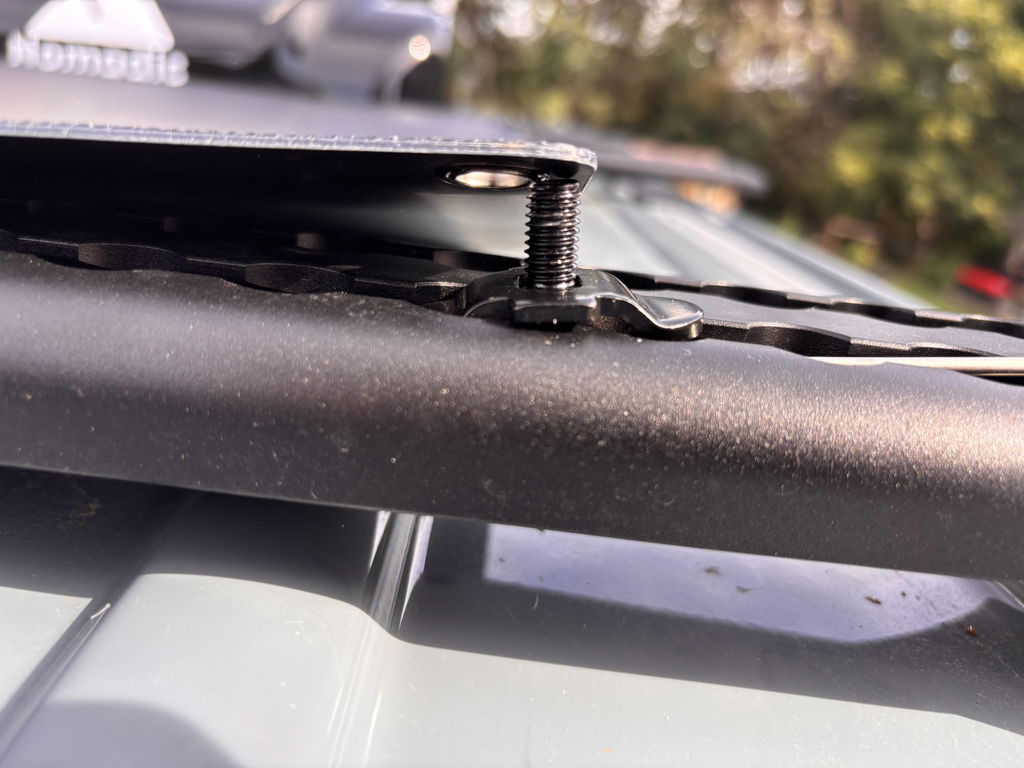
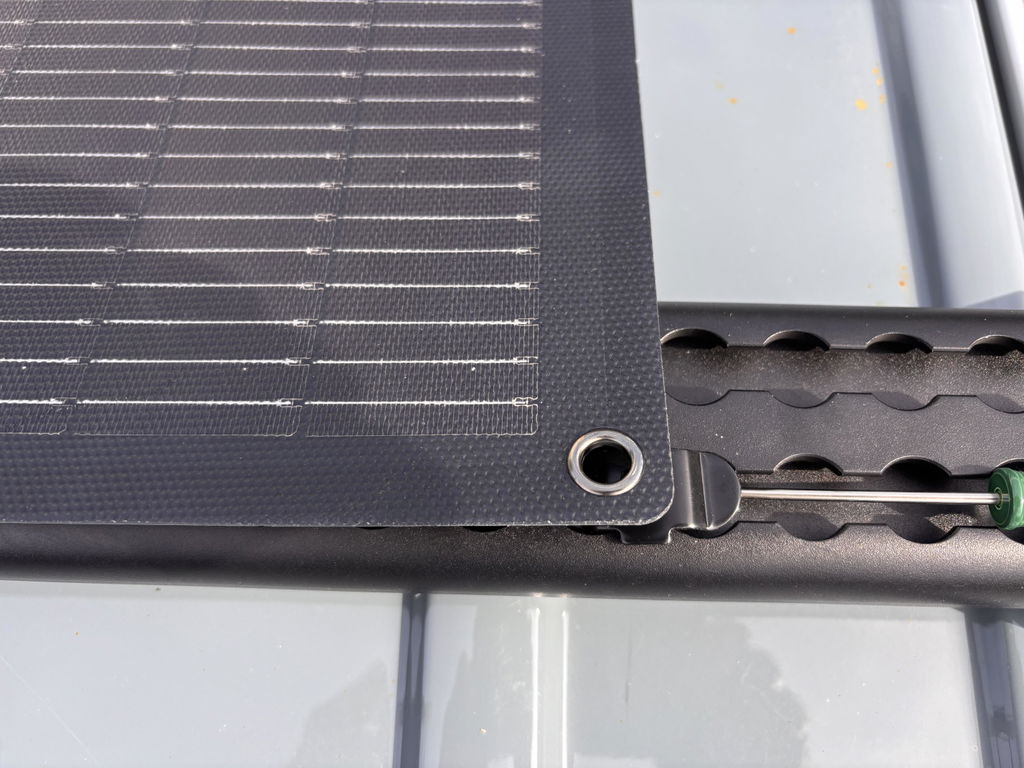
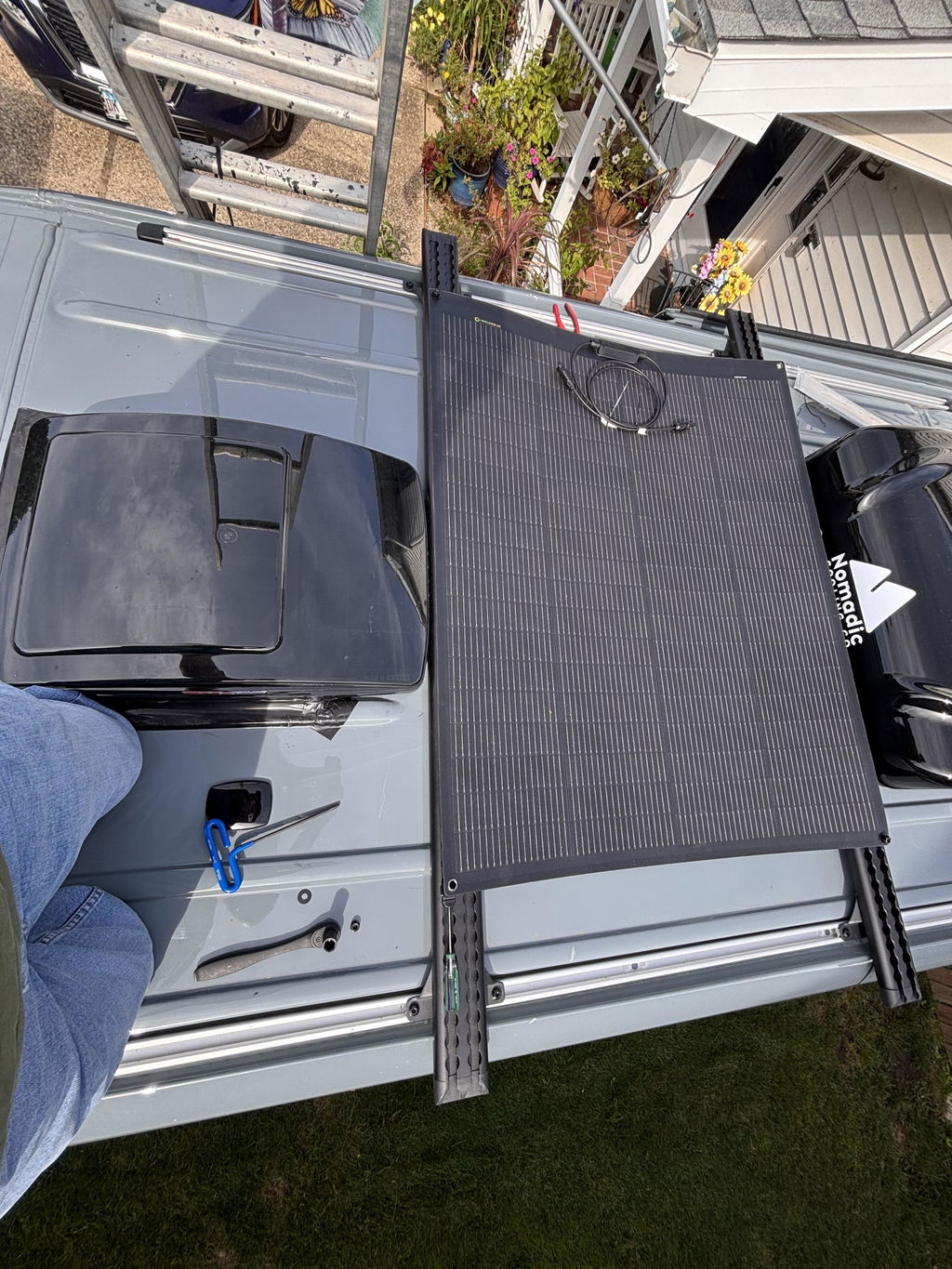
LoadSpan-T™ rails installed on a Sprinter — the entire rail pair weighs 8.4 lb for a 144" wheelbase.
Sprinter roof weight budget: 330 lb dynamic limit, all variants. A typical setup — full-length rack rails (~8–15 lb), two 100W solar panels (~18 lb total), a side awning (~28–35 lb), and a rooftop tent (~75–120 lb) — can hit 130–190 lb before any gear. DVA LoadSpan-T rails (8.4 lb, 144" WB) + DualTrack-T crossbars (~12 lb) = ~20 lb for the structural platform, leaving the maximum budget for payloads. Rule of thumb: stay under 250 lb for the static load; the 330 lb dynamic figure is the Mercedes limit for driving over rough terrain.
Search any Sprinter build forum and you'll find the same story: someone stacks a platform rack, two solar panels, an awning, a MaxxAir cover, and a light bar on the roof, then asks what's left for a rooftop tent. The answer, more often than not, is nothing — or worse, they're already over.
The Sprinter's 330 lb dynamic roof load limit applies to every variant — 144" wheelbase, 170", 170" Extended, standard roof, high roof. There's no higher-capacity option. That 330 lb has to cover the rack itself, every mounting bracket, every wire run, every accessory bolted up there, and whatever cargo you plan to carry on top. Miss any line item and you're guessing.
This guide breaks the budget into real numbers. We'll weigh every common roof component, walk through three build scenarios, and show where the biggest weight savings come from — starting with the mounting system itself.
The 330 lb Rule: What Mercedes Actually Specifies
Mercedes-Benz rates the Sprinter at 330 lb (150 kg) dynamic — meaning while the vehicle is moving. This limit applies to every roof height: standard, high, and super-high. There is no higher-capacity variant.
This number comes from the Mercedes-Benz Sprinter body/equipment guidelines and has been verified across multiple sources, including the Sprinter-Source.com "Max weight addition to roof" thread, where user gwiz42 documented it directly from the manufacturer specifications:
Maximum roof load: 330lbs (150kg) with a minimum of 3 pairs of supports. The data is valid when the load is distributed evenly over the entire roof area.
— gwiz42, "Max weight addition to roof", Sprinter-Source.com
The critical detail: 330 lb includes everything attached to the roof — rack structure, mounting hardware, bolts, solar panels, awning, fan covers, light bars, antenna mounts, and any cargo sitting on the rack. It's not 330 lb of payload on top of the rack; it's 330 lb total from the roof skin up.
The 330 lb figure is the dynamic rating — what you can carry while driving. Static load (vehicle parked, engine off) is higher. This is why rooftop tents work on Sprinters: the tent plus occupants can load the roof beyond 330 lb when parked and sleeping, as long as the driving load (tent hardware plus everything else bolted up there) stays within budget. You still need the dynamic total to be under 330 lb before you turn the key.
What Everything Weighs: The Component Reference Table
Here's where most builders go wrong — they estimate instead of weighing. Below are real-world weights for the most common Sprinter roof components, sourced from manufacturer spec sheets and owner-reported data.
| Component | Typical Weight | Notes |
|---|---|---|
| Steel platform rack (full-length) | 60–120 lb | Galvanized steel, welded construction |
| Aluminum platform rack | 40–65 lb | Lighter, still substantial |
| DVA LoadSpan-T™ rails (pair, 144") | 8.4 lb | Extruded aluminum, includes hardware |
| DVA DualTrack-T™ crossbars (2-bar kit) | ~12 lb | Extruded aluminum, dual L-Track + T-Slot |
| Rigid solar panel (200W) | 25–28 lb | Per panel, glass-face monocrystalline |
| Rigid solar panel (400W) | 48–55 lb | Single large panel |
| Flexible solar panel (200W) | 8–12 lb | Adhesive mount, shorter lifespan |
| Awning (standard, ~11.5 ft) | 35–48 lb | With brackets and hardware |
| Rooftop tent (hardshell) | 130–165 lb | Folded/closed weight |
| Rooftop tent (softshell) | 90–120 lb | Lighter, bulkier when closed |
| MaxxAir fan cover | 3 lb | Plastic housing |
| Starlink Mini | 2.4 lb | Plus mount bracket (~1 lb) |
| LED light bar + mount | 5–15 lb | Varies by length and housing |
| Mounting hardware (misc.) | 5–10 lb | Bolts, brackets, adapters — often forgotten |
That miscellaneous hardware line at the bottom is the one everyone forgets. Awning brackets, solar panel Z-mounts, light bar brackets, wiring runs, sealant plates — it adds up to 5–10 lb on nearly every build.
The Weight Budget Formula
The math is simple. Executing it honestly is the hard part.
The mounting system is the first line item and the one with the biggest variance. A full-length steel platform rack with hardware can consume 65–130 lb of your 330 lb budget before a single accessory goes up. An extruded aluminum rail-and-crossbar system like the LoadSpan-T™ plus DualTrack-T™ combination starts around 20–25 lb for the same functional capability — freeing up 40–100 lb for actual gear.
Three Real Build Scenarios
Let's walk through three common Sprinter roof configurations and see how the budget shakes out.
Build 1: Weekend Adventurer (Solar + Awning + RTT)
This is the aspirational build — the owner who wants everything on the roof. It's also the build most likely to bust the budget.
| Component | With Steel Rack | With DVA Rail System |
|---|---|---|
| Mounting system | 75 lb (rack + hardware) | ~22 lb (LoadSpan-T + DualTrack-T 4-bar) |
| Solar (2× 200W rigid) | 52 lb | 52 lb |
| Awning (~11.5 ft) | 44 lb | 44 lb |
| MaxxAir cover | 3 lb | 3 lb |
| Misc. hardware | 8 lb | 5 lb |
| Subtotal (fixed) | 182 lb | 126 lb |
| Remaining for RTT | 148 lb | 204 lb |
With a steel platform rack, you've got 148 lb left — barely enough for a lightweight softshell tent (90–120 lb) with some margin, and no room for a hardshell (130–165 lb) unless you strip something else. With the DVA extruded aluminum system, you have 204 lb — enough for most hardshell tents with room to spare.
That 56 lb difference comes entirely from the mounting system.
Build 2: Full-Time Vanlife (Maximum Solar + Awning, No RTT)
| Component | Weight |
|---|---|
| DVA LoadSpan-T™ rails (170" pair) | 11.3 lb |
| DVA DualTrack-T™ crossbars (2-bar) | ~12 lb |
| Solar (3× 200W rigid) | 78 lb |
| Awning (~11.5 ft) | 44 lb |
| MaxxAir cover | 3 lb |
| Starlink Mini + mount | 3.4 lb |
| Misc. hardware | 7 lb |
| Total | 158.7 lb |
| Remaining | 171.3 lb |
Full-time vanlifers who skip the rooftop tent end up with generous headroom — 600W of solar, an awning, connectivity, and still over 170 lb of reserve. This build is where Sprinter-Source.com user campskunk landed on a similar approach:
I incorporated one large ~340 watt solar panel into my roof rack/deck. If I were doing this again, I may add a second panel over the first that stays out for two panels and then can be pushed on sliders over the lower one when using the roof deck.
— campskunk, "Thoughts on roof rack and solar panels", Sprinter-Source.com, Sep 2021
The lesson: even with 600+ watts of solar ambition, a lightweight mounting system keeps your options open for future additions.
Build 3: Work Van (Rack + Cargo + Light Bar)
| Component | Steel Platform | DVA System + Cargo Basket |
|---|---|---|
| Mounting system | 85 lb | ~22 lb |
| LED light bar + mount | 12 lb | 12 lb |
| MaxxAir cover | 3 lb | 3 lb |
| Hardware | 5 lb | 5 lb |
| Fixed weight | 105 lb | 42 lb |
| Available for cargo | 225 lb | 288 lb |
For work vans that need to carry ladders, conduit, pipe, or lumber on top, every pound of rack weight directly subtracts from usable cargo capacity. The 63 lb difference between a steel platform and an extruded aluminum rail system translates to real-world cargo capability.
Where the Biggest Savings Come From
Looking at the numbers across all three builds, a pattern emerges: the mounting system is the single biggest variable. Solar panels weigh what they weigh. Awnings weigh what they weigh. But the structure you bolt everything to? That ranges from 20 lb to 120+ lb depending on what you choose.
Why Material Matters

DualTrack-T™ crossbar — dual L-Track + 25mm T-Slot channels in a single extruded aluminum profile.
Steel platform racks are popular because they're strong and relatively cheap to manufacture. But strength isn't the constraint on a Sprinter roof — the 330 lb limit is well below what any competent rack structure can handle. The constraint is weight, and steel loses that contest by a wide margin.
Extruded aluminum — the material DVA uses for both the LoadSpan-T™ rails and DualTrack-T™ crossbars — delivers the structural performance at roughly one-third the weight. The LoadSpan-T rail pair for a 144" Sprinter weighs 8.4 lb. A comparable steel rail set weighs 25–40 lb. That's 15–30 lb of budget recovered before you mount a single accessory.
The DualTrack-T crossbar system adds another layer of efficiency. The 2-bar kit runs about 12 lb and provides dual L-Track plus 25mm T-Slot channels across each bar — so solar panel mounts, awning brackets, and tie-down hardware all attach directly without adapters or additional bracket weight. A steel crossbar setup for the same functionality typically weighs 20–35 lb with the necessary adapter plates.
That 330lb is including the rack, solar panels, fasteners, wires, etc. You run out of allowance really fast. My rack is 42mm galv steel unistrut rails along the sprinter roof channels, installed with M8 rivnuts and butyl tape.
— u/reddit user, "Cargo box on sprinter roof rack?", r/VanLife, Feb 2026
Five Mistakes That Blow the Budget
- Forgetting to weigh the rack itself. The most common error. Builders add up solar + awning + tent and compare to 330 lb. The rack, crossbars, and all mounting hardware have to come out first.
- Ignoring miscellaneous hardware. Awning adapter brackets, solar Z-mounts, wiring clips, sealant plates, light bar brackets — this stuff totals 5–10 lb on every build.
- Using "dry weight" for the awning. Manufacturer specs for awnings often exclude mounting brackets. Add 4–6 lb for the bracket set.
- Overbuilding the rack for accessories it won't carry. A full-length steel platform rack makes sense if you're hauling lumber daily. For solar, an awning, and a tent? You're paying 60–80 lb of weight penalty for a platform deck you don't need.
- Not planning for the future. If your build currently totals 310 lb and you think you might add a Starlink dish or light bar later — you can't. Leave margin.
Experienced builders target 80% of the rated limit — about 264 lb — as a practical ceiling. This leaves room for hardware you forgot to count, seasonal gear changes, and the reality that manufacturer weights are often optimistic. If your spreadsheet shows 330 lb exactly, you're almost certainly over.
The Weight Budget Worksheet
Print this, fill it in, and tape it to your build wall. Every line item gets a real weight — from a scale, a spec sheet, or a manufacturer page. No estimates.
If you're planning a build with LoadSpan-T™ rails and DualTrack-T™ crossbars, lines A–C total roughly 22–25 lb for the entire mounting system. That leaves 305+ lb for everything else — enough headroom for solar, an awning, and a rooftop tent on the same van.
Static vs. Dynamic: When the Rules Change
The 330 lb number governs what you can carry while driving. Once the van is parked and stationary, the static capacity is significantly higher — the roof structure can handle more weight when road forces aren't a factor. This matters for one specific scenario: rooftop tents.
A hardshell rooftop tent might weigh 150 lb closed (the dynamic load you drive with). When you park, open it, and two adults climb in, the total load jumps to 400–500 lb. The static roof can support that, but it would obliterate the dynamic limit. The tent hardware weight is what counts against your 330 lb driving budget — not the sleeping weight.
This is why the weight budget worksheet only tracks component weights (dynamic loads). Once you're parked, the roof can handle the occupants. But you still need every bolt and bracket on the roof to total under 330 lb before you turn the key.
Putting It Together: The DVA Approach

The complete LoadSpan-T™ + DualTrack-T™ system — rails, crossbars, and all hardware total roughly 22 lb.
The entire weight budget conversation comes down to one decision: how much of your 330 lb do you spend on structure versus function?
DVA's approach is to minimize structural weight. The LoadSpan-T™ rails mount through factory pre-punched roof holes — no drilling — and weigh 8.4 lb for the 144" pair (11.3 lb for 170"). The DualTrack-T™ crossbars bolt directly to those rails and provide dual L-Track plus 25mm T-Slot channels across each bar. Both products are extruded 6061-T6 aluminum — strong, light, and corrosion-resistant.
The combined weight for a complete LoadSpan-T + DualTrack-T system on a 144" Sprinter is roughly 20–22 lb. That's the rails, crossbars, and all mounting hardware. Compare that to a typical steel platform rack at 60–85 lb with hardware, and you've recovered 40–65 lb of roof budget — enough for an entire additional accessory or a heavier rooftop tent.
For builders planning a solar, awning, and tent combination, this weight savings isn't a luxury. It's the difference between a build that fits within 330 lb and one that doesn't.
Sources
- Mercedes-Benz Sprinter body/equipment guidelines — 330 lb (150 kg) dynamic roof load, raised roof, minimum 3 pairs of supports
- gwiz42, "Max weight addition to roof", Sprinter-Source.com, Aug 2009
- campskunk, "Thoughts on roof rack and solar panels", Sprinter-Source.com, Sep 2021
- r/VanLife, "Cargo box on sprinter roof rack?", Reddit, Feb 2026
- DVA LoadSpan-T™ product page — rail weights, load ratings, specifications
- DVA DualTrack-T™ product page — crossbar weights, load ratings, specifications
- Fiamma F45S specification sheet — awning weights by model (25.4 lb to 48+ lb)