INEOS Grenadier Warning Lights: What Every Owner Needs to Know
DPF regeneration, post-battery cascades, TPMS quirks, ESC alerts — this guide covers every warning Grenadier owners actually encounter, ranked by frequency, with severity ratings, cost ranges, and the complete A1-C11 icon reference.
1. The warnings you'll actually see
These are the top 8 warnings Grenadier owners deal with, ranked by how often they show up in forums and shop visits. For each one: what it looks like, what owners report, what it usually means, and whether you should worry.

1. DPF Regeneration Warnings (Diesel)
USUALLY NOT AN EMERGENCY⛽ Diesel only (B57 3.0L inline-6). This section applies to the diesel Grenadier only. Petrol models (B58 3.0L inline-6 turbo) do not have a DPF system. If you have the petrol variant, skip to the next warning.
The single most common panic moment for new Grenadier diesel owners. You park the truck, turn it off, and the engine keeps running. Or the cooling fan is blasting. Or there's a weird hot smell. Or the idle was sitting at 1,100 RPM for the last ten minutes of your drive. Or all of the above.
What's actually happening: The B57 diesel has a particulate filter (DPF) that collects soot. Periodically, the engine burns this soot off at very high exhaust temperatures — that's a regeneration cycle. The truck does this automatically. You'll notice:
- Idle RPM bumps up 100-200 RPM
- Cooling fan runs harder than usual (and may continue running after you shut off)
- A hot, slightly acrid smell — especially if you park on grass or near debris
- Fuel economy drops slightly during the regen cycle
- If it's been interrupted too many times: amber check engine light or a DPF-specific message in the cluster
When to actually worry:
- Amber check engine + DPF message that won't clear: You've been doing too many short trips. The filter is loaded. Take it on the highway — 20+ minutes at 2,000+ RPM, steady throttle. Most of the time, this fixes it.
- You've tried 2-3 highway runs and it won't clear: Now you need a dealer forced regeneration. This is a specific procedure using ISTA — not something a generic code reader can trigger.
- Red check engine + limp mode: The DPF is critically loaded. Don't keep driving. Schedule service.
Is it urgent? Usually no. The smell and fan are normal regen behavior. An amber DPF warning means "go for a highway drive soon." Only escalate if it won't clear after highway driving or you're in limp mode.
Cost if it needs service: $0 (highway drive fixes it) → $150-300 (dealer forced regen) → $2,000-4,000+ (DPF replacement if neglected long-term)
DIY or dealer? Highway regen is DIY. Forced regen is dealer (requires ISTA). DPF replacement is dealer. The lesson: don't ignore it, but don't panic either. Just drive the truck properly.
2. Check Engine Light (MIL)
SCHEDULE SERVICE — USUALLY NOT IMMEDIATEThe check engine light is the dashboard's catch-all complaint department. On the Grenadier, here's what it's usually about — ranked by how often owners report each cause:
Top 5 causes on the Grenadier:
| # | Cause | How common | Typical cost |
|---|---|---|---|
| 1 | DPF / aftertreatment related (diesel) — see warning #1 above | Very common | $0–$4,000+ |
| 2 | Software calibration / post-update recalibration | Common | $0–$150 (dealer clear) |
| 3 | O2 sensor or fuel metering deviation | Moderate | $200–$600 |
| 4 | Loose or improperly seated fuel cap (EVAP system) | Moderate | $0 |
| 5 | Actual engine/emissions issue (misfire, catalyst, vacuum leak) | Less common | $300–$3,000+ |
Is it urgent? Amber CEL with no drivability change: schedule within a week or two. Flashing CEL or red CEL: stop driving. A flashing check engine light means active misfire — continued driving can destroy the catalytic converter.
Cost range: $0 (loose fuel cap, software clear) → $200-600 (sensor replacement) → $1,000-3,000+ (major emissions/engine work)
DIY or dealer? You can read basic P-codes with a $30 Bluetooth OBD-II adapter. But on the Grenadier, a significant chunk of CEL causes require ISTA to properly diagnose. If your code reader shows a generic P-code and the light clears after a drive cycle, monitor it. If it comes back, dealer time.
Cost ranges are approximate, vary by dealer and region, and assume parts + labor at authorized INEOS service centers.

3. TPMS — Low Tire Pressure
USUALLY NOTHING — CHECK AND MOVE ONThe tire pressure monitoring system on the Grenadier is sensitive — and owners hear about it constantly, especially in the fall and spring.
What owners report:
- TPMS warning after overnight temperature drops — goes away as tires warm up
- TPMS warning after wheel/tire changes, rotations, or switching to winter/off-road wheels
- Persistent TPMS warning on one corner that checks out fine with a gauge
- TPMS fault after running different-size spare
What it usually means:
- Seasonal: A 10°F temperature drop can reduce tire pressure by ~1 PSI. If your tires are already on the low side of spec, a cold night pushes them below the threshold. Top them up and the light goes away.
- After wheel work: The TPMS sensors need to be re-learned to the correct corner positions. Some shops forget this step. If the light comes on right after a tire rotation or wheel swap, that's your answer.
- Actual pressure loss: Don't assume it's always the sensor. Check with a gauge first. Always.
Recalibration procedure: The Grenadier uses an auto-learn TPMS system. After a wheel swap, drive at 15+ mph for 10-15 minutes — the system should re-map sensors to corners. If it doesn't, a dealer can force the relearn through ISTA. Some aftermarket TPMS tools (like Autel) can also do the relearn.
Is it urgent? Only if a tire is actually losing pressure rapidly. TPMS + visible tire deflection = pull over now. TPMS alone on a cold morning with tires that look fine = top up and carry on.
Cost: $0 (add air) → $50-100 (TPMS relearn at shop) → $80-200 per sensor (battery-dead TPMS sensor replacement)
DIY or dealer? Checking pressure and adding air is obviously DIY. Relearn after wheel swap: some owners handle it with aftermarket TPMS tools. Sensor replacement: shop or dealer.

4. Post-Battery-Disconnect Warning Cascade
DON'T PANIC — THIS IS NORMALThis one scares the hell out of people. You disconnect the battery — maybe to install an accessory, maybe the dealer did it for service — and when you reconnect, the dashboard lights up like a Christmas tree. Four, five, six warnings at once.
What typically lights up (and why):
| Warning | Why it appears | Clears after... |
|---|---|---|
| ESC / Traction | Steering angle sensor lost its zero reference | A few turns of the steering wheel + short drive |
| TPMS | Sensor communication reset | 10-15 minutes of driving at 15+ mph |
| ABS | Wheel speed sensor initialization | A few minutes of driving |
| Check Engine | Various learned values cleared, pending re-adaptation | 1-2 drive cycles (15-20 min each) |
| Steering Warning | EPS calibration needs relearn | A few full lock-to-lock turns |
The "Don't Panic" guide:
- Reconnect the battery, start the engine, and let it idle for 2-3 minutes
- Turn the steering wheel full lock to full lock, slowly, 2-3 times
- Drive normally for 15-20 minutes — mixed speeds, some stops
- Most warnings should clear during that drive
- If anything persists after 2-3 full drive cycles (not just a trip around the block): schedule a scan
Prevention: If you're doing accessory installs that need battery disconnect, follow the Grenadier-specific battery disconnect/reconnect sequence in your owner's handbook. The dual-battery system and combiner relay have a specific sequence that reduces the cascade.
Is it urgent? Almost never. If a warning persists after 2-3 drive cycles, or if you notice actual behavior changes (braking feels different, steering pull, engine running rough), then schedule service.
Cost: $0 (drive cycle clears it) → $100-150 (dealer diagnostic + reset if it doesn't clear)
DIY or dealer? The drive-cycle reset is DIY. If warnings won't clear, dealer.
Owners adding roof accessories or auxiliary power — Starlink, lighting, compressors — can tap the Grenadier's factory DTP ports instead of the battery directly. DVA's PowerVault™ Utility Hub R2 and DTP-06-2S Splitter distribute switched power at the roof rail — no battery disconnect needed, no post-disconnect cascade to worry about.


5. ESC / Traction Warnings Off-Road
EXPECTED BEHAVIOR — NOT A FAULTYou took your Grenadier off-road (as intended), and now the ESC light is blinking, or the traction control light is on, or both. New owners sometimes interpret this as a system failure.
What's normal off-road:
- ESC light flashing: The system is actively intervening — applying brakes to individual wheels to maintain stability. This is exactly what it's supposed to do on loose surfaces. The flashing means "I'm working."
- Traction control light on steady: Wheels are slipping and the system is managing it.
- ESC OFF indicator (B3): You deliberately disabled stability control for off-road use. Green status indicator — not a fault.
- Diff lock indicators (A6, B6, C6): Green status lights confirming your diff locks are engaged. Expected when you've selected them.
What's NOT normal (actual fault):
- ESC or traction warning stays lit on dry pavement after returning from off-road
- ESC warning + ABS warning together on normal roads
- Any of these lights accompanied by a change in braking feel
- Warning doesn't clear after a restart and 5 minutes of normal driving
Is it urgent? Off-road: no, this is the system doing its job. On-road persisting after restart: schedule service — likely a wheel speed sensor issue from trail debris.
Cost if actual fault: $100-150 (diagnostic) → $150-400 (wheel speed sensor replacement)
DIY or dealer? Cleaning wheel speed sensors is DIY (inspect for mud/debris packing). Sensor replacement or ABS module diagnosis is dealer/shop.
6. Post-Software-Update Transient Warnings
USUALLY CLEARS — GIVE IT A DRIVE CYCLEYou picked up your Grenadier from the dealer after a software update, and there's a warning light that wasn't there before. This is a documented pattern in the Grenadier community.
What happens: Software updates can reset adaptation values, trigger re-learning cycles, or briefly flag systems during the recalibration process. The Grenadier's BMW-derived architecture is particularly sensitive to this — the ECU needs to re-learn fuel trims, idle parameters, and sensor baselines.
Common post-update warnings:
- Check engine light (re-adaptation in progress)
- ADAS/camera warnings (camera calibration pending or in progress)
- ESC warning (steering angle re-learning)
- Overall warning triangle with a vague message center text
What to do:
- Drive normally for one full drive cycle (15-20 minutes, mixed conditions)
- If warnings clear: done
- If warnings persist after 3 complete drive cycles (not 3 short trips — 3 proper drives): go back to the dealer
Is it urgent? Almost never. If the warning is red, or you notice actual drivability changes, go back immediately. For amber warnings post-update, give it the drive cycle before calling.
Cost: $0 (clears on its own) → $0 (dealer re-flash if their update caused it — should be warranty)
DIY or dealer? Drive cycle is on you. If it doesn't clear, this is a dealer problem — the update they performed didn't complete correctly.

7. Oil Pressure Warning
STOP. NOW. THIS ONE IS REAL.This is the one warning on this list where we don't tell you to "monitor it" or "give it a drive cycle." When the oil pressure light comes on red, you shut the engine off. Period.
What it means: Oil pressure has dropped below the minimum threshold for safe engine operation. The B57 diesel and B58 petrol engines in the Grenadier are precision-machined, tight-tolerance engines. Running them without adequate oil pressure — even for 30 seconds — can cause bearing damage that turns a $50 oil top-up into a $15,000+ engine rebuild.
When it's the sensor vs. when it's real:
- Flicker on rough terrain at low RPM: Oil pickup can momentarily lose prime on steep angles or very rough terrain. Brief flicker (1-2 seconds) that goes away when you level out or increase RPM — likely oil slosh. Still worth checking your level at the next stop.
- Stays on for more than a few seconds at any RPM: Real. Shut it down.
- Comes on at idle on flat ground: Real. Shut it down.
- Comes on with engine noise change (knocking, ticking): Critical. Shut it down immediately and do not restart. Tow.
Immediate steps:
- Pull over safely and shut off the engine
- Wait 5 minutes for oil to drain back to sump
- Check oil level on level ground per the handbook dipstick procedure
- If low: top up to the correct spec and monitor closely
- If level is fine and warning returns on restart: do not drive. Tow to service.
Cost: $0-15 (low oil, just needs a top-up) → $150-400 (oil pressure sensor replacement) → $5,000-15,000+ (engine damage from running without pressure)
DIY or dealer? Checking oil level is DIY. If the level is fine and the warning persists, dealer only. Do not attempt to diagnose oil pressure faults by continuing to drive.
Cost ranges are approximate, vary by dealer and region.

8. Coolant Temperature / Overheat
STOP AND COOL DOWN — ENGINE DAMAGE RISKCoolant temperature warnings on the Grenadier have some diesel-specific patterns worth understanding.
Diesel-specific patterns:
- After DPF regeneration + stop: The regen cycle raises exhaust temps significantly. If you park immediately after a regen (stop-and-go traffic where regen was in progress), residual heat can push coolant temps up. The cooling fan should handle this, but in extreme ambient heat, you may see a warning.
- Aux coolant pump monitoring: Early production Grenadiers have had some reports of electric auxiliary coolant pump issues. If you're getting intermittent coolant warnings with no visible leak and coolant level is fine, the aux pump circuit is worth having inspected.
- Towing / heavy load in heat: The B57 runs hot under sustained load. If you're towing near max capacity in summer, keep an eye on temps. This isn't a fault — it's physics.
When it's real vs. transient:
- Temp creeps up in traffic, cools when moving: Likely a cooling fan or airflow issue. Not immediately catastrophic but needs inspection.
- Temp spike with visible steam or coolant smell: Real. Stop immediately. Do not open the cap while hot.
- Warning + coolant level visibly low: You have a leak. Stop, let it cool, and tow.
- Warning + no symptoms, level fine: Possible sensor fault. Still stop and let it cool — don't gamble on it being the sensor.
Is it urgent? Yes. Overheating causes head gasket failure, warped heads, and engine damage. Unlike some amber warnings, this one escalates fast. Stop, cool down, check level. If it recurs, service before driving further.
Cost: $0 (transient, cools down fine) → $100-300 (coolant top-up + thermostat) → $500-1,500 (aux coolant pump replacement) → $3,000-8,000+ (head gasket / major cooling system repair)
DIY or dealer? Checking coolant level (when cool) is DIY. Thermostat replacement is shop-level. Anything involving the aux pump or head gasket diagnosis is dealer.
Cost ranges are approximate, vary by dealer and region.
When your warning lights are sorted and you're ready to build out your Grenadier, start with the utility platform. DVA's DualTrack™ Roof Crossbar System provides L-Track-native roof mounting for tents, awnings, and gear carriers. For lighting, the DVA LED Roof Light Bar tape-mounts directly to the roof and draws power from the factory DTP outlet — no relay, no battery wiring, no scan-tool flags.


2. The A1-C11 quick reference
Need to look up a specific light? This is the complete INEOS Grenadier telltale index. Find your icon, check the severity, read the one-line action.
Severity system
Stop safely, diagnose immediately. Safety- or damage-critical.
Caution. May be driveable, but service/inspection required soon.
Status indicator. System active — usually informational.
| Icon | Code | Meaning | Severity | Action |
|---|---|---|---|---|
 |
A1 | Left turn signal | Info | Normal operation. |
 |
A2 | Exterior bulb failure | Amber | Replace bulb; schedule service. |
 |
A3 | Side lamps on | Info | Normal operation. |
 |
A4 | ABS fault | Amber | Drive cautiously; service soon. |
 |
A5 | Low beams on | Info | Normal operation. |
 |
A6 | Front diff lock engaged | Status | Off-road only; unlock on pavement. |
 |
A7 | High beams on | Info | Normal operation. |
 |
A8 | Battery / charging fault | Red/Amber | Reduce electrical loads; stop and diagnose if persistent. |
 |
A9 | Rear fog lights | Info | Use only in poor visibility. |
| A10 | A10 | Market-dependent telltale | Refer handbook | Check your specific handbook edition. |
 |
A11 | Right turn signal | Info | Normal operation. |
 |
B1 | ESC fault / active blink | Amber | Faulted: drive cautiously, service soon. Blinking: system intervening (normal). |
| B2 | B2 | Market-dependent telltale | Refer handbook | Check your specific handbook edition. |
|
B3 | ESC off | Status | Expected when deliberately disabled / off-road. |
| B4 | B4 | Market-dependent telltale | Refer handbook | Check your specific handbook edition. |
 |
B5 | Brake system fault | Red | Do not drive. Tow to service. |
 |
B6 | Center diff lock engaged | Status | Off-road mode; avoid normal road use when locked. |
 |
B7 | Parking brake on | Status | Confirm fully applied/released as intended. |
|
B8 | Check engine (MIL) | Amber/Red | Amber: limit driving, service soon. Flashing/Red: stop immediately. |
 |
B9 | Transmission failure | Red | Do not drive. Tow to service. |
 |
B10 | Off-road / wading mode | Status | Mode engaged; confirm speed constraints. |
 |
B11 | Trailer turn signal | Info | Normal with trailer connected. |
 |
C1 | Seat belt warning | Amber | Buckle all occupied seats. |
 |
C2 | Forward collision / AEB | Amber/Red | Amber: system issue. Red: imminent collision detected. |
|
C3 | Low tire pressure (TPMS) | Amber | Check all tires with gauge; correct pressure. |
 |
C4 | Airbag / SRS fault | Amber | Drive cautiously; diagnose restraint system promptly. |
 |
C5 | Front camera warning | Amber | Camera obstructed; ADAS unavailable. Clean camera area. |
 |
C6 | Rear diff lock engaged | Status | Traction mode; disengage after obstacle. |
 |
C7 | Low gear range (L) | Status | Transfer case low range; not for highway speeds. |
|
C8 | Oil pressure / oil level | Amber/Red | Check level. If red: stop immediately. See warning #7 above. |
|
C9 | Coolant temperature | Red risk | Stop, cool down, inspect. See warning #8 above. |
 |
C10 | Steering system failure | Red | Stop immediately and tow. |
|
C11 | Overall warning triangle | Amber/Red | Check message center for specific fault. |
3. ISTA vs. your $30 code reader
Here's the thing about the Grenadier that a lot of owners learn the hard way: your generic OBD-II code reader can only see part of the picture.
The Grenadier runs on BMW-derived diagnostic architecture. That means the vehicle's brain is split across dozens of control modules — engine, transmission, ABS, airbags, ADAS, body electronics, and more. Each module stores its own fault codes. A standard OBD-II reader talks to exactly one of those modules: the engine/powertrain control module. It reads P-codes (powertrain codes). That's it.
What your $30 code reader CAN do
- Read powertrain fault codes (P-codes): misfires, fuel trim issues, O2 sensor faults, DPF status
- Clear a check engine light (temporarily — it'll come back if the fault is still present)
- Read basic live data: RPM, coolant temp, fuel trims, short-term/long-term values
- Tell you if your problem is a simple engine-related issue vs. something deeper
What your $30 code reader CANNOT do
- Read chassis codes (C-codes): ABS faults, ESC faults, steering faults, suspension
- Read body codes (B-codes): airbag/SRS faults, seat occupant sensors, door modules
- Read network codes (U-codes): communication faults between modules
- Access ADAS modules: forward collision, camera calibration, lane departure
- Perform adaptations: DPF forced regen, steering angle calibration, battery registration
- Read freeze-frame data from non-powertrain modules
The middle ground: BMW-compatible scan tools
Tools like BimmerLink, Carly, or ISTA+ with a compatible interface can access most of the Grenadier's modules because they speak BMW's proprietary diagnostic protocol. These cost $50-200 for the app + a compatible Bluetooth adapter, and they're a massive step up from generic readers. They can:
- Read fault codes from all modules (not just powertrain)
- Show module-specific live data
- Perform some basic coding and adaptations
- Give you enough information to have an informed conversation with your dealer
When the $150 dealer diagnostic is worth it
| Situation | $30 reader enough? | BMW tool enough? | Need dealer ISTA? |
|---|---|---|---|
| Simple check engine light, no drivability change | Yes — read code, research | Yes | Probably not |
| DPF warning after short-trip driving | Yes — P2463 confirms it | Yes | Only if forced regen needed |
| ABS / ESC / steering warning | No | Partially | Yes — for full diagnosis |
| Airbag / SRS light | No | Can read code | Yes — for safe repair |
| ADAS / camera warnings | No | Limited | Yes — calibration required |
| Multiple warnings after battery disconnect | No | Can help clear | Only if drive cycle doesn't clear them |
| Transmission fault / limp mode | Limited P-codes only | Better | Yes — transmission adaptation data |
| Post-update persistent warnings | No | Maybe | Yes — may need re-flash |
4. Decision tree: what to do when a light comes on
Structured triage logic for any warning light — including the edge cases that catch owners off guard:
| What you see | What to do | Why |
|---|---|---|
| Red warning + vehicle drives differently | STOP immediately. Don't "drive to a shop." | Red + behavior change = potential immediate safety or mechanical risk. |
| Red warning + drives normally | Drive slowly to a safe spot, then stop and investigate | May be sensor-related. If it recurs after restart, do not keep driving. |
| Amber warning, everything feels normal | Keep driving (limited), schedule diagnostics within a week | Non-immediate fault. Still needs resolution before it escalates. |
| Multiple amber warnings at the same time | Slow down, stop soon, photograph everything | Multiple ambers often = one upstream cause (sensor bus, power supply, wiring). |
| Warning only on cold start, clears in minutes | Monitor for 3-5 starts. Schedule scan if consistent. | Sensor warm-up behavior. Consistent recurrence = developing fault. |
| Warning after battery work | Drive cycle first (15-20 min). Worry later. | See warning #4 above. Most clear on their own. |
| Warning after dealer software update | One full drive cycle. Return to dealer if still on after 3 cycles. | Re-adaptation period. See warning #6 above. |
| Warning after wheel/tire work | Check TPMS relearn + inspect wheel speed sensors | Two most common causes. Usually resolved with a relearn procedure. |
| Green/blue mode indicators | Monitor — these are status, not faults | System or mode active as selected. Informational only. |
The "photograph first" rule
Before you cycle the ignition or do anything else: take a photo of the instrument cluster and any message center text. Some warnings clear on restart and don't come back — but you'll want that photo when talking to service. Also note any recent context: battery work, wheel swap, accessory install, software update, off-road use.
5. Known Grenadier patterns
These are the recurring warning-light scenarios that the Grenadier community has documented. Understanding these patterns helps you contextualize what your dashboard is telling you before you assume the worst.
DPF regeneration behavior (diesel)
Covered in depth in warning #1 above. The short version: the B57 diesel needs to burn off soot periodically. Short-trip urban driving prevents this. If you're exclusively doing city driving in a diesel Grenadier, plan a 20-30 minute highway run at least once a week. Owners who do this rarely see DPF warnings. Owners who don't... see them constantly.
Post-software-update transients
Covered in warning #6. INEOS has pushed several software campaigns through the dealer network. Each one can trigger temporary warnings during the ECU re-adaptation period. The community consensus: if your dealer did an update and you have a new warning, drive it normally for 1-2 full cycles before going back.
TPMS after seasonal wheel swaps
Covered in warning #3. This is perennial in cold-climate markets. Owners switching between summer and winter wheel sets report TPMS warnings until the sensor relearn completes (10-15 minutes of driving at 15+ mph). Some aftermarket wheels use different valve stem positions that can delay the auto-learn.
Battery-disconnect cascades
Covered in warning #4. The dual-battery system with combiner relay makes this more dramatic than in most vehicles. The community has settled on a consistent "reconnect ritual" — idle 2-3 min, full lock-to-lock steering 2-3 times, 15-20 min drive — that reliably clears the cascade.
Cold-start sensor warnings
In temperatures below freezing, some owners report transient sensor warnings during the first few minutes of operation that clear as the engine and electronics warm up. These are documented across cold-climate owner forums. If a warning consistently appears at cold start and clears within 5 minutes of driving, monitor the frequency. If it happens every cold start, schedule a diagnostic — an intermittent fault is developing.
Auxiliary coolant pump monitoring (diesel)
Some early production Grenadiers have shown intermittent coolant warnings traced to the electric auxiliary coolant pump circuit. Symptoms: brief coolant temperature spike or warning with no visible leak and normal coolant level. If you're experiencing this, have the aux pump circuit inspected proactively. Monitor INEOS TSB/recall announcements for updates on this pattern.
ADAS camera warnings in adverse conditions
Heavy rain, snow, mud splash, or direct sun glare can temporarily blind the forward-facing camera, triggering ADAS/AEB unavailability warnings. This is expected behavior, not a fault. The warnings should clear when conditions improve and the camera lens is clean. Persistent camera warnings in good conditions = schedule calibration check.
6. Service interval connections
Sometimes a warning light isn't a surprise — it's just your truck telling you what the service schedule already predicted. Here's how common warnings connect to routine maintenance:
| Warning | Service connection | What's actually going on |
|---|---|---|
| TPMS / Low Tire Pressure | Seasonal temperature changes | A 10°F ambient drop = ~1 PSI loss. Autumn and spring transitions catch a lot of owners. Check pressures before assuming a sensor fault. |
| Oil Level / Oil Pressure (amber) | Approaching oil service interval | Some oil consumption between services is normal for the B57 and B58. If you're near your service interval and the amber oil level warning appears, check and top up. Red oil pressure = stop regardless of interval. |
| Brake System Warning | Brake pad wear at expected mileage | Pad wear sensors trigger warnings at threshold. If you're near brake service mileage, this is likely routine pad replacement, not hydraulic failure. |
| Check Engine (DPF) | Driving pattern, not mileage | DPF warnings are pattern-triggered, not interval-triggered. Short trips = more frequent warnings. Adjust driving habits or plan periodic highway runs. |
| Battery / Charging | Battery age + accessory load | The dual-battery system ages. If you've added significant accessories (winch, auxiliary lights, fridge) without a charging system assessment, battery warnings may appear earlier than expected. |
| Exterior Bulb Failure (A2) | Bulb service life | Simple wear item. Some owners keep spare bulbs in the glovebox. LED upgrades — like the DVA Roof Pod Light Bar — extend service life significantly while adding scene lighting capability through the factory EXT circuits. |
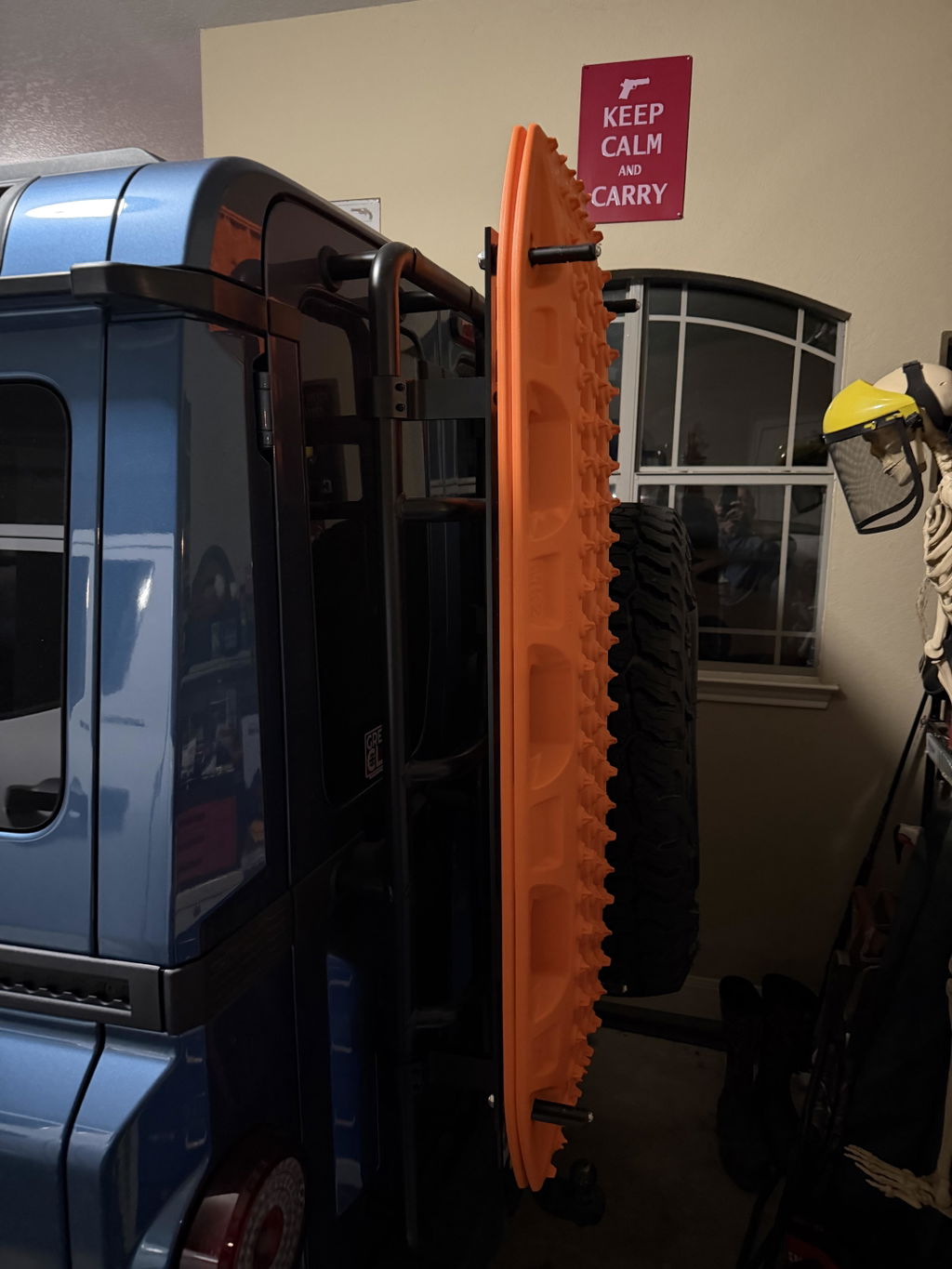
When service intervals are current and your warning lights are clear, it's the right time to finish your trail-prep kit. DVA's rear-ladder mounts put recovery gear where it belongs — accessible in an emergency, secured when you don't need it.


Sources
- INEOS Grenadier Owner's Handbook (MY2024-MY2025 regional editions) — official telltale definitions, severity classifications, and recommended owner actions.
- INEOS Service Documentation — technical specifications for warning light behavior and diagnostic procedures.
- Owner Communities: r/ineosgrenadier and The INEOS Forum — real-world warning light scenarios, owner troubleshooting experiences, and community-documented patterns.
- BMW B57/B58 Service Literature — engine-specific diagnostic and service information applicable to the Grenadier's powertrain.
- DVA Mechanics shop experience — hands-on diagnostic and repair patterns observed across Grenadier service work.
Warning lights are one thing — but building your Grenadier with the right accessories from the start can prevent problems down the road. See our owner-ranked guide to the best Grenadier accessories for 2026, or browse DVA's engineered Grenadier upgrades.
Built by DVA Mechanics from real owner experiences, shop-floor diagnostics, and the official INEOS Grenadier handbook. Questions? Reach out at dvamechanics.com.