⚡ Quick Answer: DualTrack-T Installation
The DualTrack-T™ crossbar bolts onto any existing Sprinter longitudinal roof rails — OEM, LoadSpan-T™, or compatible aftermarket. No drilling. Installation takes 30–45 minutes per bar with basic hand tools (5mm and 6mm Allen keys). Position front bar 12–18" behind the cab transition; space bars 24–36" apart depending on load type. Snug mount hardware to 8–10 ft-lb (no torque wrench required; firm but not gorilla-tight). Each bar carries 150 lb dynamic; total Sprinter roof budget is 330 lb dynamic.
Sprinter crossbar installation takes 30–45 minutes with basic hand tools — no drilling, no roof modifications. DVA's DualTrack-T™ is a dual-channel crossbar that runs L-Track and 25mm T-Slot hardware simultaneously, the only Sprinter crossbar that eliminates the choose-one-standard problem. This guide covers the full install from unboxing to first load, written for the VS30 chassis with factory OEM rails or DVA LoadSpan-T™ longitudinal rails already in place.
Before You Start: Prerequisites & What's in the Box
Prerequisites
DualTrack-T mounts to existing longitudinal roof rail tracks — it does NOT attach to factory threaded roof inserts or bare sheet metal. If your Sprinter has no roof rails installed, you need to fit either the OEM MB longitudinal rails or DVA's LoadSpan-T™ rails first.
- ✅ OEM Mercedes-Benz longitudinal roof rails (NCV3 / VS30)
- ✅ DVA LoadSpan-T™ load-spreading roof rails
- ✅ Compatible aftermarket T-slot longitudinal rails (25mm or larger T-channel)
- ❌ Bare van roof or threaded-insert-only setups — DualTrack-T cannot mount without rails
Kit Contents (2-Bar Kit)
- 2× DualTrack-T™ crossbar rails (61¾" / 156.8 cm each)
- 4× saddle clamp mounts (2 per bar, one each side)
- Mounting hardware: M6 hex bolts, lock washers, T-nuts
Tools Required
- 5mm Allen key (hex wrench)
- 6mm Allen key
- Tape measure
- Torque wrench (optional but recommended) — 8–10 ft-lb range
- Permanent marker or chalk (for positioning marks)
- Step stool or van roof access (ladder or step rail)
Step-by-Step Installation
Step 1 — Clean the Rail Channels
Before mounting anything, wipe out the T-slot channels on your longitudinal rails with a clean rag. Road grit and residue in the channel causes binding and prevents the T-nuts from seating flat. A few seconds of cleaning now prevents frustrating re-torquing later.
From the forums: Owner j12y, planning a 2022 144" High Roof build, noted that pre-cleaning rail channels and doing a dry-fit of all hardware before final mounting saved significant time during installation — Sprinter-Source thread #115051 — Planning Roof Layout / Roof Rack Decisions.
Step 2 — Mark Your Crossbar Positions
Before lifting bars onto the roof, decide positioning on the ground. Common spacing:
| Load Type | Front Bar Position | Bar Spacing | Notes |
|---|---|---|---|
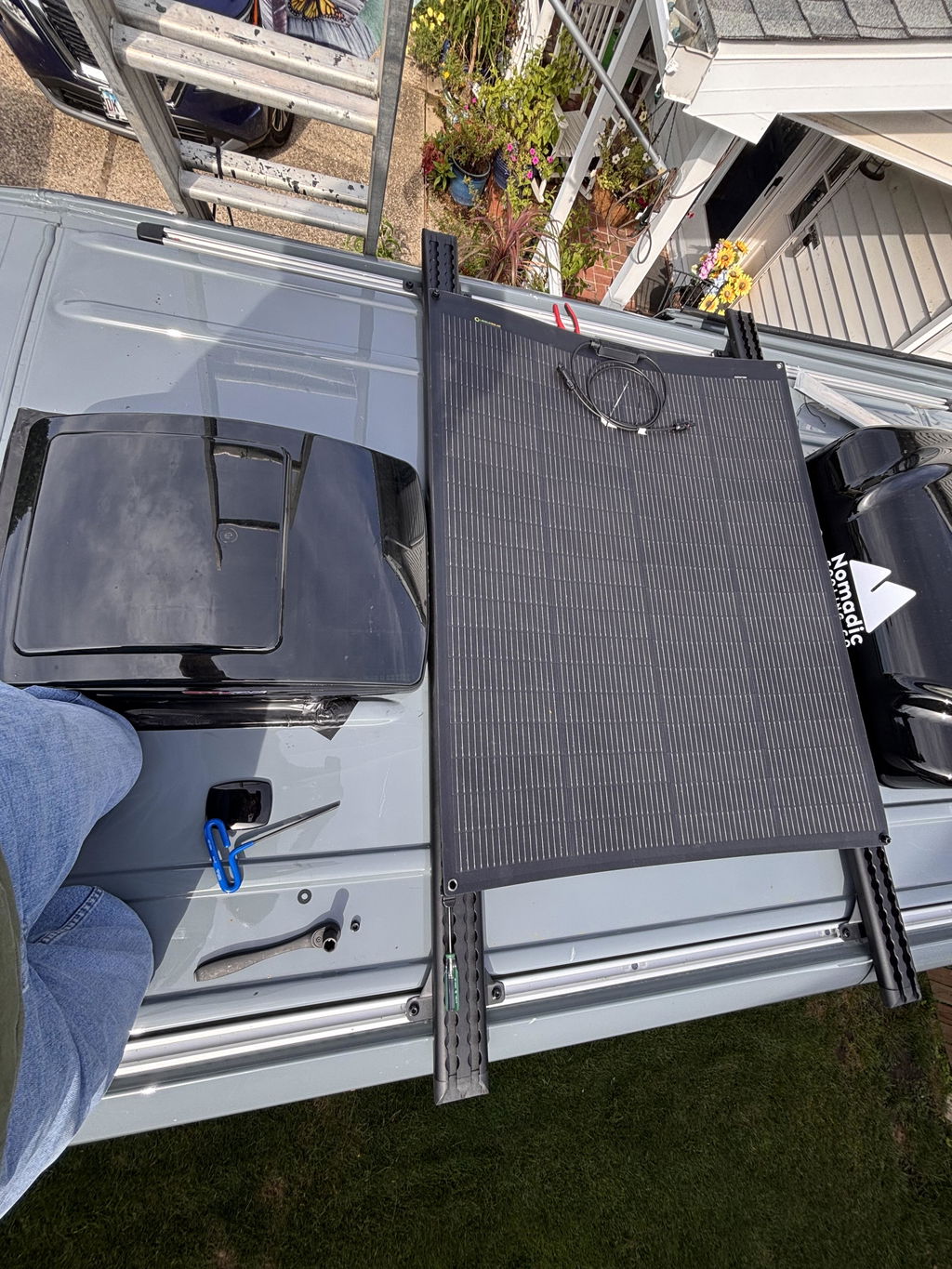
| Solar panels only | 12–18" behind cab break | 28–36" | Match panel width; leave 3–4" clearance at panel edge for airflow |
| Awning + solar | 14–16" behind cab break | 24–30" | Front bar serves as awning mount point; rear bar anchors solar |
| Cargo basket / platform | 8–12" behind cab break | 36–48" | Wider spacing distributes load better across roof structure |
| Roof tent | 10–14" behind cab break | 40–52" (tent footprint dependent) | Tent manufacturer spacing spec overrides; verify before cutting position |
| General-purpose (2-bar) | 12" behind cab break | 30–36" | Good default for mixed loads on 144" wheelbase; adjust for 170" |
Mark the desired bar position on the rail with a piece of masking tape or chalk. On a 144" van, the flat roof span is approximately 80–85" front to back; on the 170", approximately 110–115". Leave at least 10" clearance from the rear edge of the rails for clean mount geometry.
Step 3 — Install T-Nuts into Longitudinal Rail Channels
Slide the included T-nuts into the running channel of your longitudinal rail at each marked position. The T-nut should slide freely along the channel but not rattle — if it binds, check for debris or try rotating it 90° to drop in, then rotate back flat.
Place one T-nut on each side (driver and passenger) at each crossbar position: 4 T-nuts total for a 2-bar kit.
Step 4 — Position Saddle Clamps onto Crossbar Rails
With the DualTrack-T crossbar on the ground or workbench, slide the saddle clamp mounts onto the underside of the crossbar — one at each end. The saddle clamp is contoured to wrap the top of the longitudinal rail and bolt down to the T-nut below. Leave the bolts hand-loose at this stage.
Step 5 — Lift and Set the Crossbar
Lift the assembled crossbar (bar + 2 loose saddle clamps) onto the longitudinal rails at your marked position. The bar should sit flat across both rails. Rotate each saddle clamp so it fully contacts the rail's outer edge — the clamp's bearing face must sit flush, not cocked to one side.
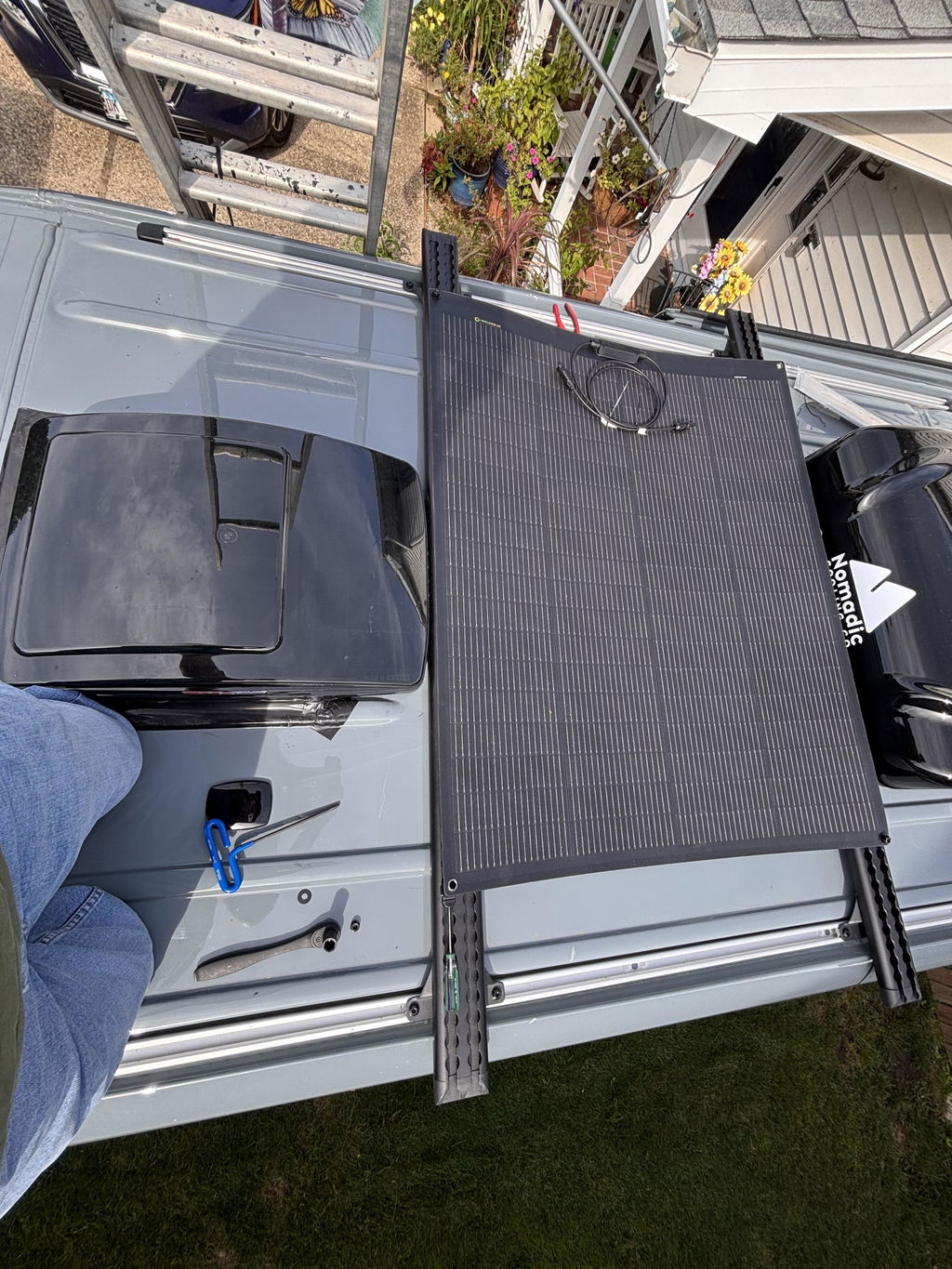
DVA install team note (field-confirmed on 2024 builds): For solo installs, tape the crossbar position mark on both rails before climbing up. Set the bar on one side, hold with your knee, then position the second side. Having a helper for initial positioning saves a lot of time — especially on high-roof vans where the climb adds complexity.
Step 6 — Thread and Snug Hardware
Insert the M6 hex bolt through the saddle clamp, thread it into the T-nut below. Do this for all 4 clamp points. Hand-tighten until snug, then use your 5mm Allen key to bring all 4 fasteners to equal tension before doing a final torque pass. Equalize first — uneven torque can cause the bar to creep off-square over time.
Step 7 — Final Torque Pass
Target: 8–10 ft-lb (96–120 in-lb). This is "firm but controlled" — not as tight as wheel lugs, not fingertip snug. With a torque wrench set to 9 ft-lb, you'll feel a clear click. Without a torque wrench, "firm 1/4-turn past snug with a short (3") Allen key" is a reliable field approximation.
Do not over-torque. Over-torquing the M6 hardware can deform the T-nut, crush the rail channel lip, or strip the saddle clamp thread. If the bar feels immovable after snugging, that's correct — don't keep going. More torque beyond that point adds zero clamping force and only adds risk of fastener damage.
Tip from a Sprinter-Source member doing OEM rail installation: "I used a 1/4" drive ratchet and did all the nuts in three passes: 1) just to flush, 2) snug but not super tight, 3) torqued tight to significant firm resistance." — Sprinter-Source thread #44398 — MB OEM Roof Rail Install with Problem. The three-pass discipline applies directly to DualTrack-T saddle clamps for consistent clamping.
Step 8 — Verify Squareness and Repeat for Second Bar
With the first bar torqued, stand back and verify it's square to the van roof — a quick eyeball down the centerline is enough. The bar should be perpendicular to the longitudinal rails, not angled. Then repeat Steps 3–7 for the second bar. Check both bar positions relative to your load plan one final time before proceeding to accessory mounting.
DualTrack-T Channel Guide: L-Track vs 25mm T-Slot
Each DualTrack-T crossbar has two independent channels running its full 61¾" length:
L-Track Channel (Inner)
The inner channel accepts standard L-Track hardware — sliders, tie-down rings, anchor mounts, cargo net attachments, recovery board carriers, awning bracket adapters, and Pelican case rails. L-Track hardware slides in from the bar end, slides to position, and locks with a thumb-turn or bolt.
Best for: Tie-down points, cargo anchors, awning brackets, recovery gear mounts.
L-Track Tie-Down Ring 4-Pack →25mm T-Slot Channel (Outer)
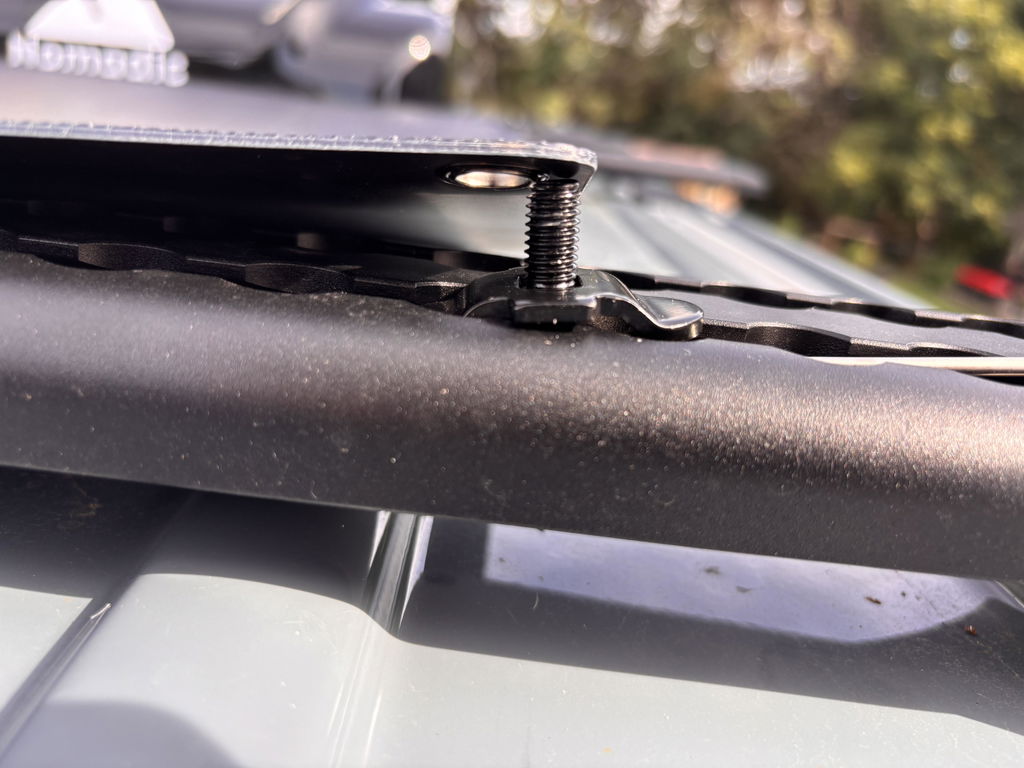
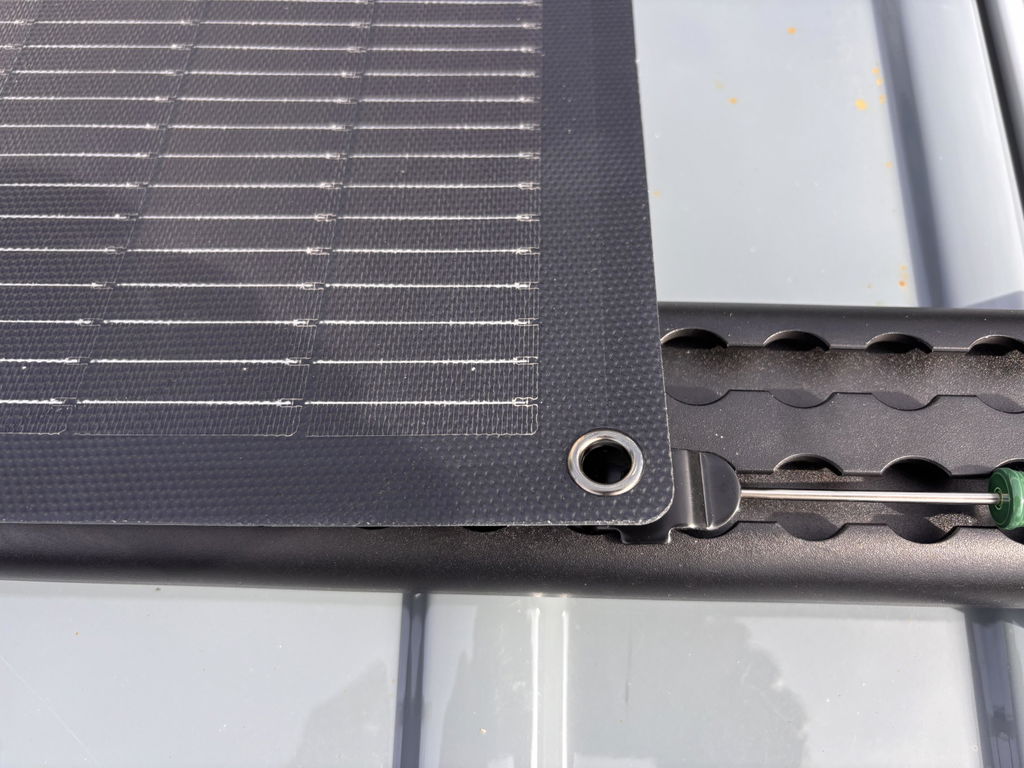
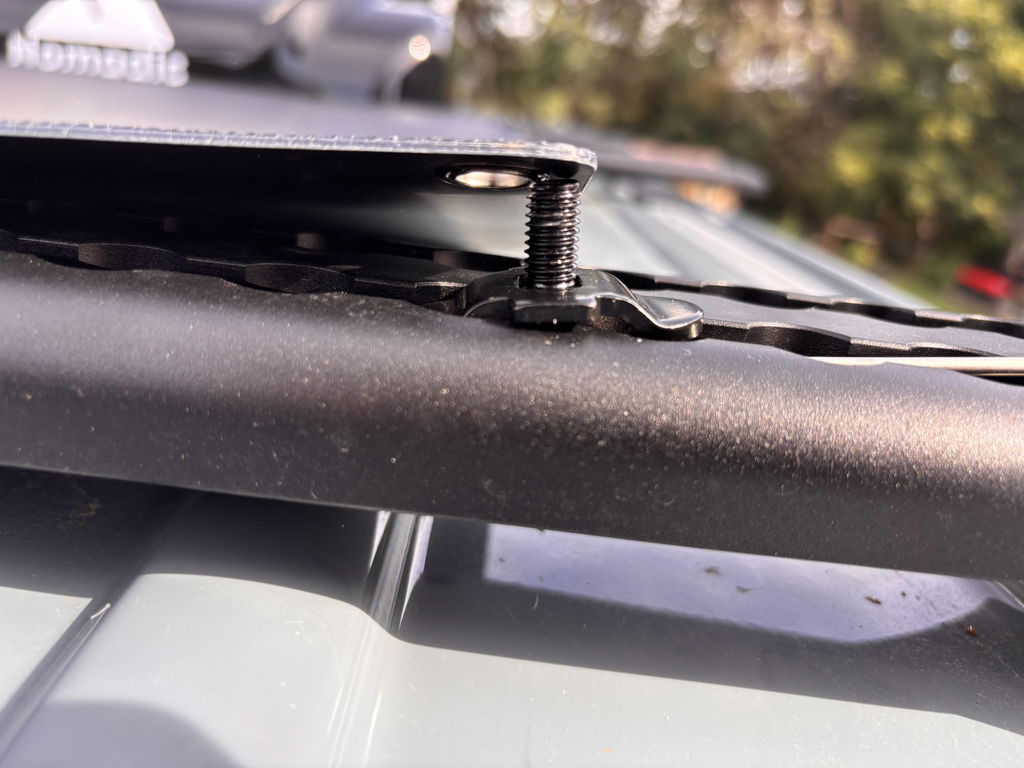
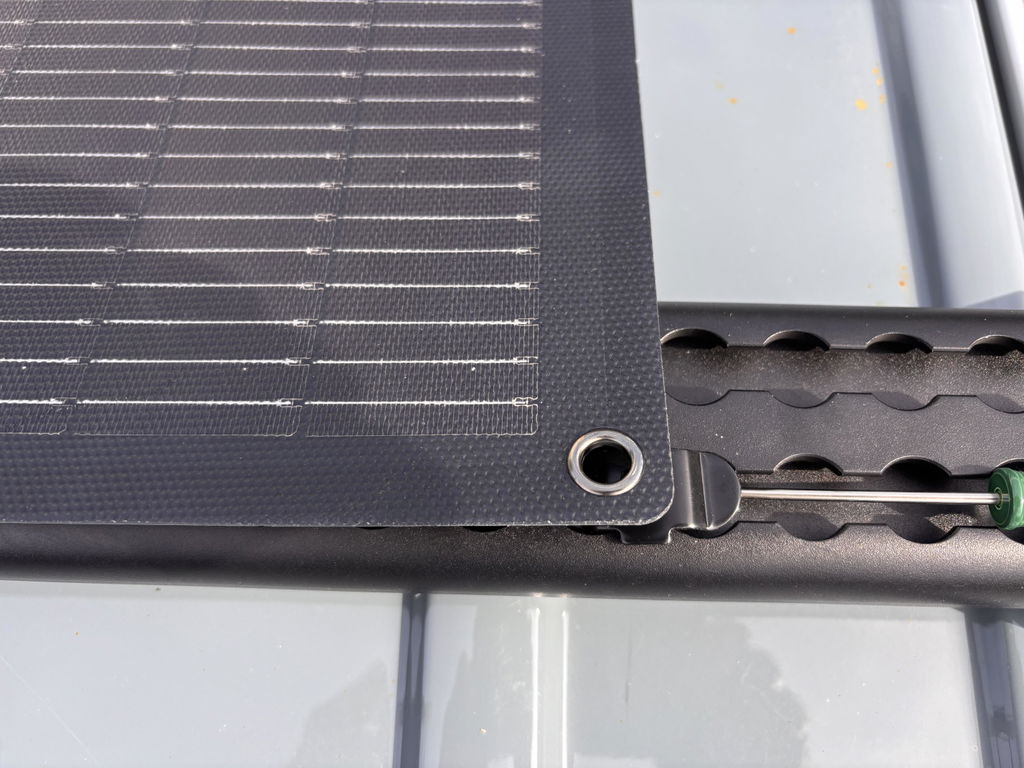
The outer channel is a standard 25mm T-slot that accepts T-bolt hardware — solar panel feet, light bar mounts, slide-in mounting fixtures, and antenna brackets. T-bolt hardware drops in from above, slides to position, and locks with a nut torqued from below.
Best for: Solar feet, light bars, crossbar accessories, branded mounting systems.
Pair with LoadSpan-T™ Rails →Both channels are simultaneously active — you can run L-Track tie-downs for a cargo net on the same bar as 25mm T-Slot solar feet, without adapters or conflicts. This eliminates the frustration owners run into when they mount solar first and then discover the awning bracket won't work with T-slot hardware. DualTrack-T handles both upfront.
Mounting solar panels? Set the 25mm T-bolt solar feet first, then add L-Track tie-downs alongside them. Panel footprint on the bar depends on your panel width — most 100W panels fit between 44" and 54" wide, comfortably within the 61¾" span. Leave at least 3–4" clearance between the panel edge and the outer rail for airflow cooling.
From Sprinter-Source on panel clearance: "Make sure to pick your mount to allow an awning mount if you plan to have it. There is clearance required between the roof rail and the solar panel edge so the awning's brackets can be mounted on the rail." — Sprinter-Source thread #52499 — Mounting Bracket for Solar Panels onto OEM Rails.
Load Limits: What the 330 lb Sprinter Roof Limit Means for DualTrack-T
Mercedes-Benz specifies 330 lb (150 kg) dynamic roof load for the Sprinter — this applies at all roof heights (low, medium, high) and is the limit for the van's roof structure, not just any single component. The 2-bar DualTrack-T kit is rated 150 lb dynamic across both bars combined; the 4-bar kit is rated 300 lb dynamic.
In practical terms: the Sprinter roof is your hard ceiling. You can load up to 150 lb of payload across a 2-bar DualTrack-T kit while driving. Anything mounted to the bars — solar panels, awning, cargo, tent — counts toward that total. The bars themselves won't be the failure point before the roof is; plan your total roof payload budget before you start adding gear.
330 lb dynamic is a total roof limit, not a per-bar limit. Two bars each rated at 150 lb doesn't give you 300 lb of usable capacity — the van's roof structure is the constraint at 330 lb. For loads that maximize your DualTrack-T bars, plan for the Sprinter's 330 lb ceiling and leave margin for the bars' own weight (8.5 lb each = 17 lb for a 2-bar kit).
Common Installation Mistakes and How to Avoid Them
1. Skipping the Rail Channel Cleaning Step
Grit in the T-slot channel causes the T-nut to sit at a slight angle. When you torque down, the nut doesn't bed flat — you'll feel inconsistent resistance and the bar may develop a slight rock. Clean the channel first, every time.
2. Torquing One Side Fully Before the Other
If you fully torque one saddle clamp before the opposite side is threaded in, you create uneven stress that can rotate the bar off-square. Always bring all 4 clamp points to snug first, verify squareness, then do the final torque pass.
3. Positioning Bars Before Knowing Load Layout
This is the most common spacing regret we see. Owners bolt bars at even thirds of the roof for aesthetics, then discover the awning bracket requires a specific forward position. DualTrack-T bars slide freely when loose and are fully reversible — use the spacing guide above and lay out your accessories on the ground before finalizing position.
4. Mounting Crossbars Without Longitudinal Rails
The DualTrack-T clamps to rail channel stock — it cannot attach to bare roof sheet metal or threaded inserts. If your van doesn't have longitudinal rails installed, start with either the OEM MB rails or DVA's LoadSpan-T™ rails, which include the integrated T-slot channel the crossbar needs.
What to Mount on Your DualTrack-T: Accessory Quick Reference
The dual-channel format means almost any roof accessory you'd want fits without adapters:
- Solar panels: 25mm T-bolt solar feet → outer T-Slot channel. Position feet at panel manufacturer's mount spacing (typically 30–36" apart on the same bar or across bars).
- Awning: L-Track awning bracket adapter → inner L-Track channel on the forward crossbar. Run along the passenger side bar for a driver-side awning.
- Cargo nets / tie-down rings: L-Track tie-down rings → inner L-Track channel, anywhere along the bar length.
- LED light bars: 25mm T-bolt mount → outer T-Slot channel on the forward bar.
- Antenna brackets: 25mm T-bolt hardware → outer T-Slot channel, any position on either bar.
- Recovery boards: L-Track recovery board carrier → inner L-Track channel. Mount on the rearward bar for better weight balance.
- Kayak / bike mounts: T-bolt crossbar adapters → outer T-Slot, or use L-Track J-hooks for vertical board storage.
Complete roof system: DualTrack-T crossbars pair with DVA's LoadSpan-T™ Dual-Channel Roof Rails for a fully integrated system where both the longitudinal rails and the crossbars share the same L-Track + T-Slot dual-channel design. No compatibility issues, no mismatched hardware. The complete Sprinter roof rail collection includes all rail and crossbar configurations for every Sprinter wheelbase and height.
Verification Checklist Before First Load
Before putting any load on your DualTrack-T bars, run through this quick verification:
- ☐ All 4 saddle clamp bolts torqued to 8–10 ft-lb
- ☐ Both bars square to the van (perpendicular to longitudinal rails)
- ☐ Bar positions match your planned load layout
- ☐ No bar rock or wiggle when pushed laterally at the ends
- ☐ T-nuts fully seated and flat in rail channel (not cocked)
- ☐ Accessory hardware threaded into correct channel (L-Track vs T-Slot)
- ☐ Total planned roof payload calculated against 330 lb dynamic limit
After 100 miles of driving, re-check the saddle clamp bolt torque. The first drive can settle hardware that was slightly uneven during install. After that first re-check, DualTrack-T crossbars are stable and typically don't need re-torquing unless you reposition a bar or change your load layout significantly.