✅ Quick Answer — Sprinter Interior Cargo Rails 2026: Sprinter interior cargo rails run in three planes: (1) OEM floor rails — factory longitudinal L-track, 1,124 lbf (5,000 N) tensile, threaded into M8 floor cross members; (2) wall L-track — aftermarket, 562 lbf at 24–28" (lower mount) or 337 lbf at 42–48" (upper mount), rivnut-anchored to body ribs; (3) ceiling L-track — optional, 150–300 lbf on overhead rib anchors for overhead storage. Start with floor rails. Add wall L-track for tall cargo, camp furniture, or bike mounts. The same fittings — tie-down rings, threaded lugs, and gear hooks — work across all three planes.
Sprinter interior cargo rails are the longitudinal L-track channels built into the cargo area — floor, wall, and ceiling. The OEM floor rails ship standard in every Sprinter cargo van; wall and ceiling L-track are aftermarket additions. For a complete Sprinter L-track cargo setup, you need three planes: floor rails (OEM-rated 1,124 lbf tensile load) as your primary anchor points, wall L-track at 24–28" and/or 42–48" for tall cargo, and optional ceiling track for overhead gear limited to 150–300 lbf on rib anchors. Most builders start with the OEM floor rails and add wall L-track at one or two heights. The system works because Mercedes engineered the floor rail geometry to the same L-track standard used in aircraft — the same fittings work across all three planes.
This guide covers interior cargo rail setup from the floor up: OEM specs, aftermarket L-track layouts, and the configuration patterns that actual Sprinter builders — from commercial cargo operators to expedition camper van conversions — have validated in the forum threads and build logs from 2024–2025.
01 · OEM Sprinter Floor Rails: Factory Baseline
The stock Sprinter cargo van ships with factory floor L-track running longitudinally through the cargo area, anchored into M8 tapped holes in the floor cross members beneath the plywood cargo floor. These rails are not an afterthought — they are engineered to the same logistical track standard used in commercial freight and aircraft.
Per the Mercedes Sprinter owner's manual (confirmed on the Sprinter-Source wiki), the OEM floor rail specifications are:
| Rail Position | Max Tensile Load | Load Type |
|---|---|---|
| Floor load rails (cargo area) | 1,124 lbf (5,000 N) | Normal tensile — pull-out / upward |
| Lower sidewall rails | 562 lbf (2,500 N) | Normal tensile |
| Upper sidewall rails | 337 lbf (1,500 N) | Normal tensile |
The floor rail rating of 1,124 lbf per fitting matters for cargo work. Under dynamic loading — the forces generated during hard braking or emergency maneuvers — a 300-pound load can generate 600–900 lbf of pull-out force. The OEM system handles that margin. Aftermarket additions to the factory floor channel, including DVA L-track tie-down rings, use the same anchor points and do not degrade the factory rating when installed correctly.
What's Not Factory (and Why Owners Add It)
The factory Sprinter comes with floor rails but typically does not include upper sidewall rails in the standard configuration. Conversion builders add wall and ceiling rails to handle the full range of cargo — from securing tall items upright against the sidewall, to hanging lightweight gear from ceiling-mounted tracks overhead.
The track systems are supported by many fasteners, not point loaded. If the track fasteners should fail, the track will not pull out and release the load as a single point fastener will. If a fastener(s) fails the track will distort, but the load will still be retained — a sort of domino effect which absorbs the energy. The track fasteners in the immediate area see pullout loads. As the stress moves down to other fasteners, those fasteners see more shear load.


02 · Wall L-Track Setup: Height and Orientation
Wall-mounted L-track in a Sprinter runs horizontally (most common) or vertically, depending on the load type. Horizontal mounting at the right height is the most debated layout choice in Sprinter builder communities — the height determines what you can secure and how efficiently.
Optimal Height by Use Case
| Mount Height | Best For | Load Rating (OEM reference) |
|---|---|---|
| Floor level (0–12") | Pallet-height loads, floor cargo extension | 562 lbf (lower rail) |
| Mid-wall (24–36") | Securing tall cargo upright (canopies, boards, ladders) | 562 lbf (lower rail) |
| Upper wall (42–54") | Medium-weight gear strapping, light tool organization | 337 lbf (upper rail) |
For most cargo setups, a two-rail horizontal layout — one at 24–28" and one at 42–48" — covers the widest range of cargo types. Commercial cargo operators typically run three horizontal rails (low, mid, upper) for maximum anchor point density. Camper van conversions often use a single mid-wall rail on the driver's side, leaving the passenger side clean for wall panels and cabinetry.
"Stop thinking of the track system as a single point attachment like a D ring. The track systems are supported by many fasteners, not point loaded. If a fastener fails the track will distort, but the load will still be retained in a sort of domino effect which absorbs the energy."
— Sprinter-Source forum, thread #28138 'Mounting L-track to walls'
Fastener Strategy for Thin Sheet Metal
The Sprinter's wall sheet metal is thin-gauge — thinner than most builders expect. Mounting L-track to walls requires a backing strategy to distribute the load across the panel rather than concentrating it at individual bolt holes. Common approaches include:
- Aluminum backing plate: A 1/8" aluminum flat bar behind the panel, longer than the track, distributes fastener loads across a wider area. This is the most reliable method for structural wall mounts.
- Nutserts (rivet nuts): Installed from the panel face, expanding on the backside. Works well for mid-weight applications (upper sidewall tracks). Requires a nutsert tool and proper installation torque to avoid backing-plate spin-out.
- Sheet metal screws with fender washers: Viable for lighter-duty wall applications. Not recommended for lower sidewall tracks carrying heavy loads — pull-out strength is lower than bolted-through configurations.
DVA L-Track Accessories
Tie-down rings, threaded lugs, and gear hooks — designed for the standard L-track channel used in Sprinter floor and wall rail systems.
Shop L-Track Tie-Down Rings →03 · Ceiling L-Track: Overhead Cargo Management
Ceiling-mounted L-track is the least common of the three planes but handles cargo types that floor and wall rails can't address efficiently: bikes, surfboards, long lumber, folded canopies, and overhead tool organization in commercial setups.
Ceiling mount load ratings depend entirely on the backing structure rather than OEM specs (the factory Sprinter ceiling is not designed for cargo loads). Standard Sprinter builder practice is to run ceiling L-track anchored through a structural ceiling sub-frame or directly to the rib structure. Load ratings in this configuration are governed by the ceiling structure, not the L-track itself — most builders target a conservative 150–300 lbf per track run for overhead hanging loads.
Ceiling Track Limitations
Overhead L-track works for hanging or clamping loads — not for resisting pull-out under emergency braking. If you're securing bike frames, boards, or long-length items overhead, they still need to be supplemented with forward/aft tethers anchored to floor or wall rails to prevent the load from swinging forward under hard deceleration.
"I ran non-flanged track the length of the van with 1/4" rivnuts in existing holes in the roof supports. It is plenty strong to hang cabinets or other items. I've even hung like a monkey from it and no deflection. The limiting factor on load capability will not be the span of the L-track. The limit will be the strength of the cross ribs."
— Sprinter-Source forum, thread #73816 'L-Track ceiling install North South'
04 · Interior Rail Layout Patterns by Build Type
No single layout pattern works for every Sprinter. The configurations below reflect what actual builders have settled on after testing across three core build types.
Commercial Cargo
- 3× floor rail runs (left, center, right)
- 2× horizontal wall rails each side (low + mid)
- No ceiling track (clearance priority)
- Heavy use of anchor rings + threaded lugs
Expedition / Overland
- 2× floor rails (sides, not center — for gear staging)
- 1× mid-wall rail driver's side only
- 1× ceiling track run for overhead gear
- DVA adjustable gear hooks on wall rail
Camper Van Conversion
- Floor rails covered/integrated into platform base
- 1× upper wall rail for strapping during transit
- Ceiling track optional (bikes/boards only)
- Roof-integrated L-track via LoadSpan-T rails
Tradesmen / Work Van
- 3× floor rails
- Full-height vertical wall tracks for tool boards
- Upper wall rail for long-handle tool organization
- O-ring fittings for quick-attach equipment
05 · Roof L-Track: The Third Axis
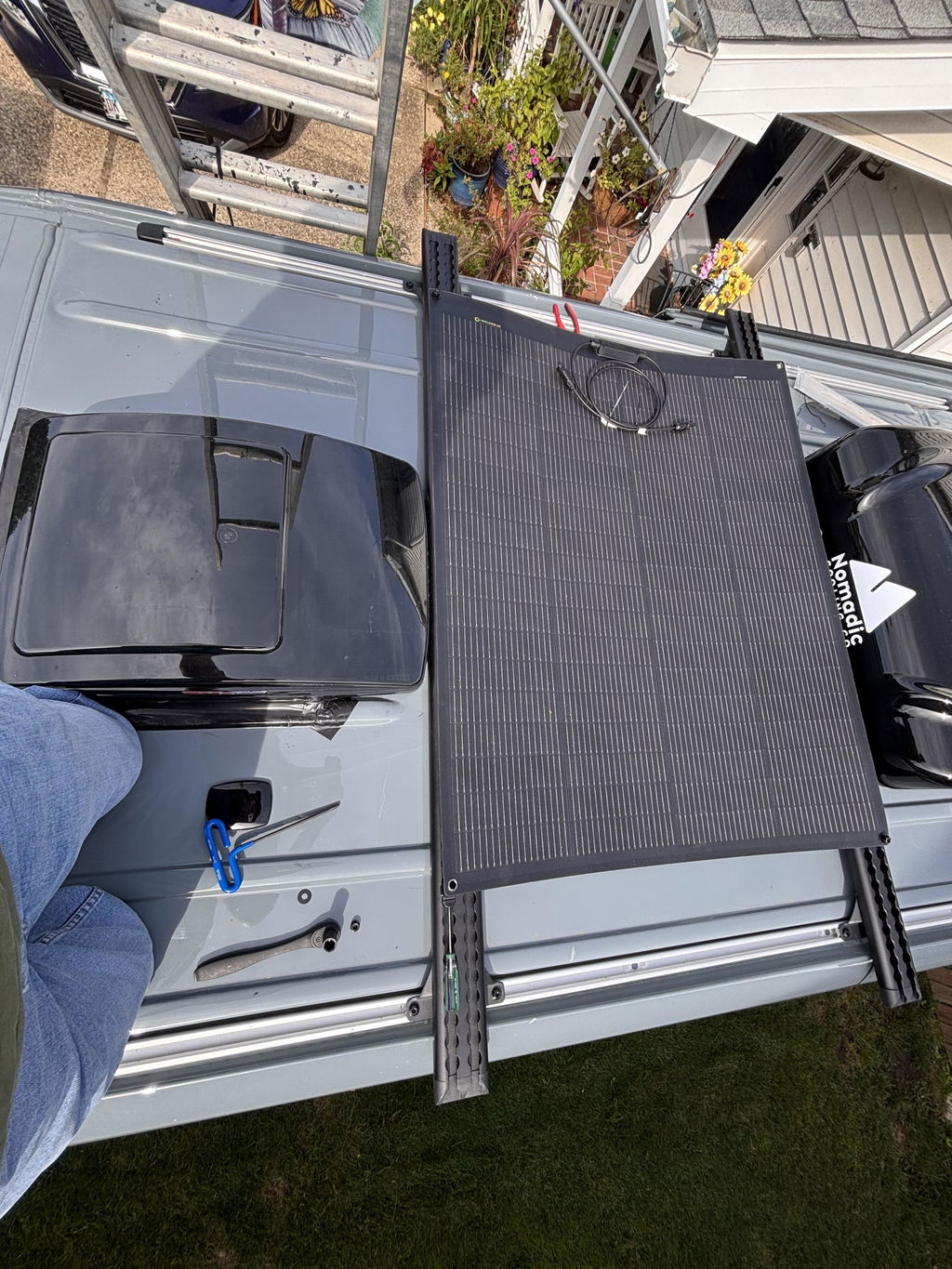
The cargo rail system extends beyond the Sprinter's interior. The roof of a Sprinter can carry a full L-track rail system via properly engineered roof rail mounts — adding the third axis for cargo that can't fit inside or needs roof staging for loading/unloading.
DVA's LoadSpan-T™ Roof Rails integrate a full-length L-track channel into a dual-channel roof rail system, giving you a continuous cargo management track from the interior floor through to the roof exterior. The LoadSpan-T rails carry a 330 lb dynamic roof load (calculated across the roof panel span), with the L-track channel itself rated to L-track standard tensile loads for properly spaced fittings.
Sprinter Roof L-Track Integration
The LoadSpan-T roof rail system includes integrated L-track channels — extend your interior cargo rail system to the roof exterior for full-axis cargo management.
View LoadSpan-T Rails →06 · DVA L-Track Product Guide for Sprinter Builds
DVA stocks the L-track accessories that work in the standard L-track channel geometry used by Sprinter floor rails, aftermarket wall rails, and the DVA LoadSpan-T roof system. The entire line is designed around the insert-and-twist lug mechanism standard to aircraft and van L-track.
| Component | Use Case | Load Notes |
|---|---|---|
| L-Track Tie-Down Ring, 4-Pack | Primary cargo anchor points (floor + wall) | Double-stud lug — highest per-point rating |
| Heavy-Duty Threaded Lug, 8-Pack | Custom strap / hook attachment points | 3/8" thread, for M10 hooks and straps |
| Adjustable Gear Hook, 4-Pack | Wall-mounted tool / gear hanging | Repositionable anywhere along the track |
| O-Ring Stud Fitting, 4-Pack | Strap loop and D-ring attachment | Stainless O-ring for corrosion resistance |
| L-Track Rail 58.5" × 1.5", Set of 2 | Aftermarket wall / ceiling track runs | Standard 1.5" L-track profile |
| DualTrack-T Cross Bar Kit | Roof L-track crossbars with T-slot + L-track channels | 330 lb dynamic roof load (Sprinter) |


07 · Installation Reference: Bolt Specs & Spacing
L-track installation quality determines the system's actual load capacity. Regardless of the track's published rating, an under-bolted installation limits performance to the weakest fastener point. Key specifications from Sprinter builder documentation and DVA installation testing:
- Floor rail fastener spacing: Match OEM spacing — approximately every 12" — for full load distribution benefit
- Bolt spec for floor mount: M8 × 40mm for standard plywood cargo floor; use M8 × 60mm if adding backing plate beneath the subfloor
- Wall mount bolt spec: M8 with nutserts or through-bolted with aluminum backer; do not use self-tapping screws for lower sidewall rails under structural load
- Ceiling mount: 5/16" or M8 into ceiling rib or structural sub-frame only — do not anchor to sheet metal ceiling skin alone
- Fitting insertion torque: Insert-and-twist lugs should seat firmly but not be over-torqued — approximately 8–12 ft-lb for M8 threaded lug
L-Track Mounting Hardware
M8 × 20mm, 40mm, and 60mm L-track bolts — matched to standard L-track slot pitch for floor, wall, and ceiling installations.
Shop L-Track Bolts →📅 2026 Build Context: As of mid-2026, the forum consensus has shifted toward combining OEM floor rails with aftermarket 1.5" flanged L-track on walls — the OEM wall rails are no longer considered necessary for most builds. DVA L-track accessories (tie-down rings, threaded lugs, gear hooks) now cover the full range of cargo management fittings in a single system. For builders sourcing wall track: the 58.5" × 1.5" rail set is the most commonly spec'd length for Sprinter 144 side walls in 2025–2026 builds.
Summary: Interior Cargo Rail Setup Checklist
Floor: Use OEM rails as your primary heavy-load anchor points (1,124 lbf rated). Add DVA tie-down rings and threaded lugs to the existing channel — no new drilling needed.
Walls: Mount horizontal L-track at 24–28" (mid-wall) and 42–48" (upper) for standard cargo. Use aluminum backing plates or nutserts — not sheet metal screws alone — for lower sidewall runs.
Ceiling: Anchor to structural ribs or sub-frame only; limit hanging loads to 150–300 lbf and supplement with fore/aft floor anchors for anything that could swing under braking.
Roof extension: DVA LoadSpan-T rails integrate exterior roof L-track with the interior system for full-axis cargo management on expedition and commercial builds.
Cross-reference: For load rating comparisons between L-track and E-track systems, see our Sprinter L-Track Mounting Systems guide. For Sprinter roof rail infrastructure and rail spacing specs, see the Sprinter Roof Rail Buyers Guide.