For off-grid cooling, a 12V DC rooftop unit (typically 6,000–10,000 BTU, drawing 35–50A at 12V) paired with 400Ah+ LiFePO4 and 800–1,200W solar is the realistic path — providing 6–8 hours of overnight cooling on a full battery. For shore-power or generator use, a 120V rooftop unit (13,500 BTU, ~1,200–1,500W draw) costs less upfront and cools faster. Mini-splits work but add installation complexity. Portable units are limited to temporary or shore-power-only situations. The forums' consistent lesson: insulation quality matters more than AC unit choice.
- 12V rooftop: 6,000–10,000 BTU, ~400–600W, needs 400Ah+ LiFePO4 + 800W+ solar
- 120V rooftop: 13,500 BTU, ~1,400W, needs inverter (2,000W+) or generator/shore power
- Mini-split: Quiet, zoned cooling; 12V/24V; high install complexity
- Portable: No roof penetration; limited to shore power; not practical off-grid
Why Cooling a Sprinter Van Is Genuinely Hard
A Sprinter van is essentially a metal box. Even with insulation, a parked van in direct summer sun can reach 130°F+ inside before you open a door. The two physics problems: the van gains heat fast from a large sheet-metal roof exposed to the sky, and has very little thermal mass to buffer swings in temperature. Running an air conditioner in this environment is fighting physics with electricity.
The second problem is electrical. Cooling a Sprinter interior (roughly 500–600 cubic feet for a 170" wheelbase) requires a meaningful BTU output — typically 8,000–13,500 BTU for the space in realistic conditions. The electrical load to produce those BTUs ranges from 400W at minimum on the most efficient 12V units to 1,500W+ for a standard rooftop unit. Sustaining that draw overnight without shore power demands a battery bank that most builds don't have.
The forums discovered all of this the hard way over the last decade. The summary of what owners have learned: insulation reduces the load enough to make 12V cooling viable; without good insulation, no 12V system will keep up.
The Four AC Options: Honest Breakdown
1. 12V DC Rooftop Units
True 12V (or 24V/48V) rooftop units run directly from your house battery bank via a compressor built around a variable-frequency brushless DC motor. These draw 35–50A at 12V (400–600W) in normal operation, and up to ~80A at peak startup — though most modern units have soft-start to reduce that spike.
The key advantage over 120V units is efficiency: no AC inverter losses, no startup surge that trips breakers, and a load that your solar array can directly offset during the day. On a Sprinter 170" wheelbase roof with 800–1,200W of solar panels, a well-insulated van can run the 12V AC continuously when the sun is out, extending into evening on battery.
The catch: 12V rooftop units in the 6,000–10,000 BTU range cost significantly more than equivalent 120V units, and they produce less cooling per dollar than a traditional rooftop RV unit. For full-timers and boondockers, the off-grid capability justifies the premium. For weekend warriors with shore-power hookups, it often doesn't.
2. 120V AC Rooftop Units (Generator or Shore Power)
Traditional rooftop RV air conditioners (the same units used on Class B and Class C motorhomes) produce 13,500–15,000 BTU and draw approximately 1,200–1,500W running, with a 2,000–3,500W surge at startup. They require a 30A shore power connection, a generator, or a large inverter (minimum 2,000W, preferably 3,000W with soft-start).
These are less expensive to purchase ($800–1,500 installed vs $2,000–4,000+ for 12V units) and cool a Sprinter van faster due to higher BTU output. The downside is the dependency on 120V power — which means either plugging in, running a generator, or investing in a large inverter and a large LiFePO4 bank (the battery bank cost often exceeds what you'd spend on the 12V unit).
For van builds that stay at campgrounds with electrical hookups, the 120V rooftop path is hard to argue against on cost-effectiveness grounds. The real-world consideration is generator noise and campsite etiquette — most campgrounds enforce quiet hours that align with the hours you most want AC.
3. Mini-Split Systems (12V / 24V)
Mini-split systems separate the compressor (condenser unit) from the air handler (evaporator), connected by refrigerant lines. In van applications, the condenser mounts under the van, on the rear doors, or on the roof exterior, while the air handler mounts inside. 12V and 24V DC mini-splits designed for vehicle use draw similar power to rooftop 12V units but offer quieter operation and more flexibility in routing.
The forum consensus: mini-splits work, but the installation is more involved than a rooftop cutout, and the condenser placement is a genuine engineering challenge in a Sprinter. Mounting between the undercarriage cross-members has airflow restrictions; rear-door mounts add weight to the doors and require flex refrigerant lines.
The practical advantage of mini-splits is noise: the compressor runs outside the cabin, making sleeping significantly more comfortable than with rooftop units where the compressor vibrates directly above your head. For full-time van lifers who prioritize sleep quality, the installation complexity may be worth it.
4. Portable Units
Portable air conditioners (single-hose or dual-hose) require 120V and exhaust hot air via a duct to the outside. In a van, "outside" means either a window vent or a wall penetration — both of which break the van's weatherproofing and are inconvenient to set up and take down. They also require either shore power or a generator.
The honest assessment from owners: portables are useful for stationary builds with reliable shore power access, as a stop-gap while planning a permanent install, or for cargo/conversion vans where you can't or won't cut the roof. For a full van build, they're rarely the right long-term answer.
BTU Sizing for Sprinter Vans
Sizing an AC unit for a van is different from sizing for a room because the heat load in a van is dominated by solar gain through the roof and walls, not by occupancy or appliance heat. The starting point is the van's insulation quality — an uninsulated Sprinter needs 2–3× the BTU of a well-insulated build to reach the same interior temperature.
| Wheelbase / Configuration | Insulation Quality | Recommended BTU | Notes |
|---|---|---|---|
| 144" (all roof heights) | Good (2"+ closed-cell foam) | 6,000–8,000 BTU | Comfortable for 2-person occupancy in most climates |
| 144" | Poor or none | 10,000–13,500 BTU | Fighting condensation and radiant heat constantly |
| 170" standard roof | Good | 8,000–10,000 BTU | Most 12V rooftop units in this range |
| 170" high roof | Good | 10,000–13,500 BTU | High roof adds ~20% volume; 120V units often preferred |
| Extended 170" (crew or extended) | Good | 13,500–15,000 BTU | Borderline for single-unit coverage at peak summer temps |
The forum consensus on sizing: most builders underestimate the BTU requirement on their first build and overestimate it on their second. A well-insulated 170" standard roof van in a dry climate can be kept at 72°F on 8,000 BTU. The same van in Houston in August is a harder problem — plan for 10,000 BTU minimum.
Most 12V rooftop AC units weigh 35–55 lbs. A 120V RV rooftop unit runs 70–90 lbs. Add solar panels, a roof rack, and a roof vent fan and you're at 200–300 lbs total roof load on a 170" van. See the Sprinter roof weight budget guide for the full payload math before planning your roof layout.
Battery Bank Math: What It Really Takes to Run AC Overnight
This is where most plans fall apart. A 12V rooftop unit drawing 45A average over 8 hours of nighttime cooling requires 360Ah of draw. With LiFePO4 at 80% usable depth of discharge, you need 450Ah of battery capacity to cover one night without exhausting the bank. Add a margin for a cloudy next day, and the military vehicle AC engineer cited in forum discussions was right: 800Ah minimum is the realistic figure for reliable off-grid overnight cooling.
Our install team has helped spec cooling systems for Sprinter builds since 2022. The most consistent spec mistake: choosing the AC unit before running the battery math. Builders who start with 200–300Ah assume they can add more batteries later — but the electrical architecture (wire gauge, fuse sizing, solar controller capacity) is harder to upgrade after the build is finished than it is to spec correctly the first time. Build to 400Ah+ LiFePO4 from the start if you plan to run AC off-grid, and size the solar charge controller for 800–1,200W even if you install panels in phases.
| Scenario | AC Draw | 8-hr Night Draw | LiFePO4 Bank Needed | Solar to Recharge |
|---|---|---|---|---|
| Mild climate, good insulation | 35A avg | 280Ah | 350–400Ah | 600–800W |
| Hot climate, good insulation | 45A avg | 360Ah | 450–500Ah | 800–1,000W |
| Hot climate, modest insulation | 60A avg | 480Ah | 600Ah+ | 1,000–1,200W |
| 120V unit via 3kW inverter | 125A avg (12V equivalent) | 1,000Ah | 1,200Ah+ | Not realistic off-grid |
The 120V rooftop path via inverter is not off-grid viable for overnight cooling in a Sprinter without an extreme battery investment. At 1,200+ Ah of LiFePO4, you're spending $8,000–12,000 on batteries alone before the inverter and AC unit. That's the math that pushes serious off-grid builders toward 12V units despite the higher upfront cost.
Solar Integration: Powering Your AC Off the Roof
For 12V AC systems to work off-grid, solar charging needs to replace the overnight draw during the day. On a Sprinter 170" wheelbase, the roof offers approximately 65–80 square feet of usable space — enough for 1,000–1,400W of panels depending on roof height and what else is mounted (fans, antennas, awning brackets).
The math for a moderate climate scenario: 1,000W of solar in 5 peak sun hours produces 5,000Wh = roughly 400Ah at 12V. That matches the overnight draw for a well-insulated van running a 12V AC unit in mild-to-moderate heat. On ideal days, you break even. On cloudy days or in extreme heat, you run a deficit and need either shore power or a generator for topping up.
Mounting Solar for AC Power: Maximize Your Roof
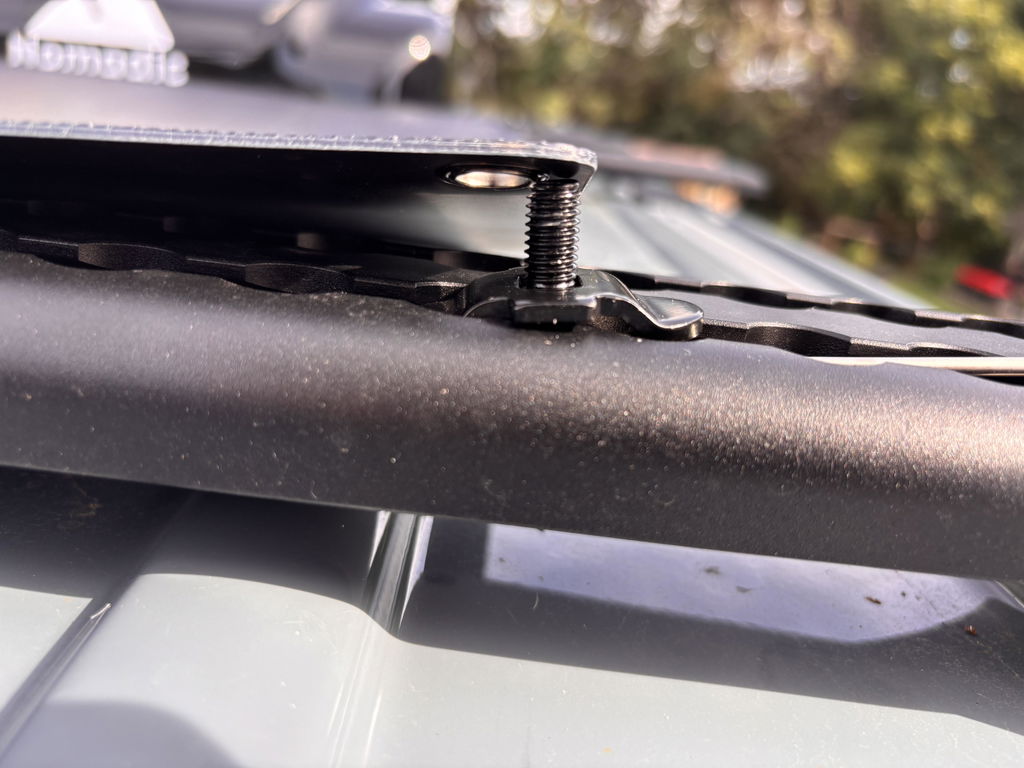
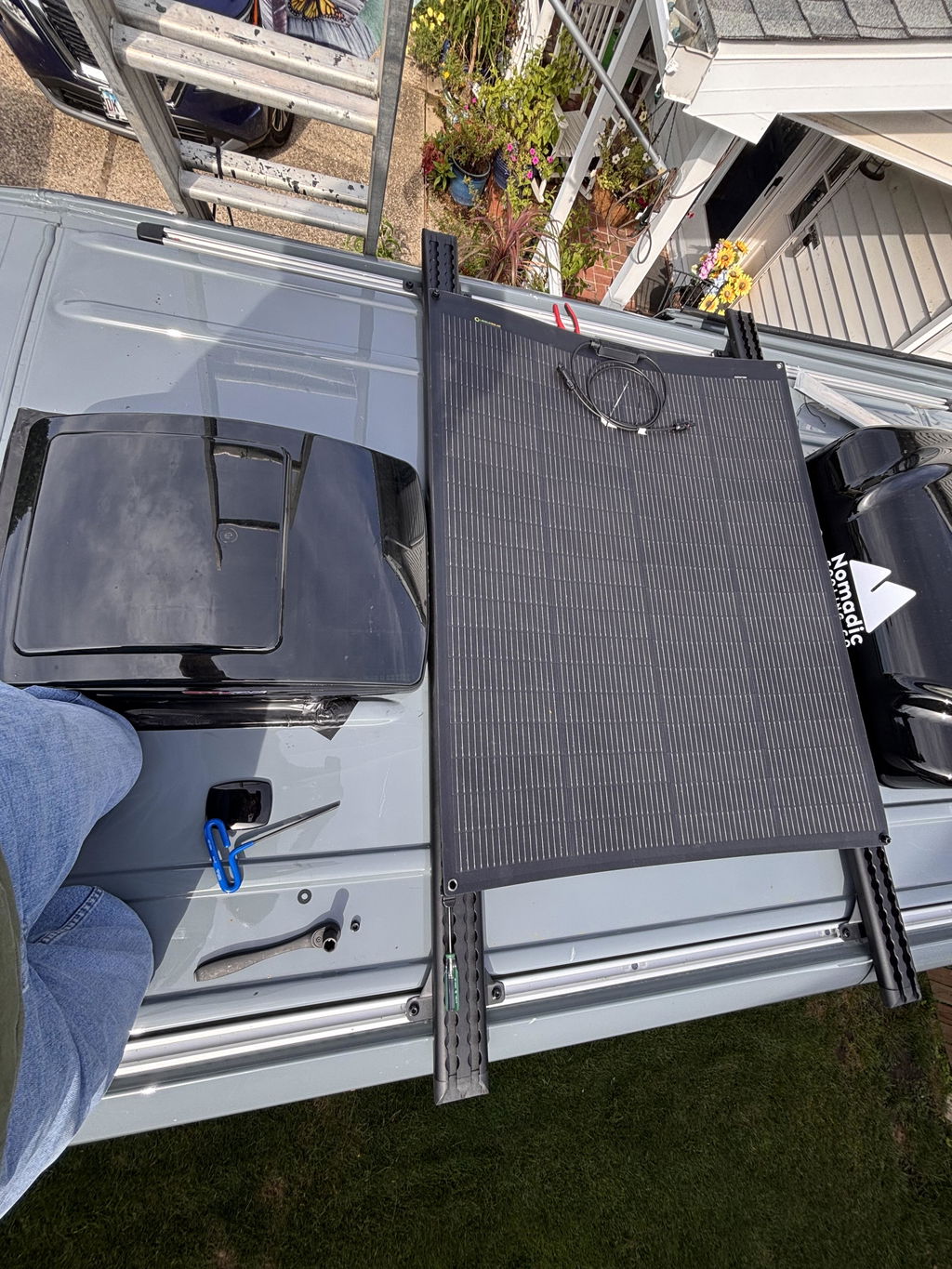
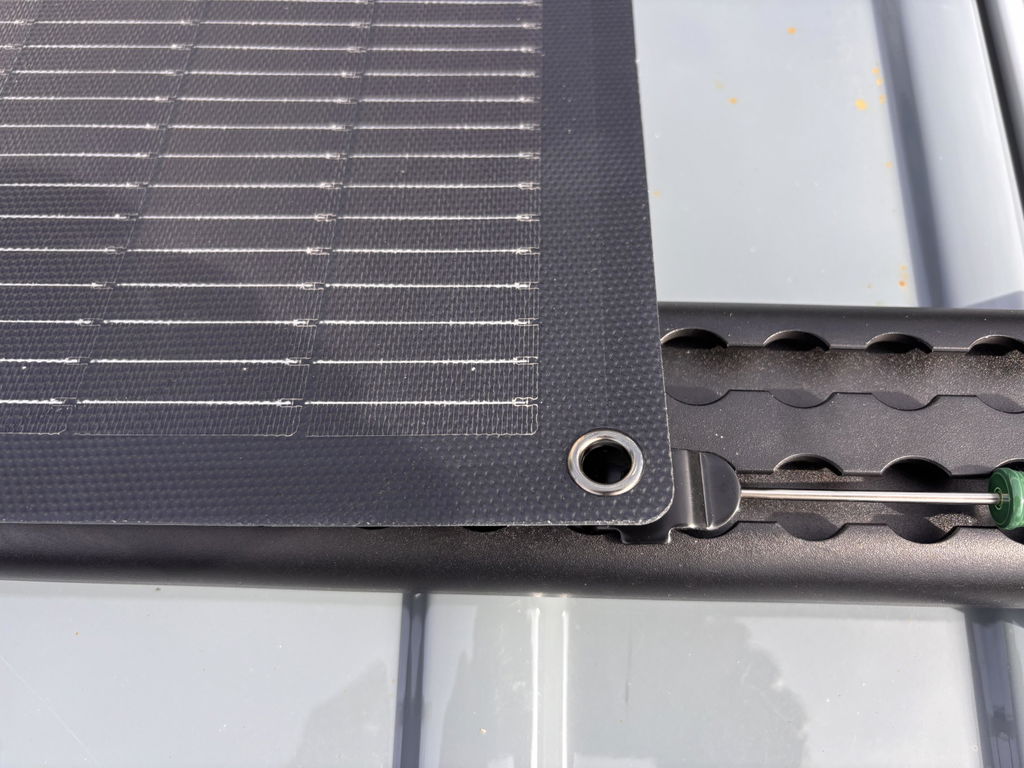
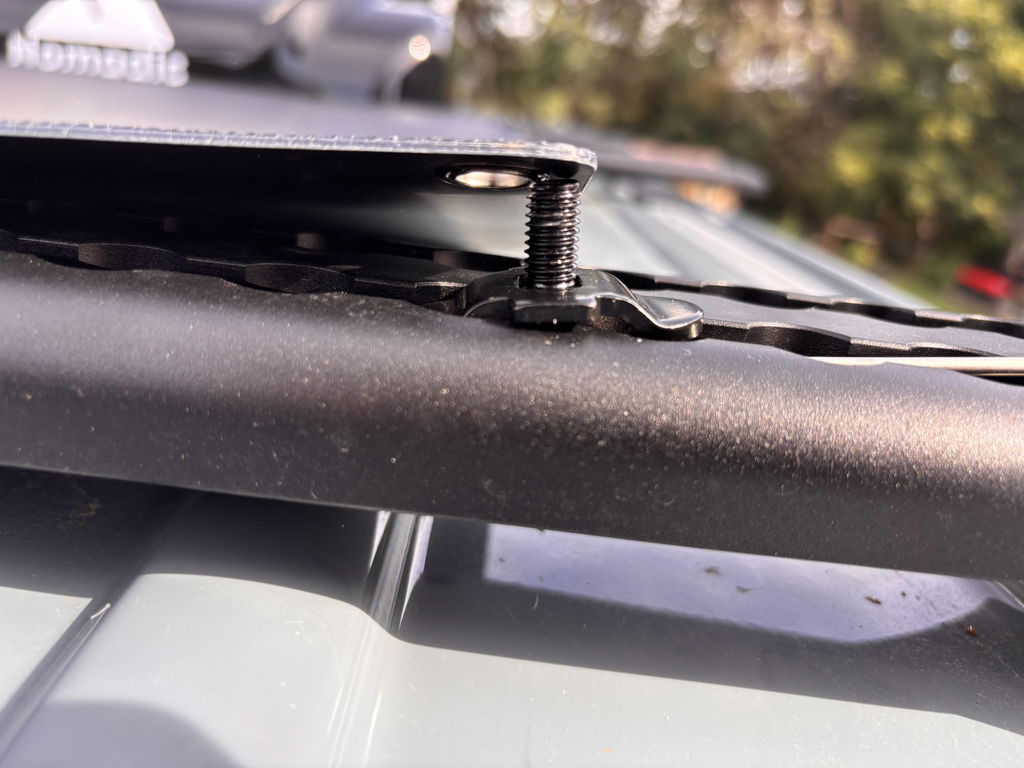
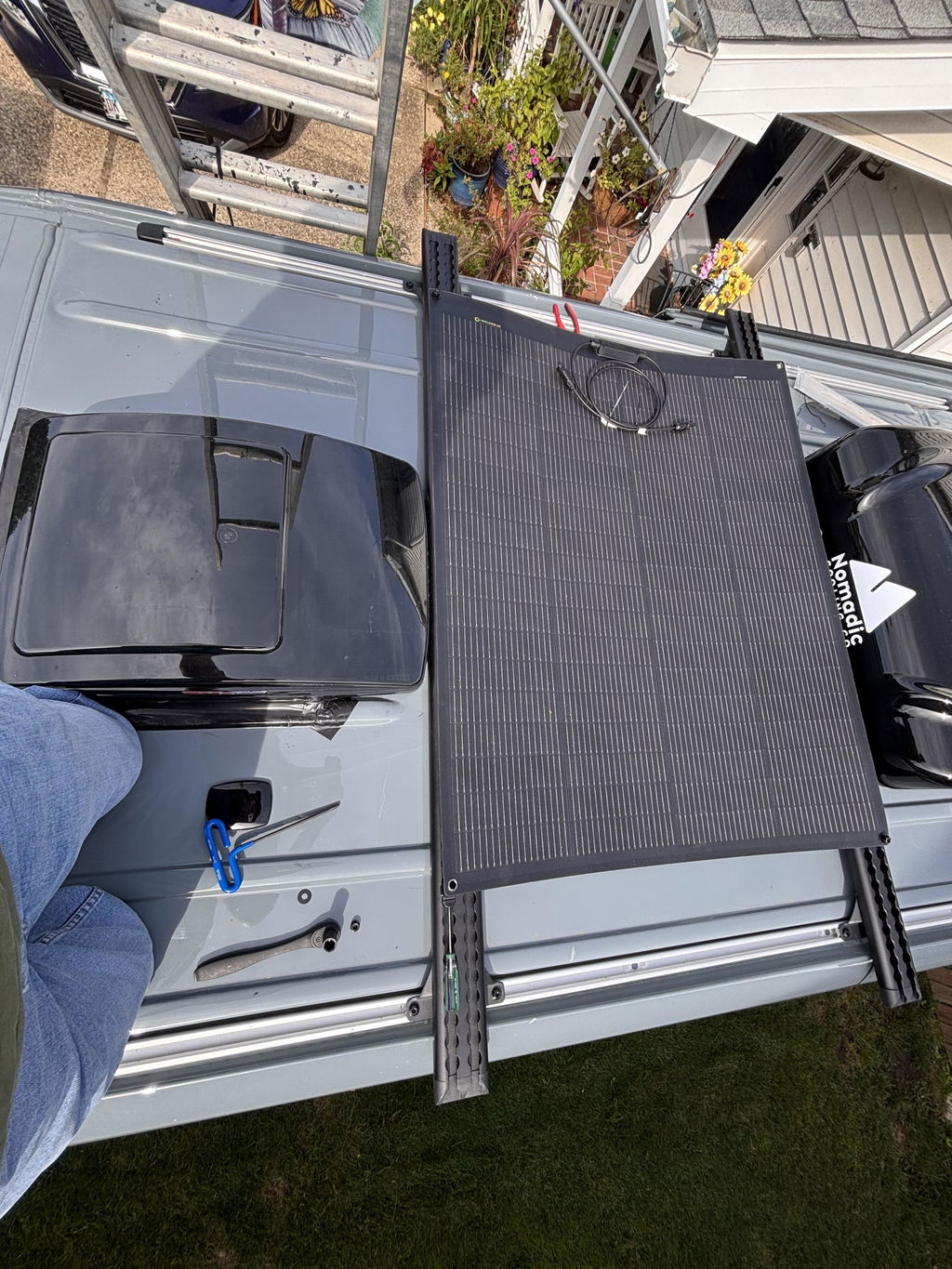
Getting enough solar panels on a Sprinter roof to power a 12V AC system demands a mounting solution that maximizes usable area, keeps panels close to the roof (reduces drag and wind load at highway speeds), and allows clean cable routing. A chaotic roof with conflicting mounts wastes both watts and structural capacity.
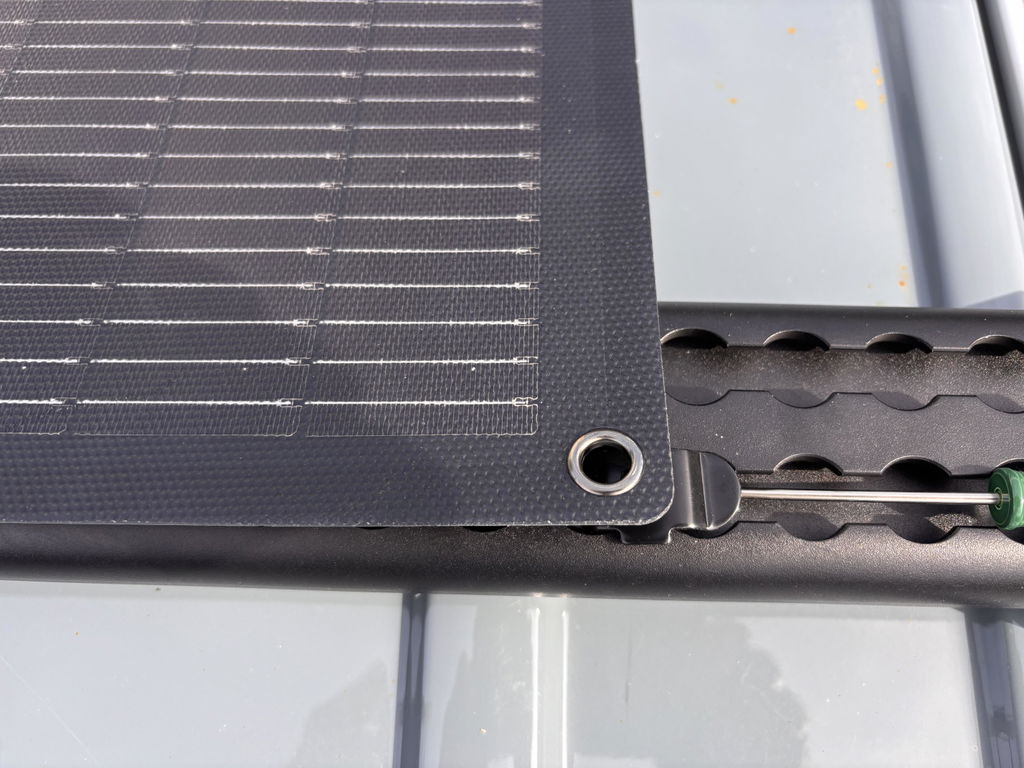
DVA's LoadSpan-T Dual-Channel Roof Rails for Sprinter run full-length along both sides of the roof, providing a T-slot and L-track channel that solar panels, crossbars, and fans all mount directly to — no secondary brackets needed. The dual-channel design means you can run three crossbars across the full width and lay 400W panels flat between them, clearing the center for a roof vent fan without sacrificing panel count.
Pair with DualTrack-T Crossbars for a rigid grid that supports 200–400W panel arrays without drilling additional holes.
Roof Cutout and Installation: What Builders Actually Do
All rooftop AC units (12V or 120V) require a roof cutout — typically 14" × 14" for RV-standard units, and similar for most 12V units. This is a significant, permanent modification that affects the Sprinter's structural integrity and waterproofing. The steps that matter:
Location: Most builders place the AC unit near the center of the cabin over the living area, offset slightly forward of center to avoid compromising the rear bed area. The unit cannot go above structural roof ribs — plan around those before measuring. On a high-roof Sprinter, you also have the option of mounting near the rear cargo area if that's your sleeping zone.
Headliner clearance: The stock Sprinter headliner is 3–4" below the roof skin. After cutting and fitting the AC unit, you lose that clearance directly below the unit. Most builders either remove the headliner locally (maintaining ceiling height everywhere else) or use a lower-profile 12V unit designed with this constraint in mind.
Waterproofing: Butyl tape plus a roofing sealant (not silicone — use a UV-stable non-hardening tape-and-cap system) is the forum-standard approach. A leak around the AC cutout is difficult to diagnose and repair after the interior is built out. Take extra time here.
Electrical routing: 12V units need heavy-gauge cable runs (typically 4 AWG or larger) from the battery bank to the unit. Route through an existing grommet or firewall penetration if possible, and protect all wire runs with split loom in areas that contact metal. Use an appropriately rated fuse at the battery end — 100A for most 12V rooftop units.
What Forum Owners Actually Run (By Use Case)
After reading through years of Sprinter-Source threads and Reddit build logs, the pattern by use case is consistent:
| Owner Profile | What They Run | Why |
|---|---|---|
| Full-time boondocker, hot climates | 12V rooftop, 400–600Ah LiFePO4, 1,000W+ solar | Only path to consistent off-grid overnight cooling |
| Full-time, campground mix | 12V rooftop or 120V via inverter; shore power for AC-heavy nights | Hybrid — runs solar during day, plugs in when hot |
| Weekend warrior, campgrounds | 120V rooftop + 30A hookup | Simple, effective, cheap. Generator for dispersed camping |
| Sleep-quality priority (quiet) | 12V or 24V mini-split; condenser under or at rear | Compressor noise isolated from cabin |
| No roof cutout possible | Portable 120V unit + window vent adapter | Stop-gap or rental/fleet builds |
Insulation: The Variable That Changes Everything
No forum discussion about van AC is complete without the insulation caveat. A well-insulated Sprinter — 2" closed-cell spray foam on walls and ceiling, Thinsulate in cavities, reflective barrier on the roof — can hold temperature well enough that a 6,000 BTU 12V unit runs at 30% duty cycle in moderate heat. The same van without insulation needs the unit running near-continuously and still may not reach a comfortable sleeping temperature.
The practical implications for your AC plan: if you're in the planning stage, invest in insulation before specifying your AC unit. Every R-value point you gain from insulation is direct BTU you don't need to generate electrically. That reduces your battery requirement, your solar requirement, and your budget for the cooling system itself. The insulation ROI is higher than any upgrade to the AC unit.
Payload and Roof Capacity: Solar + AC + Fan
A 12V AC system added to a Sprinter roof alongside solar panels and a roof vent fan represents meaningful weight: the AC unit (40–55 lbs), solar panels (100–180 lbs for 800–1,200W), roof rails and crossbars (25–40 lbs for a full DVA system), and a ventilation fan (5–10 lbs). Total roof load: 170–285 lbs before any awning bracket.
Sprinter payload ratings vary by model year and GVWR — a standard 2500 high-roof 170" typically has 1,500–2,200 lbs of payload remaining after the van's curb weight. With a full build-out (bed, cabinets, water system, batteries), that payload budget gets consumed quickly. See the battery bank sizing guide and the water system guide for the full payload picture when planning your electrical and thermal systems together.
For roof organization, DVA's L-Track system provides the reconfigurable anchor points for battery boxes, electrical enclosures, and interior cargo restraint — keeping heavy components low and centered while leaving the roof clean for the solar and AC layout.
Summary: The Decision Framework
Pick your cooling strategy based on where you spend the most time, not the most extreme scenario you can imagine:
Primarily at campgrounds or with reliable shore power access? A 120V rooftop unit with a 30A hookup is the simplest, most effective answer. Save the budget for insulation and a quality roof vent fan for the 90% of nights when the AC isn't running.
Spending significant time off-grid in hot climates? A 12V rooftop unit with 400Ah+ LiFePO4 and 1,000W solar is the minimum viable system. Treat insulation as non-negotiable — without it, no 12V system keeps up in serious heat.
Sleep quality is your top priority? A 12V or 24V mini-split with an external condenser mount is the quietest option. Budget extra installation time for refrigerant routing and condenser placement.
No roof penetration, or testing the concept first? A portable unit with a window duct works for shore-power situations. Know it's a step in the process, not the destination.
As of mid-2026, 12V rooftop AC unit pricing has come down meaningfully from 2022–2023 peaks. The 6,000–10,000 BTU range that once cost $2,500–4,000+ is now available in the $1,200–2,200 range from newer manufacturers. Forum consensus in 2026: the economic case for 12V vs 120V has shifted for full-time builders — the upfront premium is smaller than it was, while the off-grid advantage remains the same. If you priced out 12V options in 2022 and dismissed them on cost, the math is worth running again.