A Sprinter high roof already punches an 8.5 m² hole in the air at Cd 0.32. Bolt on the wrong crossbar system and you'll hemorrhage 1–4 mpg for the life of the vehicle. Here's the physics, the real-world data, and how to stop the bleeding.
Quick Answer
How much does a Sprinter roof rack hurt fuel economy?At 65 mph highway: a round-tube rack with no fairing adds roughly 1–4 mpg drag penalty (up to 25% fuel economy loss per the 2016 Berkeley Lab study). A low-profile airfoil rack with a leading-edge fairing typically measures 0.2–0.5 mpg impact. Three biggest variables: crossbar profile (round = worst, airfoil = best), standoff height (lower = better), and leading-edge treatment. DVA's DualTrack-T™ crossbars use a 1″ low-profile section that stays within the roof's existing drag shadow; LoadSpan-T™ rails mount through factory pre-punched points — no extra frontal area added. Scroll to the decision framework to calculate your annual fuel cost.
Why Aerodynamics Matter More on a Sprinter Than Almost Any Other Vehicle
The Mercedes-Benz Sprinter high roof has a frontal area of approximately 8.5 m² (91.5 ft²) (calculated from vehicle height × width; not a Mercedes-published value) — roughly three times a midsize sedan. Mercedes engineers achieved a remarkably low drag coefficient of Cd 0.32 for the VS30 platform (sourced from Mercedes-Benz press release), which is better than many SUVs. They earned that number through careful body sculpting: a tapered rear section, integrated roof spoiler, sealed underbody panels, and radiused panel transitions.
But aerodynamic drag doesn't care about the coefficient alone. It cares about the product of the coefficient, the frontal area, and the square of your speed.
At 65 mph (29 m/s), a stock Sprinter high roof generates approximately 440 N (99 lbf) of aerodynamic drag. That's already substantial — the engine must continuously burn fuel just to push air out of the way. Now bolt a rack system on top and you're changing two variables at once: increasing the effective frontal area and raising the drag coefficient by disrupting the laminar flow Mercedes spent millions in wind-tunnel time optimizing.
The Berkeley Lab Study: What the Research Actually Says
In 2016, researchers Alan Meier (Lawrence Berkeley National Laboratory) and Yuche Chen (National Renewable Energy Laboratory) published the first national-scale study on roof rack fuel consumption impacts in the journal Energy Policy. Their findings were striking.
Key findings from the Chen & Meier study:
- Unloaded roof racks increase aerodynamic drag by 10–22% depending on speed and crosswind conditions
- Loaded roof racks (carrying a ladder or cargo) increase drag by 13–28%
- The fuel consumption penalty ranges from 0 to 25% depending on rack configuration and vehicle type
- Nationally, roof racks consumed an estimated 100 million gallons of gasoline in 2015 alone
- Total miles driven with empty racks is 4–8× higher than miles driven with loaded racks
That last point is critical for Sprinter owners. Most van lifers and fleet operators install a roof rack system and leave it mounted permanently. The rack is empty for 80–90% of its driving life. Every one of those empty miles carries a fuel penalty.
The study specifically noted that manufacturers can design roof racks with greatly improved aerodynamics — and that the difference between a well-designed and poorly-designed system can be the difference between negligible drag and a 25% fuel economy hit.
What Sprinter Owners Are Actually Experiencing
Forum data from Sprinter-Source and Reddit tells a consistent story — but with enormous variance depending on rack design.
A 4 mpg drop on a 20 mpg baseline is a 20% fuel economy penalty. At $4.00/gallon diesel and 15,000 miles per year, that's an extra $1,500 annually in fuel costs — just from an unfaired roof rack sitting on top doing nothing.
The pattern is unmistakable: low-profile, well-faired systems cost owners near-zero mpg, while full platform racks without fairings can cost 2–4 mpg. The difference is design, not luck.
The Physics of Why Crossbar Profile Matters
Not all crossbars are created equal. The shape of the bar cross-section determines how air flows around it, and small differences in profile geometry produce dramatic differences in drag.
Round Tube Crossbars
The worst offender. A circular cross-section creates Von Kármán vortex shedding — alternating low-pressure vortices that peel off each side of the tube at regular intervals. This produces both high drag and the characteristic high-pitched whistle that drives owners insane at highway speeds. The drag coefficient of a cylinder oriented crosswise to flow is approximately Cd 1.2 — one of the worst shapes in aerodynamics, worse than a flat plate (Cd ~1.0 for a thin plate of the same projected area at certain Reynolds numbers).
Square/Rectangular Crossbars
Marginally better in drag terms (Cd ~1.0 for a square section), but they create sharp flow separation at each corner, generating turbulent wakes and contributing to both drag and noise. The T-slot channels often machined into square bars for accessory mounting create additional vortex-shedding cavities.
Aerodynamic (Teardrop/Airfoil) Crossbars
A properly shaped airfoil crossbar can achieve Cd 0.04–0.08 — literally 15–30× less drag than a round tube of similar frontal area. The tapered trailing edge prevents flow separation, eliminating the wake turbulence that causes both drag and noise. This is the same principle used in aircraft wing struts and modern bridge cables.
| Crossbar Profile | Approx. Cd (Crossflow) | Relative Drag | Wind Noise |
|---|---|---|---|
| Round Tube | 1.2 | 30× | Severe whistling |
| Square / Rectangular | 1.0–1.1 | 25× | Moderate drone + slot whistle |
| Elliptical | 0.3–0.6 | 8–15× | Low hum |
| Airfoil / Teardrop | 0.04–0.08 | 1× (baseline) | Minimal to none |
When you multiply these crossbar drag coefficients by the number of bars (typically 2–4), their width across the roof (~1.8 m for a Sprinter), and the speed squared, the difference between a round-tube rack with four bars and an airfoil system becomes hundreds of newtons of parasitic drag at highway speed.
Quantifying the Cost: A Fuel Economy Model for Sprinter Roof Systems
Let's build a practical model so you can estimate the real cost of your specific rack configuration.
Baseline Assumptions
- Vehicle: VS30 Sprinter 2500 High Roof, diesel (OM654 or OM651)
- Stock fuel economy: 19 mpg combined (real-world owner average for diesel, highway-weighted)
- Annual mileage: 15,000 miles
- Diesel price: $4.00/gallon
- Highway driving fraction: 70%
Drag Penalty Estimation
The incremental drag from a roof rack system can be estimated by calculating the drag area (Cd × A) added by each component:
For context, the stock Sprinter's total drag area is Cd × A = 0.32 × 8.5 = 2.72 m². Three round-tube crossbars add 0.324 m², which is a 12% increase in total vehicle drag area. Three airfoil bars add 0.016 m² — a 0.6% increase. At highway speeds where aerodynamic drag dominates rolling resistance, that 12% translates almost directly to 8–12% more fuel burned to maintain speed.
Annual Cost Comparison
| Rack Configuration | Est. MPG Penalty | New MPG | Extra Gallons/Year | Extra Cost/Year | 5-Year Cost |
|---|---|---|---|---|---|
| No rack (stock) | 0 | 19.0 | 0 | $0 | $0 |
| Low-profile rails only | −0.1 to −0.3 | 18.7–18.9 | 8–13 | $32–$50 | $160–$250 |
| Airfoil crossbars on rails | −0.2 to −0.5 | 18.5–18.8 | 11–21 | $42–$84 | $210–$420 |
| Full platform rack with fairing | −0.5 to −1.5 | 17.5–18.5 | 21–64 | $84–$258 | $420–$1,290 |
| Full platform rack, no fairing | −2.0 to −4.0 | 15.0–17.0 | 83–197 | $333–$789 | $1,665–$3,947 |
| Full rack + loaded cargo box | −3.0 to −5.0 | 14.0–16.0 | 132–268 | $526–$1,071 | $2,632–$5,357 |
Wind Noise: The Other Aerodynamic Penalty
Fuel economy gets the attention, but wind noise from roof rack systems is the complaint that actually drives people to forums at 11 PM. The physics are related: the same flow separation and vortex shedding that creates drag also creates noise.
How Crossbar Noise Is Generated
When air flows over a cylindrical or bluff crossbar, vortices shed alternately from each side at a frequency determined by the Strouhal number:
The frequency shifts with speed, which is why owners report the noise changing pitch as they accelerate. T-slot channels on square bars create a separate cavity resonance — a higher-pitched whistle that can be even more irritating than the base drone.
Common DIY fixes include wrapping rope or bungee cord around the crossbar in a spiral pattern to disrupt vortex shedding, stuffing foam into T-slot channels, or adding aftermarket wind fairings. These work to varying degrees, but they're treating the symptom. An aerodynamic crossbar profile eliminates the problem at the source.
The Leading Edge Problem
Where the rack meets the airflow at the front of the van is where the most damage happens. A sharp leading edge — the front crossbar or the front rail terminus — trips the boundary layer from laminar to turbulent, and that turbulent wake then expands downstream across the entire roof surface.
This is why a front fairing or wind deflector on a roof rack makes such a disproportionate difference. It's not reducing the drag of the fairing area itself — it's preserving attached flow over the entire remaining roof surface behind it. One Sprinter-Source member documented exactly this effect:
Why the Sprinter's Boattail Design Amplifies the Problem
Mercedes engineers gave the Sprinter a subtle rear taper — what aerodynamicists call a "boattail" — to reduce the low-pressure wake behind the van. This is the same reason nothing inside the cargo area is square as you move from front to back, which van builders complain about endlessly.
The boattail works by gradually closing the cross-section to reduce the pressure differential at the trailing edge. But it only works if the flow arriving at the rear is reasonably organized. A rack system that trips the flow turbulent at the front of the roof sends chaotic, high-energy turbulence into the boattail section, partially or fully negating its drag-reduction benefit. You're effectively undoing millions of dollars of Mercedes wind-tunnel optimization with a poorly designed roof accessory.
The Speed-Squared Trap: Why Highway Driving Matters Most
The drag equation contains V² — velocity squared. This nonlinear relationship means aerodynamic drag at 80 mph is not double that at 40 mph; it's four times as much.
| Speed | Relative Aero Drag | Aero % of Total Resistance | Rack Drag Penalty Amplification |
|---|---|---|---|
| 30 mph (city) | 1.0× | ~20% | Low — rolling resistance dominates |
| 55 mph | 3.4× | ~50% | Moderate — aero and rolling resistance roughly equal |
| 65 mph | 4.7× | ~60% | High — aero drag dominates |
| 75 mph | 6.3× | ~70% | Very high |
| 80 mph | 7.1× | ~75% | Extreme — nearly all fuel goes to pushing air |
This means the fuel economy penalty from a roof rack is disproportionately worse at highway speeds. An owner who commutes at 35 mph through city streets will barely notice a rack. An owner who cruises at 75 mph on I-10 will feel it in every fill-up. Since most Sprinter owners — van lifers, overlanders, fleet operators — do significant highway miles, the aero penalty of a roof rack system is amplified precisely where it hurts most.
Rear-Mounted Accessories: The Trailing Edge Isn't Free Either
Many Sprinter owners assume that equipment mounted to the rear of the van — bike racks, spare tires, ladder carriers — doesn't create drag because it's "behind" the van and "out of the wind." This is incorrect.
The answer came from another member who understands trailing-edge aerodynamics:
Anything that extends the bluff rear profile or disrupts the boattail's pressure recovery adds drag. Rear-mounted bikes protruding above or below the roofline, side-mounted ladders creating additional flow separation, auxiliary lighting bars — they all contribute to the total drag budget. The effect is smaller than front-of-roof disruptions, but it's not zero.
What Distinguishes a Good Roof Rack System from a Bad One
Based on the aerodynamic principles and owner data, here are the engineering characteristics that separate fuel-efficient roof systems from fuel-burning ones:
1. Profile Shape
Airfoil or teardrop crossbar cross-sections reduce bar drag by 15–30× compared to round tubes. This is the single biggest factor.
2. Low Standoff Height
The closer the rack sits to the roof surface, the less additional frontal area it adds and the more the roof itself acts as a ground plane, reducing effective drag. Rails that hug the roof contour are inherently lower-drag than systems elevated on tall feet.
3. Leading-Edge Treatment
A radiused or ramped front edge that gradually introduces the rack to the airflow, rather than presenting a bluff face, preserves attached flow downstream. This benefits every component behind it.
4. Sealed Channels
T-slot channels, bolt holes, and open cavities create cavity resonance (whistling) and additional parasitic drag. Sealed or covered channels eliminate both problems.
5. Removability
The Berkeley Lab study's most striking finding was that empty racks account for 4–8× more fuel-wasted miles than loaded racks. A system where crossbars are easily removable — leave the rails on, pull the bars off — means you only pay the drag tax when you're actually carrying something.
6. Minimal Component Count
Every additional crossbar, side rail extension, accessory mount, and light bar adds incremental drag. A system designed for mission-specific loading with two or three bars rather than a permanent eight-bar platform eliminates unnecessary drag area.
Rails vs. Full Platform: The Modularity Advantage
The traditional approach to Sprinter roof carrying is a full platform rack — a welded aluminum frame with integrated crossbars, walk-on decking, and mounting points everywhere. It's versatile. It's also aerodynamically ruinous when empty, which is most of the time.
The modular approach separates the system into layers:
- Base rails: Low-profile, aerodynamic rails that mount directly to the roof's structural ribs. These stay on permanently and add minimal drag — typically 0.1–0.3 mpg.
- Crossbars: Slide onto the rails when needed, remove when not. Pay for drag only when carrying cargo.
- Mission accessories: Solar panel mounts, cargo baskets, bike carriers — all attach to crossbars for specific trips.
This approach treats the roof like a tool system rather than a permanent installation. You wouldn't leave a ladder extended on the side of your house when you're not painting — why leave crossbars creating drag when you're not carrying anything?
Solar Panel Aerodynamics: A Special Case
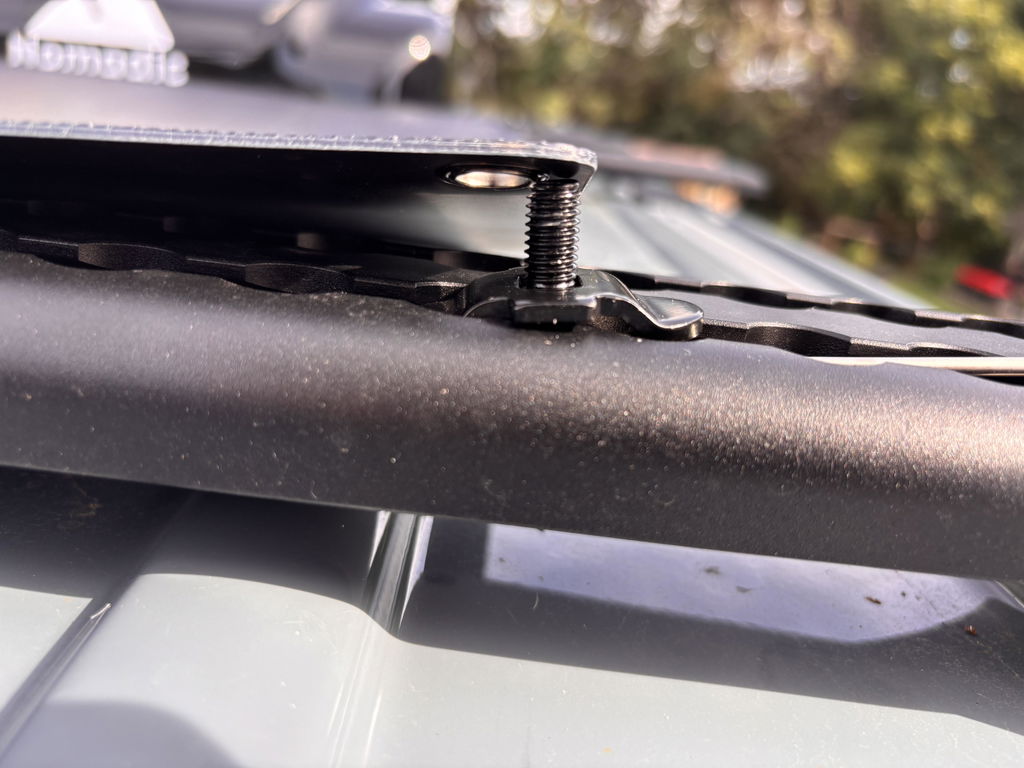
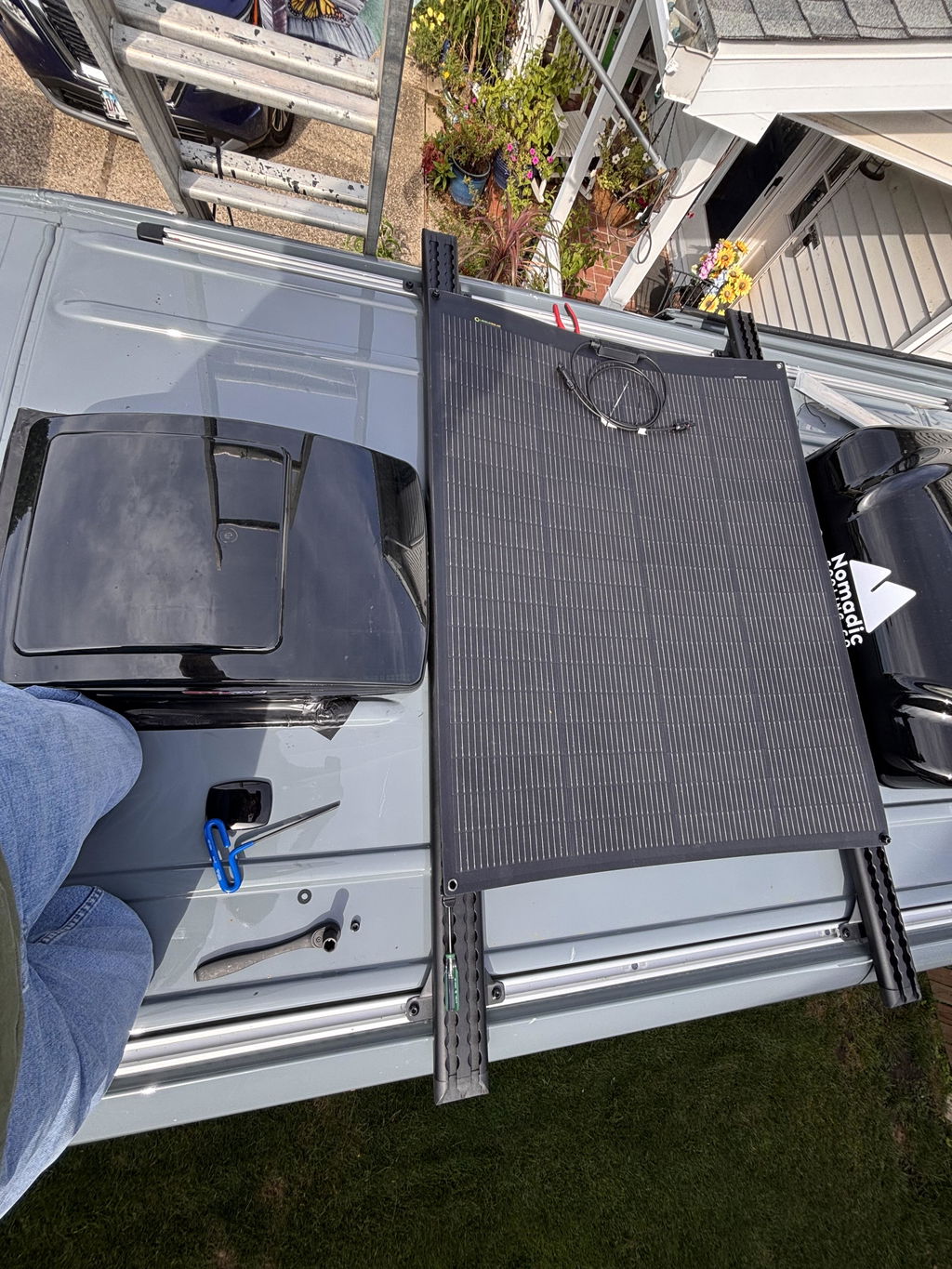
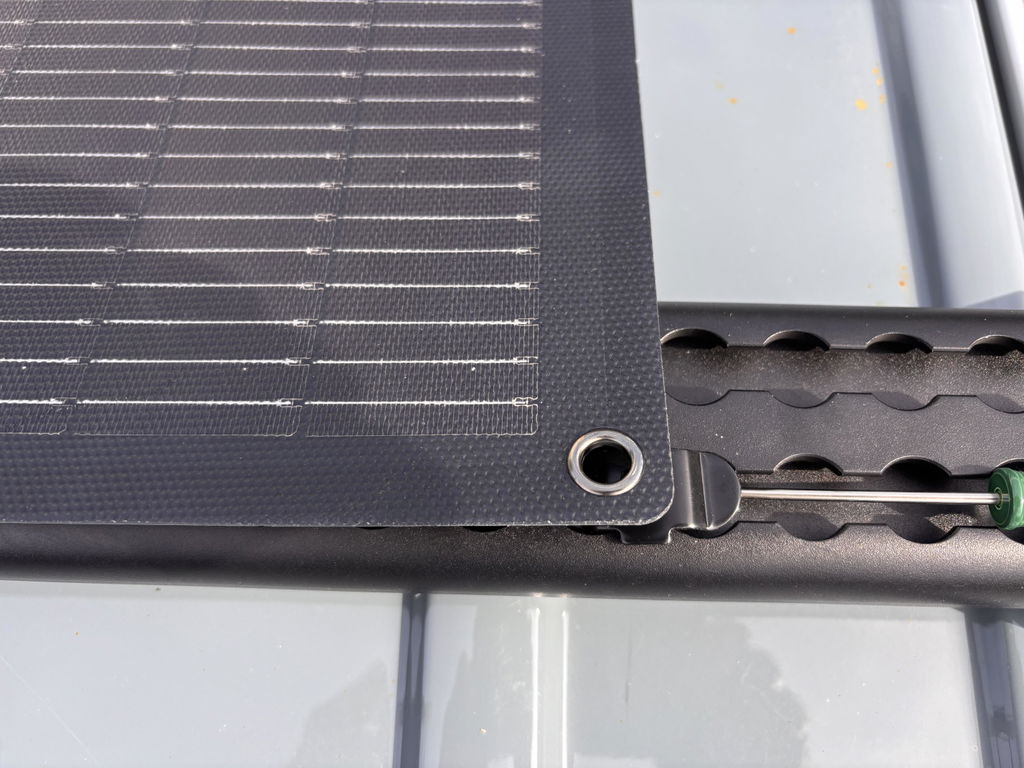
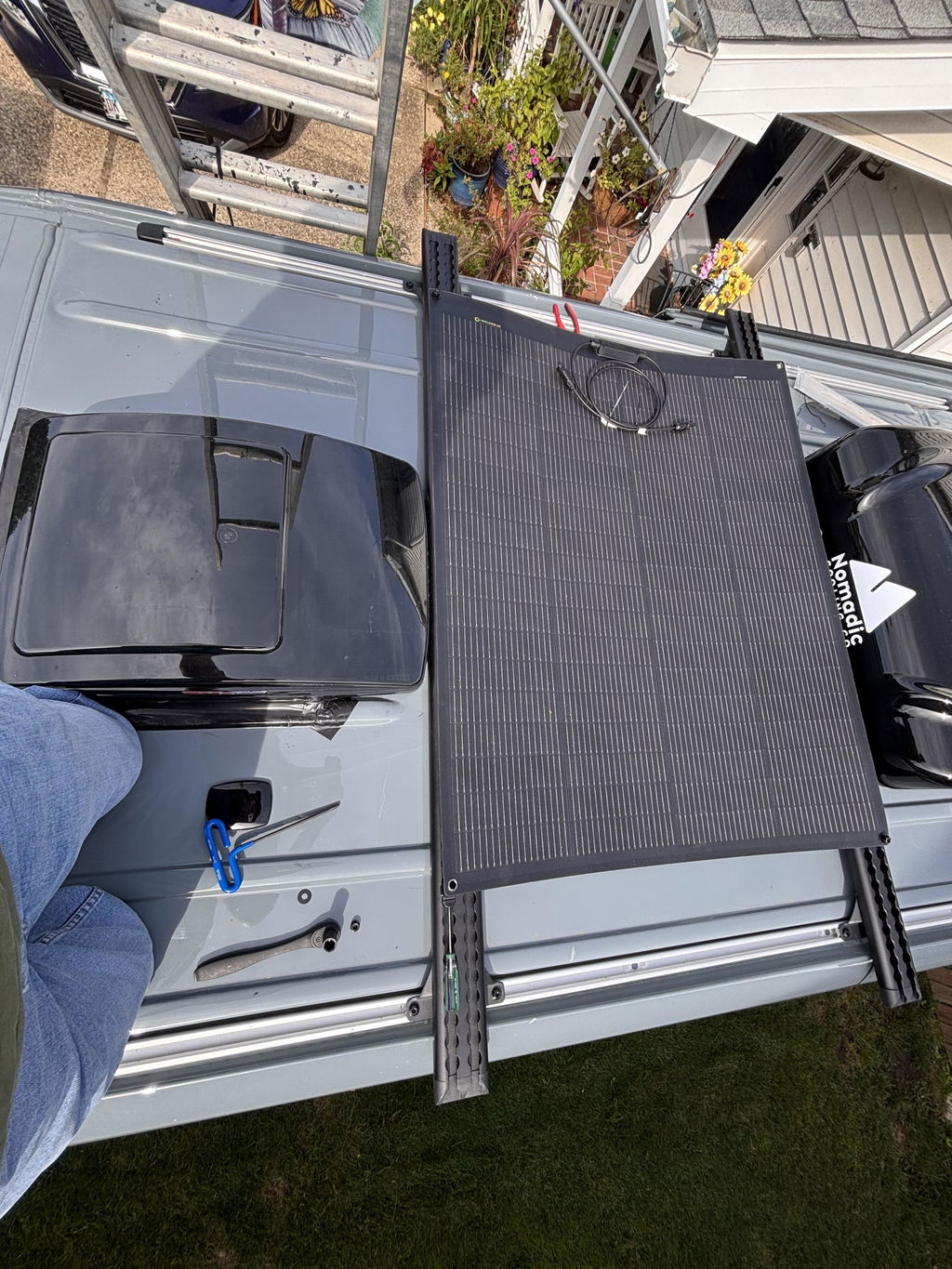
Solar panels present a unique aerodynamic situation. A flat panel mounted flush to the roof surface — either directly bonded or sitting inside a low-profile rack — actually improves aerodynamics in some cases by smoothing over roof features (vent openings, fan housings) that would otherwise create turbulence.
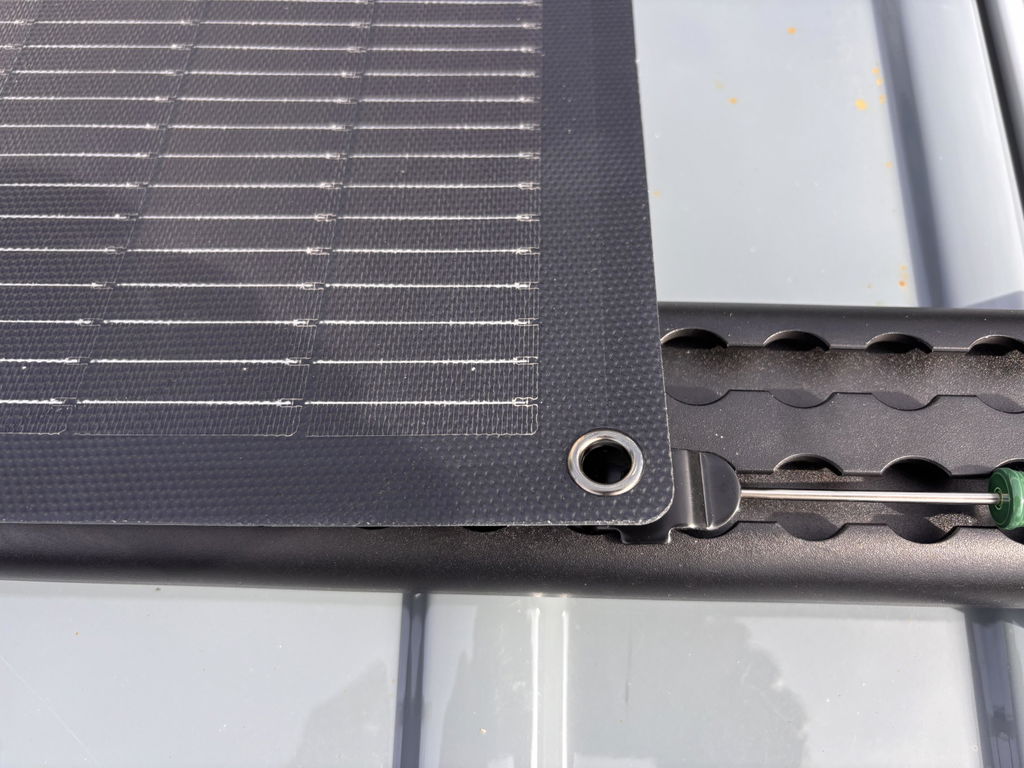
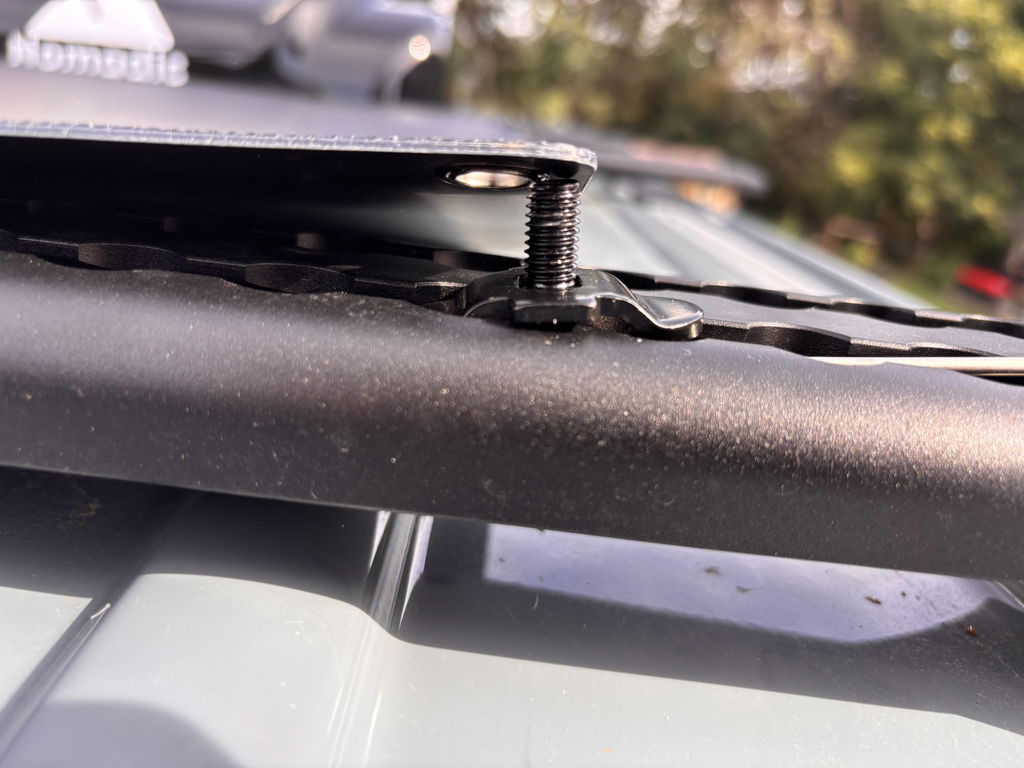
However, panels mounted with significant standoff — raised on brackets for ventilation cooling — create a channel flow effect that can generate more drag than the panel itself. The optimal approach for both aerodynamics and panel efficiency is a thin standoff (10–15 mm) that allows cooling airflow without creating a high-drag gap.
Several Sprinter-Source members have noted this effect:
A single flush-mounted panel on low-profile rails adds negligible drag. A field of panels elevated on tall brackets on a full platform rack can add 1–2 mpg of penalty from the rack alone, even before accounting for the panel surfaces.
The Vortex Generator Option
Some aerodynamically aware Sprinter owners have experimented with vortex generators — small triangular or rectangular fins that trip the boundary layer from laminar to turbulent intentionally, keeping the flow attached over curved surfaces that would otherwise see separation.
Vortex generators are used extensively in aviation (on wings, tail surfaces, and engine nacelles) and increasingly on commercial trucks. On a Sprinter, small VGs placed just ahead of the rear boattail section can reduce base drag by 5–10% by keeping flow attached longer. However, the benefit is most pronounced on vehicles that already have relatively clean airflow — meaning they work best when the roof rack system hasn't already tripped the flow into fully turbulent chaos.
Putting It All Together: The Decision Framework
Before bolting anything to your Sprinter's roof, work through this decision tree:
Step 1: Define Your Actual Roof Usage
- Permanent solar only? → Low-profile rails + flush-mount panels. Skip the crossbars entirely.
- Occasional cargo (kayaks, lumber, bikes)? → Permanent rails + removable crossbars. Pull bars when not in use.
- Work truck with daily ladder/pipe access? → Full system is justified, but invest in aerodynamic bars and a good front fairing.
- Overlander with rooftop tent? → Accept the drag penalty from the tent, but minimize everything else. Aero bars, fairing, clean layout.
Step 2: Calculate Your Real Cost
Step 3: Invest in Aerodynamics, Not Just Strength
A roof rack system should be evaluated on three axes: load capacity, ease of use, and aerodynamic efficiency. Most buyers focus on the first two and ignore the third. The aerodynamic cost is invisible at purchase time but accumulates every mile for every year you own the vehicle.
Summary: The Numbers That Matter
| Metric | Value | Source |
|---|---|---|
| Sprinter high roof Cd | 0.32 | Mercedes-Benz press release, 2019 |
| Sprinter high roof frontal area | ~8.5 m² (91.5 ft²) | Calculated from vehicle dimensions (height × width) |
| Unloaded rack drag increase | 10–22% | Chen & Meier, 2016 (Energy Policy) |
| Loaded rack drag increase | 13–28% | Chen & Meier, 2016 |
| Worst-case MPG loss (unfaired rack) | 4 mpg (20%) | Sprinter-Source owner data |
| Best-case MPG loss (low-profile/aero) | <0.3 mpg (<2%) | Sprinter-Source owner data |
| Round tube Cd (crossflow) | ~1.2 | Fluid dynamics reference |
| Airfoil bar Cd (crossflow) | ~0.04–0.08 | Fluid dynamics reference |
| Empty rack miles vs. loaded miles | 4–8× more | Berkeley Lab national survey |
| Dynamic roof load limit (high roof) | 330 lb (150 kg) | Mercedes-Benz Sprinter manual |
The Sprinter is one of the most aerodynamically refined commercial vans ever built. Its Cd 0.32 is an engineering achievement. The question isn't whether to add roof carrying capacity — it's whether to add it intelligently or carelessly. The physics don't care about brand loyalty or budget. They care about shape, profile, and frontal area. Choose accordingly.
Published March 24, 2026 · LoadSpan Engineering · dvamechanics.com
Ready to Upgrade Your Sprinter?
DVA Mechanics engineers purpose-built Sprinter accessories — designed, tested, and backed by real-world data.
- DVA LoadSpan™ Roof Rails
- DVA LoadSpan-T™ Roof Rails
- DVA DualTrack-T™ Cross Bars
- DVA L-Track collection