2023 Mercedes Sprinter 144" Low Roof: Specs, Dimensions & Build Guide

2023 Mercedes Sprinter 144" Low Roof: Specs, Dimensions & Build Guide
The 2023 Mercedes-Benz Sprinter 144" Low Roof is the most garage-friendly, parking-structure-compatible configuration in the VS30 lineup. At roughly 8'2" exterior height, it clears the 8'2" minimum at most structured parking decks and fits in a standard reside
Quick Answer — 2023 Sprinter 144" Low Roof Key Specs
- Interior cargo length (144" WB): ~132 in. / 11 ft. from bulkhead to rear doors
- Interior height (low/standard roof): ~59 in. / 4'11" — seated work height, not stand-up
- Interior width at floor: ~70 in. max / 53 in. between wheel wells
- Dynamic roof load limit: 330 lb — same for ALL Sprinter roof heights
- OEM rail spacing: 51.875 in. — matches DVA LoadSpan-T and DualTrack-T (VS30, 2019+)
- Exterior height (standard roof): ~97.9 in. / 8'2" — fits most parking structures
- GVWR (2500): 8,550 lb · Verify door placard for your specific VIN
The 2023 Mercedes-Benz Sprinter 144" Low Roof is the most garage-friendly, parking-structure-compatible configuration in the VS30 lineup. At roughly 8'2" exterior height, it clears the 8'2" minimum at most structured parking decks and fits in a standard residential garage — a capability the 170" High Roof cannot match. This guide covers the exact interior dimensions, roof load limits, and DVA roof system that 144" LR owners have adopted across day van, commercial, and ultralight conversion builds.
Why the 144" Low Roof? Four Distinct Use Cases
The 144" Low Roof isn't a compromise — it's the right platform for specific jobs the 170" High Roof can't do:
- Fits in a garage. The VS30 standard-roof exterior height is approximately 97.9 in. (8'2"). A standard two-car garage clears 7 feet at the door — the 144" LR fits with a door threshold above 98 in. The 170" High Roof exterior height of approximately 108 in. (9'0") does not. For owners who want to store their van at home, the 144" LR is often the only viable option without a commercial or RV-height door.
- Parking structure access. Most urban and airport parking structures have a posted clearance of 8'0"–8'2". The standard-roof Sprinter is the only configuration that reliably clears them. Photography crews, airport shuttles, and regional field teams who park in structured lots cannot use a high-roof van without risking a claim every trip.
- Commercial and trade builds. Electricians, plumbers, HVAC technicians, and last-mile delivery operators favor the 144" WB because it maneuvers in tight residential driveways, reverses into loading docks that the 170" can't reach, and still carries a full workday's load. The 132" cargo length (11 feet) handles 8-foot lumber and conduit with a fold-down front bulkhead extension.
- Ultralight overlanding and day van. Owners who want a compact, lower-profile rig — a "stealth" van that doesn't announce itself in a neighborhood — choose the 144" LR. The shorter wheelbase also improves approach/departure angles for off-pavement use and reduces the turning radius from ~25 ft. (170") to approximately 19 ft. (144").
Interior Dimensions: What to Measure Before You Buy Components
Mercedes-Benz publishes nominal dimensions, but VS30 interior measurements vary slightly between vans depending on trim level, factory options, and whether the cargo partition is a solid bulkhead or cargo net partition. These are the verified measurements builders rely on:
| Dimension | 144" LR (Standard Roof) | Notes |
|---|---|---|
| Interior cargo length | ~132 in. (11'0") | Bulkhead face to rear door closed |
| Interior height (standard roof) | ~59 in. (4'11") | Floor to ceiling, center; not stand-up height |
| Interior width — max at floor | ~70 in. (5'10") | Behind wheel wells, mid-cargo |
| Width between wheel wells | ~53 in. (4'5") | The critical constraint for lengthwise bed platforms |
| Exterior height (standard roof) | ~97.9 in. (8'2") | Roof skin to ground; critical for parking structures |
| Exterior length | ~233.5 in. (19'5") | Full van, bumper to bumper |
| Cargo volume | ~195 cu ft | Standard roof; vs ~270 cu ft for 144" High Roof |
The 59-inch ceiling is the key constraint. You cannot stand upright in a standard-roof Sprinter (a 5-year-old might clear it). Bench work, loading gear from a kneeling position, and seated workstations all work well. For any build that requires standing — kitchen galley, sleeping loft with head clearance, full insulation + flooring + bed — the High Roof is the right choice. The Low Roof excels at cargo, tool organization, and sleeping flat (no loft required when floor height is low).
Roof Specs and Load Limits
The VS30 Sprinter's roof is an aluminum-skinned steel-stiffened structure with four factory rail attachment points per side. These specs apply identically to the 144" Low Roof as to every other VS30 configuration:
- Dynamic roof load limit: 330 lb. This is the load the roof structure can handle while the van is moving. Static load (van parked) can be higher, but Mercedes-Benz specifies 330 lb as the safe dynamic rating for all VS30 models — standard roof, high roof, 144" WB, 170" WB.
- Rail spacing (VS30, 2019+): 51.875 in. This is the center-to-center distance between left and right OEM roof rails. It's consistent across all VS30 models and directly determines cross-bar span and accessory fitment. DVA's LoadSpan-T and DualTrack-T are engineered to this exact spacing.
- Usable roof rail length (144" WB): ~150–160 in. The distance from the forward-most to rear-most factory roof rail mounting hole. This is roughly 30–40 inches shorter than the 170" WB (which runs approximately 190–200 in.) — an important number for solar panel placement and cross-bar count.
- Factory mounting points: 4 per side. Each factory attachment point uses an M8 threaded insert in the roof rib. DVA LoadSpan-T rails bolt directly to these — no drilling, no sealant required beyond the factory sealing that's already present.
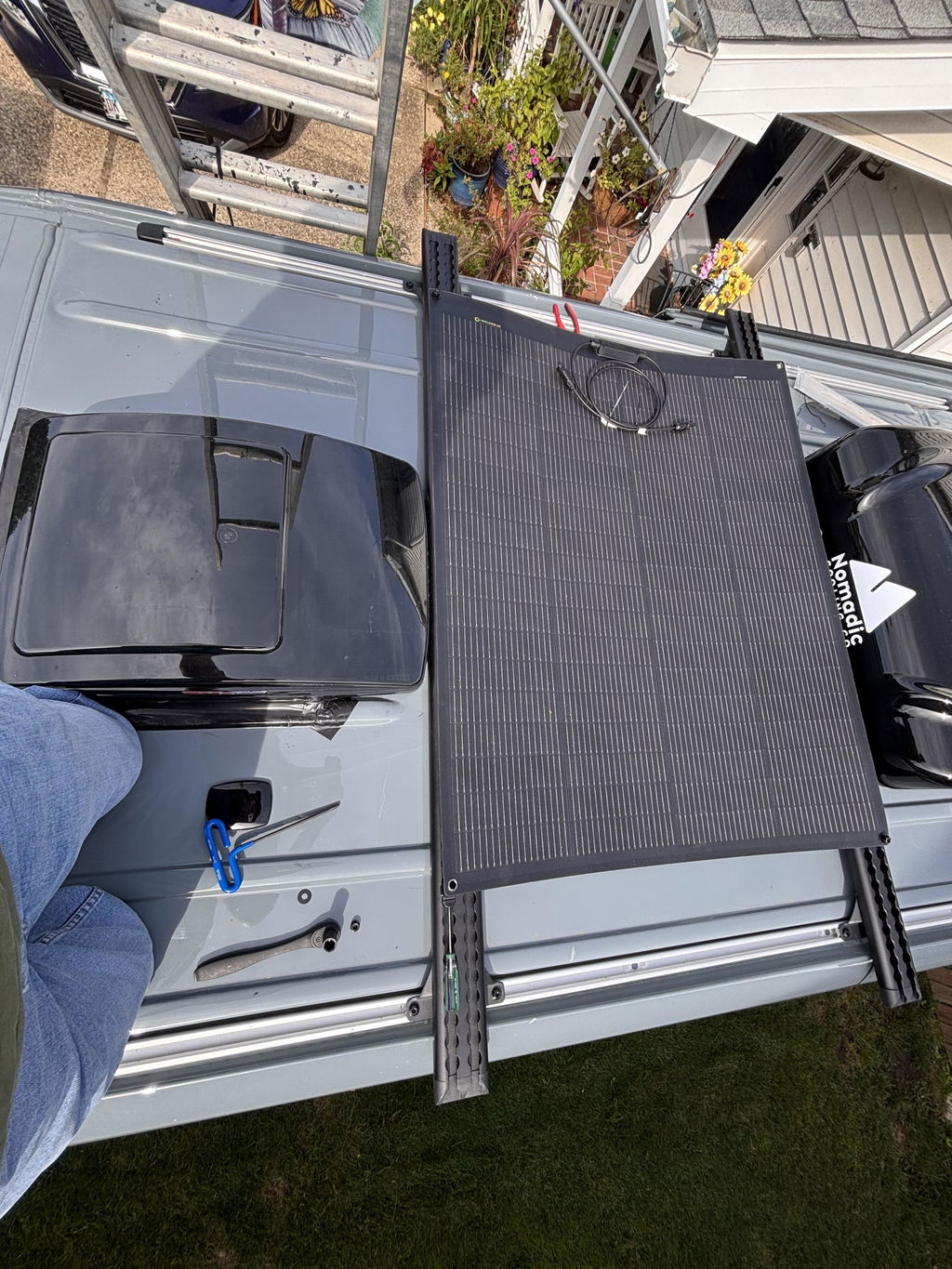
The shorter roof length of the 144" WB does affect solar planning. A 170" WB can fit three full 200W panels end-to-end; the 144" LR typically fits two 200W panels with room for a third narrow panel or rooftop accessories alongside. For a weekend or day-van build with modest power needs, two panels (400W) paired with a 100–200 Ah LiFePO₄ battery is the standard configuration Sprinter-Source builders recommend for this chassis.
DVA Roof System for the 2023 Sprinter 144" Low Roof
DVA Roof System — 2023 Sprinter 144" Low Roof
Both DVA roof products specify the 144" WB at checkout and bolt directly to the four factory attachment points on the VS30 standard-roof platform:
- LoadSpan-T™ Dual-Channel Roof Rails — Anodized 6061-T6 aluminum rails with integrated full-length L-Track + 25mm T-Slot. Distribute load across all four factory attachment points (vs. two for aftermarket stud-mount rails). Select the 144" WB option at checkout. 330 lb dynamic rating matched to Mercedes spec.
- DualTrack-T™ Cross Bar Kit — Bolt-on cross bars that attach to the LoadSpan-T channel. Slide and lock anywhere along the 150–160" usable rail length. No tools needed to reposition once rails are installed.
Browse the full selection: Sprinter Roof Rails · L-Track & Accessories
The load-spreading advantage of the LoadSpan-T is more significant on the standard-roof 144" platform than on the high-roof variants. The standard roof has a lower roof rib height, which reduces the moment arm of a cantilevered point-load rack mounting — making distributed attachment even more important for maintaining the 330 lb dynamic limit without local deformation at individual mounting points.
Build Strategies for the 144" Low Roof
The low ceiling height and shorter cargo length require different planning trade-offs than a 170" HR build. These are the patterns Sprinter-Source owners and DVA customers have refined:
Commercial Trade Build
A 144" LR outfitted for daily trade work typically runs wall-mounted shelving on the driver side (aluminum shelving units bolted through the factory D-rings), a slide-out drawer unit behind the front seats, and a full-width ladder/pipe system on the roof. The 330 lb roof load carries two 16-foot ladders in a carrier system comfortably. DVA LoadSpan-T + DualTrack-T gives a continuous top rail without the fixed cross-bar positions of a traditional ladder rack, so ladder-holder clamping can be repositioned for different ladder types without drilling new holes.
Day Van / Weekend Warrior
The 144" LR floor (132" usable length, accounting for the wheel-well intrusion reducing clear width to 53") can fit a 74"×30" sleeping platform lengthwise between the wheel wells if you accept a 30"-wide sleeping surface, or build a cross-wise queen platform above the wheel wells at 70"×60" — wider than the 53" well-to-well span, elevated above the wells on a box frame. The ceiling at 59" leaves enough overhead clearance to sit up in bed, and the shorter van length means total conversion weight is lighter — helpful for payload math.
Ultralight Overlanding
Sprinter-Source members who run 144" LRs for overlanding cite three primary reasons: turns shorter than a 170" (19 ft vs ~25 ft turning radius), fits in mountain forest service road pullouts that a 170" can't navigate, and matches standard parking clearances. For a roof-loaded overlanding rig, the DVA LoadSpan-T rails can carry a rooftop tent (select hardshell models rated under 200 lb), a Jerry can carrier, and a Starlink flat-panel mount — all on a single full-length rail without needing a full basket rack that would push the exterior height above the 8'2" line.
144" Low Roof vs. 144" High Roof: Which to Choose
Mercedes-Benz also offers the 144" WB in High Roof. If you're deciding between them, here's the direct comparison:
| Factor | 144" Low Roof | 144" High Roof |
|---|---|---|
| Interior height | ~59 in. (4'11") | ~78 in. (6'6") |
| Exterior height | ~97.9 in. (8'2") | ~108 in. (9'0") |
| Fits standard garage door (7'0" min) | ✅ Yes (clears ~8'2" threshold) | ❌ Requires commercial/RV door |
| Fits most parking structures | ✅ Yes (~8'2") | ❌ Usually exceeds 8'0"–8'2" limits |
| Stand-up headroom | ❌ Not possible | ✅ Clears up to ~6'2" |
| Roof load limit | 330 lb dynamic | 330 lb dynamic |
| Highway fuel economy | Slightly better (lower drag) | ~1–2 MPG penalty vs LR |
| Best for | Commercial, day van, stealth, urban use | Full conversion, livability, stand-up kitchen |
Factory Roof Rail Option: OEM vs. Aftermarket
The 2023 Sprinter 144" Low Roof is available factory-ordered with or without OEM roof rails. If your van did not come with rails, the factory attachment points are covered by plastic clips — these can be removed and the M8 threaded inserts used to bolt aftermarket rails directly.
Major Sprinter conversion shops have noted in their builder documentation that ordering the OEM rails avoids the risk of those plastic clips being dislodged during insulation installation and creating a leak path at the factory sealing points. If your van came without OEM rails and the clips are still in place, inspect the roof rail channels for any gaps before installing aftermarket rails — this is a common source of mystery roof leaks reported on Sprinter-Source.
DVA LoadSpan-T rails bolt to the same M8 factory attachment points. The install requires removing the plastic clips (if present), feeding the rail into position, and torquing the factory-spec fasteners through the pre-existing holes in the roof rib. No sealant drilling required.
Payload Math for the 2023 Sprinter 144" Low Roof 2500
GVWR for the 2500 variant is 8,550 lb. Curb weight for a base 2023 Sprinter 2500 144" WB cargo van is approximately 5,400–5,700 lb depending on options. That leaves roughly 2,800–3,150 lb of useful payload before you reach GVWR — significantly more than a Transit or ProMaster in the same wheelbase class.
For a roof build specifically: with the DVA LoadSpan-T rail system (approx. 60 lb for the pair), two DualTrack-T cross bars (~20 lb), and a roof load of ladders, panels, and gear at the 330 lb limit, the total roof system weight is approximately 410 lb — well within the vehicle's payload budget while preserving over 2,400 lb for cargo.
Related Resources
- Sprinter Roof Rails: Load-Distributing Rail Systems Explained — covers VS30 rail attachment, load math, and rail system selection across all Sprinter configurations
DVA Products for the Sprinter 144" Low Roof