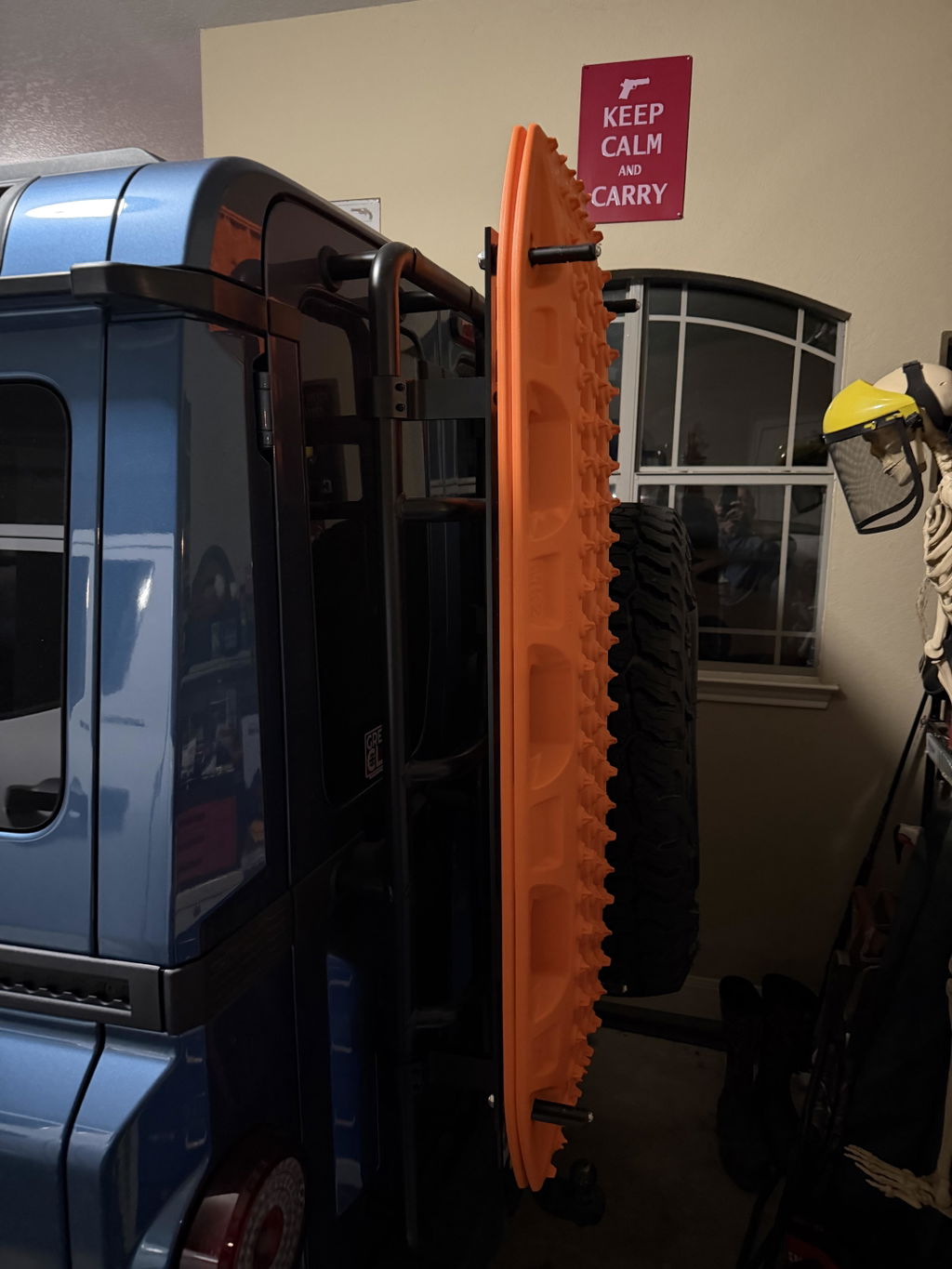
Most Grenadier owners reach the same conclusion within the first overland season: the rear ladder is the single best piece of real estate on the vehicle for recovery gear. It's structural, it's already there, it keeps weight low and aft rather than up on the roof, and it doesn't eat into your cargo volume. The factory ladder on the Wagon is rated to 150 kg static load per the INEOS owner's manual — far more than a MaxTrax pair and a Hi-Lift combined.
The problem that actually stops people isn't weight. It's door clearance. Forum discussions going back to early 2024 show the same hesitation: owners want recovery boards or a jack on the ladder, but they're worried they won't be able to grab the door handle. Getting the gear placement sequence right solves this completely.
The INEOS Grenadier rear ladder is rated to 150 kg static load (INEOS owner's manual). For dynamic driving load, most owners treat 50 lb (23 kg) total as the practical limit to avoid fatigue stress on hinges over time. A MaxTrax MKII pair weighs ~10.5 kg, a Hi-Lift 60" jack weighs ~13.5 kg, and a full 20L NATO jerry can weighs ~18 kg — together 42 kg, well within both limits when distributed across the uprights.
What the 150 kg Rating Actually Means
The INEOS Grenadier owner's manual includes a specific warning under the Access Ladder section: "Maximum load capacity on the Access Ladder is 150 kg." That figure is a static load — it assumes the vehicle is parked and weight is applied without road vibration multiplying the force at the mounting points.
Forum user heater.9047580 on TheIneosForum was first to dig this spec out of the manual after another owner asked about mounting a 43 kg outboard engine on the ladder. Forum user anand.9047199 followed with the caveat most owners now cite: "The rating is static load (when the vehicle is not moving); as with the roof rack on every vehicle, the dynamic load (when driving) is usually far less. This is due to the shift in CG as well as the constant vibration forces caused on the mounting points." (TheIneosForum — Rear Ladder Weight Capacity, Jun 2023)
DVA's working recommendation for continuous dynamic load — the weight riding on the ladder while the vehicle is in motion on rough terrain — is approximately 50 lb (23 kg) total, distributed across both uprights. This is well below the OEM static rating and reflects the reality that hinge fatigue and door-seal wear compound over years of cycles, not just single-event stress. Owners running heavier sustained loads on trail-heavy vehicles have not reported failure, but this is the load band we design and test our carriers around.
For the purposes of gear setup, a MaxTrax MKII pair (~10.5 kg), a 60" Hi-Lift jack (~13.5 kg), and an empty 20L NATO jerry can (~2.5 kg, or ~18 kg when full of diesel) total 26.5 kg empty and 42 kg full — both within the practical range when the weight is distributed correctly between the two uprights rather than cantilevered off one side.
The Door Clearance Problem — and Why It's Mostly Solved
The door clearance issue came to a head in the January 2024 MaxTrax ladder thread on TheIneosForum. User mattg.9047954 had successfully mounted Maxtrax-mini brackets to the ladder using four clamps and 30×3mm flat steel bar reinforcement, reporting: "Very rigid, lockable and still allows plenty of access to the rear door handle." (TheIneosForum — Maxtrax Recovery Track Ladder Mounting Bracket, Jan 2024)
But user and3rew.9045828 had a different experience with an earlier mount: "It's going to make it a pain to access the door button and handle. I tried mounting mine there and decided I couldn't live with it." The difference comes down to mount geometry — specifically how far the carrier sits off the ladder rungs relative to the door button location on the left upright.
Does it make it hard to open the door? That is the only reason I am not trying this.
— tr182md.9055300, Santa Rosa CA, TheIneosForum — DVA Mechanics Rear Ladder Recovery Board Carrier thread, Jun 2025
The answer from DVA's own post in that same thread: "We designed it so that it sits out far enough to easily reach behind it to the door handle. There are a LOT of Grenadiers with this setup." The key design requirement is that any ladder mount must not clamp directly over the door latch zone on the left upright, and must provide enough clearance between the mounted gear and the door face that a hand can reach the recessed handle easily. Purpose-built mounts engineered for the Grenadier ladder geometry address this; improvised clamp setups from tube mounts not designed for the Grenadier often don't.
Recovery Boards: MaxTrax MKII & Lite on the Rear Ladder
Recovery boards on the rear ladder are the most common Grenadier ladder load. The MKII pair fits horizontally across the two uprights at mid-ladder height — keeping the weight centered, the boards accessible without climbing, and the roof load limit unaffected. The DVA Ladder-Mounted Recovery Board Carrier is purpose-built for this configuration: it mounts directly to the Grenadier's factory ladder tubing, comes with a full hardware kit including ladder brackets and quick-release pins compatible with MaxTrax MKII, MaxTrax Lite, and similar traction boards, and uses 3M anti-vibration pads to eliminate rattle on rough terrain.
The quick-release pin design matters more on trail than it sounds. Recovery scenarios where you need a board fast — wheel slip in mud, sand crossing, snow — don't give you time to wrestle with knobs or tool-required fasteners. The carrier releases the board in one motion so you're not fumbling at the ladder while the vehicle is settling.

Hi-Lift Jack: Ladder Mount vs. Roof Mount
Most Grenadiers that see serious off-pavement use carry a Hi-Lift or equivalent recovery jack. The question is where it lives. Roof mounts are common on builds with a full rack, but they put a 13–14 kg steel jack at the highest point of the vehicle, raising the center of gravity in situations — descents, side-slopes — where you need the CG as low as possible. Ladder mounts solve this at the cost of a slightly awkward reach when the jack is needed.
The DVA Ladder-Mounted Hi-Lift Jack Carrier bolts to the Grenadier's factory rear ladder and positions the jack low and aft. At 13.5 kg for a standard 60" Hi-Lift, the ladder mount uses less than 10% of the 150 kg static rating alone — and the low position means you retrieve the jack without climbing the ladder or reaching over the roof rail.
Load Priority: Jack Before or After Recovery Boards?
If you're running both a recovery board carrier and a Hi-Lift mount, position the Hi-Lift on the opposite upright from where the boards mount if possible, or below the boards on the same upright. The Hi-Lift is heavier and denser — you want it lower in the load stack so the combined center of mass stays close to the ladder's structural attachment point at the door hinge. Forum builds that run both typically place the Hi-Lift on the left (driver-side) upright and the recovery boards on the right, which also naturally moves the heavier item farther from the door handle zone.

Jerry Cans on the Rear Ladder
Jerry cans are the most weight-sensitive item in a ladder load-out. A full 20L NATO jerry can of diesel weighs approximately 18 kg — and if you're running two, that's 36 kg of liquid fuel swinging on the door every time you hit a rut. Most Grenadier owners running jerry cans on the ladder do so with a modular accessory carrier that distributes the load across both uprights, not a single clamp on one side.
The DVA Ladder-Mounted Accessory Carrier Gen 2 is designed for exactly this use: it spans the full width of the rear ladder and accepts the 20L NATO Jerry Can Carrier as a bolt-on accessory. The carrier sits parallel to the door, keeping the can's mass centered on the ladder axis rather than cantilevered to one side. This is the critical difference between a jerry can setup that rattles and one that doesn't — distributed load across two uprights, not a single-point hang.
User parb.9048775 ran this DVA bracket configuration to Lake Tahoe in November 2024 and reported back on the forum: "I'm pretty happy with my mount of my ladder using the DVA mechanics bracket. Going up to Lake Tahoe this weekend and will be out bouncing in the mountains, i'll let you all know how it holds up." — and the follow-up was positive: no rattle, no shift, door clearance remained functional throughout. (TheIneosForum — Accessories Mounted on Rear Ladder, Nov 2024)


Full Load-Out Sequence: Running All Three
When running recovery boards, a Hi-Lift, and a jerry can simultaneously, load sequence and position matter more than total weight. Here's the setup that keeps door access clear, load balanced, and gear accessible when you actually need it on trail:
Recommended Rear Ladder Load Sequence
- Hi-Lift Jack (left upright, mid-height) — heaviest single item, mounted low on the structural side away from the door latch. Keeps center of mass low. Retrieve without climbing.
- Recovery Boards (right upright or horizontal across both) — MaxTrax MKII or Lite at mid-ladder height. Quick-release pins face outboard for trail access. Clear of door button zone.
- Jerry Can (Gen 2 Modular Carrier, full-width mount) — spans both uprights. Mount last so it's the outermost item and easiest to detach when fuel is needed. Keep empty when possible on technical terrain.
The table below shows total dynamic load for common ladder configurations. The working limit most Grenadier owners apply to avoid long-term hinge fatigue is approximately 50 lb (23 kg) in continuous driving use:
| Configuration | Approx. Weight | Within 50 lb Working Limit? |
|---|---|---|
| MaxTrax MKII pair only | ~10.5 kg / 23 lb | ✓ Yes |
| Hi-Lift 60" jack only | ~13.5 kg / 30 lb | ✓ Yes |
| MaxTrax + Hi-Lift (no jerry) | ~24 kg / 53 lb | ~ Borderline |
| MaxTrax + empty 20L jerry | ~13 kg / 29 lb | ✓ Yes |
| Full kit: MaxTrax + Hi-Lift + full 20L jerry | ~42 kg / 93 lb | Consider partial fuel on technical terrain |
What Doesn't Work on the Grenadier Rear Ladder
A few configurations that look fine on paper consistently cause problems in practice:
- Single-clamp tube mounts not designed for the Grenadier — these position the carrier directly across the door latch zone because the Grenadier's ladder geometry is different from generic 4x4 ladders. Door access becomes difficult as the user and3rew.9045828 described, and vibration rattle is common.
- Full 20L jerry cans on single-upright hangers — 18 kg cantilevered off one side of the door creates uneven hinge loading. Use a full-width carrier that spans both uprights.
- Recovery boards mounted vertically (standing upright) — raises the effective center of mass significantly and can obstruct rear visibility. Horizontal or slight-angle mount is the standard for a reason.
- MaxTrax full-size on Mini brackets — the weight and lever arm of full MKII boards exceed what mini-specific brackets are rated for when the vehicle is moving. The forum thread from January 2024 raised this; use brackets sized for the board length you're running.
The rear ladder is one of the most underutilized mounting locations on the Grenadier when owners over-think the weight rating and under-think the geometry. Get the mount right for each item, distribute the load across both uprights, and keep the heaviest items low — and the ladder becomes a fully functional, always-ready gear platform that doesn't touch your roof capacity at all.
Sources
- INEOS Grenadier Owner's Manual — Access Ladder section, 150 kg maximum load capacity
- TheIneosForum — Rear Ladder Weight Capacity (Jun 2023) — heater.9047580, anand.9047199, daveb.8923052
- TheIneosForum — Maxtrax Recovery Track Ladder Mounting Bracket (Jan 2024) — mattg.9047954, and3rew.9045828
- TheIneosForum — Accessories Mounted on Rear Ladder (Sep 2024 – Nov 2024) — parb.9048775, logsplitter.9046026
- TheIneosForum — DVA Mechanics Rear Ladder Recovery Board Carrier (Jun 2025) — tr182md.9055300