Real dimensions, stack-up calculations, parking garage clearance data, and three complete build examples with DVA DualTrack crossbars.
Quick Answer
The INEOS Grenadier stands 80.2" (2,036 mm) bare. DVA DualTrack crossbars add 1" to 81.1"—the only roof rail that fits comfortably under a standard 7' garage door. Any rooftop tent pushes you to 86"+ and requires an 8' opening. Use the stack-up formula below to calculate your specific build.
1. Why "Paper Height" Gets You Stuck
The INEOS Grenadier spec sheet says the vehicle is 2,036 mm (80.2 inches) tall. That number is technically correct and practically useless for real-world clearance planning.
The spec sheet measurement applies to a bare-roof Grenadier at unladen curb weight with factory tire pressures. Add a rack, cargo, different tires, or passengers and gear, and that number changes. When you're approaching a parking garage with a posted height limit, it changes in the wrong direction.
This guide gives you actual numbers and formulas to calculate clearance for your specific build, with worked examples using DVA DualTrack rails and common accessory combinations.
2. The Grenadier Baseline: Verified Dimensions
These numbers come from INEOS official specifications cross-referenced with physical measurements by multiple Grenadier owners on The INEOS Forum:
| + Low-profile platform rack | 2,087 mm / 82.2" | 47 mm / 1.9" | ⚠️ Tight — measure first |
| + Platform + closed hardshell RTT | ~2,212 mm / ~87.1" | No fit ❌ | ❌ Exceeds 7' by 3+ inches |
| + Full-height platform rack | 2,130 mm / 83.9" | 4 mm / 0.2" | ❌ No clearance |
5. Three Complete Build Examples
Build 1: Daily Driver — Garage Compatible
Owner profile: Parks in a standard 7' residential garage. Wants a roof light bar and the ability to carry a cargo box on weekends.
| Layer | Component | Height Added | Cumulative Height |
|---|---|---|---|
| Base | Grenadier (bare roof) | — | 2,036 mm / 80.2" |
| Rack | DVA DualTrack 2-bar kit ($279) | 25 mm / 1.0" | 2,061 mm / 81.1" |
| Accessory | a roof-mounted LED light bar | ~25 mm / ~1.0" | ~2,086 mm / ~82.1" |
| Tolerance buffer | — | 50 mm / 2.0" | ~2,136 mm / ~84.1" |
Weight budget:
- DVA DualTrack 2-bar kit: 10 lb
- Weekend cargo box (loaded): ~80 lb
- Total dynamic load: ~100 lb — exactly at the 2-bar kit's 100 lb dynamic rating
Upgrade path: If you later want a rooftop tent, add 2 more DualTrack bars (going from 2-bar to 4-bar) without replacing existing hardware. The 4-bar kit handles 200 lb dynamic, enough for most hardshell tents.
Build 2: Weekend Overlander — RTT Setup
Owner profile: Parks outdoors or in an 8' garage. Wants a rooftop tent for camping weekends, plus recovery gear and a solar panel for remote camps.
| Layer | Component | Height Added | Cumulative Height |
|---|---|---|---|
| Base | Grenadier (bare roof) | — | 2,036 mm / 80.2" |
| Rack | DVA DualTrack 4-bar kit ($499) | 25 mm / 1.0" | 2,061 mm / 81.1" |
| RTT | Hardshell RTT (closed, typical) | ~125 mm / ~5.0" | ~2,186 mm / ~86.1" |
| Tolerance buffer | — | 50 mm / 2.0" | ~2,236 mm / ~88.1" |
Weight budget:
- DVA DualTrack 4-bar kit: 20 lb
- Hardshell RTT: 140 lb
- Recovery boards (pair, L-Track mounted): 18 lb
- 100W solar panel: 18 lb
- Total dynamic load: ~196 lb — within the 4-bar kit's 200 lb dynamic rating with 4 lb margin
Key consideration: This is right at the DualTrack 4-bar limit. If your RTT is heavier than average (160+ lb), or you want to add an awning, you need to move to a platform rack with a higher dynamic rating. The DualTrack 4-bar sweet spot is RTT + minimal accessories, not RTT + awning + solar + everything else.
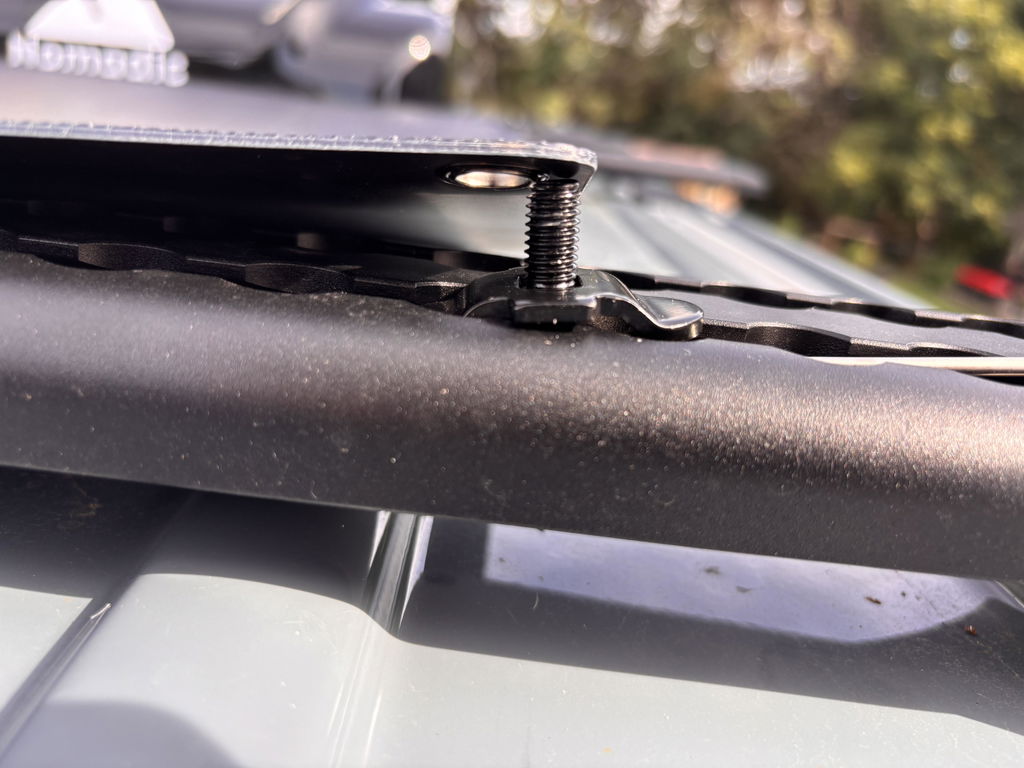
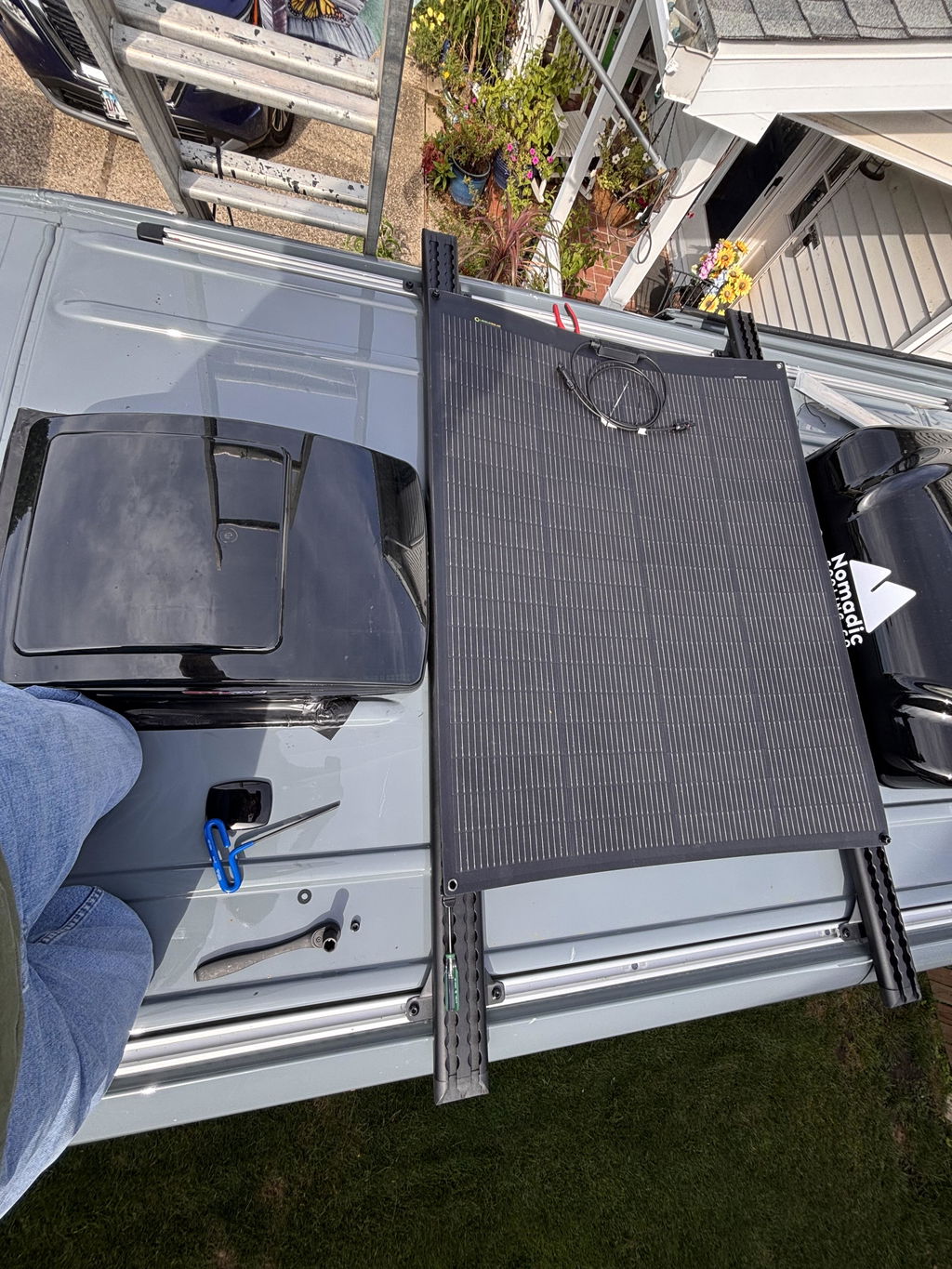
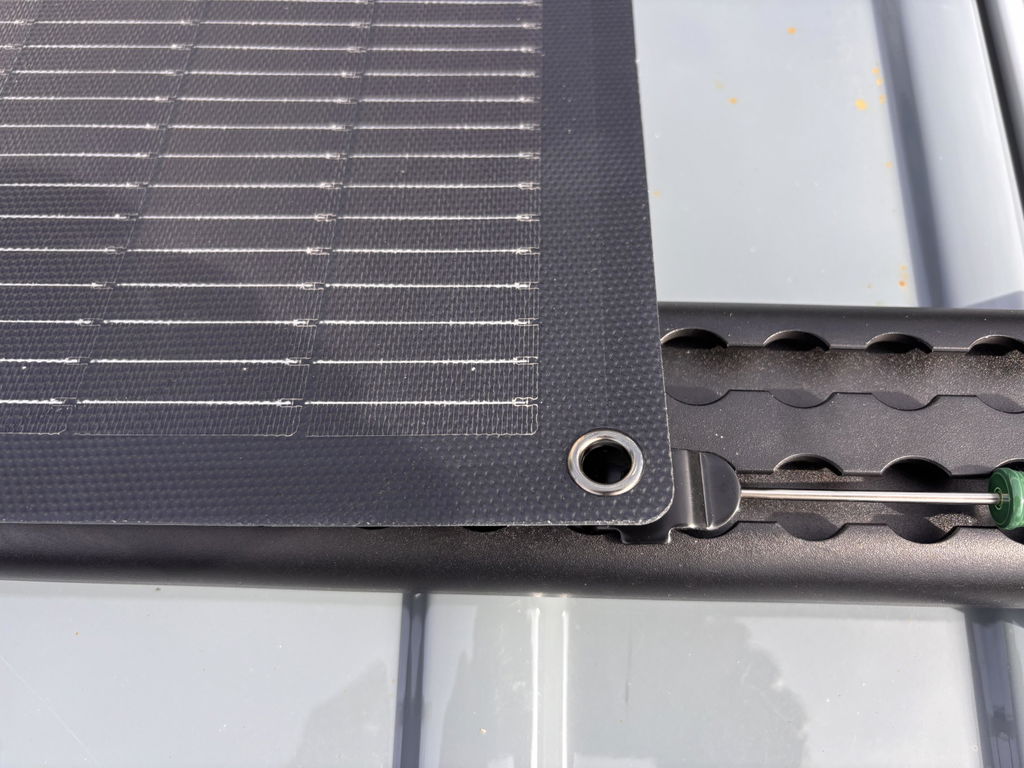
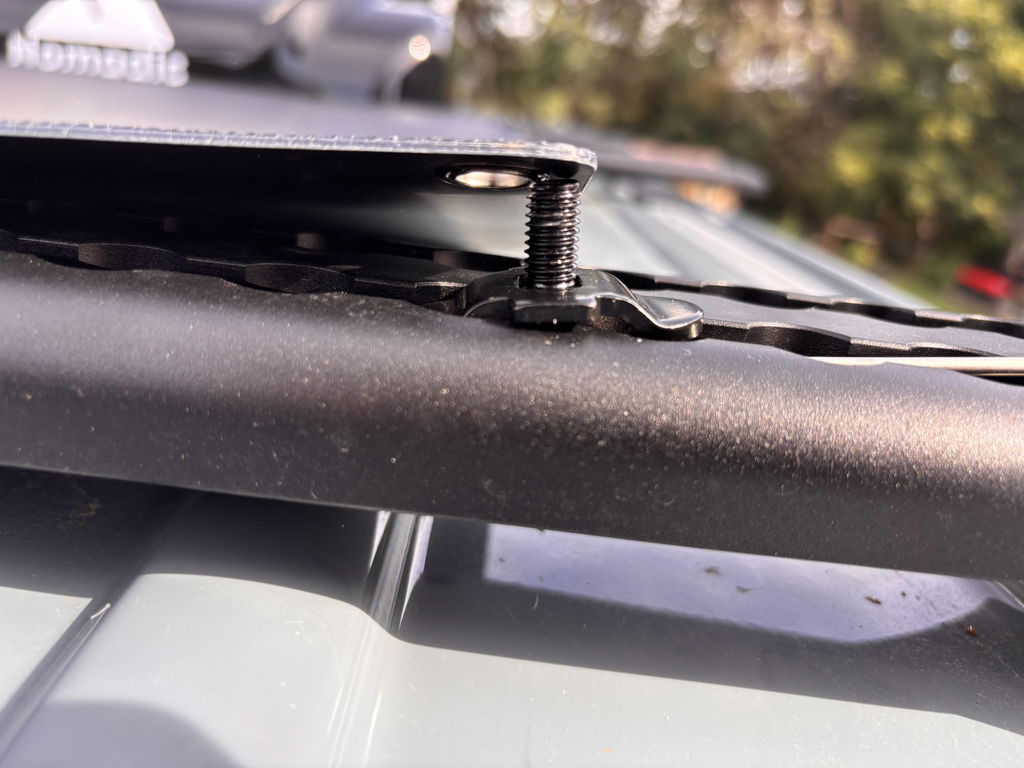
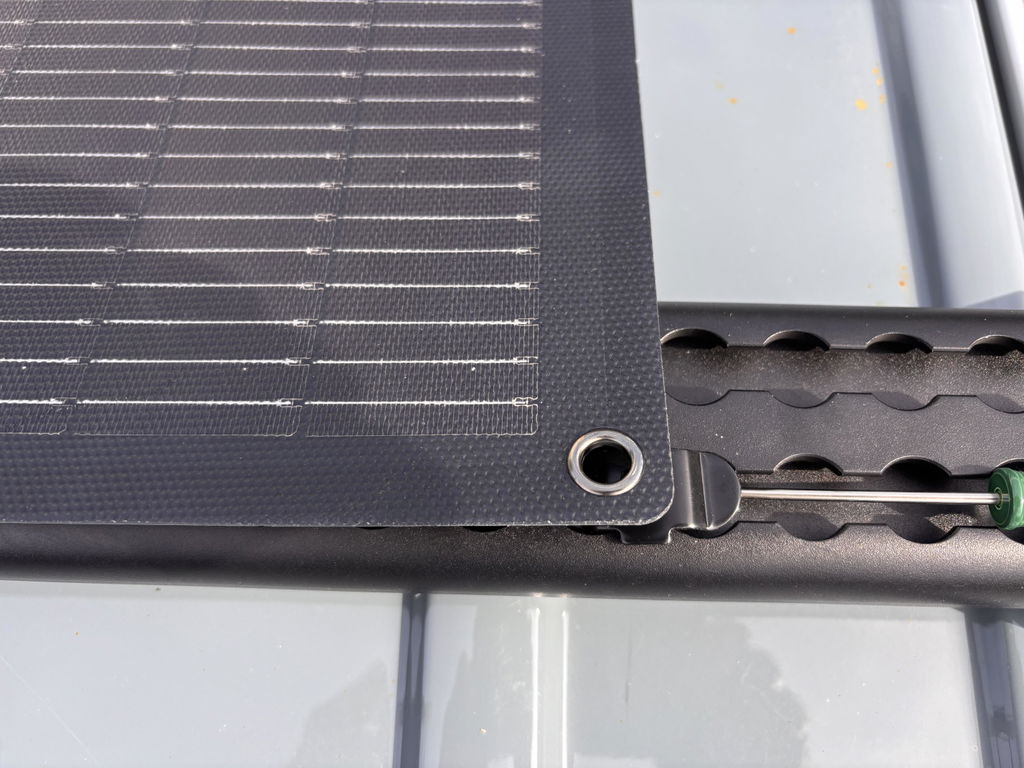
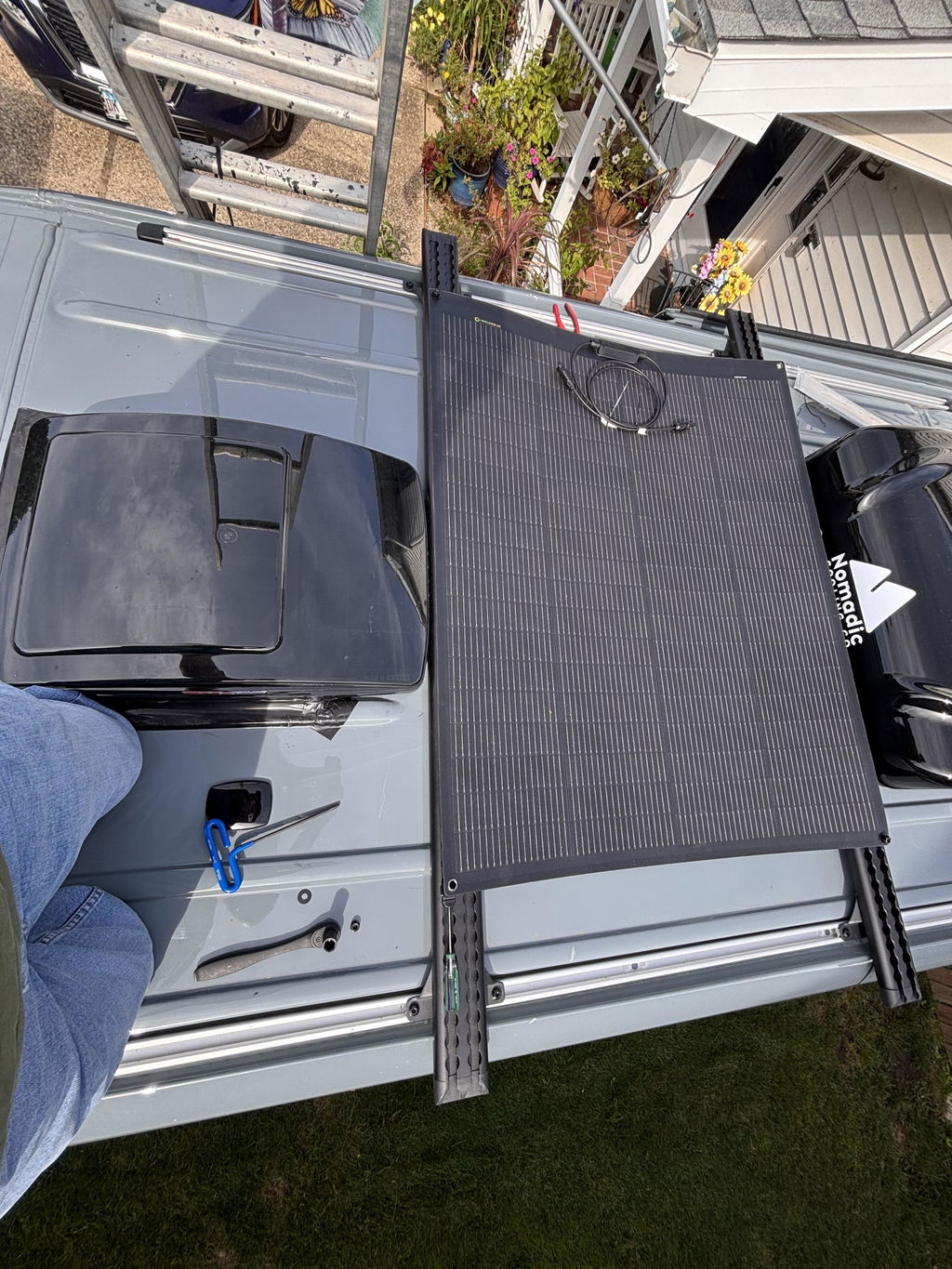
Solar panel integration: Mount a 100W rigid panel to one of the center DualTrack bars using L-Track solar panel brackets. Route the MC4 cables along the crossbar to the DTP roof connector, down to the CTEK D250SE for MPPT charging. The panel sits nearly flush with the DualTrack bar surface — total added height for the panel is approximately 35 mm (1.4"), which is included in the RTT mounting height above.
Build 3: Expedition Rig — Maximum Utility
Owner profile: Multi-week overland trips. Needs RTT, solar, communications (Starlink), lighting, and recovery gear. Parks outdoors. Height is not a constraint.
| Layer | Component | Height Added | Cumulative Height |
|---|---|---|---|
| Base | Grenadier (bare roof) | — | 2,036 mm / 80.2" |
| Rack | Full platform rack (aluminum) | ~94 mm / ~3.7" | ~2,130 mm / ~83.9" |
| RTT | Hardshell RTT (closed) | ~125 mm / ~5.0" | ~2,255 mm / ~88.8" |
| Tolerance buffer | — | 50 mm / 2.0" | ~2,305 mm / ~90.7" |
Weight budget:
- Full platform rack: 55 lb
- Hardshell RTT: 150 lb
- 200W solar panel: 30 lb
- 270° awning: 50 lb
- DVA Starlink Mini Mount + Starlink: 5 lb
- Recovery boards (pair): 18 lb
- Total dynamic load: ~318 lb — requires a rack rated for 330+ lb dynamic
Clearance reality: At nearly 91 inches (2,305 mm) with buffer, this build clears most commercial parking structures (8' 2" standard) but will not fit in any standard residential garage. Budget for outdoor parking or a commercial-height garage.
DVA products in this build:
- DVA Starlink Mini Mount: Positions the Starlink Mini at the rear of the platform for unobstructed sky view. Cable routed through DTP connector.
- DVA Exterior Utility Belt ($399): Mounted on the vehicle body (not the rack) using L-Track channels. Provides additional mounting points for recovery gear, RotoPax fuel cans, and tools without consuming roof space.
- DVA Side Accessory Carrier ($179): Mounts RotoPax or jerry cans to the body side, freeing roof capacity for the tent and solar panel.
6. Variables That Change Your Height
Your calculated height is only accurate under specific conditions. These variables can add or subtract significant clearance:
Tire Pressure
The Grenadier's factory tire pressure recommendation produces the baseline ride height. Airing down for off-road (common at 18–25 psi from the factory 36+ psi) can reduce vehicle height by 15–25 mm (~0.6–1.0"). After re-inflating, the ride height returns to baseline. While aired-down tires technically improve garage clearance, always re-inflate to highway pressure before returning to paved roads. Running aired-down at highway speeds risks sidewall failure and compromises handling and braking.
Load-Induced Compression
Adding 200+ lb of roof cargo compresses the springs slightly. On vehicles with progressive-rate coil springs, load sag typically ranges from 5–10 mm per 100 kg. The Grenadier's specific spring rate has not been publicly documented — measure your own baseline at curb weight and loaded weight to determine your vehicle's actual compression. A fully loaded expedition build with 150 kg of roof cargo may sit 10–15 mm lower than unladen — which actually helps garage clearance.
Suspension Modifications
Lift kits are popular on the Grenadier. A 2" (50 mm) lift adds exactly that to your total height. If you're already tight on garage clearance, a lift kit will push you over. Calculate lift height into the formula before installation.
Antenna Height
Don't forget vertical projections from antennas. The factory shark fin antenna adds minimal height (sits below the roofline profile), but aftermarket CB/ham radio antennas can add 300–1,000+ mm above the roof depending on type and mounting location. If you've installed a whip antenna on the roof rack, include it in your stack-up — it will be the first thing to contact a low ceiling.
Tire Diameter Changes
Upgrading from factory 265/65R18 tires to larger off-road tires increases ride height. Each 10mm increase in tire diameter adds approximately 5 mm to overall vehicle height. A common upgrade to 275/70R18 adds roughly 15–20 mm (0.6–0.8") of height.
7. Dynamic Load vs. Clearance: The Hidden Relationship
Clearance isn't just about fitting through openings. It directly affects vehicle dynamics and safety:
Center of Gravity
Adding height to the roof raises the center of gravity. The Grenadier is already relatively high (body-on-frame 4x4 with 264 mm ground clearance). Adding 150 lb of rooftop tent at 88+ inches meaningfully affects vehicle dynamics:
- Cornering stability: Higher CoG means more body roll at the same speed. The relationship is roughly linear for small changes — a 5% increase in CoG height produces approximately 5% more body roll at the same speed and cornering force. Reduce cornering speed with roof loads.
- Rollover threshold: Static stability decreases with height, especially on off-camber terrain.
- Braking distance: Weight transfer under braking increases with CoG height, requiring longer stopping distance.
The Speed-Height Rule of Thumb
For every 4 inches (100 mm) of accessory height above the roofline, reduce your maximum highway speed by about 5 mph when fully loaded. This accounts for increased crosswind sensitivity and reduced stability margin. A bare Grenadier handles 80+ mph. A Grenadier with a rooftop tent at 88" should cruise at 65–70 mph in crosswinds.
8. The Measurement Protocol
Before you buy, before you install, measure. Here's the protocol:
Step 1: Measure Your Garage (Once)
- Open the garage door fully.
- Measure from the garage floor to the lowest point of the door opening — not the door track, not the header, but the actual lowest point you must pass under. This is often lower than the door panel due to weather stripping or track hardware.
- Walk the entire path from entry to parking spot. Look for hanging obstructions: light fixtures, garage door opener units, sprinkler pipes, shelving brackets.
- Record the minimum clearance point along the entire path. This is your real clearance number.
Step 2: Measure Your Vehicle (After Install)
- Park on a level surface with correct tire pressures.
- Measure from the ground to the highest point on the vehicle — include any antenna, rack accessory, light bar, or tie-down hardware. The highest point is often not where you expect it.
- Measure at both the front and rear of the vehicle. The Grenadier's roof has a slight crown, and front-mounted accessories may sit higher than rear ones.
- Add your tolerance buffer (minimum 50 mm / 2").
Step 3: The Go/No-Go Calculation
If the result is positive: you fit. If it's negative: you don't. If it's less than 25 mm (1"): you'll fit today but one hot afternoon with expanded tires and you might not. Add margin.
9. Quick Reference: DVA DualTrack Stack Heights
For owners using DVA DualTrack crossbars, here are pre-calculated total heights for common configurations:
| Configuration | Height Above Roof | Total Vehicle Height | 7' Garage? |
|---|---|---|---|
| DualTrack crossbars only | 25 mm / 1.0" | 2,061 mm / 81.1" | ✅ Yes (73 mm margin) |
| DualTrack + A roof-mounted LED light bar | ~50 mm / ~2.0" | ~2,086 mm / ~82.1" | ✅ Yes (48 mm margin) |
| DualTrack + Starlink Mini mount | ~40 mm / ~1.6" | ~2,076 mm / ~81.7" | ✅ Yes (58 mm margin) |
| DualTrack + cargo box (low profile) | ~300 mm / ~12" | ~2,336 mm / ~92.0" | ❌ No |
| DualTrack + recovery boards (flat) | ~60 mm / ~2.4" | ~2,096 mm / ~82.5" | ✅ Yes (38 mm margin) |
| DualTrack + hardshell RTT (closed, see table below) | ~100–150 mm / ~4–6" | ~2,161–2,186 mm / ~85–86" | ❌ No |
| DualTrack + solar panel (flat mount) | ~60 mm / ~2.4" | ~2,096 mm / ~82.5" | ✅ Yes (38 mm margin) |
RTT Closed-Height Reference by Model
Rooftop tent closed heights vary significantly by model. The ~125 mm "generic" figure used elsewhere in this guide is an average — check your specific tent:
| RTT Model | Approximate Closed Height | Total on DualTrack (from ground) | Notes |
|---|---|---|---|
| GFC Platform Camper | ~100 mm / ~4.0" | ~2,161 mm / ~85.1" | Lowest profile; closest to garage compatibility |
| Alu-Cab Gen 3 / III | ~130 mm / ~5.1" | ~2,191 mm / ~86.3" | Mid-range; popular on Grenadiers |
| iKamper Skycamp 3.0 | ~150 mm / ~5.9" | ~2,211 mm / ~87.1" | Tallest common option |
| Roofnest Falcon | ~120 mm / ~4.7" | ~2,181 mm / ~85.9" | Low-profile alternative |
Heights are approximate and measured from the rack mounting surface to the top of the closed tent. Verify with the manufacturer's spec sheet for your specific model and year. Add your rack profile height and 50 mm tolerance buffer to calculate total vehicle height.
The key takeaway: with DVA DualTrack crossbars, any configuration that doesn't include a rooftop tent or full-height cargo box will fit in a standard 7' garage. Light bars, solar panels, recovery boards, and Starlink mounts all maintain comfortable clearance. The moment you add a rooftop tent, you need an 8'+ opening.
10. The Rear Door Constraint
One clearance factor unique to the Grenadier: the rear barn doors swing wide and the spare tire carrier adds projection. When calculating total vehicle dimensions for tight parking situations, account for:
- Rear door swing radius: When fully open, the doors extend approximately 450 mm (17.7") beyond the body side. In tight parking garages, this may contact adjacent vehicles or pillars.
- Spare tire projection: The rear-mounted spare adds approximately 200 mm (7.9") to the overall vehicle length. Total length with spare: approximately 5,056 mm (199.1").
- DVA Side Accessory Carrier: If mounted with RotoPax or jerry cans, adds approximately 100–150 mm (4–6") of lateral projection. Account for this in narrow parking situations.
- Hi-Lift mount: DVA's hi-lift jack mount positions the jack along the vehicle side. Total lateral addition is approximately 75 mm (3") — generally not an issue for parking but relevant for tight trail situations.
Summary: The Clearance Decision in 60 Seconds
- Measure your garage. Write down the minimum clearance — not the door size, the actual lowest point in the entire entry path.
- Start with base height: 2,036 mm (80.2"). Add your rack profile, accessories, and 50 mm buffer.
- If you need to fit a 7' garage: DVA DualTrack crossbars (~1" / 25 mm added) are the only rack system that maintains comfortable margin with accessories like light bars and solar panels. The 4.5 kg-per-rail weight also maximizes your dynamic load budget. Platform racks are borderline to impossible.
- If you're adding a rooftop tent: You need 8'+ clearance regardless of rack choice. Plan for outdoor parking or verify your garage clears 2,250+ mm.
- When in doubt, measure twice. Use the stack-up formula, add the tolerance buffer, and verify physically after installation. Paper numbers are a starting point, not a guarantee.
Sources
- INEOS Grenadier Technical Specifications (official spec sheet)
- The INEOS Forum — owner measurements and real-world builds
- CarsGuide vehicle database