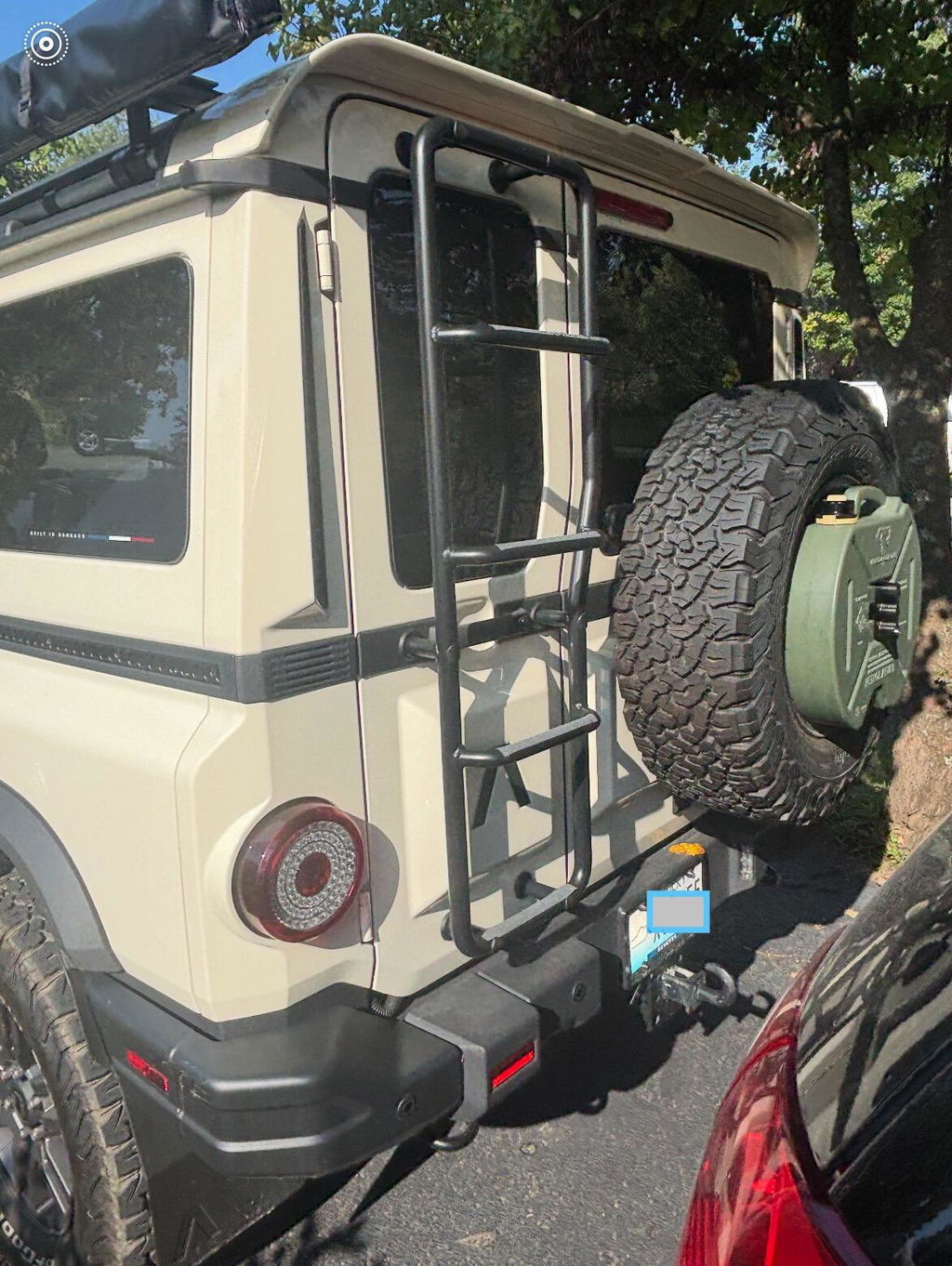
Roof pod: 160W total, ~7,000 lm wide flood, mounts to roofline via automotive tape, powers from the EXT2 DTP connector. Best for camp lighting, site work, and perimeter coverage.
Bumper kit: 80–110W, ~8,800–13,200 lm forward driving beam, bolts to factory bumper mounting points, powers from EXT1 or EXT5 pigtail. Best for trail driving and forward illumination.
The two zones draw from separate circuits and don't conflict, so many owners run both.

Why Mount Position Matters More Than Wattage
When owners search for a Grenadier light bar, they're usually comparing output figures — watts, lumens, beam distance. But the most important variable is simpler: where does it go? That single decision determines what the light actually illuminates, how it wires in, and whether it interferes with the rest of your roof build.
Two real examples from TheIneosForum illustrate why this matters. In June 2024, a forum member described what happened after their dealer installed a crossbar-mounted light bar in the forward position:
"It was really noisy when driving — the crossbar making a loud whistle above 50 mph, even having added rubber noise-reducing strips in every gap. So I moved the light bar to the B-pillar."
— sean0809, TheIneosForum, Light bar and mounting thread, June 2024
And in April 2026, a Grenadier owner in Los Angeles documented the wiring side of the same problem:
"I went through a lot of trial and error, so hopefully this makes life easier for everyone else. To connect a light bar to the roof AUX DTP connectors, all you need is the contacts for the male plug that's provided. I thought it was a dummy plug but it isn't — it's functional and just needs the contacts installed."
— reidanerg, TheIneosForum, DTP connectors thread, April 2026
These are the two friction points that trip up Grenadier owners: mount position (which affects wind noise, crossbar clearance, and beam angle) and wiring path (the DTP system is not as obvious as standard pigtail connectors). Both are fully solvable. The sections below cover both.
Zone 1: Roof Mount — Flood, Camp, and Perimeter Coverage
The Grenadier's roof presents a physics challenge that doesn't exist on conventional crossbar-based roof racks. Its factory roof is relatively flat, and a light bar mounted on forward crossbars sits directly in the vehicle's aerodynamic wake — which is why the wind noise complaint above happened even with dampening strips. The fix owners find is moving the light bar back to the B-pillar position, but that creates a new problem: it consumes the rear crossbar slot and limits what else can go on the roof.
DVA's Roof Pod takes a different approach. The doesn't use crossbar mounting at all. It uses high-strength automotive-grade VHB-class adhesive tape to follow the Grenadier's roofline contour exactly. No bracket hardware. No slot in the crossbar system. Nothing in the slipstream.
- LED configuration
- 4 × 40W high-output LEDs — 160W total
- Luminous output
- ~7,000 lumens, wide flood beam pattern
- Housing
- ABS composite, precision-molded to Grenadier roofline contour
- Mount method
- High-strength automotive tape — no drilling, no permanent modification
- Power — DTP Edition
- Plugs directly into roof EXT2 DTP connector (Deutsch DTP-Series, 25A)
- Power — FOB Edition
- Under-hood DC connection, Bluetooth key-fob wireless control
- Fitment
- Grenadier Station Wagon and Quartermaster (2023–present)
- Safari windows
- Does not interfere with Safari window operation
- Install time
- ~30–45 minutes, no drilling
The 7,000-lumen wide flood pattern is tuned for 180° coverage around the vehicle — the full camp perimeter, a job site, a recovery zone. Because the beam spreads laterally rather than throwing far forward, it doesn't blind against nearby terrain, tree lines, or other people in camp. It's oriented toward presence illumination rather than driving illumination.
When roof is the right choice
- Camp and basecamp lighting — flood coverage around the vehicle where a narrow driving beam is actively counterproductive
- Site work and recovery — 360° worksite visibility, hands-free lighting for setup tasks
- Owners who want OEM+ integration — the flush mount follows the roofline; there's no bracket hardware visible from the outside
- Builds with DualTrack crossbars — the roof pod mounts to the roofline itself, leaving all crossbar L-Track slots available for cargo, solar, or a rooftop tent
Zone 2: Bumper Mount — Driving Beam and Forward Throw
The Grenadier's front bumper has four factory-engineered mounting points built into its geometry for auxiliary lighting. They're designed for this. DVA's Front Bumper Light Kits bolt directly to those factory points — zero drilling, no modification to approach angle or bumper geometry, 45–60 minutes to install.
Three output variants are available:
| Variant | Output | Beam type | LED technology |
|---|---|---|---|
| 3-Light LED Bar | ~110W / ~13,200 lm | Forward driving beam | Cree 4-chip, IP68 |
| 2-Light LED Bar | ~80W / ~8,800 lm | Forward driving beam | Cree 4-chip, IP68 |
| 32" LED Bar | ~90W / ~8,800 lm | Wide-reach bar pattern | Osram LED, IP68 |
All three variants share the same factory mounting interface, the same hardware kit, and the same ~45–60 minute install. The difference is output level and beam geometry: the Cree pod configurations deliver tighter forward driving beams at higher lumen output; the 32" bar spreads a wider pattern at slightly lower total output.
Wiring path: Bumper lights don't use the DTP connectors on the roof. They wire into the under-hood pigtail connectors — EXT1 (10A, available on all Grenadiers) or EXT5 (25A, High-Load Auxiliary Switch Panel option). Both harnesses come pre-assembled in the kit.
When bumper is the right choice
- Trail driving after dark — forward throw and beam distance matter far more than perimeter coverage here
- Grenadiers with loaded roof systems — if DualTrack crossbars are carrying a tent, cargo boxes, or solar panels, the bumper mount keeps lighting completely separate from the roof build
- High-Load Auxiliary Switch Panel owners — the 25A EXT5 circuit runs the 3-light kit cleanly without taxing the standard 10A EXT1
- Quartermaster owners — QM DTP port count varies by configuration and aux power option; bumper mounting gives the QM full lighting capability independent of roof DTP availability
The DTP Wiring Reality Check
The roof DTP connectors confused enough Grenadier owners that a how-to thread posted on TheIneosForum in April 2026 has become the primary reference on the forum's Lighting board.
Forum member thedocaus — a veteran contributor with over 5,000 posts who has documented the Grenadier's auxiliary power system in detail — provided the technical breakdown:
"The 25 amp Deutsch plugs used in the INEOS are two-pin DTP-style plugs, with size 12 pins rated at 25 amps (14–12 AWG wire size). These plugs can be found on the roof — 4 locations on the Station Wagon, but only 2 locations on the Quartermaster — if you selected the auxiliary power option."
— thedocaus, TheIneosForum, DTP connectors thread, April 2026
The DVA Roof Pod Light Bar (DTP Edition) ships with a pre-wired DTP adapter cable — the male housing, pins, and wedgelock are already assembled and included. That's the piece most owners spend time sourcing separately when adapting generic light bars to the DTP system. For reference, if you're adapting your own lights, the parts are:
- DTP06-2S — male housing with wedgelock (two sockets for the DTP06 plug)
- DTP04-2P — female housing with wedgelock
- Size 12 pins — rated 25A, compatible with 14–12 AWG wire
The Grenadier's roof DTP system is actually two separate circuits, not one pool of ports. EXT2 is a single dedicated 25A port. EXT3 is three shared 25A ports running off one shared circuit. The Roof Pod Light Bar (DTP Edition) plugs into EXT2, which keeps the three EXT3 ports completely free for side lights, a Starlink mount, or other roof accessories.
For Quartermaster builds: DTP port count and layout vary by configuration and aux power option — confirm your build sheet with your dealer before planning a multi-accessory roof build. If your QM DTP allocation is limited, the FOB Edition of the Roof Pod (which draws from under-hood DC) keeps all roof DTP ports available for other accessories.
Running Both Zones at Once
Many Grenadier owners run both zones — roof flood and bumper driving beam — simultaneously. The electrical system is designed for it. EXT2 powers the roof DTP port; EXT1 or EXT5 powers the bumper pigtail. They're separate circuits on separate switch positions. There's no shared load, no relay required, and no interaction between the two.
If your build includes DVA DualTrack crossbars on the roof, the DVA Roof Pod Light Bar mounts to the roofline surface ahead of the crossbar system — all L-Track slots on the crossbars remain fully available for gear, solar panels, recovery boards, or an RTT. The two systems don't compete for the same space.
Net: 160W wide flood from above, 80–110W forward driving beam from the front. With the High-Load Auxiliary Switch Panel, both circuits are independently switched from the dash without any aftermarket relay or fuse tap.
The Decision Framework
| Use case | Better mount | DVA product |
|---|---|---|
| Camp / basecamp lighting | Roof | |
| Trail driving at night | Bumper | Bumper 3-Light Kit |
| Recovery operations | Both | Roof flood + bumper drive |
| Overlanding build, full roof load | Bumper | Bumper 2-Light Kit |
| Stealth / urban / OEM+ look | Roof | |
| Quartermaster (DTP count varies by config) | Bumper or Roof-FOB | Bumper Kit or |
Roof Pod for Camp. Bumper Kit for Trail. Both DTP-Ready.
Roof pod for flood. Bumper kit for drive. DualTrack crossbars to carry everything else. All bolt-on, all DTP-ready, all designed specifically for the Grenadier platform.