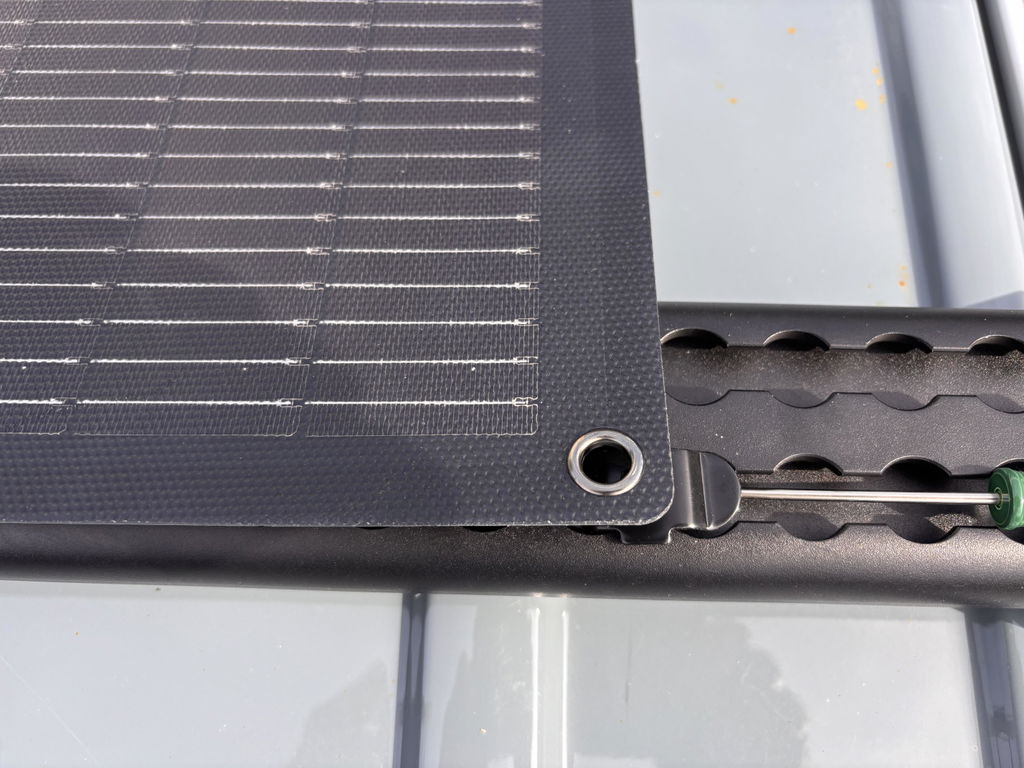
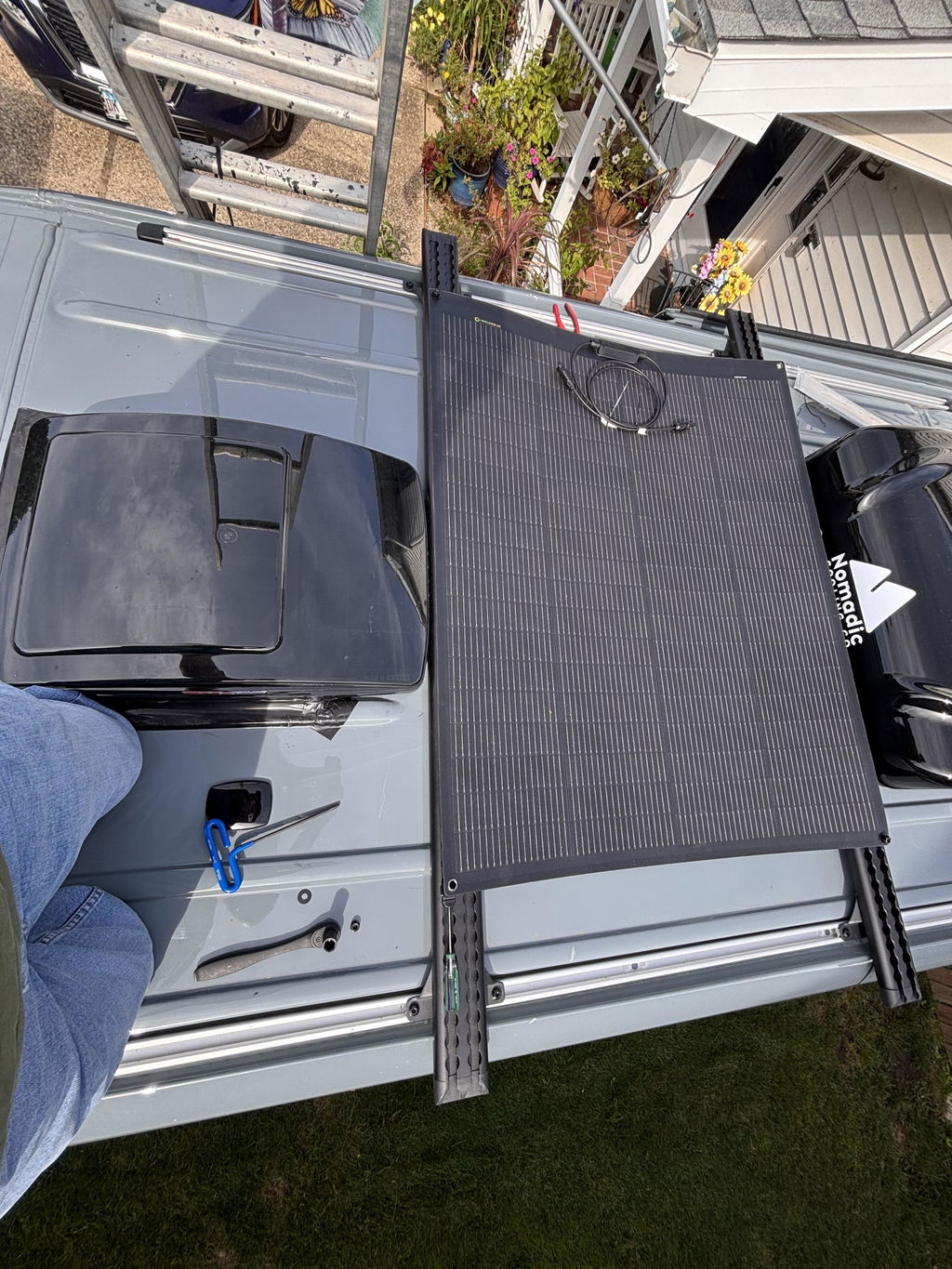
In 2026, the 330 lb dynamic roof limit on a Mercedes Sprinter remains a hard ceiling — it covers everything on the roof simultaneously: rack, crossbars, solar, fan, hardware. A DVA DualTrack-T 2-crossbar kit paired with LoadSpan-T rails comes to approximately 25 lb combined — leaving roughly 305 lb for cargo and accessories. Two 200W rigid panels typically land at 40–55 lb combined. Add a MaxxAir fan (~7 lb) and mounting hardware (~3–5 lb) and you're at approximately 80–90 lb total for a baseline solar setup, well inside the limit. The crossbar selection determines whether solar clamps can be installed without drilling — DualTrack-T's 25mm T-slot channel accepts standard solar clamps directly.
The 330 lb Number Most Builders Get Wrong
Every Sprinter owner eventually asks: how much solar can I put on the roof? The answer isn't about wattage — it's about weight, and the math is more constrained than most builders expect.
Mercedes specifies a 330 lb (150 kg) dynamic roof load for all VS30 Sprinter roof heights — high roof, low roof, standard roof, it's the same number. Dynamic means while driving. That limit isn't just for cargo; it applies to everything bolted, clamped, or strapped to the roof at highway speed. Your crossbars, your rails, your fan housing, your solar panels, and every piece of hardware holding them down all count against the same 330 lb.
The number catches builders off guard because it's lower than most van-specific roof racks are rated for in static terms. A typical multi-bar roof platform is rated 400–800 lb static. That rating describes what the rack itself can hold structurally. It has nothing to do with what the Sprinter's roof attachment system tolerates at speed. The OEM factory rail mounts set the actual ceiling — and Mercedes set it at 330 lb dynamic.
Maximum dynamic roof load on a Sprinter is quite low at 330lb. People underestimate how fast you hit that number when you add real gear.
r/VanLife commenter, Cargo Box on Sprinter Roof Rack thread · Feb 11, 2026
The Full Weight Budget for a Solar-Crossbar Build
Before selecting panels, build a weight register. Every component that lives on the roof year-round gets a line item. Here's a realistic 400W build using the DVA utility platform:
| Component | Weight | Notes |
|---|---|---|
| LoadSpan-T rails (pair) + DualTrack-T 2-crossbar kit | ~25 lb | Confirmed DVA product data; bolt-on, no drilling |
| 2× 200W rigid solar panels | 40–55 lb | Varies by brand and framing — verify your panel spec sheet |
| MaxxAir 7000K fan (installed) | ~7 lb | MaxxAir published spec |
| T-slot solar clamps + hardware | ~3–5 lb | Standard 25mm T-slot clamp sets |
| Total baseline | ~75–92 lb | Leaves 238–255 lb remaining from 330 lb limit |
Rigid 200W panel weights have held steady in 2026 — standard monocrystalline panels from major brands run 19–26 lb per panel depending on frame design. Flexible panel technology has improved but most 200W flex options still match or exceed rigid frame weights per watt. Panel prices have dropped roughly 20–30% from their 2022 peak, meaning builders are fitting more panels per build, which makes accurate weight accounting before ordering more important than ever. Always verify the spec sheet for your specific panel — manufacturers update frame designs and weights without changing model numbers.
At 75–92 lb, a well-planned 400W solar setup with quality crossbars uses roughly 25–28% of the dynamic roof capacity — leaving the rest for a rooftop tent, awning, additional cargo, or a later satellite mount without approaching the ceiling.
The variable that changes the equation fastest isn't the panels — it's the rack system. Builders who choose heavy full-frame roof platforms often commit 60–75 lb to the structure alone before a single panel goes up. One Sprinter-Source user documented this firsthand:
I got the full length 170 rack — six uprights, eight crossbars. The cross bars weigh more than the uprights. Carrying the box up from the mailbox, I'd say the whole thing weighed 60–75 lbs.
Sprinter-Source member, Low Pro Roof Rack Install Observations · Sep 2020
A 70 lb rack leaves 260 lb for everything else — panels, fan, awning, cargo. It's workable, but the margin is tight on a 170" extended wheelbase build with multiple accessories.
Why Crossbar Selection Determines Your Solar Install Method
Most crossbar systems force you to choose how you mount solar panels before you commit to the rack. The two common methods are drill-through and clamp-on — and crossbar profile determines which approach is possible.
Drill-through mounting
You drill through the crossbar extrusion and use through-bolts to clamp the panel frame. It works, but it's permanent, it voids any rain seal on the bar, and repositioning panels later means new holes. This method is used on ladder-style racks and simple crossbar setups with no T-slot channel.
T-slot clamp mounting
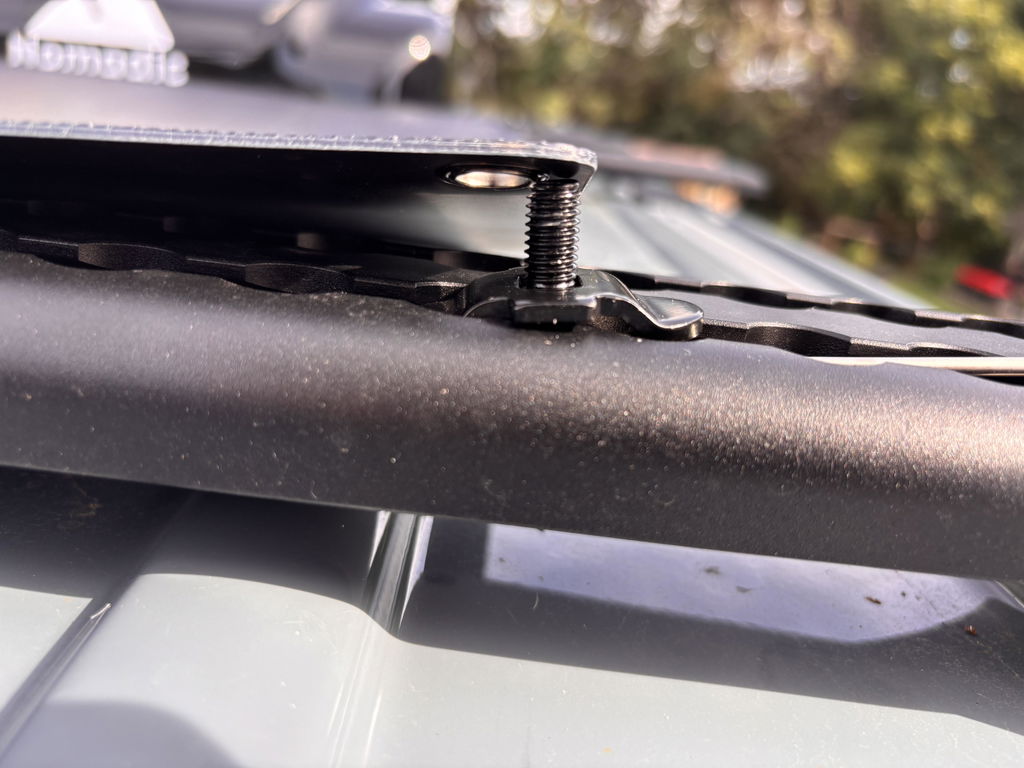
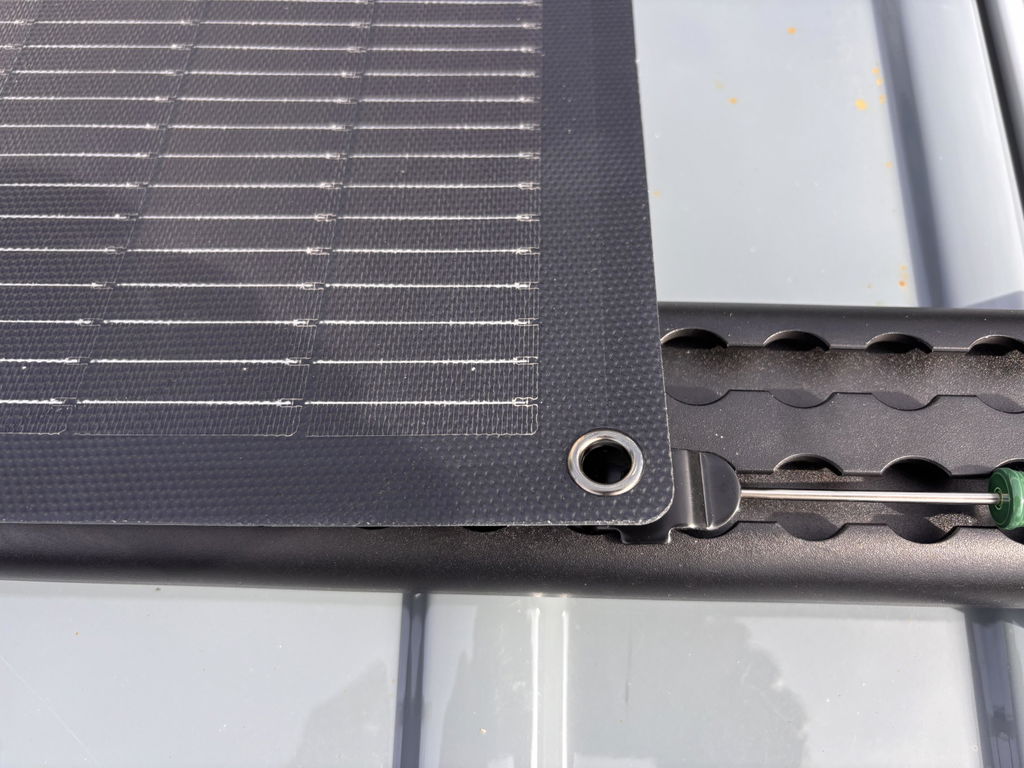
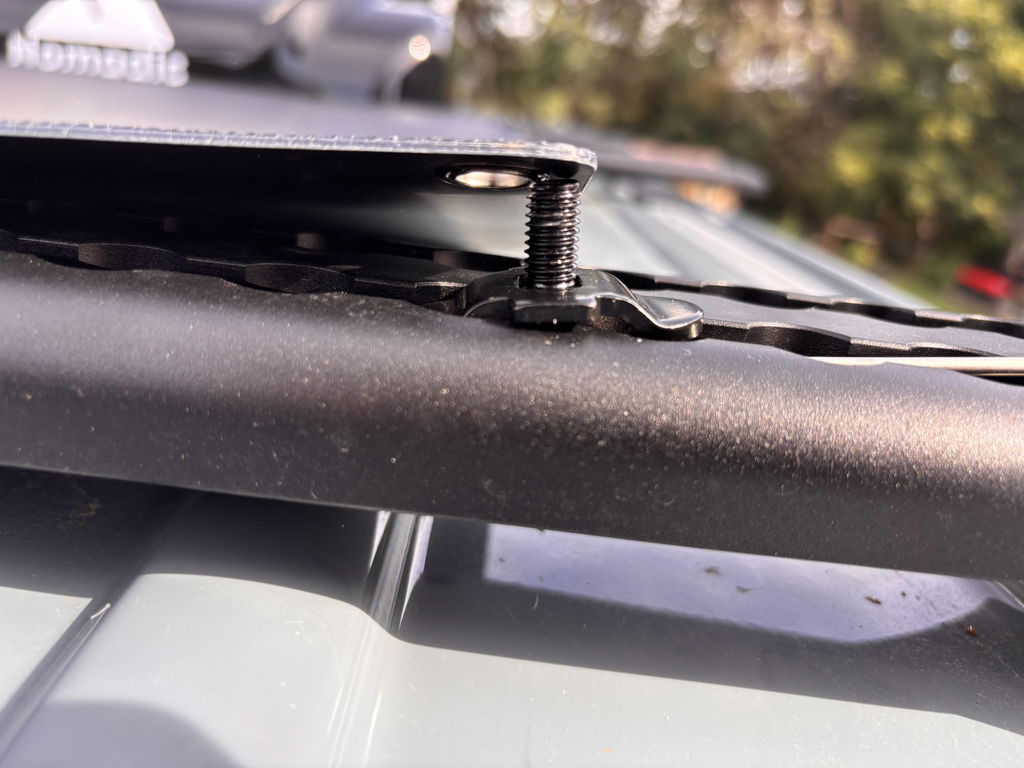
T-slot or L-track channels accept sliding hardware — solar clamp sets drop into the slot, tighten against the panel frame, and can be repositioned without tools in minutes. No drilling, no sealant, reversible. Panel spacing adjusts in seconds for seasonal repositioning or configuration changes.
The Sprinter-Source community identified this early. In a 2015 thread evaluating roof rack options, one builder noted the practical advantage: "trivial to mount & dismount anything with a t-slot style rack" — and went on to choose a fully modular T-slot system specifically because solar panel position could be adjusted without committing to fixed drill points. (Sprinter-Source: Roof Racks thread, Jul 2015.)
The limiting factor: standard 10-series T-slot (1") doesn't accept common 25mm solar clamp hardware without an adapter. 15-series extrusion (1.5") has more clearance but different clamp sizing. The DVA DualTrack-T cuts through this with a purpose-built 25mm T-slot channel alongside its L-track channel — the 25mm slot is the industry standard for solar clamp hardware, no adapters needed.
The DualTrack-T Solar Mounting System
DVA built the DualTrack-T crossbar — extruded aluminum, powder-coat finished — around a dual-channel profile that runs two mounting standards in parallel across the full 61¾" length: an L-track channel and a 25mm T-slot channel. For solar installations, this means:
- 25mm T-slot channel accepts standard solar panel clamp sets directly — four clamp positions per bar, no adapters
- L-track channel handles tie-downs, cargo nets, awning mounts, recovery board carriers — completely independent of the solar hardware
- Both channels are active simultaneously — you're not giving up cargo utility to mount panels
Load ratings for the 2-crossbar kit (the baseline solar configuration): 300 lb static / 150 lb dynamic. Add two more bars for the 4-bar kit and the rating doubles to 600 lb static / 300 lb dynamic — which matches the Sprinter's full 330 lb dynamic roof limit on a single system.
Each bar weighs 8.5 lb including hardware. The bars are 3" wide and 1" tall — low-profile enough that wind resistance and clearance issues that affect taller rack systems don't apply here.
The DualTrack-T mounts to OEM Sprinter longitudinal roof rails (all model years with factory rails), DVA LoadSpan-T rails, or compatible aftermarket rails. No drilling into the roof or van body. Install time with basic hand tools is typically 1–2 hours.
The LoadSpan-T rails are purpose-engineered for VS30 Sprinters (144, 170, and 170 EXT wheelbases) and bolt directly to the factory roof mounting points — no drilling, no brackets. Pair with DualTrack-T crossbars for a complete utility platform: load-spreading rails as the base, dual-channel crossbars for solar and cargo. The two systems share the same hardware standard and are designed to work together.
Planning Your Solar Layout Before You Order
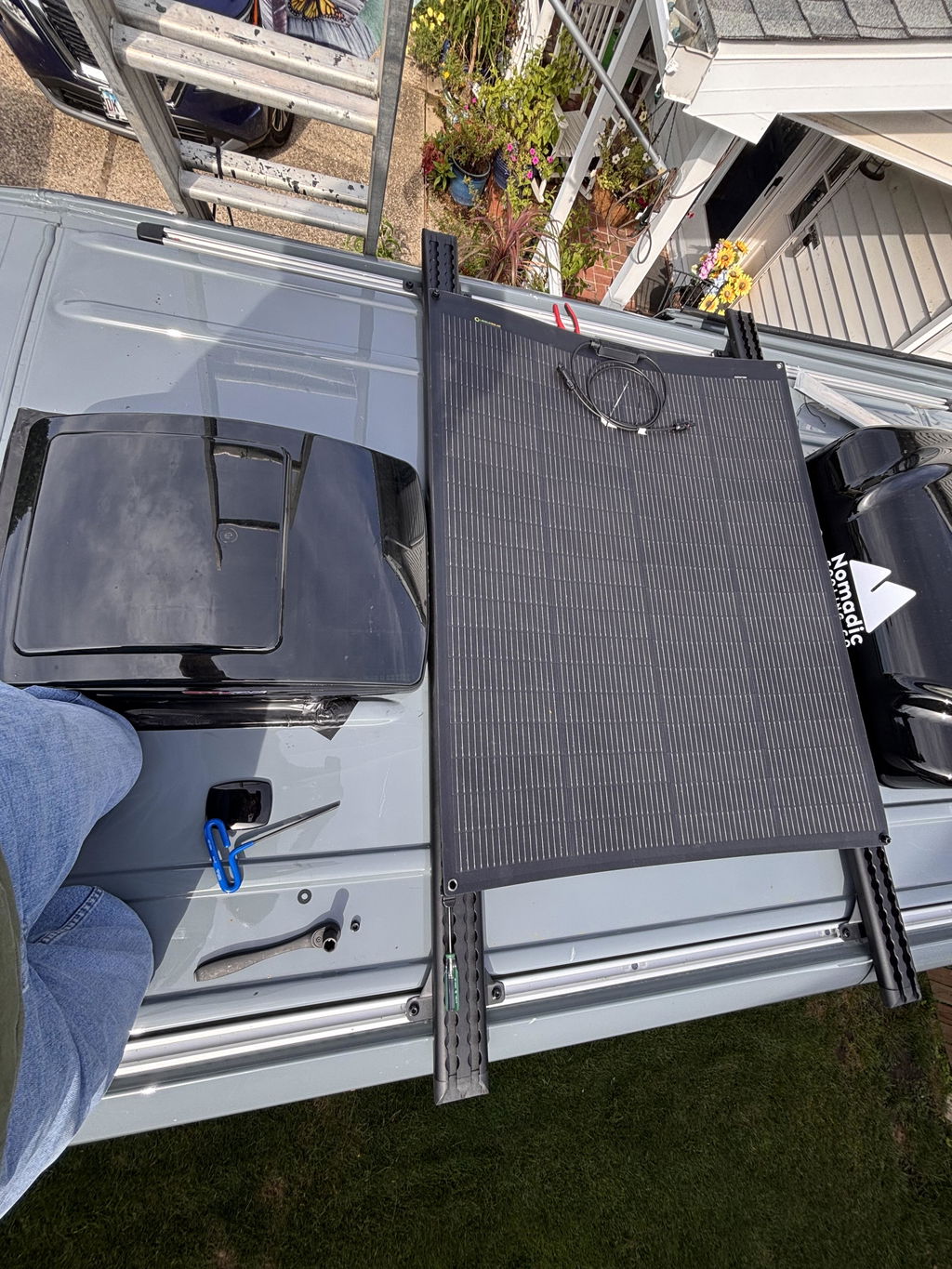
The DualTrack-T crossbars span 61¾" across the Sprinter's OEM rail spacing (51.875" between factory rails, with overhang). Standard 200W rigid panels range from 38"–44" wide. With two crossbars positioned 34" on-center — the standard spacing used for most solar panel mounting — a 2-crossbar kit handles two full-size panels side by side, leaving the rear of the roof clear for additional accessories or a fan cutout.
For 400W from four 200W panels on a 170" wheelbase, the 4-bar kit provides four attachment lines for panel clamps and distributes load across the full rail span.
The practical checklist before ordering:
- Verify your panel's weight against the budget table above — always check the spec sheet, not assumed averages
- Confirm whether your panel frames accept standard T-slot clamps (most rigid panels do; flexible panels typically require a different mounting strategy)
- Check your fan, awning, and antenna weights and add them to the register before hitting order
- Choose 2-bar or 4-bar kit based on panel count and final weight budget, not just wattage
The full Sprinter roof rail system at DVA covers the platform from base rails to crossbars to L-track cargo accessories. If you're building from scratch, the LoadSpan-T → DualTrack-T → L-track accessory stack is designed to work together as a single ecosystem — the DVA vehicle utility platform for Sprinter builders who want every square inch of roof to pull its weight.
The DVA Setup for This
DVA Crossbars for Sprinter Solar Panels
DualTrack-T crossbars accept any T-slot solar bracket — repositionable without tools. At 330 lb system limit, a full 400W array (≈35 lb) leaves 295 lb for other gear.
DualTrack-T Crossbars →LoadSpan-T Rails