Sprinter Engineering Series

DualTrack-T™ Sprinter Cross Bars: Why Purpose-Built T-Track Systems Outperform Universal Roof Racks

Universal roof racks treat every vehicle the same. The Sprinter's roof tracks deserve cross bars engineered specifically for them — with dual-channel versatility that generic racks can't match.

The Mercedes Sprinter has a 330 lb (150 kg) dynamic roof load rating — regardless of roof height. Most universal cross bars waste a significant portion of that capacity fighting their own attachment compromises: plastic feet that concentrate stress, rectangular profiles that generate aerodynamic drag, and dissimilar metals that corrode against the Sprinter's steel roof. The DualTrack-T™ system is purpose-built to mount onto Sprinter roof tracks — OEM roof rails or aftermarket options like DVA's LoadSpan-T™ — with an integrated dual-channel profile (L-Track for sliding accessories and 25mm T-Slot slots for fixed clamping), delivering 150 lb capacity per 2-bar kit with zero drilling and zero adapter brackets.

150 lb
Dynamic Load / 2-Bar
300 lb
Dynamic Load / 4-Bar
330 lb
Sprinter Roof Rating

1. The Universal Rack Problem

Walk through any Sprinter forum and a pattern emerges. Owners who bolted on universal cross bars — the kind sold as "fits 200+ vehicles" — keep running into the same set of failures. Not because those products are poorly made, but because a one-size-fits-all approach introduces engineering compromises that compound over time on a working vehicle.

Stress Concentrations at Attachment Points

Universal racks interface with the Sprinter's roof through adapter feet — typically injection-molded plastic or cast aluminum clamps designed to grip a range of rail profiles. These feet create point loads rather than distributed loads. Instead of spreading force across the full width of a factory mounting point, they concentrate it through a small contact patch. Under dynamic loading (highway speeds, crosswinds, braking), these stress concentrations can exceed the design limits of the adapter, the roof rail, or both.

"When I first got my T1N in 2006 I used 2 standard round crossbars mounted on their plastic feet. Didn't see a speed bump in Baja and hit it at 50 mph — sheared the plastic feet in half. Gave up on plastic."

Galvanic Corrosion: Aluminum on Steel

The Sprinter roof is steel. Most universal cross bars are extruded aluminum. When two dissimilar metals sit in direct contact and moisture enters the joint, you get galvanic corrosion — an electrochemical reaction where the more anodic metal (aluminum) sacrifices material to protect the more cathodic metal (steel). The result: white aluminum oxide buildup, pitting, and eventually a joint that's either seized solid or structurally weakened.

Galvanic Series (Seawater Reference)
Aluminum alloys: −0.76 V to −1.00 V
Carbon steel: −0.60 V to −0.71 V
Potential difference: 0.05 V to 0.40 V
→ Sufficient to drive measurable corrosion in wet environments

Without an isolation barrier between the aluminum rack and the steel roof, every rain event accelerates this process. Universal racks rarely include proper dielectric isolation — they rely on paint or powder coat as a barrier, which chips under vibration and load cycling.

Wind Noise from Rectangular Profiles

Universal cross bars are typically extruded with a rectangular or square cross-section. This is the cheapest profile to manufacture across a broad product line, but it's the worst aerodynamic shape for a roof-mounted bar. Rectangular profiles create vortex shedding — alternating low-pressure zones behind each edge that generate the characteristic howl owners describe at highway speeds.

"I've had 5-6 different rack iterations on my van at this point, some have been affected by wind noise and others aren't. There's no way to really know until it's up there and you're on the highway."

The physics are straightforward: a rectangular bar of 30mm height at 65 mph produces vortex shedding at roughly 200-400 Hz — right in the middle of human hearing sensitivity. Rounded or teardrop profiles push the separation point downstream, reducing the intensity of shed vortices by 60-80%.

DualTrack-T cross bars installed on Mercedes Sprinter roof showing curved aerodynamic profile
DualTrack-T™ cross bars on a Sprinter — note the curved-edge profile versus typical rectangular universal bars.

2. Purpose-Built Geometry for Roof Track Mounting

The DualTrack-T™ is designed to mount onto roof tracks — longitudinal rails that run along the length of the Sprinter's roof. These can be OEM Sprinter roof rails (factory tracks), DVA's LoadSpan-T™ roof rails, or other compatible third-party roof tracks. The tracks themselves attach to the roof structure; the cross bars mount down onto the tracks.

A purpose-built cross bar system starts its engineering from these tracks, not from a universal clamp that has to accommodate everything from a Honda Civic side rail to a Ford Transit T-track. The DualTrack-T™ mounts to Sprinter roof tracks with machined aluminum feet designed for the track profile. No adapters. No shimming. No plastic clips doing structural work.

Engineering Note

The DualTrack-T™ feet clamp onto roof tracks using stainless steel fasteners with integrated isolation washers to prevent galvanic contact between the aluminum bar and the track — addressing the dissimilar-metal problem at the design level rather than relying on paint as a barrier.

Because the track mounting geometry is fixed and known, the cross bar span, foot angle, and load path can all be optimized for the Sprinter's specific roof curvature and reinforcement structure. Universal racks can't do this — they have to accommodate variation, which means over-engineering in some dimensions and under-engineering in others.

3. The Dual-Channel System: L-Track + 25mm T-Slot

Most cross bars give you one attachment method: clamp something to the bar. The DualTrack-T™ integrates two independent channel systems into a single extruded profile — a design distinction that changes what's possible on the roof.

L-Track (Airline Track) Channel

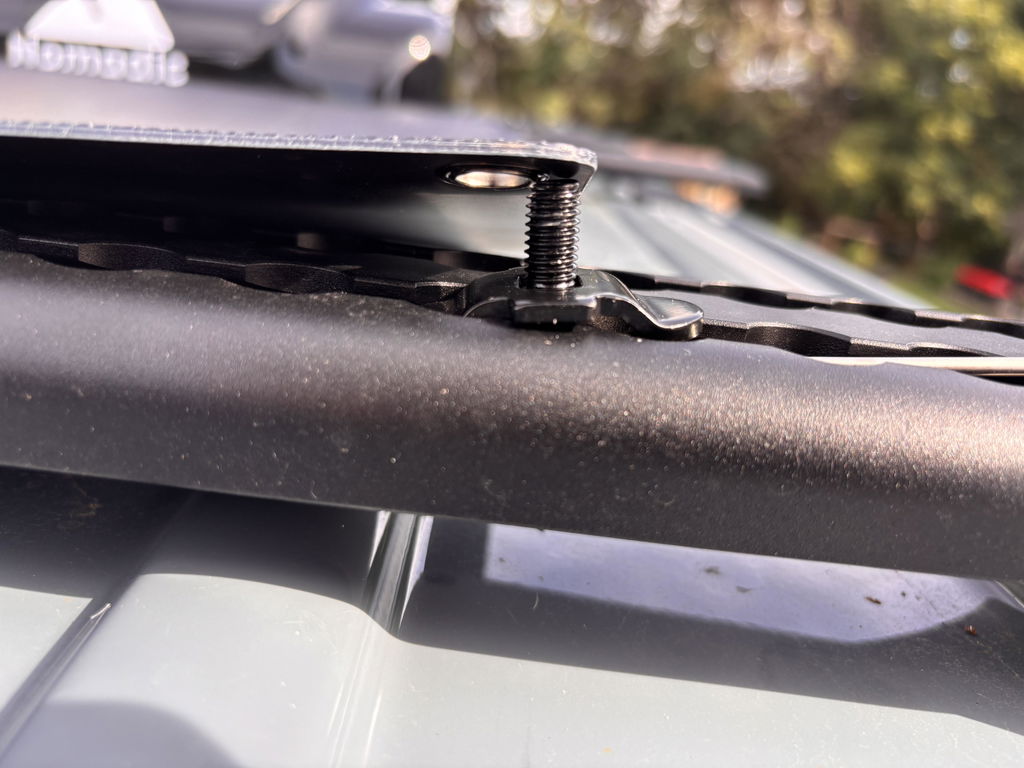
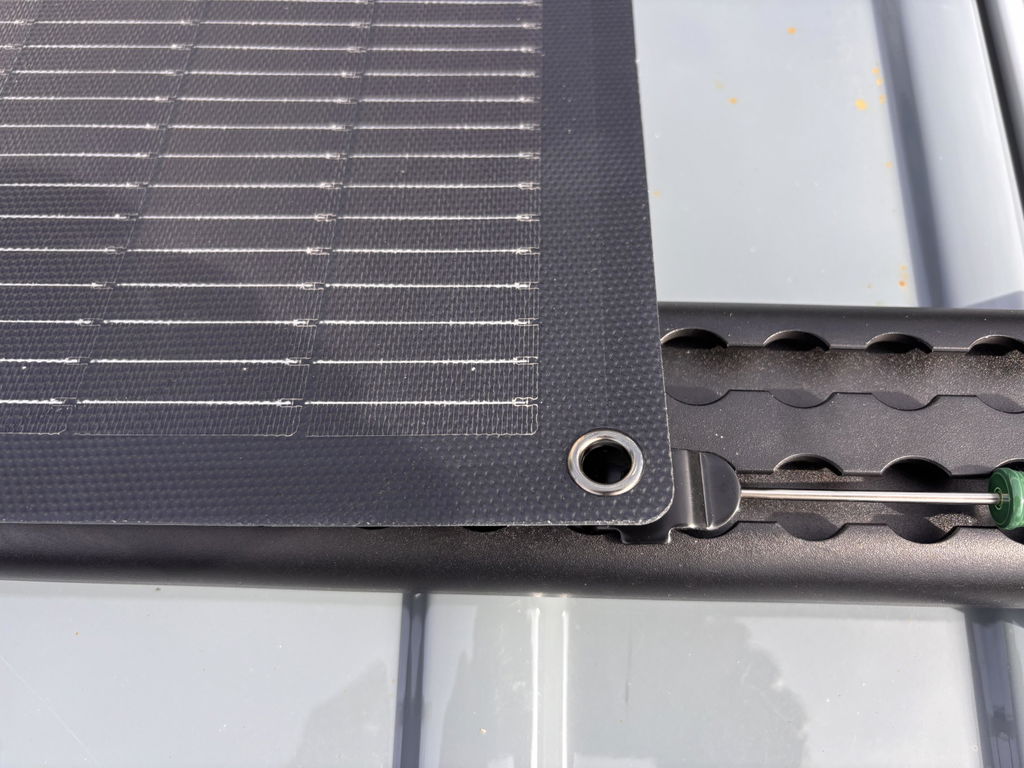
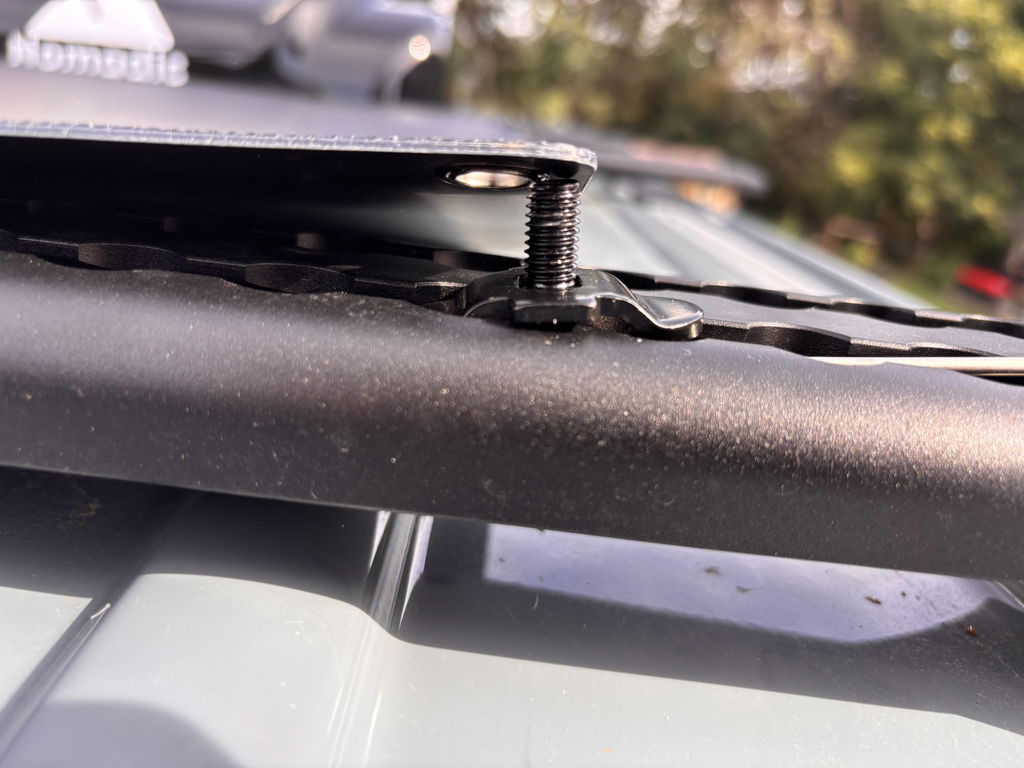
The L-Track channel runs the full length of each bar. L-Track is the same system used in aircraft cargo floors, military vehicle tie-downs, and commercial truck beds. Single-stud fittings drop into the track and lock with a quarter-turn. The key property: fittings slide freely along the track before locking. This means accessories can be repositioned anywhere along the bar without tools — adjust solar panel placement, shift a cargo box forward or back, re-center a ladder for balance.

25mm T-Slot (T-Slot) Channel

The 25mm T-Slot channel runs parallel to the L-Track and accepts standard T-slot bolts (also called hammer-head bolts). T-slot bolt connections are fixed-position, high-clamping-force attachments. Once torqued, they don't slide. This is the channel for permanent or semi-permanent installations: crossbar-to-platform adapters, fixed awning brackets, or any accessory that needs to resist lateral and rotational loads without any possibility of shifting.

"I'm a huge fan of t-slot extrusion. That's what's in my entire build. It's not inexpensive but super easy to work with."

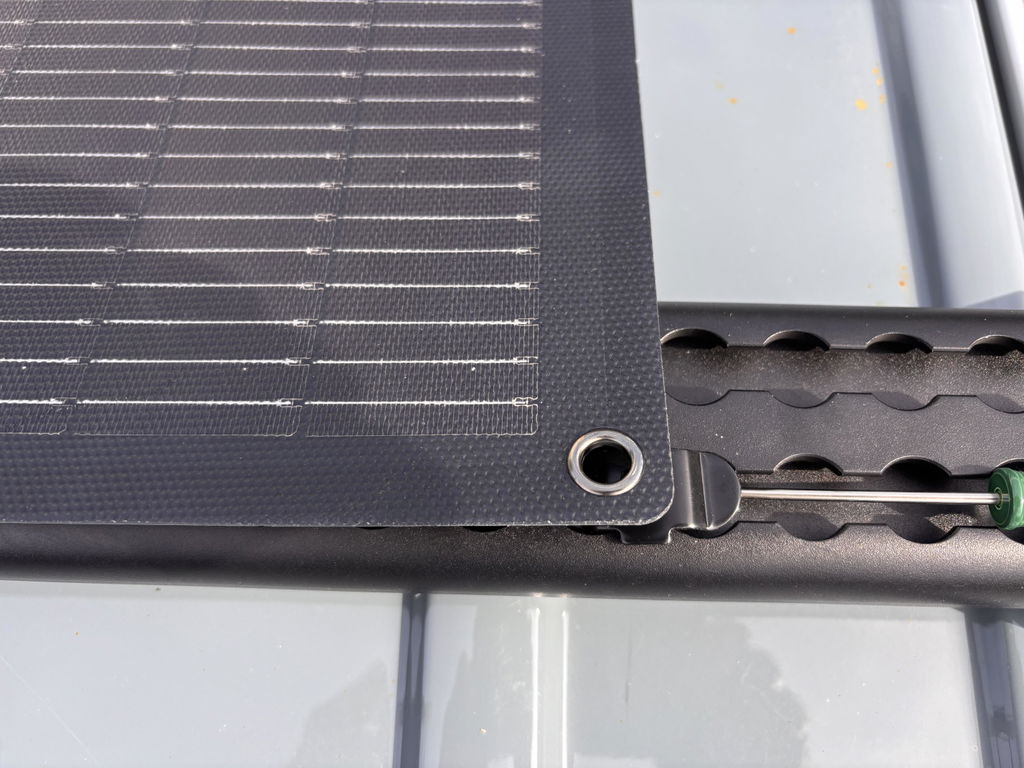
Close-up of DualTrack-T dual channel profile showing L-Track and 25mm T-Slot slots
Dual-channel profile: L-Track (sliding) and 25mm T-Slot slot (fixed clamping) in a single extrusion.

🟢 L-Track Channel

  • Sliding repositioning without tools
  • Quarter-turn single-stud locking
  • Aircraft-grade tie-down system
  • Ideal for: cargo straps, adjustable mounts

🟢 25mm T-Slot Channel

  • Fixed-position, high clamping force
  • Torque-locked — no sliding under load
  • Standard 25mm T-Slot/hammer-head compatibility
  • Ideal for: platforms, awnings, fixed accessories

Having both systems in one bar means you're not choosing between adjustability and rigidity — you get both, on the same cross bar, simultaneously. Run a fixed awning bracket on the 25mm T-Slot channel while keeping the L-Track open for seasonal accessories that change between trips.

Patent Pending

The dual L-Track + 25mm T-Slot integrated cross bar profile is patent pending. It's the first cross bar system to combine both channel standards in a single vehicle-specific extrusion.

4. Load Distribution: Point Loads vs. Track Mounts

Load capacity numbers on cross bars are meaningless without understanding how the load reaches the roof. Two systems can both claim 150 lb capacity, but the stress distribution at the roof interface can differ by an order of magnitude.

The Point Load Problem

Universal rack feet typically contact the roof rail or mounting surface through a small area — often less than 4 cm². Under a 150 lb distributed load across two bars, each foot carries roughly 37.5 lb. Through a 4 cm² contact patch, that's approximately 9.4 lb/cm² (0.67 kg/cm²) of static pressure. Add dynamic loads from braking, cornering, and wind — which can multiply static loads by 1.5-2.5× — and peak pressures at the contact patch can exceed 23 lb/cm².

Track-Mount Distribution

The DualTrack-T™ feet mount directly onto roof tracks, distributing force along the track interface. Each foot clamps to the track through a machined baseplate that spreads the load across the mounting surface. The load path runs from the cross bar foot, through the track, into the track's mounting hardware, and into the roof reinforcement — a clean, engineered chain with minimal joints.

Load Path Comparison
Universal adapter foot → plastic/aluminum clamp → roof rail edge → rail mounting bolt → roof panel
DualTrack-T™ foot → machined baseplate → roof track → track mount → roof reinforcement panel

The universal path has 4 joints and 2 material transitions. The purpose-built path has fewer joints and a direct track-to-roof connection.

Fewer joints means fewer failure modes. Each joint in a load path is a potential source of loosening, fretting, or fatigue cracking. The purpose-built system eliminates the adapter clamp entirely — the component most likely to fail on a universal rack.

DualTrack-T mounting feet installed on Sprinter factory roof mounting points
DualTrack-T™ feet mounted on Sprinter roof tracks — no adapters, no plastic clips, no universal compromises.

5. Aerodynamic Profile: Curved vs. Rectangular

Cross bar aerodynamics matter more on a Sprinter than on a sedan. The Sprinter's slab-sided body already has a drag coefficient around 0.35-0.38 Cd. Adding rectangular cross bars to the roof doesn't just create noise — it measurably increases fuel consumption.

The Drag Tax

A rectangular cross bar acts as a bluff body in the airstream. At highway speeds, the pressure differential between the front face and the wake behind the bar creates drag proportional to the bar's frontal area and its drag coefficient. For a rectangular bar, Cd is approximately 2.0-2.1. For a rounded or elliptical profile of the same frontal area, Cd drops to 0.4-0.6.

Profile Shape Drag Coefficient (Cd) Relative Drag Noise Character
Rectangular / Square 2.0 – 2.1 Baseline (worst) Tonal whistle, vortex shedding
Round / Circular 1.0 – 1.2 ~50% reduction Broadband hum, less tonal
Elliptical / Curved-Edge 0.4 – 0.6 ~70-80% reduction Minimal — wind noise below cabin threshold
Teardrop / Airfoil 0.04 – 0.1 ~95% reduction Near-silent (impractical for cross bars)

The DualTrack-T™ uses a curved-edge profile — not a full airfoil (which would be too tall and impractical), but an elliptical cross-section with radiused leading and trailing edges. This pushes the flow separation point past the widest section of the bar, dramatically reducing vortex intensity and the associated noise and drag.

Fuel Economy Impact

Published SAE studies on roof-mounted accessories show that two rectangular cross bars on a van-class vehicle increase fuel consumption by 1-3% at sustained highway speeds. Over 15,000 highway miles per year at current diesel prices, that's $75-225 annually — a cost that accumulates every year the bars are installed. Curved-profile bars reduce this penalty to under 0.5%.

6. Real-World Applications

The dual-channel system opens mounting configurations that would require multiple adapter kits on a universal bar — or wouldn't be possible at all.

Solar Panels

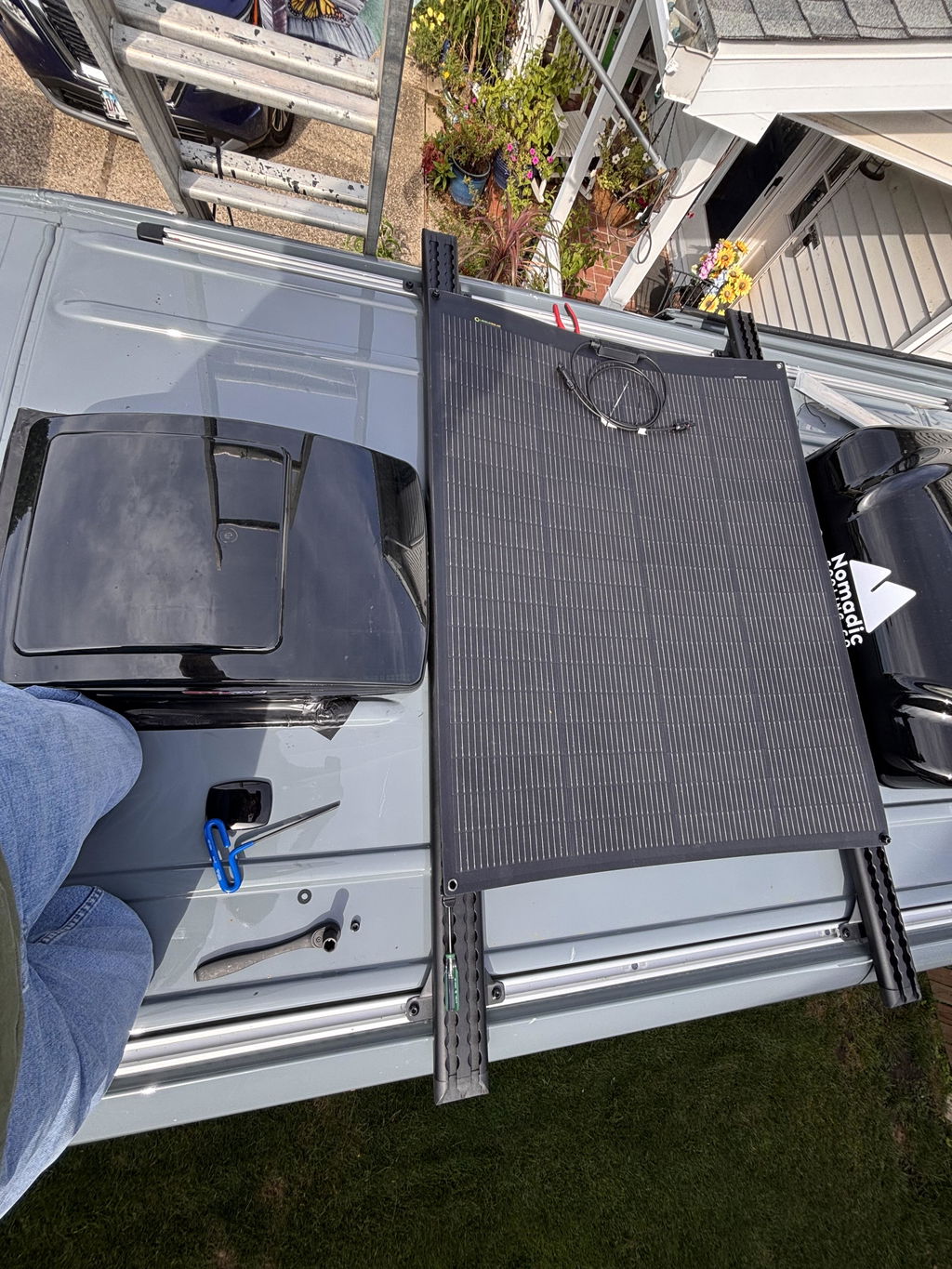
Solar panels mount to the 25mm T-Slot channel using standard panel Z-brackets. The fixed 25mm T-Slot connection prevents any lateral movement under wind load — critical when panels are mounted flat on the roof and acting as a sail. The L-Track channel remains available for running wiring clips or securing a tilt-mount for seasonal angle adjustment.

Cargo Boxes and Baskets

Rooftop cargo boxes and baskets bolt to the 25mm T-Slot channel through their standard mounting hardware. The DualTrack-T™ spacing matches the most common cargo box bolt patterns, eliminating the need for adapter plates. For soft cargo (dry bags, duffels), the L-Track provides tie-down points anywhere along the bar.

Roof-Top Tents (RTTs)

RTTs are the highest sustained load most Sprinter owners will put on their roof. A typical hard-shell RTT weighs 120-180 lb. With a 4-bar DualTrack-T™ kit rated at 300 lb dynamic, there's adequate capacity for the tent plus occupants' static weight when parked (static load ratings are typically 3× dynamic). The 25mm T-Slot channel provides the fixed, high-torque connection RTT mounting rails require.

Ladders

Rear-mounted ladders typically attach to the rearmost cross bar. L-Track fittings allow the ladder mounting bracket to slide into the optimal position — centered, offset for door clearance, or moved to accommodate other gear — then lock in place. Adjust between trips without drilling new holes.

Awnings

Side-mount awnings bolt to the T-slot bolt channel on the driver or passenger-side cross bars. The fixed connection resists the cantilever loads an extended awning generates in wind. Multiple 25mm T-Slot points along the bar allow the awning to be mounted at any longitudinal position.

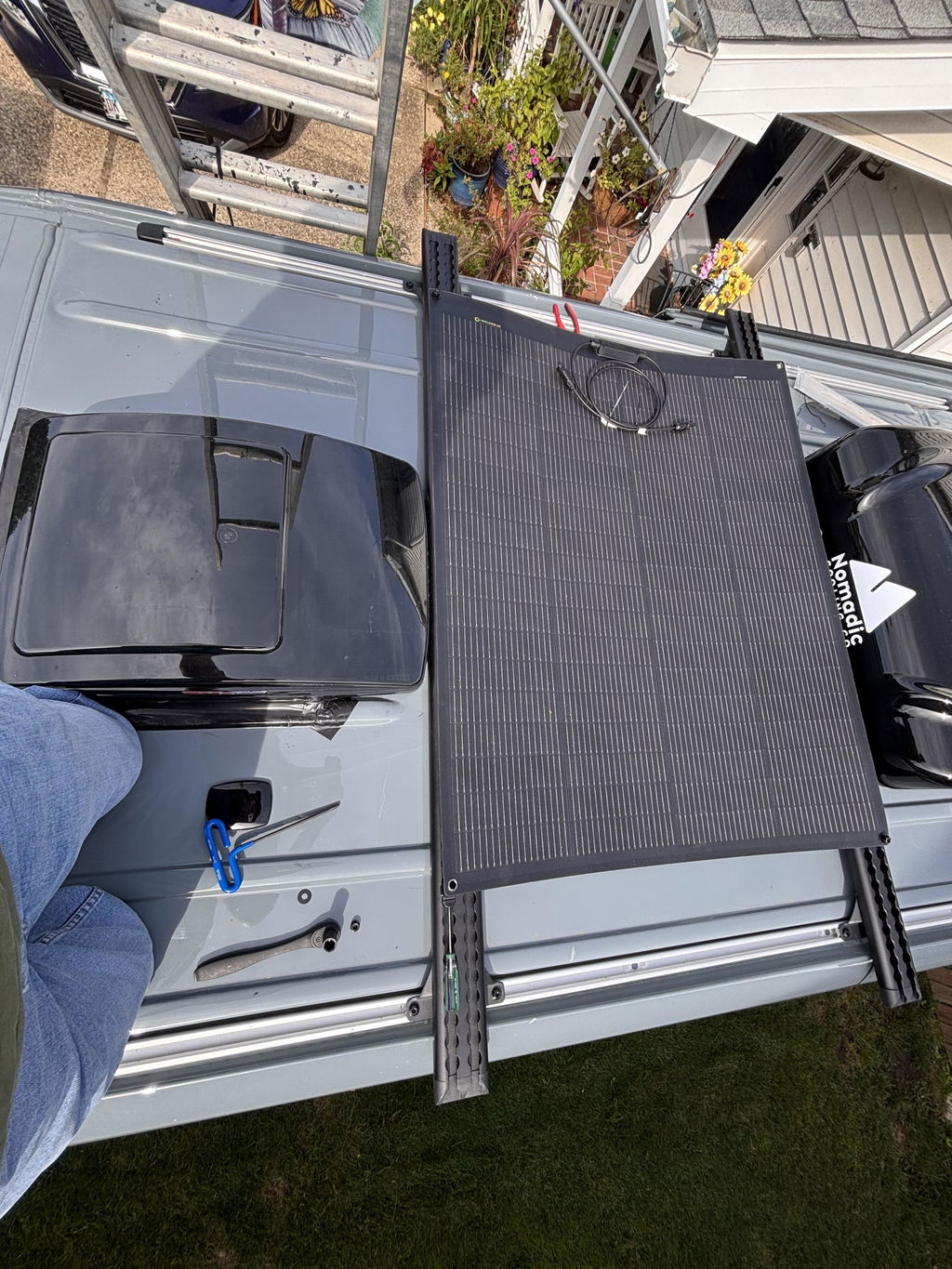
Aerial view of DualTrack-T cross bars installed on Sprinter roof
Aerial view showing DualTrack-T™ cross bar placement on Sprinter roof tracks.

7. Installation: Mount to Roof Tracks, No Drilling

The DualTrack-T™ mounts onto roof tracks that are already installed on your Sprinter. No drilling into the roof. No rivnuts. No structural modification. You'll need roof tracks in place first — either OEM Sprinter roof rails, DVA's LoadSpan-T™ roof rails, or other compatible third-party tracks.

Don't Have Roof Tracks Yet?

If your Sprinter doesn't have roof rails or tracks installed, you'll need them as the foundation for the DualTrack-T™ cross bars. DVA's LoadSpan-T™ load-spreading roof rails are purpose-built for the Sprinter and provide the ideal mounting platform.

1

Confirm Roof Tracks Are Installed

Verify that your Sprinter has roof tracks (OEM roof rails, LoadSpan-T™, or compatible third-party tracks) securely installed along both sides of the roof. All Sprinter roof heights (standard, high, super-high) are supported.

2

Position Cross Bars on Tracks

Place each cross bar across the roof tracks at your desired spacing. Slide the mounting feet along the tracks to set the fore-aft position. Each foot includes an integrated isolation washer to prevent metal-to-metal contact between the aluminum foot and the track.

3

Secure to Tracks

Tighten the supplied stainless steel fasteners to clamp each foot onto the roof track. Hand-tighten first to verify alignment and spacing across all mounting points before final torque.

4

Torque to Specification

Final torque each fastener to the specified value using a torque wrench. Do not overtighten — let the track and fastener interface do the work as designed.

5

Verify and Load

Confirm all feet are seated securely on the tracks with no play or gaps. Verify each fastener is at spec. The system is ready to load immediately — no settling period, no re-torque after break-in.

Tools Required

Torque wrench (Nm-capable), appropriate bit or socket for the supplied fasteners. Total install time: 20-30 minutes for a 2-bar kit.

DualTrack-T cross bars detail showing mounting hardware and bar profile
Detail view of the DualTrack-T™ showing the curved-edge extrusion profile and mounting hardware.

8. Technical Specifications

Specification 2-Bar Kit 4-Bar Kit
Dynamic Load Capacity 150 lb (68 kg) 300 lb (136 kg)
Channel System Dual: L-Track + 25mm T-Slot (patent pending)
Bar Profile Curved-edge elliptical extrusion
Material 6063-T6 aluminum extrusion, anodized
Mounting Mounts to Sprinter roof tracks (OEM rails, LoadSpan-T™, or compatible)
Fasteners Stainless steel with dielectric isolation washers
Drilling Required None
Compatibility Mercedes Sprinter (VS30 / NCV3) — all roof heights
Sprinter Dynamic Roof Load 330 lb (150 kg) — all roof heights

9. Frequently Asked Questions

Does the DualTrack-T™ fit all Sprinter roof heights?

Yes. Standard roof, high roof, and super-high roof Sprinters are all supported. The cross bars and feet are identical across all roof height variants — you just need compatible roof tracks installed.

What's the difference between dynamic and static load capacity?

Dynamic load is the maximum weight the system can safely carry while the vehicle is moving — accounting for braking, cornering, wind loads, and road vibration. Static load (vehicle parked) is typically 3× the dynamic rating. The 150 lb (2-bar) and 300 lb (4-bar) ratings are dynamic. When parked, the system supports significantly more — relevant for roof-top tent use.

What if my Sprinter doesn't have roof tracks?

The DualTrack-T™ requires roof tracks as its mounting foundation. If your Sprinter doesn't have OEM roof rails installed, DVA's LoadSpan-T™ load-spreading roof rails are purpose-built for the Sprinter and provide the ideal base for the DualTrack-T™ cross bars.

Can I mix L-Track and 25mm T-Slot accessories on the same bar?

Yes. The two channels are independent and run parallel along the full length of each bar. You can run 25mm T-Slot-mounted solar panels and L-Track tie-downs on the same cross bar simultaneously.

Will this work on a Sprinter that already has factory roof rails?

Yes — the DualTrack-T™ mounts directly onto OEM Sprinter roof rails. If your Sprinter already has factory roof tracks installed, you're ready to go. Simply position the cross bars on the tracks and secure them.

Do I need to seal anything after installation?

The DualTrack-T™ feet include gasket material between the baseplate and the track surface. The roof tracks themselves should already be sealed to the roof (OEM rails are factory-sealed; aftermarket tracks like LoadSpan-T™ include sealing hardware). No additional sealant is required for a weather-tight installation, though a thin bead of butyl tape between track and roof can be used for additional peace of mind in extreme climates.

What L-Track and 25mm T-Slot accessories are compatible?

The L-Track channel accepts any standard single-stud L-Track fitting — the same fittings used in aviation and commercial transport. The 25mm T-Slot channel accepts standard M8 25mm T-Slot (hammer-head bolts) used across the industrial T-slot-style extrusion ecosystem. Both are widely available from industrial hardware suppliers.

How does the 150 lb dynamic rating compare to universal racks?

Most universal cross bar kits rate between 100-165 lb dynamic for a pair, depending on the vehicle-specific adapter. The DualTrack-T™ delivers its 150 lb rating through a clean track-to-roof load path — no adapter feet in the chain to derate the system. The 4-bar configuration at 300 lb approaches the Sprinter's own 330 lb roof limit.

Key Takeaways

  • Track-mount design — mounts onto roof tracks (OEM rails, LoadSpan-T™, or compatible), eliminating adapter brackets, plastic feet, and the failure modes they introduce
  • Dual-channel extrusion (L-Track + 25mm T-Slot) provides both sliding adjustability and fixed clamping in one bar
  • Curved-edge profile reduces aerodynamic drag by 70-80% versus rectangular bars, cutting wind noise and fuel penalty
  • Dielectric isolation prevents galvanic corrosion between aluminum bars and the Sprinter's steel roof
  • 150 lb dynamic / 300 lb dynamic (2-bar / 4-bar) — rated through the track-to-roof load path
  • 20-30 minute install with basic hand tools, no drilling, no permanent modification

View DualTrack-T™ Cross Bar Kit →

Ready to Upgrade Your Sprinter?

DVA Mechanics engineers purpose-built Sprinter accessories — designed, tested, and backed by real-world data.

Browse All DVA Products →