Why OEM rails fade, how dual-finish solves it, and how to plan your complete side-mount build.
INEOS Grenadier exterior utility belt — quick answer
- Six L-Track rails bolt to factory threaded inserts on any Grenadier Station Wagon — no drilling, available on every trim.
- Mounts jerry cans, recovery boards, MOLLE panels, camp tables, and lights externally without consuming cargo space.
- OEM anodize-only finish fades to washed-out grey within 12–24 months outdoors; DVA dual-finish (anodize + powder coat at 60–80 µm) holds color 5+ years.
- Retrofit path: Front Set (2 rails), Rear Section (4 rails), or Full Set (6 rails) — all bolt to the same factory mounting points.
The INEOS Grenadier exterior utility belt is a set of six L-Track aluminum rails that bolt to factory mounting points along both sides of the vehicle — no drilling, no modification required. Every Grenadier Station Wagon ships with the threaded inserts pre-installed regardless of trim; the rails themselves may or may not have been ordered. Jerry cans, recovery boards, MOLLE panels, camp tables, and auxiliary lights all mount to the L-Track channel at any position along the rail using standard twist-lock fittings.
It's one of the features that separates the Grenadier from vehicles that bolt on aftermarket racks as an afterthought — the mounting infrastructure is part of the vehicle's design language. But not all utility belt rails hold up equally over time. And if you've spent any time around Grenadiers that have been in service for a year or more, you've already seen the problem.
The Factory Situation
Depending on your Grenadier's trim and configuration, you may or may not have OEM utility belt rails installed from the factory. The Trialmaster and certain accessory packages include them; other configurations ship with the mounting points present but the rails absent. This means a significant number of Grenadier owners are driving around with unused bolt holes on their flanks — potential that's sitting idle.
For owners who do have the factory rails, the track itself works fine. Both the OEM and DVA utility belts use L-Track (also called airline track or logistic track) — the industry standard slotted channel that accepts universal twist-lock fittings at any point along the rail. Standard L-Track fittings from marine, cargo, and overland suppliers all work.
The issue isn't the track. It's the finish.
The Fade Problem
The OEM utility belt rails are anodized aluminum. Anodizing creates a hard oxide layer on the surface — it resists corrosion, it's relatively durable, and it's been the default finish for aluminum extrusions for decades. For interior applications or sheltered environments, anodizing is perfectly adequate.
But the utility belt isn't sheltered. It's on the outside of the vehicle. It faces direct UV exposure every day the truck is parked or driven. It encounters brush on trails, flying gravel at speed, and constant abrasion from straps, fittings, and mounted gear being loaded and unloaded.
"I chose bump strips following early complaints of discoloration of the utility belt. Is discoloration still an ongoing issue? The few reports of discolouring were from cleaning chemicals — not a material defect."
Under these conditions, anodized aluminum fades. The black surface gradually lightens, developing a washed-out grey appearance that stands out against the Grenadier's painted body panels and powder-coated trim. It's not structural failure — the rails still function — but on a vehicle built with this level of design intention, faded rails look wrong. And once anodize fades, it can't be restored without stripping and re-finishing.
This is visible on Grenadiers that have been in service for 12+ months, particularly in high-UV environments (southern US, Australia, Middle East). The front-facing and top-facing surfaces of the rails show it first.
The Dual-Finish Solution
DVA's utility belt rails use a dual-finish process: anodized aluminum with an additional powder coat layer. The base anodize provides the corrosion barrier and adhesion surface. The powder coat on top adds the properties that anodize alone can't deliver:
UV stability — powder coat resists color fade and chalking from sustained sun exposure. The rails stay black.
Impact resistance — powder coat is significantly more flexible than anodize alone, absorbing chips from gravel and trail contact rather than fracturing
Scratch resistance — the thicker combined finish (typically 60–80 microns total vs. 15–25 microns for anodize alone) is substantially harder to mark during gear manipulation
Consistent appearance — maintains a uniform matte black finish that matches the Grenadier's exterior trim over years of use, not months
This isn't cosmetic vanity. On a vehicle where the utility belt rails are constantly interacting with metal L-Track fittings, ratchet straps, and aluminum carriers, finish durability directly affects how the truck looks two years from now. The anodize provides the foundation; the powder coat provides the armor.
OEM vs DVA: Direct Comparison
- ✓ L-Track (standard)
- ✓ Standard fitting compatibility
- ✓ Aluminum construction
- ⚠ Anodized finish only
- ✗ Fades within 12+ months
- ⚠ 15–25 µm finish thickness
- ⚠ Up to 6 positions (trim dependent)
- ✗ Dealer/special order retrofit
- ✓ L-Track (standard)
- ✓ Standard fitting compatibility
- ✓ Aluminum construction
- ✓ Anodized + Powder Coated
- ✓ UV-stable — maintains color
- ✓ 60–80 µm combined thickness
- ✓ 6 positions (full/front/rear)
- ✓ Direct bolt-on to factory points
| Feature | OEM | DVA |
|---|---|---|
| Track Type | L-Track (standard) | L-Track (standard) |
| L-Track Compatibility | Yes | Yes |
| Material | Aluminum | Aluminum |
| Finish | Anodized only | Anodized + Powder Coated |
| UV Fade Resistance | Low — fades within 12+ months | High — maintains color |
| Chip/Scratch Resistance | Moderate (15–25 µm) | High (60–80 µm combined) |
| Mounting Positions | Up to 6 (trim dependent) | 6 (full) or 2/4 (front/rear) |
| Retrofit Friendly | Dealer/special order | Direct bolt-on |
| Full Set Price | Varies by market/dealer | $499 |
The track is the same standard. The accessory compatibility is identical. The difference is what happens to the surface over 12, 24, 36 months of real-world exposure.
Six Positions, Full Coverage
The Grenadier's body provides six discrete utility belt mounting locations — three per side:
The rear and rear trunk positions are the workhorses — they're where the heavy and bulky gear lives. The front positions are shorter rails suited for lighter accessories, but they're valuable real estate for lights and quick-access panels.
All six positions bolt to the factory mounting points using the existing hardware locations. No drilling, no modification to the body.
Three Configurations
Not everyone needs all six positions on day one. DVA offers the utility belt in three configurations:
All three configurations use the same L-Track extrusion and dual-finish process. You can start with the rear section and add the front later without any compatibility concerns.
The Retrofit Question
A significant number of Grenadier owners configured their vehicles without the utility belt — either because it wasn't available in their market, wasn't included in their chosen trim, or because they didn't anticipate needing it at purchase time.
Factory mounting points are present on every Grenadier body.
"The 'Utility Belt' from Ineos is NOT compatible with industry standard L-Track. I tried to use my own mounting points on the Ineos track and no way was it going to work. Then I tried to insert a small piece of standard L-Track into the groove in my exterior side bars — it would not fit."
"You are correct — it was a matter of technique to get old sliding ring mounts to engage. The Ineos ones are nicer! They are L-track, and lots of people including me have had success using third-party single lug and double lug tie-down fittings with the installed rails."
Regardless of whether OEM rails were ordered, DVA's utility belt bolts directly to the existing threaded inserts INEOS built into the body panels. No drilling, no bracket fabrication, no trip to a specialty shop. Straightforward bolt-on installation.
For owners who do have OEM rails and want the dual-finish upgrade: it's a direct swap. Remove the factory rails, install DVA rails in the same locations. Same bolt pattern, same mounting points, same L-Track compatibility — with a finish that won't fade.
Building Out Your Utility Belt

The utility belt is infrastructure. The real question is what you build on top of it. Here are the practical combinations that work:
Fuel and Water — The Rear Trunk Positions
Mounts directly to the L-Track channel. Holds a standard 20-liter NATO-spec jerry can securely against the body. Run one on each side for 40 liters of additional fuel or water capacity. L-Track mounting means you can adjust the carrier's position along the rail to clear exhaust components or optimize weight distribution.
Recovery Gear — The Rear Positions
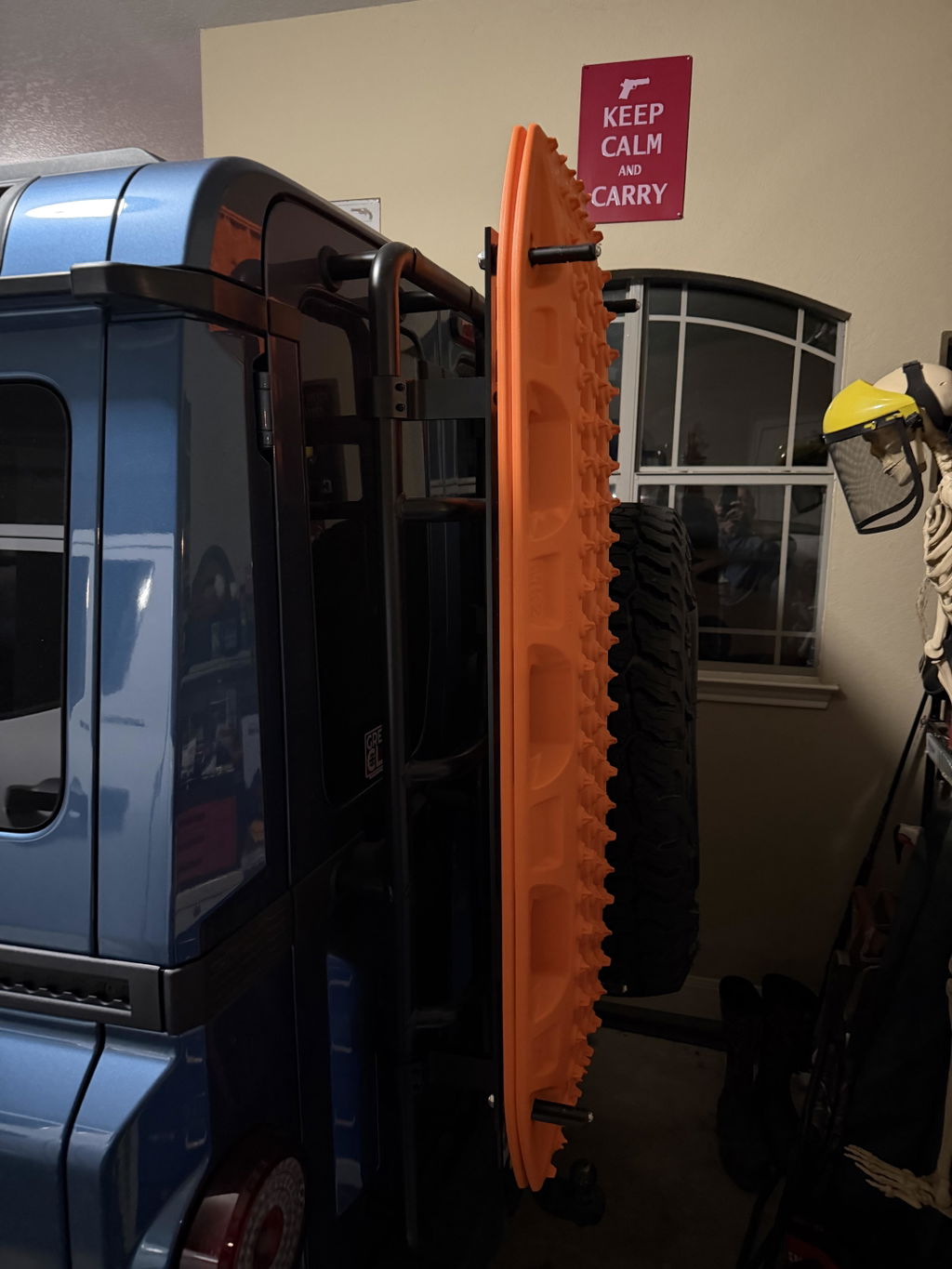
Uses the L-Track channel to mount recovery boards, Hi-Lift jacks, or other long gear flat against the body. Slide the carrier forward or back to find the position that works with your door swing and rear access pattern.
Camp Setup — MOLLE Panels and Tables
Turns a rear utility belt position into a functional camp station. The MOLLE panel accepts standard PALS-compatible pouches and organizers, while the integrated camp table folds out for food prep, laptop work, or gear staging. Gear that was buried in the cargo area now lives on the outside, accessible without opening a door.
Flexible Mounting — L-Track Sliders
Universal attachment point anywhere along the rail. Mount lights, action cameras, flag poles, antenna brackets, or any accessory with a standard bolt pattern. The slider engages the L-Track channel and locks at any position — the adapter between the utility belt and everything else.
"So far the only thing I found is a table or just putting a hanger up for a jacket. Every build out there seems to concentrate on MOLLE and roof systems. I was wondering what those utility belts can actually do."
A Practical Build Example
Full Utility Belt — All Six Positions
- FRONT L-Track sliders with auxiliary LED pods for trail lighting
- REAR · PASS MOLLE camp table — food prep, laptop work, gear staging
- REAR · DRIVER Side Accessory Carrier Gen 2 with recovery boards
- TRUNK · DRIVER NATO jerry can carrier — fuel
- TRUNK · PASS NATO jerry can carrier — water
Trail lighting, recovery capability, camp functionality, and 40 liters of additional liquid capacity — without consuming any interior cargo space. Reconfiguring for different trips takes minutes, not hours.
Planning Your Build

Start with the gear you already own or know you need. If you're carrying jerry cans, the rear trunk positions are your priority. If recovery boards are the first purchase, the rear positions matter most. If you want lighting flexibility, the front positions open that up.
The L-Track system means you're not making permanent decisions. A jerry can carrier that lives on the rear trunk position this month can move to a different position next month. A MOLLE panel can swap sides. The utility belt is a platform, and L-Track ensures you're never locked into a single configuration.
"I'm still a bit confused by the external utility belt. Can anyone demonstrate how it will be used? It seems that any proposed use will either damage the paint — imagine a shovel or axe mounted on the side body — or prevent the doors from being opened."
For most owners, the Rear Section covers the first wave of accessories. The Full Set makes sense if you're building out the complete perimeter from day one.
Whatever you mount, whatever you rearrange, whatever you add six months from now — the rails stay the same.
And they stay black.
The Material Science: Why Finishes Fail (and Don't)
Understanding why the OEM utility belt fades and why DVA's doesn't requires a brief detour into surface chemistry. These aren't marketing claims — they're measurable properties with industry-standard test data behind them.
Anodization: Type II Aluminium Oxide
The OEM utility belt uses Type II anodization — an electrochemical process that converts the aluminium surface into aluminium oxide (Al₂O₃). The resulting oxide layer is typically 5–25 µm thick, is integral to the metal (not a coating on top), and is extremely hard. So far, so good.
The problem is UV degradation. Anodized aluminium oxide is transparent, and the colour comes from organic dyes infused into the porous oxide layer before sealing. These organic dyes break down under sustained UV exposure. In direct sunlight — particularly the high-UV environments Grenadier owners tend to frequent — the dye fades within 12–24 months. The aluminium underneath is fine. The colour isn't. That chalky, washed-out grey you see on sun-exposed OEM utility belts is the dye molecules degrading while the oxide structure remains intact.
In salt spray testing (ASTM B117), bare anodized aluminium achieves approximately 336 hours before visible corrosion appears. That's adequate for architectural applications but marginal for a vehicle that sees road salt, coastal air, and trail mud.
Powder Coating: Thermoset Polymer Over Anodized Base
DVA's utility belt starts with anodization (for the aluminium-to-coating bond) and then applies a thermoset polymer powder coat at 60–80 µm thickness. This is the same process used on industrial equipment, architectural metalwork, and high-end automotive components.
The powder coat layer serves three functions:
- UV barrier: The polymer absorbs UV radiation before it reaches the underlying surface. No organic dye to degrade means no colour fade.
- Impact resistance: At 60–80 µm, the coating absorbs minor impacts (stone chips, branch strikes) that would chip through anodization alone.
- Corrosion barrier: Powder coat achieves 500–1,000 hours in ASTM B117 salt spray testing — roughly 2–3× the performance of anodization alone.
The dual-layer approach (anodized + powder coated) gives you the hardness of aluminium oxide bonded to the base metal, plus the UV and impact protection of a thermoset polymer topcoat. It's more expensive to manufacture, but it doesn't fade.
| Property | Anodized Only (OEM) | Anodized + Powder Coat (DVA) |
|---|---|---|
| Oxide/coating thickness | 5–25 µm (Al₂O₃) | 5–25 µm oxide + 60–80 µm polymer |
| UV resistance | 12–24 months before visible fade | 5+ years, no measurable fade |
| Salt spray (ASTM B117) | ~336 hours | 500–1,000 hours |
| Impact resistance | Low — oxide is hard but brittle | High — polymer absorbs impacts |
| Colour stability | Dye-based, degrades under UV | Pigment-in-polymer, UV stable |
| Repair | Cannot be re-anodized in the field | Touch-up possible with matching paint |
Installation Specifications
Torque Specs for Mounting Bolts
The utility belt mounts to factory-existing threaded inserts along the body panels. Proper torque is critical — overtightening crushes the aluminium extrusion and cracks the powder coat; undertightening allows vibration-induced loosening.
| Fastener | Size | Torque | Notes |
|---|---|---|---|
| Body panel mounting bolts | M6 | 8–10 Nm | Thread-locking compound recommended |
| L-Track rail fasteners | M6 | 8–10 Nm | Stainless steel hardware included |
| End caps / trim pieces | M5 | 5–6 Nm | Do not overtighten — cosmetic only |
| Accessory mount T-slot bolts | M8 | 12–15 Nm | Varies by accessory weight |
Use a calibrated torque wrench — not a ratchet with "feel." Aluminium extrusions deform permanently if overtorqued, and the factory threaded inserts strip at approximately 15 Nm for M6 hardware.
L-Track Load Ratings
Each L-Track attachment point on the DVA utility belt supports the following loads:
| Load Direction | Per Attachment Point | Notes |
|---|---|---|
| Vertical (downward) | ~110 kg (250 lb) | Standard single-stud L-Track fitting |
| Horizontal (shear) | ~90 kg (200 lb) | Parallel to rail direction |
| Pull-out (perpendicular) | ~70 kg (150 lb) | Away from mounting surface |
These ratings assume a single L-Track stud fitting. Using double-stud fittings (two engagement points per accessory) roughly doubles the shear and pull-out capacity. For heavy items like jerry cans (20 kg full) or rotopax fuel containers, double-stud fittings are recommended.
The practical limit isn't the L-Track — it's the body panel the rail mounts to. The Grenadier's body panels are designed for accessory loads, but concentrated point loads exceeding 30 kg at a single rail position should use backing plates to distribute force across multiple body panel fasteners.