DVA's DVA L-Track cargo management offers aviation-grade cargo management hardware designed specifically for van builds.
Quick Answer
- ✦ 6 rail positions — 4 doors + both rear trunk panels
- ✦ Weight limits — 45 kg (99 lb) front door rails, 35 kg (77 lb) rear door rails — static, off-road use only per INEOS
- ✦ L-Track compatible — standard single-lug and double-lug fittings work; quality fittings engage cleanly
- ✦ Retrofit-ready — bump strips and utility belt rails share the same captive mounting points; no drilling
- ✦ Hardware note — confirm 12 mm screw head diameter; torque to 8 ft-lbs with low-strength thread locker
The INEOS Grenadier exterior utility belt sits at the intersection of form and function — a system of L-Track rails running along both sides of the vehicle body that transforms dead panel space into mounting points for recovery gear, fuel containers, camp tables, and tool carriers. It is one of the few factory options that genuinely changes how you use the vehicle on an expedition.
But confusion around the system runs deep. Owners debate whether it's compatible with standard L-Track fittings. They question the weight limits per door. They wonder whether the bump strips that come standard can be replaced with rails after purchase. And plenty of people spec'd their Grenadier without the utility belt, only to regret it six months down the trail.
This guide covers the engineering, the real-world load ratings from the owner's manual, the compatibility issues that catch people out, and the aftermarket options that address what the factory left out.
What the Utility Belt Actually Is
The exterior utility belt is an optional factory accessory that replaces the standard bump strips running along the Grenadier's belt line. Instead of solid protective mouldings, you get extruded aluminum L-Track rails — six positions total — that accept sliding mounts, tie-down rings, and accessory brackets.
The six positions are: front driver door, front passenger door, rear driver door, rear passenger door, rear trunk driver side, and rear trunk passenger side. Each rail sits at approximately waist height, with smaller support hooks positioned roughly half a metre below on the doors.
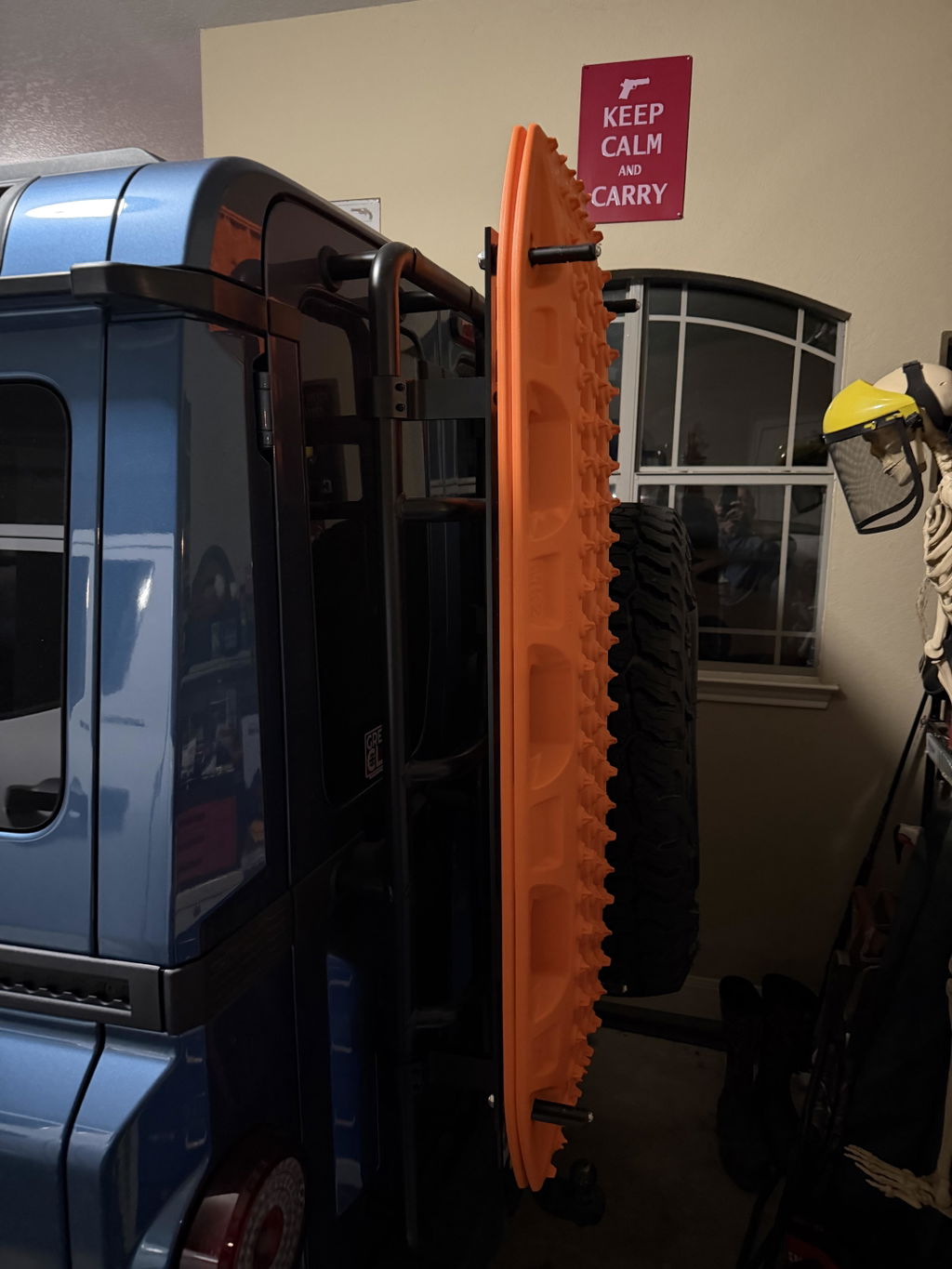
The purpose is straightforward: mount expedition gear to the vehicle's sides rather than piling everything on the roof or cramming it inside the cargo area. Shovels, Maxtrax recovery boards, RotoPax fuel and water containers, fold-down camp tables, MOLLE panels — the rails provide the anchor points, and the L-Track ecosystem provides the fittings.
I don't plan to carry stuff on it while driving on-road. But once parked I can see shelves, a shower, Maxtrax vertical on the rear doors when on Fraser Island. A shovel. Brush guards on the doors and rear panel. Have workshop, will tinker.
— DaveB, TheIneosForum.com
Weight Limits: What INEOS Actually Rates
The most common question — and the one most owners get wrong — is how much weight each rail position can hold. The figures come from the Grenadier owner's manual and the INEOS accessories brochure, and they vary by position.
| Position | Upper Rail Capacity | Lower Hook Capacity |
|---|---|---|
| Front door (driver/passenger) | 45 kg (99 lb) | 5 kg (11 lb) |
| Rear side door (driver/passenger) | 35 kg (77 lb) | 10 kg (22 lb) |
| Rear trunk panel (driver/passenger) | Per INEOS spec sheet | — |
The owner's manual states: "The Exterior Utility Belt (and any items attached to it) can only be used when off-road. On-road use is prohibited. Loading equipment on the exterior of the vehicle may change the handling characteristics." This is a legal and liability distinction. Many owners mount lightweight items for road travel, but heavy gear like loaded fuel containers should be mounted only when you're off the sealed road.
The distinction between static and dynamic load matters here. The published figures are static ratings. Off-road, the bouncing and lateral forces multiply the effective load on those mounting points. As one forum member put it when discussing a RotoPax fuel container mounted to the door:
I wonder if that is static or dynamic load. Static I think would be fine — it's the bouncing I worry about.
— Parb, TheIneosForum.com (RotoPax mounting thread)
As a practical rule: keep heavy, dense loads like fuel and water containers on the rear quarter panels where the rails bolt to the body structure, not the door skins. The rear quarter panels are steel and structurally tied to the chassis. The doors are aluminum and attached by hinges — strong enough for the rated loads, but less forgiving of sustained trail abuse with heavy gear.
L-Track Compatibility: The Confusion Explained
One of the most debated topics on the Grenadier forums is whether the utility belt rails are compatible with standard L-Track accessories. The short answer: yes, but with caveats.
The INEOS utility belt uses an L-Track–style profile. Standard single-lug and double-lug tie-down fittings from the broader L-Track ecosystem will engage with the rails. However, the Grenadier's implementation has some dimensional differences that have tripped up owners trying to use older fittings from other vehicles.
It appears that the 'Utility Belt' from Ineos is NOT compatible with industry standard L-Trak. I tried to use my own mounting points on the Ineos track in the rear floor of my Grenny, and no way was it going to work.
— Jeffrey, TheIneosForum.com
However, another experienced owner quickly clarified the issue:
They are L-track, and lots of people including me have had success in using 3rd party single lug and double lug tie down fittings with the installed rails. Maybe share a photo of your setup and components?
— Forum reply, TheIneosForum.com
Jeffrey later confirmed the confusion was technique-related: "You are correct. It was a matter of technique to get my old sliding ring mounts to engage. The Ineos ones are nicer!"
The takeaway: standard L-Track fittings work, but the Grenadier's rail profile is tighter than some generic aftermarket tracks. Use quality fittings designed for the L-Track standard, not worn or off-brand knockoffs, and they'll engage cleanly.
Utility Belt vs. Bump Strips: Which Did You Get?
If you didn't tick the utility belt option when ordering your Grenadier, you received the standard black bump strips instead. These are solid protective mouldings that fill the same belt-line channel but offer no mounting capability.
If you don't order the exterior utility belt as an option, then INEOS uses instead, black solid protection strips.
— DaveB, TheIneosForum.com
Owners who chose bump strips and later regretted it face a decision: retrofit the factory utility belt rails through an INEOS dealer, or go aftermarket. Early Grenadier deliveries actually saw some vehicles receive utility belt rails when bump strips were out of stock — INEOS offered to swap back at no charge once bump strips were available again.
Retrofitting is straightforward because both options bolt to the same captive mounting points on the body. The bump strips come out, the rails go in. No drilling, no modification to the vehicle structure. It is one of the cleaner factory retrofits you can do.
However, sourcing the OEM parts hasn't always been simple. As one owner noted:
I guess I would give up my first born child at this point for an exploded parts diagram in which to give the dealer the part number.
— Motolatte, TheIneosForum.com
The practical advice: contact your INEOS dealer's parts department directly. They have access to the exploded diagrams and part numbers. Alternatively, aftermarket manufacturers now produce direct-fit replacements.
What Owners Are Actually Mounting
The community has moved well past the early speculation about what the utility belt is for. Here's what owners are running on their vehicles in the real world.
RotoPax Fuel & Water Containers
One of the most popular builds is mounting a RotoPax container to the rear quarter panel rails. A 2-gallon water container weighs about 17 pounds loaded; a 3-gallon fuel container runs around 19 pounds. Both sit within the rail capacity when distributed between the upper rail and lower support hook. Custom welded brackets from fabricators like Scott's Welding and Machine Shop in Virginia have proven popular for clean, secure RotoPax mounting. DVA's Exterior Utility Belt Full Set includes dual-finish 6061 aluminum rails with stainless hardware — the dual anodized and powder-coat finish handles the salt and fuel exposure that comes with this kind of use.
Recovery Boards
Maxtrax, TRED, and ARB recovery boards mount vertically to the rear door rails or rear quarter panels using standard L-Track fittings. This keeps them accessible without eating roof space or blocking tailgate access. The rear door position works particularly well because the boards sit flat against the vehicle without fouling adjacent doors when opened.
Camp Tables & Cooking Setups
Several owners have designed fold-down table brackets that slot into the upper rail and use the lower hook as a stabilizer. One early design concept from forum member DaveB described a stainless steel shelf with a hinged lid panel that swings up to protect the paint from heat and splashes — ideal for positioning a JetBoil or hot plate under an awning at camp.
MOLLE Panels & Soft Gear Organization
Several aftermarket MOLLE panel systems are purpose-built for the Grenadier's rear quarter panel L-Track, adding a universal MOLLE grid that accepts pouches, tool rolls, first-aid kits, and soft storage. RotoPax containers can also mount to these panels using LOX or DLX pack mounts, giving you a modular system that reconfigures for different trip requirements. DVA's Grenadier exterior collection includes compatible mounting hardware for this configuration.
Shovels & Hand Tools
A shovel laid along the rear section of the utility belt fits without fouling the second-row door or the load space door. Multiple owners have confirmed the fitment, and it's one of the simplest mounts — two L-Track clamps and you're done. This avoids roof mounting, which creates wind noise and requires climbing up to retrieve the tool.
Door Protection
One of the most underappreciated uses: the rails themselves serve as brush guards on trails, protecting the aluminum door skins from vegetation striping. Because the Grenadier's doors and bonnet are aluminum, magnetic brush guards won't work — making the utility belt the most practical path to side-panel protection.
The Grenadier's doors and bonnet are Aluminium, which means the utility rails may be the only potential way to protect the doors.
— DaveB, TheIneosForum.com
Aftermarket Options: OEM vs. DVA vs. Third Party
The factory utility belt is a solid piece of kit. But the aftermarket has responded with options that address specific gaps — durability, partial coverage, and compatibility with vehicles that received bump strips.
| Option | Material | Finish | Coverage | Price Range |
|---|---|---|---|---|
| INEOS Factory OEM | Aluminum | Anodized only | 6 positions | Dealer pricing |
| DVA Mechanics Full Set | 6061 aluminum | Anodized + powder coat | 6 positions | $499 |
| DVA Mechanics Rear Only | 6061 aluminum | Anodized + powder coat | 2 positions (rear) | $199 |
| Aftermarket Rear Rail Kit | Aluminum alloy | Anodized | Rear section | Contact dealer |
| Series Defender Stainless Hardware Kit | Stainless steel hardware | — | Upgrade kit for existing rails | Varies |
The key differentiator in the aftermarket space is finish durability. The factory OEM belt uses a single-layer anodize. DVA Mechanics applies anodized 6061 aluminum with a powder coat over the top — a dual-layer system that provides significantly better chip resistance, UV stability, and corrosion protection. On a vehicle that sees regular trail contact with brush and stone chips, the second finish layer matters.
DVA's full set also includes stainless steel mounting hardware, where the factory version uses standard hardware. Over time in wet or coastal environments, the stainless upgrade prevents the fastener corrosion that leads to seized bolts at the worst possible moment.
Installation: Hardware Fit & Torque
Whether you're installing factory rails or an aftermarket set, the utility belt bolts directly to existing captive mounting points on the vehicle body. No drilling, no cutting, no permanent modifications. Estimated install time is 60–90 minutes with basic hand tools.
However, there's a hardware detail that has caught some owners out. The captive bolt holes on the Grenadier body have specific dimensions, and not all aftermarket hardware seats perfectly.
My experience with DVA screws and rails were the screw heads were too small for the rails holes and would not take anywhere near that torque without pulling through. It is actually the hole diameter that is the problem, too large for M6 countersunk screws. They sent me larger headed screws which worked.
— Greg, TheIneosForum.com
Another owner confirmed the fix: "I replaced mine with 316 stainless and torqued them to 8 foot pounds with pink (lowest strength) Loctite."
The lesson: confirm your screw head diameter before torquing down. The original M6 countersunk screws had an 11mm head diameter; the replacement screws that seat correctly have a 12mm head diameter. It's a 1mm difference that determines whether the hardware pulls through under load or sits flush as designed.
Per the INEOS factory manual for the exterior utility belt M6 fasteners, follow general M6 torque values. Forum-tested approach: 8 ft-lbs with low-strength (pink) thread locker. Always confirm screw head diameter matches or exceeds 12mm for the countersunk holes in the rail.
Common Mistakes to Avoid
- Overloading door-mounted rails. The front door rails are rated to 45 kg, but that's a static figure. A 20 kg RotoPax bouncing on corrugated roads at speed applies significantly higher dynamic loads. Keep heavy items on the rear quarter panels where possible.
- Assuming bump strip bolts match utility belt bolts. The mounting points are the same, but the captured bolt spacing on the body doesn't always align with pre-drilled holes on aftermarket L-track. If you're going DIY, source undrilled track and mark your holes from the vehicle.
- Using cheap L-Track fittings. The Grenadier's rail profile is tighter than some generic tracks. Worn or off-brand fittings may not engage the locking profile correctly. Stick to quality single-lug and double-lug fittings from known manufacturers.
- Ignoring the discoloration risk. Early Grenadier utility belts showed discoloration when cleaned with certain chemicals. Use pH-neutral automotive soap and avoid aggressive solvents on the anodized surfaces. Dual-finish (anodized + powder coat) aftermarket rails are significantly more resistant to this issue.
- Mounting items that block door operation. Any accessory longer than the door panel width — fishing rods, long-handled tools — will prevent that door from opening. Plan your layout with doors open before you commit to fixed mounting positions.
Quick Reference: Grenadier Utility Belt Essentials
- Six rail positions cover the entire vehicle belt line — four doors plus both rear trunk panels
- Front door rails: 45 kg max, rear door rails: 35 kg max (static ratings, off-road use only per INEOS)
- L-Track compatible — standard single-lug and double-lug fittings work, but quality matters
- Retrofit-friendly — bump strips and utility belt rails share the same captive mounting points
- Dual-finish aftermarket options offer superior chip and UV resistance versus factory single-layer anodize
- Hardware detail — confirm 12mm screw head diameter for countersunk mounting holes; 8 ft-lbs with pink Loctite is a proven torque spec