INEOS Grenadier Hi-Lift Jack Mounting: Engineering Safety Analysis
Load dynamics analysis, vibration management engineering, mounting location physics, and safety protocol framework for hi-lift jack systems on the INEOS Grenadier platform.
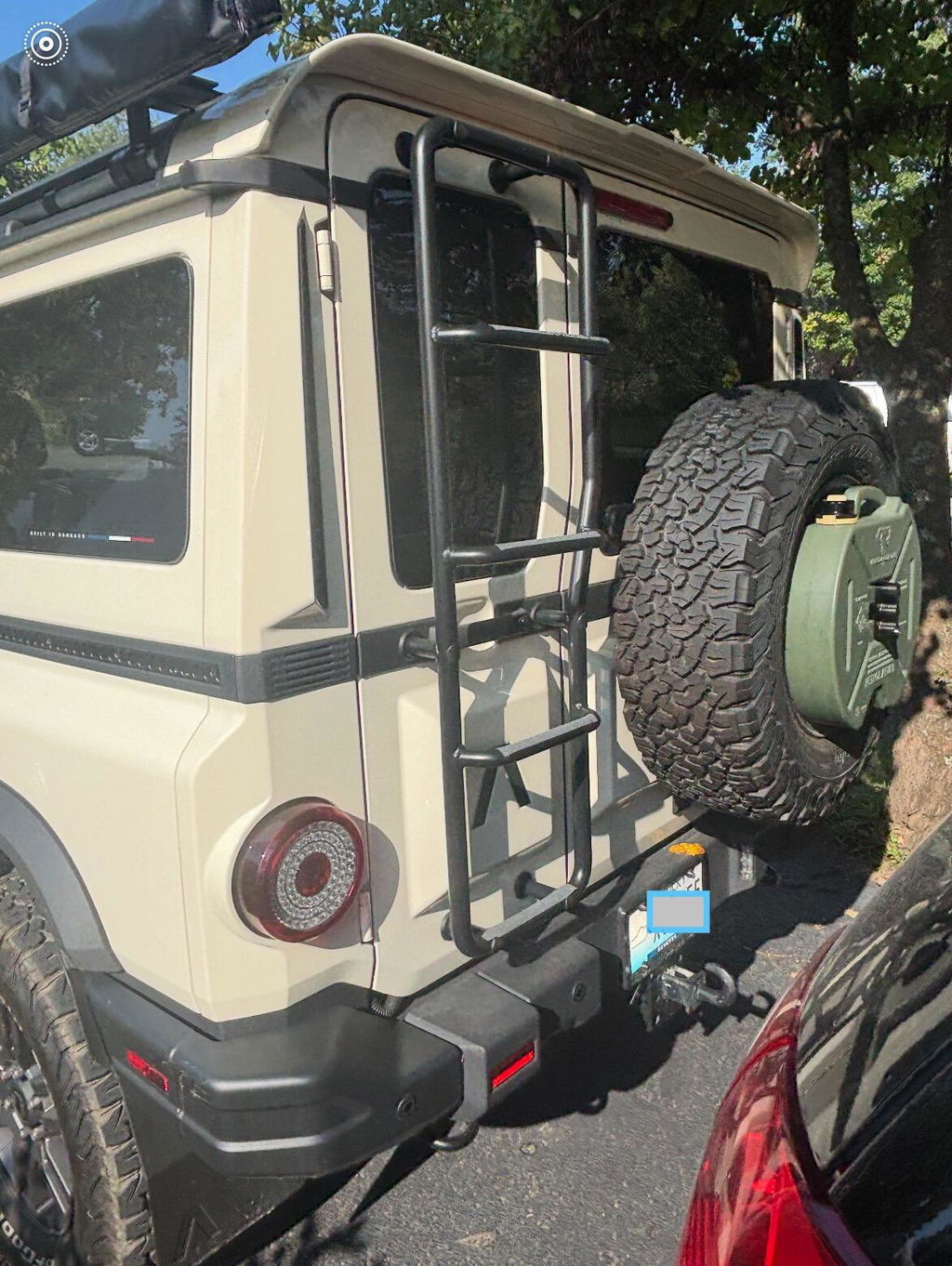
For the INEOS Grenadier Wagon, the rear ladder is the correct hi-lift jack mounting location — it uses only 9% of the ladder's 150 kg rated capacity, keeps the 30 lb jack low and aft to minimize rollover risk, and lets you grab it without climbing. The Quartermaster has no rear ladder; roof rails or front bumper mounting applies instead. This guide covers the physics behind that verdict, three-point constraint requirements for 3-8G off-road loads, and step-by-step install for the DVA ladder-mounted hi-lift carrier.
- Best location (Wagon): Rear ladder — 9% of 150 kg rating, lowest CG impact, no climbing required
- Quartermaster: Roof rails or front bumper (no rear ladder on pickup variant)
- Why not roof? Roof mounting creates 4x the rollover moment vs. ladder mount at 8G impacts
- Constraint rule: Three-point mount required — two-point systems fail under washboard vibration
1. Hi-Lift Jack System Engineering: Understanding the Mechanical Realities
A hi-lift jack is one of the most useful and most dangerous tools in off-road recovery. It's a mechanical advantage machine rated for 4,660 lbs lifting capacity while weighing only 30 lbs — creating a force multiplication ratio that demands engineering respect both in use and mounting.
Hi-Lift Jack Technical Specifications
| Specification | Value | Engineering Significance | Safety Implication |
|---|---|---|---|
| Weight (48" model) | Approximately 13.6 kg (30 lbs) | Cantilever loading on mount system | Dynamic forces 3-5× static weight |
| Overall Length | 1,219 mm (48") | Moment arm for bending forces | Requires multi-point constraint |
| Rated Lifting Capacity | 2,114 kg (4,660 lbs) | Structural load capability | Exceeds Grenadier axle weight |
| Safety Bolt Shear Rating | 3,175 kg (7,000 lbs) | Deliberate failure point | Prevents mechanism overload |
| Mechanical Advantage | Approximately 25:1 (varies by model) | Handle force multiplication | Handle kickback injury potential |
| Standards Compliance | ASME B30.1-2015 | Industrial lifting equipment standards | Certified for rated capacity |
Force Analysis in Dynamic Conditions
When mounted on a moving vehicle, the approximately 30 lb hi-lift jack experiences forces that dramatically exceed its static weight. Understanding these dynamic loads is essential for mounting system design.
| Terrain Condition | Vertical Acceleration (G) | Effective Jack Weight (lbs)* | Bending Moment (lb-in)* |
|---|---|---|---|
| Smooth pavement | 1.0G | ~30 | ~105 (baseline) |
| Highway irregularities | 1.5G | ~45 | ~158 |
| Washboard roads | 3.0G | ~90 | ~315 |
| Rock crawling impacts | 5.0G | ~150 | ~525 |
| Extreme impact (pothole) | 8.0G | ~240 | ~840 |
*Calculations based on estimated 30 lb jack weight
Bending moment calculation for cantilevered loading: For a 48" jack with two-point mounting spaced 20" apart, each unsupported 14" end creates: M = F × d = (~30 lbs × G-force × 14/48 proportion) × 14" lever arm. At 3G conditions, this equals approximately 370 lb-in per end — explaining why two-point systems fail over time.
2. Mounting Location Engineering Analysis
The INEOS Grenadier offers four potential hi-lift mounting locations, each with distinct engineering trade-offs affecting vehicle dynamics, accessibility, and safety.
Mounting Location Comparison Matrix
| Location | Center of Gravity Impact | Accessibility | Protection Level | Dimensional Impact | Engineering Verdict |
|---|---|---|---|---|---|
| Roof Rail/Rack | Maximum (highest position) | Poor (requires climbing) | Good (protected from debris) | Height increase (garage issues) | Poor choice |
| Interior Cabin | Minimal | Good (when parked) | Excellent | Cargo space consumption | Safety hazard (projectile) |
| Side Body (Utility Belt) | Low | Excellent | Poor (exposed to brush) | Width increase | Acceptable for open trails |
| Rear Ladder | Low-rear (optimal) | Excellent | Good (behind body) | Minimal length increase | Optimal solution |
Center of Gravity Impact Analysis
Adding 13.6 kg at different vehicle locations affects handling and stability:
- Roof mounting: Raises CG by maximum possible amount on a 2,643–2,790 kg vehicle (depending on specification). At 2,050 mm height, adds rotational inertia that worsens body roll and increases rollover risk on off-camber terrain.
- Rear ladder mounting: Positions mass low and aft. On a 2,922 mm wheelbase vehicle, creates minimal moment about front axle. Effect on vehicle dynamics is negligible.
Rear Ladder Structural Analysis
The Grenadier's rear ladder is engineered as a structural component, not cosmetic trim:
- Material: Steel tube construction with integrated mounting to body frame rails
- Load rating: 150 kg static capacity (manufacturer specification)
- Mounting interface: Direct connection to vehicle structure via body mounting points
- Design intent: Human climbing loads + equipment mounting
- Hi-lift compatibility: Approximately 13.6 kg jack represents 9% of ladder's rated capacity
"The Ineos supplied steps [rear ladder] are quite strong enough to be used for a hilift jack."
— Owner, TheINEOSForum.com (Apr 2025)
3. Vibration Engineering: The Multi-Point Constraint Solution
Two-point mounting systems fail because they allow rotational movement around the line connecting the two points. This creates oscillation that progressively loosens hardware and generates noise. Three-point mounting eliminates this failure mode entirely.
Two-Point vs Three-Point Mounting Physics
| Mount Type | Degrees of Freedom | Failure Mode | Vibration Behavior | Maintenance Requirement |
|---|---|---|---|---|
| Two-Point System | 1 rotational (pivoting) | Progressive loosening | Resonant oscillation at specific speeds | Frequent re-tightening |
| Three-Point System | 0 (fully constrained) | Wear at contact points only | Minimal movement, well-damped | Periodic inspection only |
Resonant Frequency Considerations
Every suspended mass has a natural frequency determined by its weight and the stiffness of its mounting system. For a 30 lb jack on a flexible two-point mount, the natural frequency typically falls between 15-30 Hz — exactly in the range of vehicle body vibrations during highway driving (18-25 Hz). This resonance creates the persistent rattle that owners experience.
Three-point mounting with rubber isolation bushings shifts the system natural frequency above the excitation range while adding damping to suppress any remaining resonant response.
4. DVA Ladder Mount System: Engineering Implementation
The DVA hi-lift carrier exemplifies proper mechanical engineering for dynamic loading conditions. Every component addresses a specific failure mode or performance requirement.
The purpose-built solution for Grenadier Wagon owners. Three-point constraint, aluminum clamps, rubber vibration bushings, and tool-free M8 hand knobs for field removal. View the Ladder-Mounted Hi-Lift Jack Carrier.
Pair with the Modular Gear Mount (Gen 2) to stack a MaxTrax, shovel, or water carrier on the same ladder — no additional vehicle mods required.
System Components Analysis
| Component | Material/Specification | Engineering Function | Design Rationale |
|---|---|---|---|
| Lower Clamp (3") | Aluminum, 3" aperture | Primary vertical support | Matches Grenadier ladder tube diameter |
| Universal Upper Clamps | Aluminum with variable geometry | Jack beam constraint | Accommodates varying jack cross-section |
| M8 Hand Knobs | Stainless steel threads, oversized grip | Tool-free clamping force | Glove-operable, field maintenance |
| Rubber Bushings | Nitrile rubber, vibration-rated | Vibration isolation + corrosion prevention | Breaks galvanic cell, dampens oscillation |
| M4 Cap Screws | Stainless steel, 12 pieces | Clamp assembly retention | Corrosion resistance, standard tooling |
Galvanic Corrosion Prevention
Aluminum clamps in direct contact with steel ladder rails create a galvanic cell in the presence of moisture — accelerating corrosion of the aluminum. The rubber bushings electrically isolate the dissimilar metals, preventing galvanic current flow. This is a detail that distinguishes engineered solutions from simple brackets.
Installation Engineering Protocol
| Step | Technical Requirement | Critical Parameters | Verification Method |
|---|---|---|---|
| Surface Preparation | Clean ladder rail contact points | No contaminants between surfaces | Visual inspection, tactile check |
| Lower Clamp Position | Jack base near ladder rung | Vertical support, minimize cantilever | Jack base contact with rung |
| Middle Clamp Position | Jack geometric center | Maximum bending moment control | Measure distances from ends |
| Upper Clamp Position | Near jack head mechanism | Vertical oscillation control | Handle operation clearance check |
| Final Torque | Hand-tight M8 knobs | Sufficient clamping without tools | Zero lateral movement test |

5. Hi-Lift Safety Engineering: Accident Prevention Analysis
Hi-lift jacks are widely considered one of the most injury-prone off-road recovery tools due to their unique operating characteristics. Understanding the failure modes enables effective accident prevention.
Injury Mechanism Analysis
| Injury Type | Mechanism | Frequency | Prevention Protocol |
|---|---|---|---|
| Hand/Thumb Fractures | Handle kickback (thumb-wrap grip) | Most common | Open-palm grip only, never wrap thumb |
| Crush Injuries | Vehicle falls off jack | Second most common | Stable ground, proper lift points, backup support |
| Facial/Head Trauma | Handle strikes operator during release | Common | Controlled lowering procedure, side positioning |
| Back/Shoulder Strain | Improper lifting posture | Frequent | Proper stance, mechanical advantage usage |
| Lacerations | Sharp edges, pinch points | Minor but frequent | Gloves, situational awareness |
Mechanical Advantage Safety Analysis
The hi-lift's high mechanical advantage (approximately 25:1 (varies by model)) creates handle forces that exceed human grip strength when the system rebounds. At rated load (4,660 lbs), the handle stores significant energy during operation:
- Required input force: Approximately 177 lbs at handle (based on estimated 25:1 ratio)
- Handle momentum: High kinetic energy during pump stroke
- Kickback scenario: If grip is lost, handle snaps back with stored energy proportional to load
- Injury threshold: Human thumb can withstand approximately 30 lbs lateral force before fracture
Vehicle Stability Engineering
Hi-lift jacks create inherent lateral instability because they lift from a single point. Vehicle stability margins during lifting operations:
| Condition | Stability Margin | Risk Level | Mitigation Required |
|---|---|---|---|
| Level ground, centered lift | High | Low | Standard procedures |
| 5° ground slope | Moderate | Moderate | Wheel chocks, backup support |
| 10° ground slope | Low | High | Alternative recovery method recommended |
| Soft/uneven surface | Variable | High | Base plate, avoid hi-lift use |
| Vehicle load shift during lift | None | Extreme | Clear vehicle of occupants/cargo |
6. Operational Protocols: Engineering Safe Usage
Safe hi-lift operation requires step-by-step adherence to engineering-based protocols that account for the tool's mechanical characteristics and failure modes.
Pre-Operational Inspection Checklist
| Component | Inspection Criteria | Failure Indicators | Action Required |
|---|---|---|---|
| Safety Bolt | No visible cracks or deformation | Stress marks, bent threads | Replace immediately — failure is unpredictable |
| Climbing Pins | Smooth operation, no binding | Sticky engagement, wear marks | Clean and lubricate with dry lubricant |
| Handle Mechanism | Full stroke, positive latch engagement | Incomplete travel, loose latch | Disassemble and inspect pivot points |
| Jack Beam | Straight, no cracks in rail | Bent beam, stress cracks | Replace jack — structural integrity compromised |
| Base Plate | Flat contact, no damage | Bent, cracked, uneven wear | Replace or repair before use |
Safe Operating Sequence
- Ground assessment: Level, stable surface. If soft ground, use base plate (minimum 12" × 12" × 1" plywood or steel)
- Lift point verification: Factory rock sliders, rated bumper points only. Never body panels or non-structural components
- Vehicle preparation: Engine off, parking brake set, occupants clear, cargo secured against shifting
- Jack positioning: Perpendicular to lift point, base plate centered under foot
- Initial engagement: Verify positive contact between jack foot and lift point
- Lifting procedure: Open-palm grip, smooth strokes, monitor vehicle stability continuously
- Work completion: Insert backup support (tire, jack stand) before working under vehicle
- Lowering protocol: Reverse lifting pin, controlled descent via incremental pumping
7. Maintenance Engineering: Preserving System Integrity
Both the mounting system and the hi-lift jack require regular maintenance to preserve reliability and safety margins in dynamic environments.
Mounting System Maintenance Protocol
| Frequency | Action Required | Technical Rationale | Failure Consequence |
|---|---|---|---|
| Pre-trip (every trail use) | Hand-verify all M8 knobs tight | Vibration progressively loosens fasteners | Mount failure, jack loss |
| Monthly (or 1,000 miles) | Remove jack, inspect clamp surfaces | Wear patterns indicate alignment issues | Progressive degradation, sudden failure |
| Post-water crossing | Check for debris in clamp interfaces | Grit accelerates wear, reduces clamping | Mount slippage under load |
| Seasonally | Rubber bushing condition assessment | UV/ozone degradation affects damping | Vibration return, corrosion initiation |
Hi-Lift Jack Maintenance Engineering
Lubrication strategy: Use dry lubricants (graphite, PTFE spray) on climbing surfaces and mechanism pivots. Avoid grease — it attracts dirt that accelerates wear and creates mechanism binding.
Corrosion prevention: Cast steel construction requires active corrosion protection for exterior mounting. Light coating of rust-preventive oil on non-functional surfaces. Avoid lubricating climbing surfaces — reduces grip security.
Mechanism inspection: Annual full-cycle test under no load verifies lifting and lowering sequences operate correctly. Binding or incomplete travel indicates internal wear requiring service.
8. Application Engineering: When NOT to Use a Hi-Lift
Hi-lift jacks excel at specific recovery scenarios but are inappropriate for others. Understanding application limits prevents accidents and equipment damage.
Appropriate Applications
- Wheel lifting: Tire changes on uneven ground, placing recovery boards under wheels
- High-center recovery: Lifting vehicle body off contact point
- Lateral winching: Using jack as hand-powered winch with chains/straps
- Component clamping: Temporary repair clamps for broken parts
- Spreading operations: Reversing jack for spreading tasks
Inappropriate Applications Matrix
| Scenario | Problem | Better Solution | Consequence of Misuse |
|---|---|---|---|
| Soft sand/mud | Base sinks under load | Exhaust jack, winch, or large base plate | Jack instability, vehicle drop |
| Steep slopes (>10°) | Lateral instability amplified | Winch with tree anchor | Vehicle rollover risk |
| Unstable lift points | Point failure under concentrated load | Spreader plate, different lift point | Structural damage to vehicle |
| Extended support | Jack not designed for long-term loading | Jack stands, blocks, or tire support | Mechanism failure, gradual settling |
Summary: Engineering Hi-Lift Safety Into Every Aspect
Complete your off-road recovery kit: the Ladder-Mounted Recovery Board Carrier mounts MaxTrax MKII or Lite boards on the same rear ladder — hi-lift and recovery boards work in tandem when a vehicle is high-centered and needs to be lifted and driven out simultaneously.
Hi-lift jack mounting and operation involve genuine engineering challenges that require systematic solutions. The physics of dynamic loading, vibration control, and safe operation procedures all demand evidence-based approaches rather than intuitive guesses.
Key Engineering Principles
- Three-point constraint: Eliminates rotational degrees of freedom that cause two-point mounting failures
- Vibration isolation: Rubber bushings break vibration transmission and prevent galvanic corrosion
- Optimal positioning: Rear ladder mounting minimizes center-of-gravity impact while maximizing accessibility
- Safety protocols: Open-palm grip and backup support prevent the majority of hi-lift accidents
- Application limits: Understanding when NOT to use a hi-lift prevents dangerous misapplications
Mount it once with proper three-point constraint. Maintain it systematically with attention to wear patterns and safety margins. Operate it with systematic adherence to proven protocols. The hi-lift will serve reliably for decades — if you respect the engineering that makes its power possible.
The DVA Setup for This
Ready to Secure Your Hi-Lift?
Mount a 48-inch Hi-Lift jack to the Grenadier's factory rear ladder with a three-point, bolt-on carrier that preserves rear-door clearance and ladder access.
Shop Hi-Lift Carrier → Browse Accessory Carriers