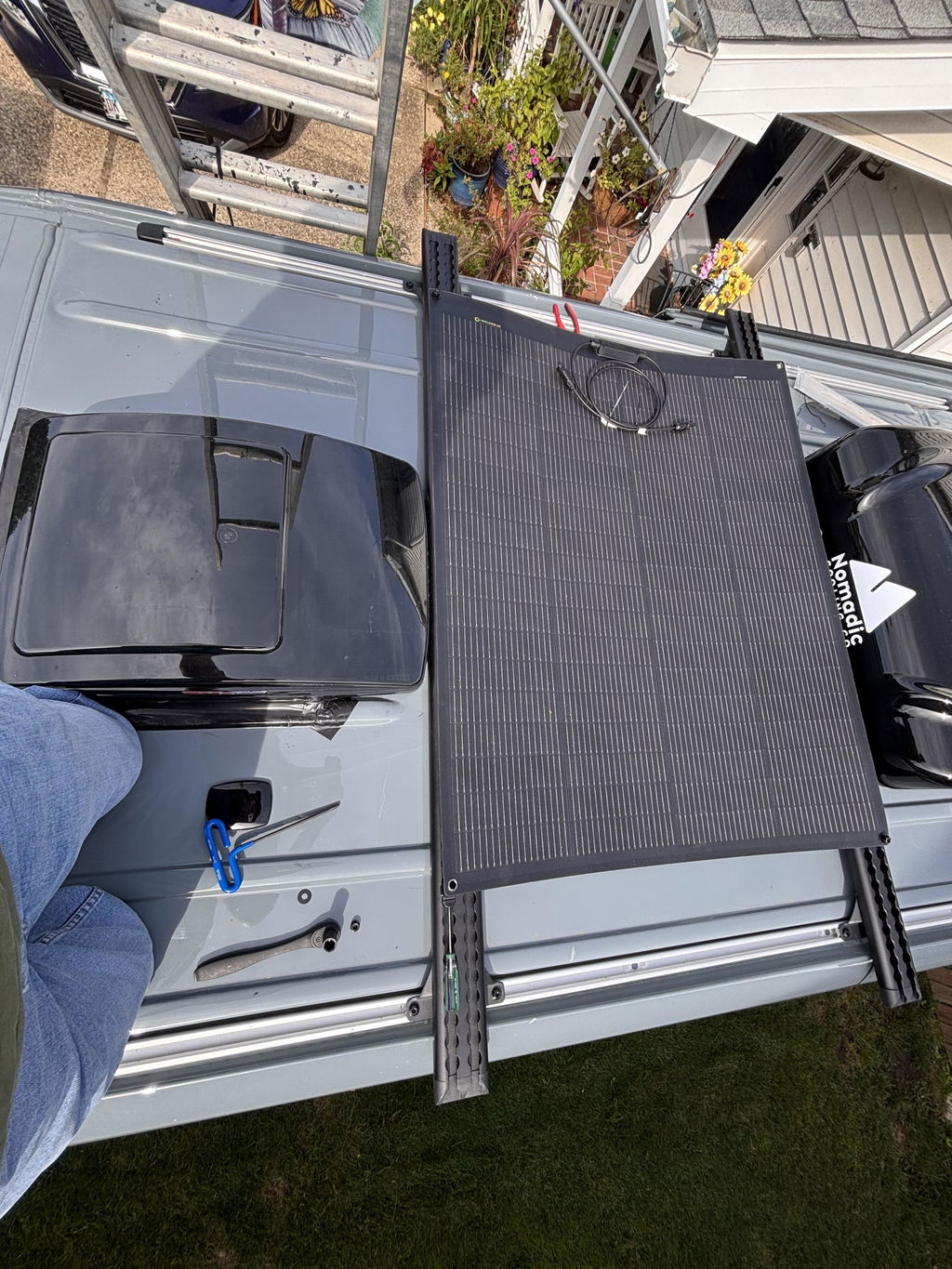
The INEOS Grenadier uses 2-pin Deutsch DTP connectors (DTP06-2S, 25A continuous) on the roof, wired to the overhead EXT switch panel. EXT2 controls the right-front roof port independently; EXT3 controls the three remaining roof ports on a shared 25A circuit. To connect any accessory, use a DTP06-2S male plug or a purpose-built adapter cable — no splicing the factory harness required. The Wagon has 4 roof DTP ports; the Quartermaster has 2.
1. The Overhead Switch Panel Nobody Reads the Manual For
Look up in a Grenadier and you'll see something unusual for a production vehicle: a row of aircraft-style toggle switches across the overhead console. These aren't cosmetic. Each one controls a dedicated auxiliary circuit — pre-wired from the factory, fused, and routed to specific locations around the vehicle.
Most Grenadier owners know these switches exist. Far fewer understand exactly what each one controls, where the wiring terminates, and what the amperage limits are. The result is a steady stream of forum posts from owners staring at their overhead panel, trying to figure out which switch powers which socket.
Here's the map. The Grenadier's auxiliary switch panel (on vehicles equipped with the High Load Auxiliary Switch Panel option) provides the following circuits:
| Switch | Circuit | Location | Rating |
|---|---|---|---|
| EXT1 | Under-hood auxiliary | Engine bay (10A output) | 10A fused |
| EXT2 | Rooftop — right front | Single DTP port above front passenger door | 25A fused |
| EXT3 | Rooftop — 3 outlets | Left front, left rear, right rear doors | 25A fused (shared) |
| EXT4 | 500A winch / NATO socket | Rear of vehicle | 500A (winch circuit) |
| EXT5 | Under-hood auxiliary | Engine bay (25A output) | 25A fused |
| INT1 | Interior — driver footwell | Driver kick plate area | 10A fused |
| INT2 | Interior — passenger footwell | Passenger kick plate area | 10A fused |
EXT3 controls three DTP outlets on a single shared circuit. This is the most common source of confusion. Owners assume each rooftop DTP port has its own switch. It doesn't. Three of the four rooftop outlets all activate together when EXT3 is toggled. EXT2 controls only the single front-passenger-side outlet independently.
This means that if you want independent on/off control for each rooftop accessory, you need to add inline switches between the DTP outlet and the accessory — or use a relay-based solution. The factory panel gives you zone control (all three EXT3 ports on/off together), not per-device control.
2. The Deutsch DTP Connector: Why INEOS Chose It
The connectors at each rooftop outlet aren't generic plugs. They're Deutsch DTP series connectors, manufactured by TE Connectivity — the same connectors used in mining equipment, agricultural machinery, and military vehicles. This isn't a marketing embellishment. It's an engineering choice with specific implications for anyone wiring accessories.
What Is a DTP Connector?
The Deutsch DTP (Deutsch Thick Pin) series is an environmentally sealed, high-current connector system designed for harsh-duty applications. It's part of a family that includes the smaller DT series (13A continuous) and the miniature DTM series (7.5A continuous). The DTP sits at the higher end of the current range.
| Specification | Deutsch DTP | Deutsch DT | Deutsch DTM |
|---|---|---|---|
| Current Rating | 25A continuous per contact | 13A continuous per contact | 7.5A continuous per contact |
| Contact Size | Size 12 | Size 16 | Size 20 |
| Wire Gauge Range | 14–10 AWG | 20–14 AWG | 24–20 AWG |
| Pin Configurations | 2-pin, 4-pin | 2 to 12 pin | 2 to 12 pin |
| Operating Temp | -55°C to +125°C | -55°C to +125°C | -55°C to +125°C |
| Sealing | Environmentally sealed | Environmentally sealed | Environmentally sealed |
| Mating Cycles | 100+ rated | 100+ rated | 100+ rated |
The Grenadier's rooftop DTP ports use the 2-pin configuration: one power pin, one ground pin. The vehicle-side receptacle is the DTP04-2P (4 = receptacle, 2P = 2-pin). The cable that plugs into it uses a DTP06-2S (6 = plug, 2S = 2-socket) male connector.
DTP04-2P = vehicle-side receptacle (the port in the roof). DTP06-2S = cable-side plug (what your accessory cable terminates in). The "04" and "06" designate the shell style, not the pin count. The "2P" and "2S" designate the number of pins/sockets. Getting this right matters when ordering connectors or adapter cables.
Why DTP Instead of Standard 12V Sockets?
A standard cigarette-lighter–style 12V socket is rated for approximately 10–15A, has no environmental sealing, no positive lock, and relies on spring tension for contact. On a vehicle designed for river crossings, dust storms, and sustained off-road vibration, that's inadequate.
The DTP connector solves each of those failure modes:
- 25A continuous per contact — more than sufficient for LED light bars, compressors, and communication equipment
- Environmental seal — the connector body includes silicone seals that exclude water, dust, and mud when properly mated
- Positive latch — an integrated locking tab prevents accidental disconnection under vibration
- Contact retention — internal wedgelocks hold the pins in place even under mechanical shock
- Temperature tolerance — rated from -55°C to +125°C, covering everything from Arctic expeditions to engine bay heat soak
That post captures the learning curve. The DTP system is robust, but it's not plug-and-play for someone used to SAE or Anderson connectors. The pins require a proper crimp tool (not pliers), the wedgelocks must be seated correctly, and the shell halves must be the matching series. Using DT-series pins in a DTP shell — a common mistake — will result in a loose, unreliable connection.
3. Wiring Accessories Properly: The No-Splice Approach
The Grenadier's factory DTP architecture was designed to make accessory wiring straightforward — if you work within the system. The pre-wired harnesses run from the fuse box, through the body, and terminate at DTP ports on the roof, under the hood, and in the footwells. Your job is to plug into those ports, not to bypass them.
The Correct Workflow
Identify Your Power Source
Determine which EXT or INT circuit matches your accessory's location and power requirements. Rooftop accessories → EXT2 or EXT3. Under-hood → EXT1 (10A) or EXT5 (25A). Interior → INT1 or INT2.
Match the Connector
Your accessory cable must terminate in a DTP06-2S male plug to mate with the vehicle's DTP04-2P receptacle. If your accessory uses a different connector standard, use a purpose-built DTP adapter cable — not a splice.
Verify Current Draw
Add up the total current draw of everything connected to that circuit. EXT3 shares 25A across three outlets. Two accessories drawing 10A each on the same EXT3 circuit = 20A total, within spec. Three accessories at 10A each = 30A, over the fuse rating. The fuse protects the wiring — exceeding it means the fuse blows, or worse, doesn't.
Route and Secure
Run cables along existing harness routes where possible. Use the factory cable channels through the roof pillars. Secure with UV-resistant tie wraps at intervals no greater than 12 inches. Avoid routing near exhaust components or pinch points in door jambs.
When You Need Multiple Accessories on One Port
Each rooftop DTP port is a single connector. One port, one plug. If you need to run two accessories from a single port — a common requirement when running side lights on both sides of a roof rack — you need a splitter cable that maintains the DTP connector standard on the vehicle side while providing two output connections.
The important constraint: the total current draw of both accessories combined must remain within the circuit's fuse rating. A splitter doesn't add power capacity. It distributes the existing capacity across two devices.
Two 30W LED side lights from a single EXT3 port: 60W ÷ 13.8V (typical running voltage) = approximately 4.3A total draw. Well within the 25A circuit capacity. This is a safe split. A 30W light plus a 200W compressor from the same port: 230W ÷ 13.8V = approximately 16.7A. Still within 25A, but now you need to verify wire gauge on the splitter legs can handle the compressor's inrush current, which can spike to 2–3× steady-state draw on startup.
4. Common Owner Mistakes — and How to Avoid Them
The Grenadier forums are full of owners who wired accessories incorrectly and learned the hard way. These are the recurring failure patterns.
Mistake 1: Wrong Wire Gauge
This is the most common and most dangerous error. Wire gauge must be matched to the current draw and the cable length. Undersized wire creates resistance, which generates heat, which melts insulation, which causes short circuits or fires.
| Wire Gauge (AWG) | Max Continuous Current | Typical Use in Grenadier Context |
|---|---|---|
| 18 AWG | ~7A | Low-power LED pods, signal wiring |
| 16 AWG | ~10A | Moderate LED lighting, Starlink Mini, comm equipment |
| 14 AWG | ~15A | Light bars under 150W, small compressors |
| 12 AWG | ~20A | High-output light bars, large accessories |
| 10 AWG | ~25A+ | Full 25A circuit loads, long runs to roof |
The DTP connector itself accepts 14–10 AWG wire. If you're crimping your own DTP pins, the wire must fall within that range or the crimp won't hold and the pin won't seat in the connector body.
Mistake 2: Bypassing Fuse Protection
Some owners, frustrated by blown fuses, upsize the fuse or bypass it entirely. Never do this. The fuse protects the factory wiring harness, not just the accessory. If the harness is rated for 25A and you install a 40A fuse, a fault condition can heat the harness wiring to failure before the fuse blows. The harness runs through the roof structure, headliner, and A/B/C pillars — all areas where a wire fire would be catastrophic and invisible until it's too late.
If you're blowing the factory fuse repeatedly, the problem is your load calculation, not the fuse. Audit the total draw on that circuit.
Mistake 3: Improper Waterproofing
The DTP connector is environmentally sealed — when properly mated. "Properly" means the latch is fully engaged and no pins are partially backed out. An unmated DTP port should have its factory dust cap in place. Owners who leave unused rooftop ports exposed, or who partially insert a connector, create an ingress path for water directly into the vehicle's wiring harness.
On the accessory side: if your adapter cable transitions from DTP to a non-sealed connector (Anderson, SAE, bare ring terminals), that transition point is now your weakest link. Seal it, or accept that water will find it.
Mistake 4: Overloading Shared Circuits
This is actually a smart approach — using a low-current switch as a relay trigger to control a higher-current circuit with its own dedicated power feed and fuse. But it highlights a broader problem: many owners don't have the High Load Auxiliary Switch Panel and its associated pre-wired DTP ports. Without it, you're working outside the factory power architecture entirely, which means running new wire, new fuses, and new relay circuits from scratch.
If you're ordering a Grenadier and plan to add any powered rooftop accessories, the High Load Auxiliary Switch Panel option is not optional. The cost of adding it at order is a fraction of the labor to wire equivalent circuits aftermarket.
Mistake 5: Using DT Pins in DTP Housings
The Deutsch DT and DTP connector shells look similar. The pins don't interchange. DT uses size 16 contacts; DTP uses size 12 contacts. A DT pin will physically insert into a DTP housing but won't lock properly and will make intermittent contact. The result is arcing, heat buildup at the pin, and eventual connection failure — potentially under load on a dark trail when you need your lights most.
5. Voltage Drop: The Math That Matters for Roof-Mounted Accessories
Voltage drop is the silent killer of 12V accessory performance. A light bar rated for 3,000 lumens at 13.8V will produce noticeably less output at 12.5V — and long wire runs from the fuse box to the roofline create exactly this kind of loss.
The Formula
Where:
L = one-way wire length in feet
I = current in amps
ρ = resistivity of copper (10.37 Ω·circular mil/ft)
A = wire cross-sectional area in circular mils
The factor of 2 accounts for the round-trip distance (positive + ground return).
For practical purposes, the simplified version using standard copper wire resistance per foot:
Where Rtotal = resistance per foot × total round-trip length
Target: Keep voltage drop below 3% of system voltage.
At 13.8V nominal: 3% = 0.41V maximum acceptable drop.
Real-World Grenadier Calculations
The one-way cable distance from the under-hood fuse area to a rooftop DTP port is approximately 8–10 feet, depending on routing. Round-trip (including ground return): 16–20 feet.
| Scenario | Current | Wire Gauge | Round-Trip | Voltage Drop | % Drop |
|---|---|---|---|---|---|
| LED side light (30W) | 2.2A | 16 AWG | 20 ft | 0.18V | 1.3% ✓ |
| Light bar (150W) | 10.9A | 14 AWG | 20 ft | 0.55V | 4.0% ✗ |
| Light bar (150W) | 10.9A | 12 AWG | 20 ft | 0.35V | 2.5% ✓ |
| Full 25A load | 25A | 12 AWG | 20 ft | 0.80V | 5.8% ✗ |
| Full 25A load | 25A | 10 AWG | 20 ft | 0.50V | 3.6% ⚠ |
Calculations use standard copper resistance values: 10 AWG = 1.00 mΩ/ft, 12 AWG = 1.59 mΩ/ft, 14 AWG = 2.52 mΩ/ft, 16 AWG = 4.02 mΩ/ft. Actual installed values may vary based on terminal resistance, crimp quality, and ambient temperature.
For most Grenadier rooftop accessories drawing under 10A — LED lights, communication equipment, Starlink via DTP power cable — 16 AWG wire is adequate and keeps voltage drop well under 3%. For accessories approaching the 25A circuit maximum, 10 AWG is the minimum recommended gauge to keep voltage drop within acceptable limits on a roof run. The factory harness wiring handles its own voltage budget — your concern is the accessory-side cable from the DTP port to the device.
6. The DTP Ecosystem: Adapting Without Compromising
The Grenadier's factory DTP ports are the starting point. What you plug into them determines whether your accessory installation is clean, reliable, and reversible — or a rats' nest of splices that the next owner will curse you for.
The fundamental challenge: most aftermarket accessories don't ship with DTP connectors. Light bars come with bare wires or DT connectors. Compressors have SAE plugs. Starlink dishes have proprietary barrel jacks. Fridges use Anderson or cigarette-lighter connections. Every one of these needs to interface with the Grenadier's DTP system.
The Adapter Cable Approach
Purpose-built adapter cables solve this cleanly. One end mates with the factory DTP port; the other end terminates in whatever your accessory requires. No splicing the factory harness. No crimping DTP pins yourself (and getting it wrong). No exposed connections on the roof.
The key properties of a proper adapter cable:
- Correct DTP mating connector — DTP06-2S male to mate with the vehicle's DTP04-2P receptacle
- Wire gauge matched to application — 16 AWG for moderate loads, 12 AWG for higher current
- Sealed or protected transition — the junction between DTP and the accessory connector must be weatherproofed, especially for rooftop installations
- Correct polarity — DTP connectors are keyed, but the accessory-side connector must maintain correct positive/negative orientation
Splitters: Multiplying Port Capacity
When your port count runs out — and it will, once you start adding lights, communication equipment, and camp power — splitter cables let you run two accessories from a single DTP port. The architecture is simple: one DTP06-2S input plug, two output connectors (either DTP04-2P or IP65 waterproof, depending on the accessory ecosystem).
The math must work, though. A splitter doesn't create power. It shares it. Two devices on one EXT3 port share that port's allocation of the circuit's 25A fuse. And all three EXT3 ports combined share the same 25A. Factor in every device on the circuit before adding another.
Transition to Other Standards
Some accessories require connector standards outside the DTP family. Anderson SB50 connectors are common in portable power systems (fridge slides, battery boxes, portable inverters). IP65 waterproof connectors serve accessories with lighter-duty connector needs. The principle is the same: maintain the DTP interface on the vehicle side, transition to the required standard on the accessory side, and keep the connection sealed and secured.
That owner's approach works if you have the right crimp tool, the right pins (size 12 for DTP — not size 16), and you verify the crimp with a pull test. It doesn't work if you use generic automotive crimp connectors, household pliers, or the wrong pin series. The forum threads where owners struggle with DTP crimping almost always trace back to one of those three errors.
Pre-terminated adapter cables eliminate the crimping variable entirely. You get a factory-quality DTP connection on the vehicle side and a verified transition to your accessory's connector on the other end. For most owners, the time saved and the risk eliminated is worth more than the cost of the cable versus a DIY crimp kit.
7. Wiring Scenarios: From Simple to Complex
Scenario A: Single LED Light on EXT2
The simplest case. One light, one port, one switch. Your LED light's DTP cable plugs directly into the EXT2 rooftop port. Toggle EXT2 on the overhead panel. Light activates. Total draw: typically 2–4A for a single LED pod or side light. No splitter needed, no voltage drop concern, no shared circuit issues.
Scenario B: Dual Side Lights on EXT3
You want lights on both sides of the roof rack, both powered by EXT3. One DTP splitter cable plugs into a single EXT3 port. Two output legs go to the two lights. Combined draw: approximately 4–5A for two 30W LEDs. EXT3 is fused at 25A shared across three outlets — you're using less than 20% of the circuit capacity on one outlet, leaving the other two EXT3 outlets fully available.
Scenario C: Light Bar + Camp Power Hub
A 150W light bar on EXT2 (approximately 11A) and a USB power hub on one EXT3 outlet. Each on its own switch, its own circuit, its own fuse. No conflict. The light bar needs 12 AWG cable to manage voltage drop. The power hub, drawing under 5A, is fine with 16 AWG.
Scenario D: Full Accessory Build
Light bar on EXT2 (11A). Two side lights via splitter on one EXT3 outlet (4.5A). Starlink Mini on a second EXT3 outlet (approximately 2A). Camp power hub on the third EXT3 outlet via Anderson adapter (5A). Total EXT3 load: approximately 11.5A — still under the 25A shared fuse, but now you're managing four devices across a single fused circuit. Documentation matters. Write down what's connected where.
Once you move beyond two rooftop accessories, keep a written record of what's connected to each port and the draw of each device. EXT3's three outlets sharing 25A can handle a lot — but only if you're tracking the total. One high-draw accessory added without checking the math can blow the fuse at the worst possible moment.
8. System Summary
The Grenadier's auxiliary power system is one of the most capable factory installations on any production vehicle. Seven switchable circuits, pre-routed wiring to the roof, engine bay, and cabin, sealed DTP connectors rated for 25A continuous in conditions that destroy standard 12V plugs, and a dedicated 500A winch circuit.
The system rewards owners who work within it. Plug into the factory DTP ports with the correct mating connector. Use wire gauge appropriate to your current draw and cable length. Respect the fuse ratings. Keep your connections sealed. Track your circuit budgets. The infrastructure is already there — your job is not to undermine it.
✓ Best Practices
- Use DTP06-2S mating connectors for all rooftop connections
- Match wire gauge to current draw and run length
- Keep voltage drop under 3% (0.41V at 13.8V nominal)
- Track total draw on shared EXT3 circuit
- Use purpose-built adapter cables for non-DTP accessories
- Maintain dust caps on unused DTP ports
- Add inline fuse protection for any non-factory circuit
✗ Common Failures
- Splicing into factory harness wiring
- Using DT (size 16) pins in DTP (size 12) housings
- Bypassing or upsizing factory fuses
- Running 18 AWG wire on 25A circuits
- Leaving DTP ports unmated and uncapped
- Crimping DTP pins with pliers instead of proper tool
- Exceeding shared circuit capacity without tracking loads
The DTP connector system is what separates the Grenadier from vehicles that treat auxiliary power as an afterthought. INEOS put serious engineering into the wiring architecture. The best way to honor that engineering is to use it correctly.
DVA's DTP Connector Ecosystem
Every DVA accessory cable is built around the Grenadier's factory DTP standard. Splitter cables, Anderson adapters, IP65 waterproof transitions, and extension cables — all engineered to maintain proper connector mating, wire gauge, and weatherproofing across the DTP system. No crimping required. No splicing. No compromising the factory harness. The goal is the same as the Grenadier's design intent: plug in, lock down, and forget about it until you need to change the setup.

Sources
- TheIneosForum.com — Overhead switch wiring thread
- TheIneosForum.com — External sockets and roof mounted switches thread
- r/ineosgrenadier
- TheIneosForum.com — DTP connectors on roof thread
The DVA Setup for This
Build from verified fitment and documented limits.
Use the live product page and vehicle documentation together. The lowest applicable vehicle, mounting-system, or accessory limit governs.
Shop Grenadier Accessories →