The INEOS Grenadier's ESP system monitors steering angle, yaw rate, wheel speed, and brake pressure simultaneously — thousands of times per second. INEOS has defined 13 specific modification categories that break its calibration model. Tyre changes, suspension lift, mass additions, sensor moves, and wheelbase modifications all invalidate ESP's assumptions about how the truck should behave. Drop the control unit during any work and it must be replaced — the internal calibration cannot be restored. Modify any of the 13 categories without recalibrating at a specialist workshop and INEOS will not make any statements about your vehicle's braking, steering, or stability response.
Quick Answer — ESP Calibration Triggers
- 13 modification categories defined by INEOS break ESP calibration
- Tyre changes, lift kits, mass additions, sensor moves all require specialist recalibration
- Dropped control unit = write-off — it cannot be reinstalled or re-calibrated
- Control unit location: centre console, geometric centre of vehicle
- After any modification: ESP sensor cluster must be recalibrated at a specialist workshop before driving
- INEOS position: will not comment on braking, steering, or ESP response for modified vehicles
What ESP Sees and What It Controls
ESP doesn't just react to a skid. It actively regulates both longitudinal and lateral dynamics, applying brakes selectively to individual wheels and cutting engine power when it detects a deviation between the driver's steering input and the truck's actual trajectory. If the truck understeers (turns less than intended) or oversteers (turns more than intended), ESP intervenes automatically.
The control logic depends on calibrated models of how the truck should behave given its mass, weight distribution, suspension geometry, and tyre characteristics. Every time you change one of those variables, you change the inputs to the model — and if the model no longer matches the physical truck, ESP can intervene incorrectly or fail to intervene when needed.
This is why INEOS takes ESP calibration so seriously. The 13 modification categories below aren't a cautious legal disclaimer — they represent every class of physical change that alters what the control unit expects to see.
The 13 Modification Categories That Break ESP Calibration
| # | Modification | Why It Breaks ESP |
|---|---|---|
| 1 | Changes to permissible total mass | Shifts inertial forces and weight distribution; ESP's stability model assumes factory mass envelope |
| 2 | Wheelbase modifications | Changes the moment of inertia around the yaw axis — the truck rotates differently than the model predicts |
| 3 | Sensor system changes | Breaks the feedback loop entirely — ESP is blind without accurate steering angle and yaw data |
| 4 | Vibration changes near the yaw rate sensor | Introduces noise into a precision measurement device; false readings cause false interventions |
| 5 | Repositioning ESP components | Changes control loop timing and spatial calibration — the system was mapped to specific physical locations |
| 6 | Suspension changes | Alters chassis natural frequency and body roll dynamics; ESP's intervention thresholds no longer match the truck's real behavior |
| 7 | Wheel and tyre changes | Changes contact patch, rolling circumference, and cornering stiffness; wheel speed sensors report inaccurate velocity data |
| 8 | Engine modifications | Affects power delivery curves and engine-cut response; ESP's torque reduction intervention may overshoot or undershoot |
| 9 | Steering modifications | Changes the steering ratio; ESP misreads driver intent (the angle signal no longer correctly maps to wheel position) |
| 10 | Braking system modifications | Changes deceleration response to brake commands; selective braking interventions can't be accurately timed |
| 11 | Hydraulic unit position changes | Alters brake pressure distribution geometry — the unit was designed and calibrated in a specific location |
| 12 | Vibration devices near the control unit | Electromagnetic noise corrupts millisecond-precision decisions made by the ECU |
| 13 | CoG changes beyond specified limits | Alters the rotational inertia and the entire stability control envelope; the truck rolls differently than modeled |
The Control Unit: Once It's Dropped, It's Dead
The ESP control unit sits in the centre console at the geometric centre of the vehicle — positioned precisely because spatial calibration matters to its reference frame. If you drop the control unit at any point during removal or installation, it must be replaced. Full stop.
INEOS is explicit on this: never try to reinstall a dropped control unit. The internal calibration is permanently compromised by the impact. There's no recalibration procedure that recovers it. The unit is a write-off the moment it hits the floor.
This is a critical point for anyone doing DIY electrical work, stereo installs, or any centre console modification that requires moving components in that area. The work may have nothing to do with ESP — but if the control unit is disturbed and dropped, you've just turned a routine job into a control unit replacement.
What Grenadier Owners Have Seen
ESP fault clusters in unmodified vehicles give a clear picture of what happens when the system detects a calibration or sensor mismatch. Forum members on TheGrenadierForum have documented what's become known informally as the "5 amigos" — five interlinked faults that fire simultaneously when the ESP subsystem loses confidence:
"ESC not available / Vehicle stability reduced TSA / Hydraulic brake malfunction / Downhill Assist not available / Uphill Assist not available — Has anyone else had the same faults at same time? Possibly a wiring fault or software?"
— r14one, TheGrenadierForum — ESC TSA Faults thread
What's notable: the original poster confirmed no modifications — this was a stock vehicle. The 5-amigo cluster is a sensor or wiring confidence failure, not a calibration mismatch. But the fault set reveals exactly which systems hang off the ESP backbone: electronic stability, trailer stability assist, hydraulic brake assist, hill descent, and hill start assist all go offline simultaneously when the control loop is broken.
In modified vehicles, you're effectively engineering this failure state in. Change tyre diameter (category 7) and wheel speed sensors deliver mismatched rollout data. Lift the suspension (category 6) without recalibration and the chassis natural frequency no longer matches the control model. The system doesn't fail gracefully — it can intervene incorrectly, fail to intervene, or drop the fault cluster entirely.
A separate incident on dry roads at highway speed — ESC triggering spontaneously — highlighted how the system's sensitivity is tuned:
"Got the vehicle with skid lines warning flash up yesterday. Road conditions dry. Had just driven over a flattened approx 3 inch piece of shiny metal. ESC code popped up and the vehicle slowed down no matter how much pressing on gas pedal."
— Catpaw4x4 (GG 4101, Virginia — 9,000 miles), TheGrenadierForum — ESC Code Activated thread
The response from an experienced forum member: a momentary wheel speed differential from the metal strip triggered the sensor, which ESP read as a slip event and intervened. In a stock, correctly calibrated truck this is expected and cleared in under 10 seconds. In a modified truck with miscalibrated wheel speed inputs, the same brief input could trigger a sustained intervention or a fault lockout.
Recalibration Requirement
After any modification affecting longitudinal or lateral inclination, the ESP sensor cluster must be recalibrated at a specialist workshop. INEOS will not make statements about driving, braking, steering behaviour, or ESP control response for modified vehicles. If you exceed the defined limits without recalibration, you own the result.
Recalibration is not a dealer software reset — it requires specialist equipment and a controlled calibration procedure. Plan for it in your build timeline and budget before you install, not after you notice anomalous ESP behavior.
Which Modifications Don't Require ESP Recalibration
The 13 categories define what breaks calibration — by implication, they also define what doesn't. Bolt-on exterior accessories that use factory mounting points, add weight within the permissible total mass envelope, and don't touch sensor locations, hydraulics, suspension geometry, or the drivetrain don't require ESP recalibration.
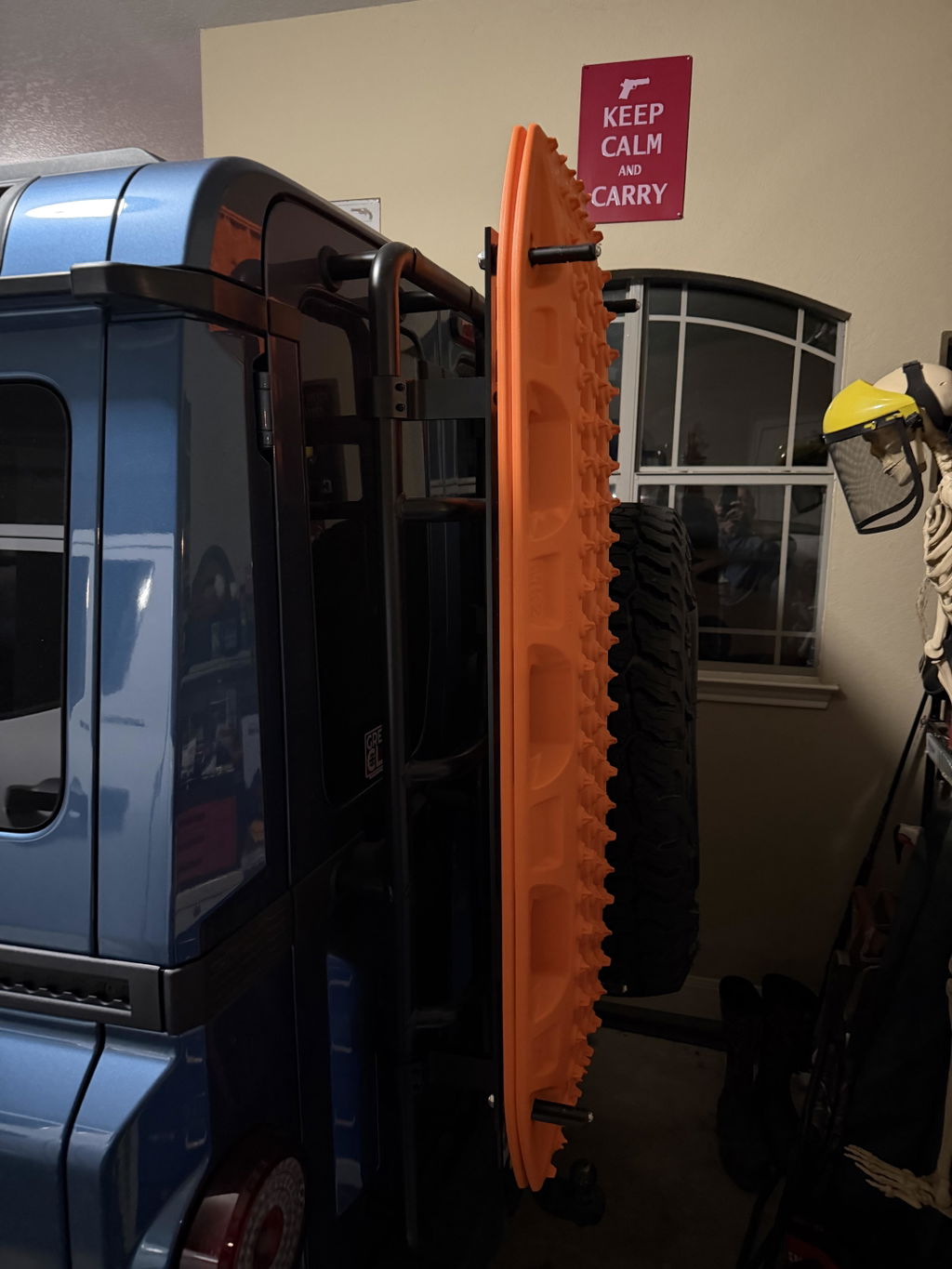
This includes roof rail systems, side accessory carriers, utility rails, rear ladder accessories, and similar bolt-on hardware — provided total payload stays within the Grenadier's rated GVM. The key question for any accessory is whether it changes the variables ESP is calibrated against: mass beyond limits, geometry (suspension, wheelbase, steering), sensor positions, or powertrain behavior.
DVA's DualTrack Roof Rail System and Side Accessory Carrier Gen 2 are both bolt-on systems using factory mounting points. They add weight above the CoG — which does affect handling characteristics — but stay within the Grenadier's permissible load limits when properly distributed. No sensor changes, no geometry changes, no recalibration required.
For a full overview of what's permitted bolt-on versus what requires engineering certification, see Springs & Suspension: What INEOS Allows Without a Clearance Certificate and Approved Tyres: Why Only Four SKUs Are Cleared.
The Real Consequence
INEOS's engineering assessment is direct: on vehicles with ESP, modifications can cause the system to no longer function as intended, resulting in system shutdowns and faulty control. This may cause the driver to lose control of the vehicle.
Those aren't hypothetical disclaimers — that's the factual description of what happens when a stability system is operating on a calibration model that no longer matches the physical vehicle. The ESP doesn't know the truck has been modified. It applies corrections based on what it thinks the truck should be doing — and those corrections may be exactly wrong for what the truck is actually doing.
Build Smart — DVA Grenadier Accessories
Bolt-on accessories that don't touch sensors, hydraulics, or geometry keep your ESP calibration intact. DVA builds for the Grenadier factory mounting points — no drilling, no permanent modification.
- DualTrack™ Roof Rail System — Dual-row L-Track, bolt-on factory hard points, no sensor interaction
- Side Accessory Carrier Gen 2 — Exterior rail system using factory mounting points only
- Full Grenadier Accessory Catalog — Bolt-on systems engineered for the Grenadier's factory architecture
INEOS Grenadier · Body Builder Guide · Technical Reference