Quick Answer — INEOS Grenadier Centre of Gravity & 30% Rule
1. Factory CG: ~700 mm above ground — already high due to body-on-frame construction, solid axles and ride height
2. Roof limits: 150 kg dynamic (structural) / 30% rule allows 225 kg of 750 kg payload — the 150 kg limit hits first
3. SSF impact: A 30 mm CG rise drops SSF from ~1.11 to ~1.07 — measurable decrease in rollover resistance
4. Rear-heavy risk: Pendulum effect, reduced front-axle load, longer braking distances, earlier ESP intervention
5. Safe rule: Keep dense, heavy items at floor or seat level; roof is for lightweight, bulky items only
Physics Does Not Negotiate
The centre of gravity (CG) of your vehicle determines how it handles corners, how it behaves on a side slope, and whether it stays on four wheels or rolls onto its roof. Every kilogram you add above the factory CG height raises it. Every kilogram you add to the roof raises it dramatically. And the consequences of getting it wrong are not a warranty claim — they are a rollover.
The 30% rule is the engineering shorthand that keeps builds safe: no more than 30% of your total payload should be carried above the roofline. For the Grenadier, with its body-on-frame architecture and solid axles, this rule is not conservative — it is the minimum standard for responsible build planning.
Understanding Centre of Gravity
The CG is the single point where the entire mass of the vehicle can be considered to act. A lower CG means the vehicle resists tipping forces more effectively. A higher CG means less force is required to initiate a rollover — whether that force comes from a sharp turn, a side slope, or a wheel catching a rut at speed.
The factory Grenadier has a relatively high CG compared to modern unibody SUVs. This is inherent to its design — body-on-frame construction, solid axles, generous ground clearance, and an upright driving position all contribute. INEOS engineered the chassis to handle this CG height with appropriate spring rates, anti-roll bars, and electronic stability control (ESP). But that engineering is calibrated to a specific weight distribution. Change the distribution and the calibration no longer matches.
The Maths
The height of the CG shifts according to a simple lever principle. If the factory CG height is approximately 700 mm above ground (a reasonable estimate for a vehicle of this class), then:
- Adding 50 kg at floor level (~400 mm) barely moves the CG
- Adding 50 kg at roof rail height (~1,900 mm) raises the CG by approximately 15 mm
- Adding 50 kg on top of a roof rack (~2,100 mm) raises it by approximately 18 mm
An 18 mm CG rise does not sound significant until you calculate its effect on the static stability factor (SSF), which is the ratio of half the track width to the CG height. The Grenadier's track width is approximately 1,555 mm (front). Even a 30 mm CG rise reduces the SSF from roughly 1.11 to 1.07 — a measurable decrease in rollover resistance.
"A lift raises the centre of gravity, making it more tippy off and on road and increasing a chance of a roll over. Unless a suspension lift includes bump stop extensions and longer shocks, then in reality all you have achieved is an aesthetic change at best and made the vehicle worse off road."
— Experienced owner on The Grenadier Forum — 35s with the Eibach 2.5" lift (March 2024)The 30% Rule in Practice
The 30% rule states that no more than 30% of the vehicle's payload should be placed at or above the roofline. For a Grenadier with 750 kg of available payload, that means a maximum of 225 kg on the roof — and that figure includes the roof rack or crossbar weight itself.
| Scenario | Roof Load | % of 750 kg Payload | Status |
|---|---|---|---|
| Crossbars (14 kg) + RTT (70 kg) | 84 kg | 11% | ✓ Good |
| Full rack (60 kg) + RTT (70 kg) + gear (40 kg) | 170 kg | 23% | ⚠ Caution |
| Full rack (60 kg) + RTT (70 kg) + gear (40 kg) + awning (25 kg) + solar (15 kg) | 210 kg | 28% | ⚠ Near limit |
| Above + additional storage (30 kg) | 240 kg | 32% | ✗ Over |
Factory Roof Load Rating
The Grenadier's dynamic roof load rating is 150 kg. The 30% rule may allow up to 225 kg of payload, but the structural roof load limit will be reached first in most cases. Always observe the lower of the two limits.
What Rear-Heavy Builds Do Wrong
A rear-heavy build shifts the CG rearward and upward simultaneously. Roof-top tents, rear-mounted spare tyres, jerry can holders, and heavily loaded drawer systems all concentrate mass at the highest and most rearward point of the vehicle. The consequences compound:
- Reduced front axle loading → lighter steering, less front-end grip, longer braking distances
- Pendulum effect → the rear of the vehicle swings wider in corners and is harder to control in emergency manoeuvres
- Reduced departure angle effectiveness → heavy rear overhang loads bottom out more easily on steep trail exits
- ESP intervention changes → the stability control system is calibrated for factory weight distribution; rear-heavy builds trigger earlier and more aggressive ESP intervention
"You want good clearance, bigger tyres, lift — but also a low centre of gravity. You want a solid build which adds weight — but also less weight for better performance, fuel consumption and range. It's great to have a solidly built vehicle but just maybe they have over-engineered the weight."
— Forum member on The Grenadier Forum — Grenadier Weight (June 2022)"The lift alone does not increase ground clearance as it is a solid axle vehicle and only increasing the wheel assembly diameter will increase ground clearance. Also a lift raises the centre of gravity, making it more tippy off and on road."
— Technical discussion on The Grenadier Forum — 35s with the Eibach 2.5" lift (March 2024)How the DVA DualTrack™ System Helps
The DVA DualTrack™ Low-Profile Crossbar System is engineered specifically to address the CG problem. Rather than adding a heavy full-length roof platform that sits 50–80 mm above the roof rails, the DualTrack crossbars mount as low as possible to the roofline, reducing the effective height of any load mounted to them.
The weight difference is significant: at approximately 14 kg for a pair of crossbars versus 60 kg for a full-length rack, the DualTrack system saves 46 kg of permanent roof weight. Over a 200,000 km vehicle life, that is 46 kg that never raises your CG, never loads your roof structure, and never consumes payload that could carry fuel, water, or recovery gear.
Low-Profile Accessory Mounting
DVA's hi-lift mounts, Starlink mounts, and LED light kits are all designed to mount at or below the crossbar plane, keeping accessory weight as close to the roofline as engineering allows. This is not a marketing decision — it is a physics decision. Every millimetre of height saved translates directly into a lower CG and a more stable vehicle.
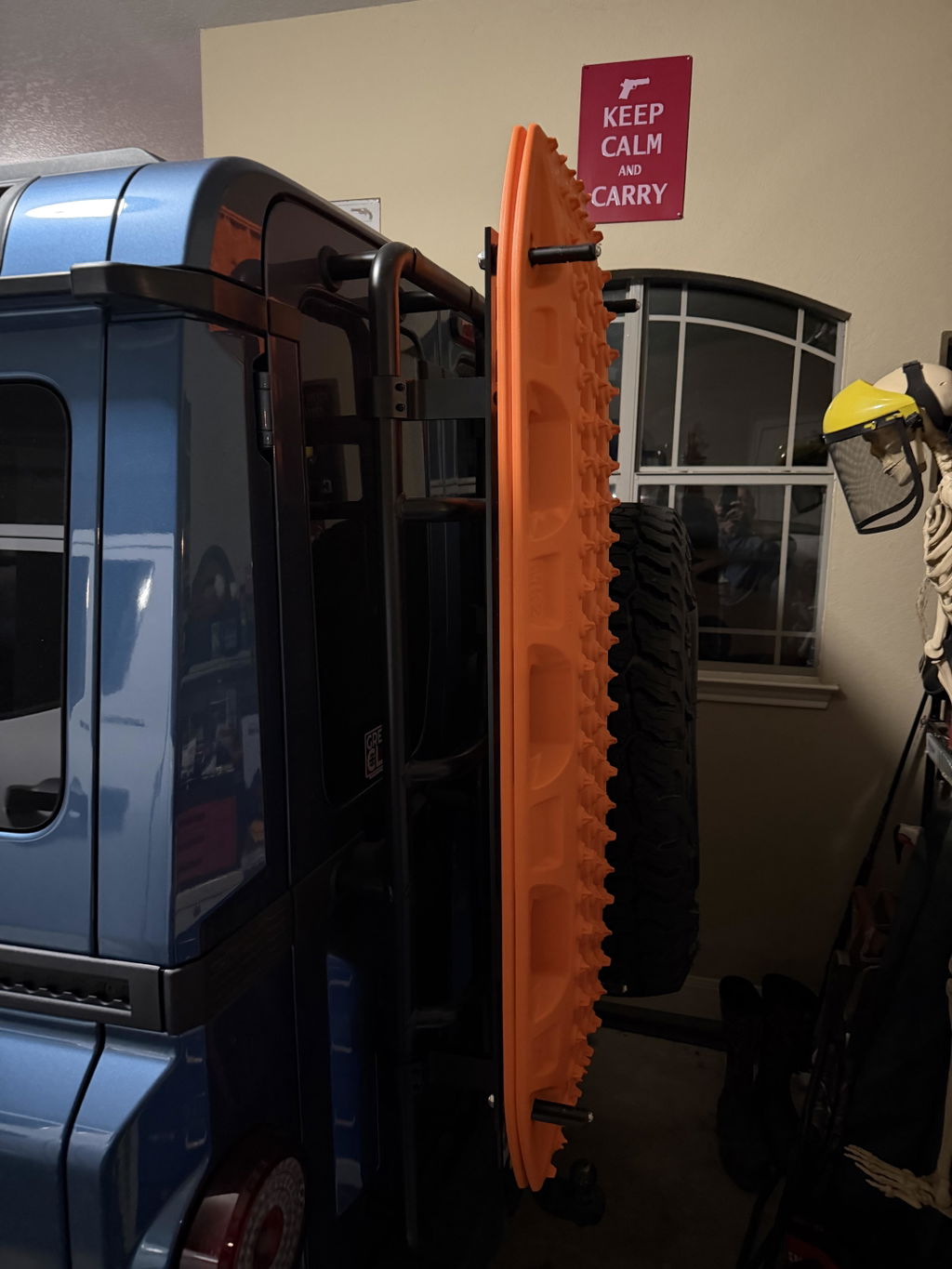
For heavy side-mounted accessories — jerry cans, hi-lift jacks, recovery boards — the DVA Exterior Utility Belt keeps that mass at door-panel height rather than roofline height. That is a CG difference of more than 700 mm per mounted item — directly measurable in your SSF calculation.
"I have DVA racks but no RTT on the Grenadier. I use the DVA L-track bolts which are M8 and come in three different lengths. I use those for my shovel mount and M6 L-track sliders for my Hi-Lift."
— DVA crossbar owner on The Grenadier Forum — DVA Mechanics roof rails with RTT and awning (February 2026)Building for Stability
1. Weigh Your Roof Load
Add up every item on the roof: rack, tent, awning, lights, mounts, solar panels, antenna. If the total exceeds 150 kg dynamic or 30% of your payload, you need to remove items or relocate them lower.
2. Prioritise Low Mounting
Heavy items belong at floor level or below: drawer systems in the cargo area, water tanks under the floor or behind the rear axle, batteries under the seat. The roof is for lightweight, bulky items — tents, awnings, and aerials. The full DVA Grenadier accessory range is designed around this principle — low-profile crossbars, side-mount Utility Belt carriers, and interior L-track systems that keep mass where physics wants it.
3. Test on a Side Slope
Before taking a loaded build off-road, find a safe slope and test how the vehicle feels at 15°, 20°, and 25° of tilt. If it feels unstable at angles you would normally drive, your CG is too high.
4. Respect the ESP
If the ESP is intervening aggressively during normal cornering, your weight distribution has moved outside the factory calibration window. Do not disable the ESP — reduce the roof load.
The Bottom Line
The Grenadier is a capable off-road vehicle with a CG that is already at the upper end of acceptable for its class. Every modification that adds height — lifts, roof loads, elevated accessories — pushes it further toward the rollover threshold. The 30% rule exists because physics does not negotiate, and a rolled vehicle is the end of every build plan.
Keep it low. Keep it centred. Keep it legal. Your vehicle — and the people inside it — depend on it.
Low-Profile by Design
DVA Mechanics' crossbar systems and accessory mounts are engineered to keep your CG where it belongs — as low as physically possible. Build capability without building instability.