Quick Answer: Where Can't You Mount Accessories in a Grenadier?
- Passenger dash top: Frontal airbag deploys here — no phone mounts, suction cups, or trim pieces
- A/B pillar headliner strip: Curtain airbag inflates downward from A-pillar to C-pillar — no overhead consoles, light bars, or grab handles
- Seat side bolster: Thorax airbag deploys laterally — no rigid seat covers, pouches clipped to the seat frame, or objects wedged between seat and door
- Steering wheel hub: Driver airbag deploys here — no aftermarket wheel covers with rigid centres
- Safe zones: Centre console, cargo area behind B-pillar, centre windshield (dashcam), under-seat floor area
The Grenadier's airbag system protects occupants across multiple deployment zones. Some of those zones are off-limits for any accessory mounting. Objects mounted within deployment zones may interfere with airbag function and occupant protection.
Airbag Types and Identification
The Grenadier is equipped with five distinct airbag types, each serving a specific protective function across the occupant compartment.
| Airbag Type | Location | Identification |
|---|---|---|
| Driver | Steering wheel | "AIRBAG" on steering wheel pad |
| Passenger | Dashboard | "AIRBAG" inscription on dashboard |
| Knee | Below instrument panel | Market-dependent — check local spec |
| Curtain | Roof rail, A to C pillar | "AIRBAG" on B-pillar |
| Thorax (Side) | Seat side bolster | On side of driver and passenger seat |
An additional identification feature is the red indicator lamp in the instrument cluster. This lamp illuminates during self-tests and warns if any restraint system fault is detected.
Prohibited Installation Zones
No installations — none — are permitted in red-marked deployment zones. The following are explicitly prohibited near airbag areas:
- Phone mounts, bottle holders, cell phone cradles
- Any fixtures near the instrument panel in deployment zones
- Installations between airbag deployment areas and front/side windows
- Modifications to seats, front-end assembly, A and B pillars, roof frame, doors
The Cockpit Boundary
Interior modifications above the belt rail line in deployment areas must meet head impact test criteria per UN-R 21 or FMVSS 201 and may compromise restraint system function. Design interior with soft edges and surfaces. Fixtures must be flame-retardant and firmly mounted.
The Airbag Control Unit
The airbag control unit sits in the footwell or centre console behind trim. It must not be modified in location, position, or fastening. No vibration-generating parts should be placed near the control unit or sensor locations. No changes to centre console or floor structure in this area are permitted.
A dropped airbag control unit must be replaced immediately — never reinstalled. The internal calibration is unknown after impact, and attempting to reuse it risks sensor malfunction during a real collision event.
Paint and Chemical Compatibility
If paint or surface treatment is applied to the instrument panel, steering wheel impact damper, or airbag tear seams, chemical reactions may occur that weaken or damage materials. The restraint systems may no longer function as intended. Use only INEOS-compatible finishes when refinishing any interior surfaces near airbag components.
Pyrotechnic Handling
Airbag and seat belt pre-tensioner units are pyrotechnic objects. Handling may only be performed by appropriately qualified personnel. Removed airbag units must be stored padded side up — if pointing downward, the unit will be shot through the air in the event of accidental ignition during storage or transportation.
Removed units must be stored in a suitably rated metal cabinet when not fitted to the vehicle. Never store airbag assemblies in passenger compartments or near heat sources. Proper storage and handling are critical safety requirements.
Dimensioned Deployment Zones: Where Exactly Are They?
Since the Grenadier's Body Builder Guide includes dimensioned diagrams that can't be reproduced here, let's describe the key zones in measurable terms that any installer can work with.
Curtain Airbag Zone
The curtain airbag runs along the roof rail from the A-pillar to the C-pillar, stored behind the headliner trim. When deployed, it inflates downward to cover the entire side window area — roughly the full height from the belt line to the headliner and the full length from the A-pillar to the rear-most side window. Nothing can be mounted in the headliner, on the roof rail trim, or between the A and B pillars where it could obstruct this deployment path. This means no overhead consoles, no grab handles, no interior light bars, and no wiring routed behind the headliner in this zone without explicit INEOS clearance.
Driver Airbag Zone
The driver airbag deploys from the steering wheel hub outward, expanding to approximately 600–700 mm diameter within milliseconds. The deployment zone extends from the steering wheel face to the driver's torso and head position. Nothing should be attached to the steering wheel (no aftermarket steering wheel covers with rigid components, no phone mounts clamped to the wheel, no suction-cup devices on the centre hub).
Passenger Airbag Zone
The passenger airbag deploys from behind the dashboard panel, expanding outward and downward. The zone extends from the dashboard surface (where "AIRBAG" is inscribed) approximately 500 mm forward into the passenger seating area. No phone mounts, tablet holders, dashcams, or aftermarket trim pieces should be attached to the dashboard surface above the glovebox in this area.
Knee Airbag Zone
Where fitted (market-dependent), the knee airbag deploys from below the instrument panel toward the driver's knees and lower legs. The zone runs from the lower dashboard panel to approximately knee height. No aftermarket pedal covers that extend upward, no under-dash storage trays, and no wiring bundles routed through this area.
Side (Thorax) Airbag Zone
The thorax airbag deploys from the outboard side of each front seat, expanding laterally to protect the occupant's ribcage. The deployment zone extends approximately 200–300 mm outward from the seat side bolster. No aftermarket seat covers that are overly thick or rigid on the sides, no objects stored between the seat and door panel, and no mounting brackets attached to the seat frame without INEOS approval.
What You CAN Mount — And Where
The airbag restrictions sound severe, but there's actually plenty of usable real estate inside the Grenadier cab for accessories. Here's where you're safe:
Centre Dashboard (Below Airbag Line)
The centre stack area — below the infotainment screen and climate controls — is outside both the driver and passenger airbag deployment paths. Phone mounts using the centre air vent blades or a suction cup on the lower windshield centre are generally safe. Avoid anything that positions a rigid object directly in front of the passenger airbag panel.
A-Pillar (Below Belt Line)
The lower A-pillar area below the belt line is viable for small accessories like dashcam cable routing — but remember the curtain airbag deploys along the upper portion. Keep installations below the belt rail line and use soft, flexible cable management rather than rigid brackets.
Rear of Centre Console
The area behind the centre console and between the front seats is outside all deployment zones. This is ideal for radio equipment, auxiliary switches, USB hubs, or small storage solutions. Just ensure nothing interferes with the airbag control unit, which sits in the footwell/console area.
Rear Cabin Area
Behind the B-pillar and in the cargo area, you have more freedom. Cargo barriers, rear seat organisers, and cargo area accessories are generally outside airbag deployment paths — though you must still respect the curtain airbag zone along the roof rail.
Overhead Console (Factory Switch Panel)
The Grenadier's factory overhead switch panel is already engineered to coexist with the curtain airbag system. The EXT and INT circuit switches live here by design. Don't add aftermarket switches or accessories to this panel — the factory layout accounts for airbag clearance; your additions might not.
Real-World Examples: Accessories That Commonly Violate Zones
These are the installations that owners attempt most often — and that fall within airbag deployment zones:
Suction-Cup Phone Mounts on the Dashboard
If the mount positions a phone or tablet directly over the passenger "AIRBAG" inscription, it's in the deployment zone. During deployment, the airbag will launch the device at the passenger's face at high velocity. Move the mount to the centre windshield area or lower dash.
Aftermarket Interior LED Light Bars Across the Headliner
Mounting a rigid LED strip or light bar across the headliner between the A and B pillars blocks the curtain airbag deployment path. The airbag cannot inflate properly, and the rigid bar becomes a projectile. Use the factory interior lighting or mount lights behind the B-pillar only.
Thick Aftermarket Seat Covers with Side Bolster Padding
Seat covers that add significant thickness over the side bolster — where the thorax airbag deploys — can delay or redirect airbag deployment. Use seat covers that are explicitly designed with airbag-compatible stitching (tear seams) on the side bolsters. The cover must split open when the airbag fires.
UHF/CB Radio Handsets Mounted on the A-Pillar
A rigid radio handset bracket on the upper A-pillar sits directly in the curtain airbag's deployment path. Mount the handset on the lower centre console or use a flexible cable mount that routes below the belt line.
Grab Handle Upgrades or Paracord Handles
Aftermarket grab handles bolted to the roof rail area between A and B pillars can obstruct the curtain airbag. The factory handles are engineered to break away during deployment. Aftermarket replacements may not. Stick with OEM handles in this zone.
The principle is consistent: if an accessory is rigid and sits between an airbag module and an occupant, it's a problem. If it's in the deployment path, it's either a projectile or a barrier. Neither outcome is acceptable in a crash.
Dimensioned Zone Descriptions: Where Every Airbag Lives
The Grenadier is equipped with 8 airbags. Each has a defined deployment zone that must remain completely clear of rigid accessories, aftermarket mounts, and stored equipment.
Airbag Locations and Keep-Out Zones
| Airbag | Location | Deployment Direction | Keep-Out Zone |
|---|---|---|---|
| Driver frontal | Steering wheel hub | Rearward toward driver | No objects between steering wheel and driver's torso/face — includes phone mounts on steering column |
| Passenger frontal | Dashboard top, passenger side | Rearward and downward | No mounts, stickers, or accessories on the dash top surface above the glovebox |
| Driver side (thorax/pelvis) | Driver seat outer bolster | Laterally toward door | No rigid objects between seat side and door — includes radio handsets, pouches clipped to seat frame |
| Passenger side (thorax/pelvis) | Passenger seat outer bolster | Laterally toward door | Same as driver side |
| Driver curtain | Headliner, above driver door | Downward along window | No grab handles, overhead storage, or accessory rails within the A-pillar to B-pillar headliner zone |
| Passenger curtain | Headliner, above passenger door | Downward along window | Same as driver curtain |
| Rear left curtain | Headliner, above rear left | Downward along window | No aftermarket storage or accessory mounts along rear headliner |
| Rear right curtain | Headliner, above rear right | Downward along window | Same as rear left |
Where You CAN Mount Accessories
Not everything is off-limits. Here are the safe zones for interior accessory mounting:
- Centre dash area (between driver and passenger): The overhead control panel and centre console are outside airbag deployment paths — suitable for small device mounts if not blocking controls
- Windscreen (upper centre): Dashcam mounting in the upper-centre windscreen area is acceptable — it's between the two curtain airbag zones and above the frontal airbag paths
- Under-seat area: Below the seat frame is generally safe for radio bodies, small storage, and fire extinguisher mounts — provided they don't interfere with seat rail travel
- Rear cargo area: Behind the B-pillar and below the rear curtain airbag line, the cargo area is free for drawer systems, fridge mounts, and storage
- Overhead control panel area: The factory switch panel is designed for accessory switches — use the available blanks
What Owners Are Learning
"For me, the under-the-front-dash has airbags interfering with it. I found that under my driver's seat there is plenty of space and there is a bar that I can mount to."
— Owner finding safe GMRS radio mount location, The INEOS Forum, July 2025
"Someone posted this auction of an accident Grenadier on Facebook. I wonder where our 8 airbags are? I've always wondered why the A-pillar trim is made of hard plastic and doesn't have any padding."
— Owner questioning airbag locations after seeing crash photos, The INEOS Forum, December 2023
"I'm using the OWL RAM mount system up on the dash."
— Owner sharing safe phone mount solution, Reddit r/ineosgrenadier, November 2024
Violation Examples: What NOT to Do
- Phone mount on A-pillar: Directly in the curtain airbag deployment path — the phone becomes a projectile at deployment speeds of 200+ km/h
- CB radio handset clipped to driver seat bolster: Blocks the side thorax airbag — the handset gets driven into the occupant's ribcage
- Aftermarket grab handle on headliner: If mounted in the curtain airbag zone, it prevents full curtain deployment and may redirect the bag in unpredictable ways
- Suction-cup accessories on passenger dash top: Items mounted on the passenger dash surface will be launched by the frontal airbag deployment
Exterior INEOS Grenadier Accessories from DVA
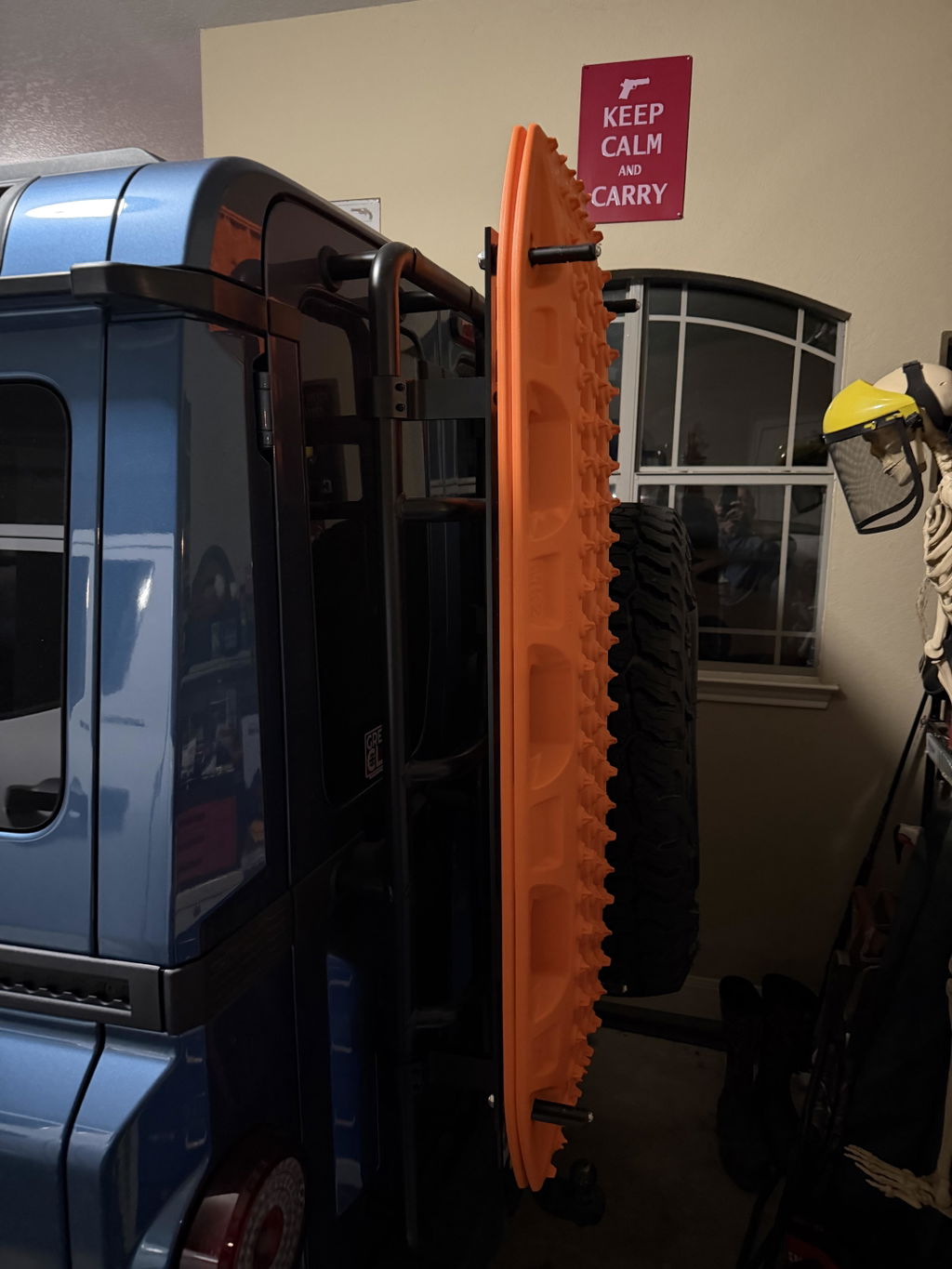
While the cab interior has strict airbag zone restrictions, the exterior of your Grenadier has plenty of room for upgrades. DVA Mechanics designs accessories that mount on exterior rails, body panels, and roof systems — keeping your build out of airbag deployment paths entirely.
- DualTrack™ Grenadier Roof Crossbar System — Exterior roof rail crossbars that keep cargo mounting above the cab and away from all interior airbag zones.
- INEOS Grenadier Exterior Utility Belt — Body panel mounting system for tools and gear — exterior only, airbag-zone safe.
- Full INEOS Grenadier Accessories Collection — Browse all DVA exterior accessories for the INEOS Grenadier platform.
INEOS Grenadier · Body Builder Guide · Technical Reference