The Grenadier tows 3,500 kg braked on a 50mm ISO ball rated to 350 kg tongue weight. Mount only to the rear longitudinal member, verify UN-R 55 clearances, and confirm the front axle still carries ≥20% of combined mass before you hook up.
Quick Answer — INEOS Grenadier Trailer Coupling
- Towing capacity: 3,500 kg braked / 750 kg unbraked. GCM is 6,720 kg (B57 diesel) or 6,490 kg (B48 petrol) — whichever ceiling you hit first is the limit.
- Tongue weight: 350 kg maximum on the 50mm ball. Some US market labels read 273 kg — use the lower figure if your vehicle carries both.
- Approved mounting: Rear longitudinal member designated points only. UN-R 55 compliant. Non-removable couplings must retain spare wheel access when fully loaded.
- 20% front axle rule: Front axle load ÷ (vehicle laden + trailer laden) ≥ 20% at all times. A 150 kg tongue weight subtracts ~105 kg from the front axle via lever effect.
- Modified Grenadiers: Weigh at a public weighbridge with accessories fitted. Rear carriers and jerry cans unload the front axle before you even hitch up.
Approved Couplings and Designated Mounting
INEOS recommends only INEOS-approved trailer couplings. Attach only to designated points on the rear longitudinal member. Those points have been engineered to carry hitch loads without deflecting the rear structure beyond acceptable limits.
Non-removable ball-head couplings must maintain spare wheel accessibility when fully loaded.
Coupling Specifications
| Specification | Value |
|---|---|
| Maximum braked towing capacity | 3,500 kg |
| Maximum unbraked towing capacity | 750 kg |
| Maximum tongue weight (ball load) | 350 kg (check your market label — some US units show 273 kg) |
| Gross Combined Mass (GCM) | 6,720 kg (B57 diesel) / 6,490 kg (B48 petrol) |
| Coupling type | 50mm ball (ISO 1103) — standard across most markets; US spec includes 2" receiver |
| Electrical connector | 13-pin Euro plug (EU/AU) / 7-pin flat (US) — LED trailer wiring requires diode isolation |
| Mounting points | Rear longitudinal member — designated bolt positions only (UN-R 55) |
The GCM is the hard ceiling. Your Grenadier's actual laden weight plus the trailer's actual laden weight cannot exceed it. This is where most towing calculations start — and where many go wrong.
UN-R 55 Compliance and Clearance Requirements
Installation must comply with UN Regulation 55. Country-specific clearance dimensions apply for coupling height, departure angle impact, and side clearances. Deviation from accident prevention regulations requires a technical certificate from the relevant authority in your country.
The Grenadier's departure angle is affected by any coupling extension — critical for owners who tow off-road. A drop hitch fitted after a suspension lift also changes the geometry and must be re-checked against market clearance requirements.
The 20% Front Axle Load Rule
Why the Front Axle Matters When Towing
With a trailer attached at the coupling point, the front axle must carry a minimum of 20% of the maximum laden mass (towing vehicle plus trailer at full load). A loaded trailer exerts downward force at the coupling point. Without adequate front axle weight, steering becomes light and unpredictable — particularly on highway sweepers and during emergency avoidance.
Calculate your laden masses before installation:
- Grenadier unladen weight (published spec)
- Your accessories and cargo weight (measured, not estimated)
- Trailer weight at actual loaded condition (not GTM)
- Total combination mass: vehicle laden + trailer laden
Front axle load under maximum laden conditions must be ≥20% of total combination mass.
Worked Calculation: Tongue Weight and Front Axle Redistribution
This is the calculation most builders skip. The trailer's tongue weight doesn't just add to the rear axle — it redistributes load across both axles based on lever arm geometry. Here's how it works with real numbers:
Example: Grenadier Towing a 2,500 kg Trailer
Starting condition (no trailer):
- Grenadier GVM: 3,280 kg
- Unladen kerb weight: ~2,550 kg
- Cargo loaded: 400 kg (gear, passengers)
- Laden vehicle weight: 2,950 kg
- Front axle: ~1,400 kg | Rear axle: ~1,550 kg
Add trailer:
- Trailer laden weight: 2,500 kg
- Tongue weight (6% of trailer weight): 150 kg
- Total combination mass: 2,950 + 2,500 = 5,450 kg
Load redistribution from tongue weight:
- The 150 kg tongue weight acts at the hitch point, behind the rear axle
- This levers weight OFF the front axle and ONTO the rear axle
- Rule of thumb: for every 1 kg of tongue weight, the front axle loses approximately 0.6–0.8 kg (depending on wheelbase-to-overhang ratio)
- Front axle reduction: ~150 × 0.7 = 105 kg lost from front
- New front axle load: 1,400 − 105 = ~1,295 kg
- New rear axle load: 1,550 + 150 + 105 = ~1,805 kg
The 20% check:
- 20% of total combination mass: 5,450 × 0.20 = 1,090 kg
- Front axle load: 1,295 kg ✓ (passes — but with only 205 kg margin)
Maximum front axle rating: 1,667 kg — still within limits ✓
Maximum rear axle rating: 2,150 kg — 1,805 kg is within limits ✓
Notice how tight the margins get. A modest 2,500 kg trailer with proper tongue weight eats most of the available headroom. Add heavier cargo or a loaded rear carrier and the numbers shift fast.
The Label Discrepancy: 350 kg vs 273 kg
Some owners have found a confusing discrepancy between the handbook figure and the physical label on the hitch plate:
"The handbook states 350 kg. Then there is a label on the bash plate that says 273 kg. Others have this same bash plate label that says 350 kg."
— US Grenadier owner reporting tongue weight label confusion, The INEOS Forum — US Trailer Hitch Problems thread, May 2024
If your vehicle shows 273 kg on the label, use that figure. The lower number is the binding constraint regardless of what the handbook states for your market.
Towing with a Heavily Modified Grenadier
If you've added accessories — roof rack and gear, bull bar, winch, rear carrier, spare tyre relocation — your unladen weight has changed, and so has your weight distribution. This has direct consequences for towing:
| Common Modification | Typical Weight Added | Effect on Towing Budget |
|---|---|---|
| Roof rack + crossbars loaded | 60–120 kg (rack + gear) | Raises centre of gravity. Reduces dynamic stability when towing. Count every kilogram against GVM. |
| Bull bar + winch | 80–120 kg | Adds to front axle — actually helps the 20% rule. But counts against GVM. |
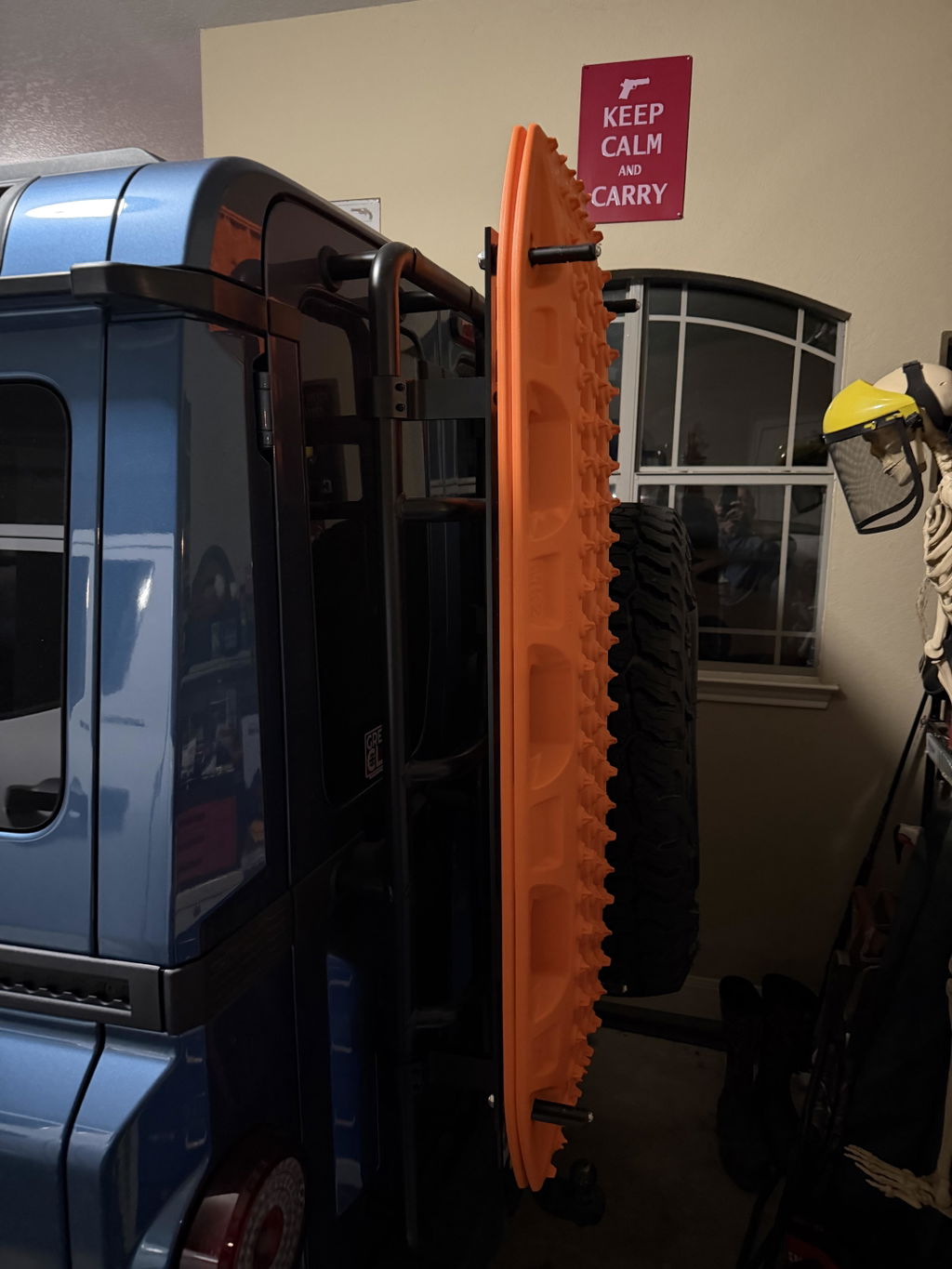
| Rear carrier + spare + jerry cans | 60–100 kg | Adds behind rear axle. Acts like additional tongue weight in reverse — further unloads front axle. Worst-case scenario for the 20% rule. |
| Suspension lift (40–65mm) | Minimal weight change | Raises coupling point height. May require drop hitch to maintain level towing geometry. Changes approach/departure angles. |
| Underbody protection/skid plates | 30–50 kg | Low and central — minimal distribution impact, but counts against GVM. |
The Modified Grenadier Towing Checklist
Before hitching a trailer to a modified Grenadier:
- Weigh your vehicle as-built (with all accessories) at a public weighbridge — front and rear axle separately
- Recalculate GVM headroom: 3,280 kg minus your actual laden weight = remaining payload capacity
- Recalculate GCM headroom: 6,720 kg minus your vehicle's laden weight = maximum trailer weight
- Verify the 20% front axle rule with your actual measured axle weights, not the factory unladen figures
- If you have a rear carrier loaded with a spare wheel and jerry cans, the front axle is already lighter than stock — your 20% margin is thinner before you even hitch up
- Consider removing rear-mounted accessories for long towing trips to recover front axle margin
Owner Towing Experiences
Forum owners have tested the Grenadier's towing in real-world conditions — including camper hitching, long-distance hauls, and off-road trailer work:
"I had to add the hitch extension and a few links of chain. I towed the camper — Airstream Basecamp at 1,700 lbs — for approx 100 miles. I hardly knew it was there."
— Owner sharing first towing experience, The INEOS Forum — Towing With The Grenadier, March 2024
"Travelled about 16,000 km now, guess 13,000 towing heavy. TPMS is the only nuisance and needs to be sorted by INEOS."
— Long-distance tower, The INEOS Forum — Actual Towing Experiences, November 2023
The consensus: the Grenadier is a capable tower, but US-spec owners commonly encounter the hitch adapter / extension requirement and the TPMS sensitivity issue when towing heavy.
Interactions with Driving Assistance Systems
A trailer coupling installation affects how driving assistance systems function. Height, angle, and geometry of the coupling influence sensor perception of vehicle attitude. Some systems require recalibration after rear structure modifications.
Permissible centre of gravity positions and axle loads must always be observed. This isn't a single calculation — it's a constraint you must verify under multiple loading scenarios: unladen tow vehicle + empty trailer, unladen tow vehicle + full trailer, fully laden tow vehicle + full trailer.
DVA Grenadier Towing and Cargo Accessories
Managing weight distribution before you hitch up is as important as the hitch itself. DVA builds purpose-specific accessories for the Grenadier towing setup:
Recommended for Grenadier Towing Builds
INEOS Grenadier 2" Rear Hitch Receiver — Heavy-duty 2" receiver hitch compatible with US-spec Grenadier. Accepts Class III ball mounts, shackles, and aftermarket towing accessories without the OEM flange fitment issues. Required for most US trailer setups.
INEOS Grenadier Accessories Collection — Roof rails, crossbars, interior cargo systems, and rear carriers engineered specifically for the Grenadier platform. Every kilogram added affects your towing budget — our engineers have the weight data for each component.
Full Grenadier Towing Guide — Companion article covering hitch setup, wiring (13-pin vs 7-pin), Trailer Stability Assist calibration, and what owners actually experienced towing with the Grenadier in 2024–2025.