A load-first approach to choosing between crossbars, platform racks, and modular systems — with worked calculations for RTT, solar, cargo, and multi-use configurations.
1. The Decision Problem Most Owners Get Wrong
Here's what typically happens: a Grenadier owner buys a roof rack based on aesthetics or brand loyalty, installs it, then discovers it doesn't fit their actual use case. Maybe the rack adds too much height for their garage. Maybe the load rating doesn't support the rooftop tent they planned to buy next. Maybe they're paying $2,000+ for a full platform when crossbars would have handled the job.
The roof rack decision is about matching your specific load requirements to the right mounting architecture — then verifying the numbers work before you buy anything.
This framework walks you through that process in order: define your load, check the Grenadier's roof load limits, calculate your specific setup weight, choose the right rack type, and verify clearance.
2. The Grenadier Roof Load Ratings — What INEOS Actually Specifies
This is where confusion starts, because INEOS has published different numbers in different markets:
| Configuration | Dynamic Load (Driving) | Static Load (Parked) | Source |
|---|---|---|---|
| Bare roof (no rack), NA market | Not rated for cargo | 100 kg / 220 lb | 2023 NA brochure fine print |
| Factory roof rails only | ~68–95 kg / 150–209 lb | ~150 kg / 330 lb | INEOS Grenadier Technical Specifications (factory rail dynamic ratings vary by market — some regions quote 95 kg rather than 68 kg; verify against your regional spec sheet, Section "Dimensions & Weights") |
| Full-length roof rack (INEOS accessory) | ~150 kg / 330 lb | ~420 kg / 925 lb | INEOS Grenadier Accessories Catalog (verify document edition and page against your market variant — ratings published in the "Expedition" accessories section) |
Roof load specifications vary by market and configuration. Verify against your regional specification sheet.
The key number for most owners is dynamic load — that's the weight limit while driving. Static load matters for camping (sleeping in a rooftop tent while parked), but dynamic load determines what you can safely carry at highway speed and on rough terrain.
3. Weight Stacking: How to Calculate Your Actual Load
Most owners underestimate their total roof load because they only think about the primary cargo item. Here's the reality: every component counts, and they stack up fast.
Common Component Weights
| Component | Typical Weight Range |
|---|---|
| DVA DualTrack 4-Bar Kit | 20 lb / 9 kg (5 lb per bar × 4 bars) |
| Full platform rack (aluminum, various brands) | 40–65 lb / 18–30 kg |
| Hardshell rooftop tent (2-person) | 120–160 lb / 55–73 kg |
| Softshell rooftop tent (2-person) | 90–130 lb / 41–59 kg |
| 270° awning | 40–65 lb / 18–30 kg |
| 100W solar panel (rigid) | 15–20 lb / 7–9 kg |
| 200W solar panel (rigid) | 25–35 lb / 11–16 kg |
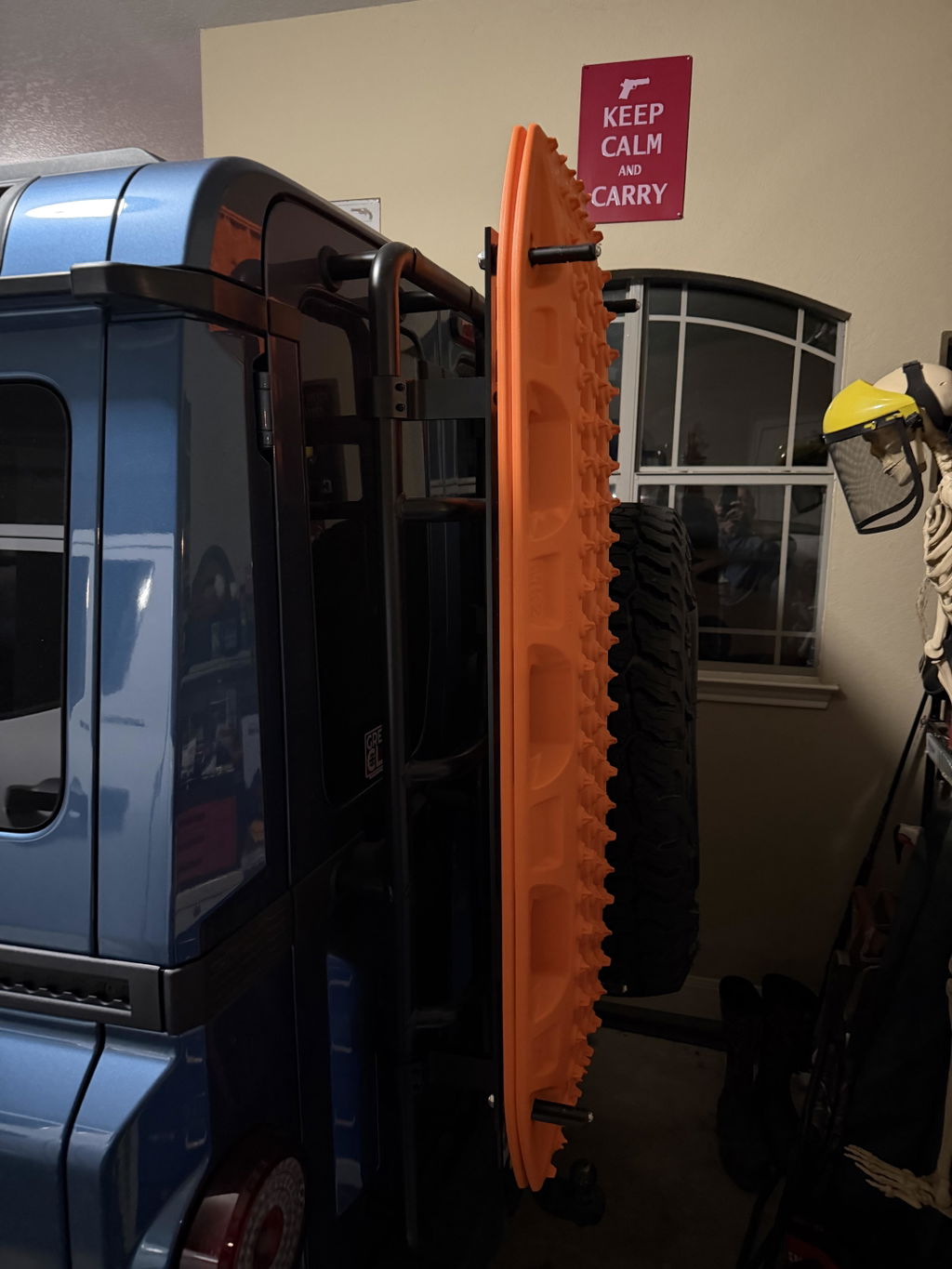
| Recovery boards (pair) | 15–20 lb / 7–9 kg |
| DVA LED Roof Light Bar | 8–12 lb / 4–5 kg (including mount) |
| Roof cargo box (medium) | 35–50 lb / 16–23 kg (empty) |
| Starlink Mini + DVA mount | 3–5 lb / 1.5–2.3 kg |
Worked Example 1: Weekend Overlander
Setup: DVA DualTrack 4-bar kit + hardshell RTT + recovery boards
| Component | Weight |
|---|---|
| DVA DualTrack 4-bar kit | 20 lb |
| Hardshell RTT (mid-range) | 140 lb |
| Recovery boards (pair) | 18 lb |
| Total Dynamic Load | 178 lb |
Verdict: The DVA DualTrack 4-bar kit is rated for 200 lb dynamic. This setup fits within the rating with 22 lb of margin. ✅ The key advantage: at only 20 lb for the rack itself, the DualTrack leaves significantly more payload capacity for actual cargo compared to a 50+ lb platform rack.
Worked Example 2: Expedition Build
Setup: Full platform rack + hardshell RTT + 200W solar + awning + light bar
| Component | Weight |
|---|---|
| Full platform rack (aluminum) | 55 lb |
| Hardshell RTT | 150 lb |
| 200W rigid solar panel | 30 lb |
| 270° awning | 50 lb |
| LED light bar + mount | 10 lb |
| Total Dynamic Load | 295 lb |
Verdict: This exceeds the 150 lb dynamic limit of factory rails alone but falls within the 330 lb rating of the INEOS full-length rack and well within the 500 lb dynamic rating of aftermarket heavy-duty racks. You need a full platform rack for this build — crossbars alone won't cut it.
Worked Example 3: Daily Driver + Occasional Cargo
Setup: DVA DualTrack 2-bar kit + cargo box + light bar
| Component | Weight |
|---|---|
| DVA DualTrack 2-bar kit | 10 lb |
| Cargo box (medium, loaded) | 80 lb |
| DVA LED roof light bar | 10 lb |
| Total Dynamic Load | 100 lb |
Verdict: Well within the 2-bar kit's 100 lb dynamic rating. This is the sweet spot for owners who want utility without committing to a permanent expedition setup. Total added height: ~1" from the DualTrack bars plus cargo box height. ✅
4. Crossbars vs. Platform Racks: The Decision Matrix
This is the core decision. Both have legitimate use cases, and choosing wrong costs you money, height clearance, fuel economy, or load capacity.
| Factor | Crossbars (e.g., DVA DualTrack) | Full Platform Rack |
|---|---|---|
| Weight | 10–20 lb (2 or 4 bars) | 40–65 lb |
| Added Height | ~1" / 25mm | 2–4" / 50–100mm |
| Dynamic Load Capacity | 100–200 lb (2 vs 4 bar) | 330–500 lb |
| Cost | $279–$499 | $1,200–$2,500+ |
| Installation Time | 45–60 minutes | 2–4 hours |
| Garage Clearance (7' door) | Fits standard 7' / 215cm garage | May not fit — measure first |
| Accessory Mounting | L-Track channels — infinite positioning | Fixed mounting holes or T-slot |
| Wind Noise Impact | Minimal — low profile, aerodynamic crossbar shape | Noticeable above 70 mph — flat/square crossbar profiles generate more turbulence and whistle than teardrop/aero profiles |
| Fuel Economy Impact | Negligible (owner-reported) | Varies — see Section 5 |
| Safari Window Compatible | Yes — bars clear window path | Depends on rack design |
| RTT Support | 4-bar kit required (200 lb dynamic) | Yes — most rated 330+ lb dynamic |
When to Choose Crossbars
- Your total dynamic load is under 200 lb
- You need to fit in a standard 7' (215 cm) garage
- You want modular — start with 2 bars, add 2 more later
- Your primary cargo is a rooftop tent, cargo box, or solar panel (not all three simultaneously)
- You value low wind noise and minimal fuel economy impact for daily driving
- You want L-Track versatility for repositioning accessories without drilling
When to Choose a Full Platform
- Your total dynamic load exceeds 200 lb
- You're stacking multiple heavy accessories (RTT + awning + solar + recovery gear)
- You need a walk-on platform for tent access or equipment staging
- Height clearance isn't a constraint (you park outdoors or have a tall garage)
- You want integrated accessory mounting rails across the entire roof surface
5. Weight Distribution & Handling Impact
Roof load doesn't just add weight — it changes where that weight sits. A loaded roof raises the vehicle's center of gravity, which affects handling at highway speeds and in crosswind conditions.
Front-to-Rear Balance
The Grenadier's factory weight distribution is approximately 52/48 front-to-rear. Roof loads shift weight depending on where the load sits on the roof:
- RTT mounted rear-biased: Shifts the balance toward the rear axle. This can lighten front-end steering feel and reduce high-speed directional stability slightly.
- Cargo distributed evenly across 4 bars: Maintains close to factory balance — the preferred configuration for highway driving.
- Heavy single item (cargo box) mounted forward: Adds front axle load, which can slightly improve steering response but increases braking distance.
Best practice: Distribute load as evenly as possible across the available mounting points. When mounting a single heavy item (RTT or cargo box), center it on the roof length to minimize balance shift.
Side-to-Side Asymmetry
Asymmetric loads — such as a 270° awning mounted on one side only — create a lateral weight bias that becomes noticeable in crosswinds and during highway lane changes. If you're running a side-mounted awning, balance it with recovery gear or other accessories on the opposite side when possible.
Handling Impact at Highway Speed
At 65+ mph, a fully loaded roof rack (200+ lb) measurably increases body roll in corners and extends the vehicle's reaction time to steering inputs. This isn't dangerous, but it requires awareness:
- Reduce speed in crosswind conditions — the Grenadier's tall, flat-sided body is already crosswind-sensitive, and roof load amplifies this.
- Allow longer following distances when carrying heavy roof loads — the higher center of gravity extends weight transfer time during braking.
- After loading, drive a few miles at moderate speed to confirm the vehicle feels stable before committing to highway speeds.
6. Fuel Economy Impact: What the Data Actually Shows
Roof-mounted cargo creates aerodynamic drag that increases fuel consumption. But how much? Owner reports from The INEOS Forum provide useful real-world data:
Estimated Fuel Economy Impact by Configuration
Note: Grenadier-specific fuel economy data with roof loads is limited. The estimates below draw on general aerodynamic research — including the 2014 Lawrence Berkeley National Laboratory study on roof rack fuel economy impact (Menon et al., "The Energy Cost of Roof Racks," LBNL-6975E) — and owner anecdotes. Actual impact depends heavily on speed, wind, and load profile.
| Configuration | Estimated MPG Impact | Confidence |
|---|---|---|
| Low-profile crossbars (empty) | Negligible | High — consistent with LBNL findings |
| Low-profile crossbars + cargo box | Minor (2–5%) | Moderate — varies with box aerodynamics |
| Full platform rack (empty) | Minor (1–3%) | Moderate |
| Full platform + RTT (closed) | Moderate (5–10%) | Low — highly variable by RTT profile |
| Full platform + RTT + awning + gear | Significant (8–15%) | Low — owner reports with many confounders |
The Grenadier B58 petrol averages approximately 16–19 MPG combined depending on driving conditions. The B57 diesel does better at 20–25 MPG. Even a 10% reduction from a fully loaded roof is roughly 1.5–2 MPG — noticeable, but typically not the deciding factor for owners who need the cargo capacity.
The real cost driver isn't the rack — it's what's on it. Empty crossbars add negligible drag. A 50" wide hardshell RTT sitting 4 inches above the roofline is a significant aerodynamic penalty. If fuel economy matters to you, choose the lowest-profile rack that meets your load requirement and use streamlined cargo containers rather than exposed gear.
7. The Grenadier Roof Dimensions You Need
Before buying any rack, you need the actual measurements. Here are the verified Grenadier dimensions from INEOS specs and owner measurements:
| Measurement | Value | Source |
|---|---|---|
| Overall height (to roof peak) | 2,036 mm / 80.2" | INEOS spec sheet, owner verification |
| Height to top of roof rails | ~2,050 mm / 80.7" | Owner measurement (The INEOS Forum) |
| Roof width (between gutter rails) | ~1,490 mm / 58.7" | Owner measurement |
| Roof length (usable mounting area) | ~2,100 mm / 82.7" | Owner measurement |
| Overall width (body) | 1,930 mm / 76.0" | INEOS spec sheet |
| Overall width (mirrors) | 2,146 mm / 84.5" | INEOS spec sheet |
| Overall length | 4,856 mm / 191.2" | INEOS spec sheet |
| Wheelbase | 2,922 mm / 115.0" | INEOS spec sheet |
DVA DualTrack Height Addition
The DVA DualTrack crossbar adds approximately 25 mm (~1 inch) above the factory roof rail mounting points. With the Grenadier's base height of 2,036 mm, a DualTrack-equipped vehicle measures approximately 2,061 mm / 81.1" to the top of the crossbar. This is specifically designed to fit under a standard 7-foot (2,134 mm / 84") garage door with approximately 73 mm / 2.9" of clearance.
By comparison, platform racks typically add 50–100 mm (2–4"), putting the total vehicle height at 2,086–2,136 mm (82.1–84.1") — right at the limit of a 7' garage door, with some designs exceeding it.
8. Safari Window Compatibility
The Grenadier's optional safari windows (pop-up rear windows) are a beloved feature. Any rack choice needs to account for their operation.
- DVA DualTrack crossbars: Compatible — bars mount to factory roof rail points and do not obstruct the safari window opening path. Confirmed by multiple owners.
- Full platform racks: Varies by design. Some platforms allow safari windows to open but prevent removal. Others block them entirely. Verify with the specific rack manufacturer before purchasing.
- 3/4-length platforms: Generally compatible — they stop short of the rear safari window area. This is the most popular platform configuration for owners who want both a rack and functional safari windows.
9. Crossbar System Specifications: DVA DualTrack Example
Crossbar systems like the DVA DualTrack use dual-row L-Track channels for accessory positioning. Here's how the architecture works:
Dual-Row L-Track vs. Traditional Crossbar
Standard crossbars provide a single round or square tube surface. Accessories mount with universal clamps that can slip, rotate, or mar the bar surface. You're limited to wherever the clamp can grip.
The DualTrack crossbar integrates two full-length rows of industry-standard L-Track channels per bar. This means:
- Accessories slide into position at any point along the 58.5" bar length — infinite adjustment
- No clamps needed — L-Track fittings lock positively into the channel
- Compatible with thousands of existing L-Track accessories from DVA and third-party manufacturers
- Recovery board mounts, light brackets, awning mounts, and Starlink mounts all use the same L-Track standard
Modularity: Start Small, Scale Up
The DualTrack system is available as a 2-bar kit ($279) or 4-bar kit ($499). The 2-bar kit handles cargo boxes, light bars, and single accessory runs. If your needs grow — you decide to add a rooftop tent, for example — you add 2 more bars to the existing setup without replacing anything. Try doing that with a platform rack. See the complete roof rail system including L-Track accessories and mounting hardware.
Material and Build Quality
- Material: 6061-T6 aluminum — the same alloy used in aircraft structural components and high-end bicycle frames
- Finish: Black powder coat — corrosion resistant for coastal and desert environments
- Weight: 5 lb (2.3 kg) per bar — the complete 4-bar kit weighs only 20 lb total
- Installation: Factory bolt-on, no drilling, 45–60 minutes with basic hand tools. Fully reversible to stock.
- Mounting: Bolts directly to factory Grenadier roof attachment points with countersunk stainless steel hardware
10. The Decision Flowchart
Work through these questions in order:
- What's your total dynamic load? List every item that will be on the roof while driving (including the rack weight itself). Add them up.
- Is it under 100 lb? → 2-bar crossbar system (e.g., DVA DualTrack, ~$279–$399). Handles cargo boxes, light bars, Starlink. Fits any garage.
- Is it 100–200 lb? → 4-bar crossbar system (e.g., DVA DualTrack, ~$499). Handles RTT + recovery gear. Still fits a 7' garage.
- Is it 200–330 lb? → Full platform rack required. Budget $1,200–2,000+. Verify garage clearance before buying.
- Is it 330–500 lb? → Heavy-duty platform rack with independently verified load ratings. This is expedition territory.
- Do you need safari windows to open? → Choose crossbars or a 3/4-length platform. Full-length platforms may block them.
- Do you park in a standard garage? → Choose the lowest-profile option that meets your load requirement. Low-profile crossbar systems (~1" profile) offer the best garage clearance.
11. Post-Install Verification
After installing any rack system, verify before loading:
- Torque check: All mounting hardware torqued to spec. Retorque after first off-road trip — this is essential with any new rack.
- Height measurement: Measure from ground to highest point of the rack with a tape measure. Compare to your garage opening. Leave a minimum 2" (50mm) margin for tire pressure variation and suspension settling.
- Shake test: Grab the rack and try to move it laterally and fore-aft. Zero movement is the target. Any play indicates loose mounting hardware.
- Drive test: Drive at highway speed (65+ mph) and listen for wind noise. Well-installed crossbars should be nearly silent. Whistling indicates a fitment issue or exposed hardware creating turbulence.
- Load test: Load your planned gear on the rack while parked. Verify the vehicle sits level (check ride height at all four corners). Uneven loading shifts the center of gravity and affects handling.