The short answer: lock the centre diff any time you leave sealed road. Drop to low range for slow, technical terrain. Engage axle lockers when centre diff alone isn't enough. Air down to 18–25 psi on sand, 20–25 on rocks. That's the Grenadier's system. The details — what settings work terrain-by-terrain, and when axle lockers actually matter — are what two years of owner forum data covers below.
- Gravel/dirt roads: 4H, centre diff locked, 36–40 psi — engage CDL before you need it
- Sand: 4H locked, air down to 18–22 psi, manual gear, maintain momentum
- Mud: 4H locked, standard pressure, rear locker if cross-axled, prioritise momentum
- Rocks: 4L locked, rear + front lockers, 20–25 psi, slow and deliberate throttle
- Water: 4L locked, wading mode on, walk the crossing first, steady bow wave
The INEOS Grenadier arrives with one of the most capable off-road drivetrains available in a production vehicle: permanent four-wheel drive, a four-position transfer case with high and low range, a lockable centre differential, and optional front and rear Eaton e-lockers. That's more hardware than most owners have ever managed. And judging by the forums, more hardware than most owners fully understand.
The confusion is real. New owners ask whether to lock the centre diff on beach sand (yes — always). Defender veterans wonder whether they truly need the axle lockers they've never had (probably not, but you'll wish you had them). And everyone wants to know the one question the owner's manual barely addresses: what settings do I use for this specific terrain?
This guide answers that question with data from owners who have put thousands of kilometres on their Grenadiers across beaches, deserts, mud bogs, rock trails, and gravel roads — and who have shared what worked, what didn't, and what they wish they'd known before their first trip.
Understanding the Grenadier's Off-Road Controls
Before diving into terrain-specific advice, you need to understand what each control actually does — because the Grenadier's system works differently from most modern SUVs, and getting the sequence wrong means your diff locks won't engage.
The Four-Position Transfer Case
The Grenadier's transfer case lever has four positions, and the naming trips people up. Here's what each one does:
- 4H (High Range, Centre Diff Open): Normal on-road driving. Power goes to all four wheels through the centre differential, which allows front and rear axles to rotate at different speeds for turning.
- 4H Locked (High Range, Centre Diff Locked): Front and rear axles receive equal torque. This is your first and most important off-road setting. Use it on any loose surface — gravel, sand, snow, wet grass.
- 4L (Low Range, Centre Diff Open): Gear reduction for slow, technical work. Centre diff remains open.
- 4L Locked (Low Range, Centre Diff Locked): Maximum mechanical advantage. Required before engaging front or rear e-lockers.
The Grenadier requires a specific order: centre diff must be locked before rear locker, and rear locker must be engaged before front locker. Disengagement reverses the order. If you get a grinding noise when trying to engage, turn the ignition off and restart — the actuator may need to re-sync. Forum members report this is common and not a fault.
Centre Diff Lock: The Setting You Should Use More
The single most valuable piece of advice from experienced Grenadier owners is simple: lock the centre diff early, and lock it often. Robert Pepper, a well-known off-road driving instructor, has made this the centrepiece of his Grenadier-specific driving guidance, and the forums overwhelmingly agree.
Speed is not really an issue. I regularly lock and unlock the centre diff in my Land Rovers at 80 to 90 kph. I've locked and unlocked the Grenadier's centre diff at 50 kph. The speed of the vehicle isn't the issue — it's the difference in speeds between the front and rear differentials is where the issue lies.
— Craig Murray, The INEOS Forum, Off Road Functions Quick Start Guide thread
The practical rule: if the surface under your tyres is anything other than sealed bitumen or concrete, lock the centre diff. Gravel road? Lock it. Dirt track? Lock it. Wet grass paddock? Lock it. You can engage it while moving at moderate speed — the key is to do it before you lose traction, not after.
Do not lock the centre diff on high-traction surfaces such as sealed roads, even when wet. The driveline cannot absorb the speed difference between front and rear axles on grippy surfaces, which causes transmission wind-up and potential damage. ESC is automatically disengaged when the centre diff is locked in high range.
Front and Rear E-Lockers: When You Actually Need Them
The optional Eaton e-lockers force all wheels on an axle to rotate at the same speed, eliminating the open differential's tendency to send all power to the wheel with the least grip. They're extraordinarily effective — and most owners rarely need them.
For 90% of owners, the F/R diff locks won't ever be required or appropriately used. PLENTY of vehicles spend lots of time off road without F/R diff locks. Unless you are positive you will correctly use them, spend the money on driver training instead. A bit of brake-throttle modulation will get you a long way.
— anand, The INEOS Forum, Front and rear diff locks or just centre diff lock thread
That said, the owners who do use them regularly have specific, repeatable scenarios:
- Cross-axle situations: When one wheel on an axle is in the air or on a surface with almost no grip (ice, wet rock, deep ruts), the open diff sends power to the spinning wheel. The locker solves this immediately.
- Heavy towing off-road: Multiple tree contractors on the forum report that towing heavy equipment (2.7+ tonnes) on muddy sites is the one scenario where axle lockers are essential — traction control is too slow to react with that much weight on the back.
- Technical rock crawling at low speed: The Grenadier's traction control allows more wheel spin before intervening than most modern vehicles. For slow, controlled rock work, mechanical lockers outperform electronic intervention.
It's hard to explain but when you've got 3.5 ton on the back, you can't wait for TC to have a think about what to do — by then it's too late, you've lost momentum. You need all 4 wheels turning before you even lose traction.
— spjnr, The INEOS Forum, Front and rear diff locks or just centre diff lock thread
One critical side effect: the Grenadier's turning radius increases drastically with each successive differential lock. Centre diff locked? Slightly wider. Rear locker engaged? Noticeably wider. All three locked? You're essentially driving on rails. This matters enormously on tight trails and is the single biggest reason to avoid triple-locking unless you genuinely need it.
Terrain-by-Terrain Settings Guide
Every terrain demands a different combination of transfer case position, diff lock settings, and tyre pressure. Here's what Grenadier owners have converged on after two years of collective experience.
| Terrain | Transfer Case | Centre Diff | Axle Lockers | Tyre Pressure |
|---|---|---|---|---|
| Gravel / fire roads | 4H | Locked | Off | Standard (36-40 psi) |
| Beach / hard-pack sand | 4H | Locked | Off | 20-24 psi |
| Deep / soft sand | 4H or 4L | Locked | Rear if bogged | 15-18 psi |
| Mud / wet clay | 4H or 4L | Locked | As needed | 22-28 psi |
| Rock crawling | 4L | Locked | Rear + Front | 20-25 psi |
| Water crossings | 4L | Locked | Off or rear | Standard |
| Snow / ice | 4H | Locked | Off | Standard or -2 psi |
For trail driving after dark, DVA's Grenadier Front Bumper 3-Light Bar integrates directly with the factory bumper — no drilling required. It keeps your hands free for drivetrain management instead of handheld lights.
Sand Driving
Sand is where most new Grenadier owners first venture off-road, and it's where the basics matter most. The formula is straightforward: air down, lock the centre diff, and maintain momentum.
Tyre pressure is the single most important variable on sand. The forum consensus falls into three tiers:
- 22-24 psi: General beach driving. Safe for speeds up to 80-90 km/h (50-55 mph). This is the go-to for most beach access driving where the surface is reasonably firm.
- 17-18 psi: Soft sand driving. The BFG All-Terrain KO2s that many Trialmaster owners run handle this well, but be aware of bead separation risk during aggressive turning.
- 8-15 psi: Emergency recovery only. Owners report going as low as 8 psi to extract from serious bogs, then immediately airing back up.
I have the centre diff locked and ESC is disengaged automatically, which is a must in and on sand. Diff locks would only come into play if I was to bog it, then into low range, rear diff locked, and try reversing out.
— Max, The INEOS Forum, Beach Sand Driving thread
Beach driving I run 22 psi, as that will get the vehicle safely up to 80-90 km/h without worrying about the tyre separating from the wheel. I find this a good general purpose beach driving pressure for the Gren. At 18 psi and lower one has to be aware of speed and resisting the urge to do tight turning.
— Ogrid, The INEOS Forum, Newbie questions — Sand driving thread
A critical tip from experienced sand drivers: use manual gear selection. The Grenadier's automatic gearbox hunts through gears on soft sand, which kills momentum. Switch to manual mode and hold second, third, or fourth gear depending on your speed. Multiple owners report this is the single biggest improvement for soft sand performance.
My big tip for when you encounter really soft sand is to put it in manual mode and drive it in 2nd, 3rd, or 4th depending on how you're going momentum-wise. I found during one particularly difficult section of 500 metres or so where it needed a boot full to get through, in Drive it would hunt through the gears much more than my 200 Series diesel LC did.
— BigLeonski, The INEOS Forum, Beach Sand Driving thread
Before hitting the sand, make sure you carry: an air compressor (you must re-inflate after), tyre deflators for quick let-down, a kinetic recovery strap rated for the vehicle weight, appropriately rated shackles, and recovery boards. If you don't have a way to air back up, don't air down in the first place.
Mud and Wet Clay
Mud is deceptive — it looks manageable until you're chassis-deep and going nowhere. The Grenadier handles wet conditions well, but the approach differs from sand.
Centre diff locked is the starting point, same as any off-road surface. But on mud, the Grenadier's traction control behaviour becomes relevant. Unlike Land Rover products that aggressively brake spinning wheels (often killing momentum in the process), the Grenadier allows noticeably more wheel spin before intervening.
The traction control system on the Grenadier allows a lot more wheelspin before kicking in compared to say, new LR products. This is a good thing in mud, as it limits brake application by the computer that would normally slow momentum — we've all seen Range Rovers grind to a halt just before making it out of the muddy track.
— spjnr, The INEOS Forum, Front and rear diff locks or just centre diff lock thread
In mud, momentum is your primary ally. Tyre pressure should stay relatively high (22-28 psi) compared to sand — you want the tyre to cut through to firmer ground beneath, not float on top. If you're cross-axle in deep ruts with one wheel spinning freely, that's when the rear locker earns its keep.
The biggest mistake in mud: stopping. Once you stop in a bog, restarting is exponentially harder. Read the ground ahead, choose your line, and commit. If you're unsure about depth, walk it first.
Rock and Technical Trails
Rock driving is the opposite of sand: slow, deliberate, and technical. This is where the Grenadier's solid axles and optional triple-locking differentials earn their reputation.
Settings: Low range, centre diff locked, and if you have them, engage the rear locker (and front if needed). The lockers matter most here because rock crawling regularly produces cross-axle situations — one wheel in the air while the diagonal wheel carries all the weight. Without a locker, the open diff sends power to the airborne wheel and you go nowhere.
Tyre pressure on rocks should be lower than road pressure (20-25 psi) to increase the contact patch and allow the tyre to conform around obstacles. This dramatically improves grip and reduces the chance of sidewall puncture from sharp edges.
Given the rudimentary brake traction control INEOS offers, I think the cross-axle lockers are a must if you are going to be off-road in any serious fashion. Yes, momentum can probably get you through most obstacles, but lockers will get you through slower and in a more controlled manner which will save you money on repairs over the long term.
— The INEOS Forum, Front and rear diff locks or just centre diff lock thread
On rocks, slow is smooth and smooth is fast. Use first or second gear in low range, idle speed, and let the engine do the work. Aggressive throttle on rocks risks damage to tyres, body panels, and underbody components. This is one area where the Grenadier's skid plates prove their worth.
Water Crossings
The Grenadier's rated wading depth is 800mm with wading mode engaged. Wading mode adjusts the air intake, locks systems to prevent water ingestion, and should be engaged before entering any water deeper than puddle depth.
Prerequisites for wading mode: the vehicle must be in low range with the centre diff locked. Some owners report that the handbrake must be set to engage it, though others find it activates without.
The most important water crossing advice from the community is not about settings — it's about preparation:
- Walk first. Check depth, current, and the exit point.
- Maintain a steady bow wave. Enter slowly and maintain consistent speed. Don't stop in the water.
- Never exceed the rated wading depth without a sealed snorkel. The standard raised air intake (RAI) is better than nothing, but it is not a sealed snorkel.
- After deep crossings, test your brakes gently. Water in the brake drums takes a few applications to clear.
Gravel and Fire Roads
This is the most common off-road scenario for Grenadier owners, and it's the simplest: 4H with centre diff locked, standard tyre pressures. That's it.
On gravel, locking the centre diff provides consistent traction on the loose surface and prevents the classic full-time 4WD problem: one axle losing grip on loose material while the other has traction, with the open centre diff sending all power to the spinning axle.
Multiple owners report driving gravel roads at 80 km/h (50 mph) with the centre diff locked, and the consensus is that on loose surfaces, this is entirely safe. The concern about driveline wind-up only applies to high-traction surfaces where the front and rear axles are forced to rotate at different speeds through corners.
Technically, if the surface is loose — gravel, sand, snow — any speed should be fine, assuming you're in high range.
— anand, The INEOS Forum, Lock that center diff early — and lock it often thread
Off-Road Mode and ESC: What the Buttons Actually Do
Beyond the transfer case and diff locks, the Grenadier has two electronic systems that matter off-road: Off-Road Mode and Electronic Stability Control (ESC). Both are frequently misunderstood.
Off-Road Mode adjusts throttle mapping, traction control thresholds, and hill descent parameters for low-speed off-road work. It's activated via a switch on the dashboard. Some owners find it engages only with the handbrake applied; others report it works without.
ESC is automatically disabled when the centre diff is locked in high range. This is by design — ESC's tendency to cut power to spinning wheels is counterproductive on low-traction surfaces like sand and mud, where controlled wheel spin is exactly what you want. You don't need to manually disable ESC if you've locked the centre diff.
The practical implication: locking the centre diff does more than split torque evenly. It also removes the electronic safety net that would otherwise fight your inputs on loose surfaces. This is a feature, not a limitation — but it means you need to be comfortable managing the vehicle without stability control intervention.
The "Do I Need Axle Lockers?" Decision
This is the most debated topic in the Grenadier community, and the answer genuinely depends on how you use the vehicle.
You probably don't need them if: you drive gravel roads, beach sand, light mud, and occasional forest tracks. The centre diff lock combined with the Grenadier's solid axles and traction control handles these scenarios comfortably. Multiple former Defender owners confirm they never needed axle lockers on their Land Rovers and don't need them on the Grenadier.
I came from old Defenders and bought a Grenadier without lockers. I have never in 30k miles found a need for them.
— jeremy996, The INEOS Forum, Front and rear diff locks or just centre diff lock thread
You probably do need them if: you regularly tow heavy loads on unpaved surfaces, tackle technical rock trails, or venture into genuinely remote areas where recovery assistance is hours away. The peace of mind alone justifies the cost in these scenarios.
The unlocked Grenadier is as good or better than my old Defenders were. But it's better to have it and not need it than need it and not have it. Vehicles with lockers hold their value better, and they can't be added after.
— Tom D, The INEOS Forum, Front and rear diff locks or just centre diff lock thread
The resale value argument is real. Grenadiers equipped with the Rough Pack (which includes the axle lockers) consistently command a premium on the used market. And there is currently no aftermarket retrofit option — once built without lockers, the vehicle stays without them.
Five Common Mistakes New Grenadier Owners Make Off-Road
Not Locking the Centre Diff Soon Enough
The most common mistake, by far. Owners leave the centre diff open on gravel roads, dirt tracks, and even beach sand — then wonder why they lost traction. Lock it the moment you leave sealed road. There's zero downside on loose surfaces.
Trying to Engage Lockers While Already Stuck
The e-lockers need the dog clutch teeth to align, which requires the wheels to be turning at roughly the same speed. If you're already bogged with one wheel spinning, engagement becomes difficult or impossible. Multiple sand driving owners report this frustration. The solution: engage lockers proactively, before you need them.
Leaving All Three Lockers Engaged on Tight Trails
Triple-locked, the Grenadier's turning radius expands dramatically. On tight switchbacks or forest trails, this can push you wide into obstacles. Lock the rear axle first and add the front only when you genuinely need it. Disengage the front locker before attempting tight turns.
Using Drive Mode Instead of Manual on Sand
The automatic gearbox hunts through gears on soft sand, dropping revs and killing momentum at the worst possible moments. Switch to manual mode and hold a gear that keeps the engine in its torque band. This applies equally to low range in technical terrain.
Airing Down Without Recovery Gear
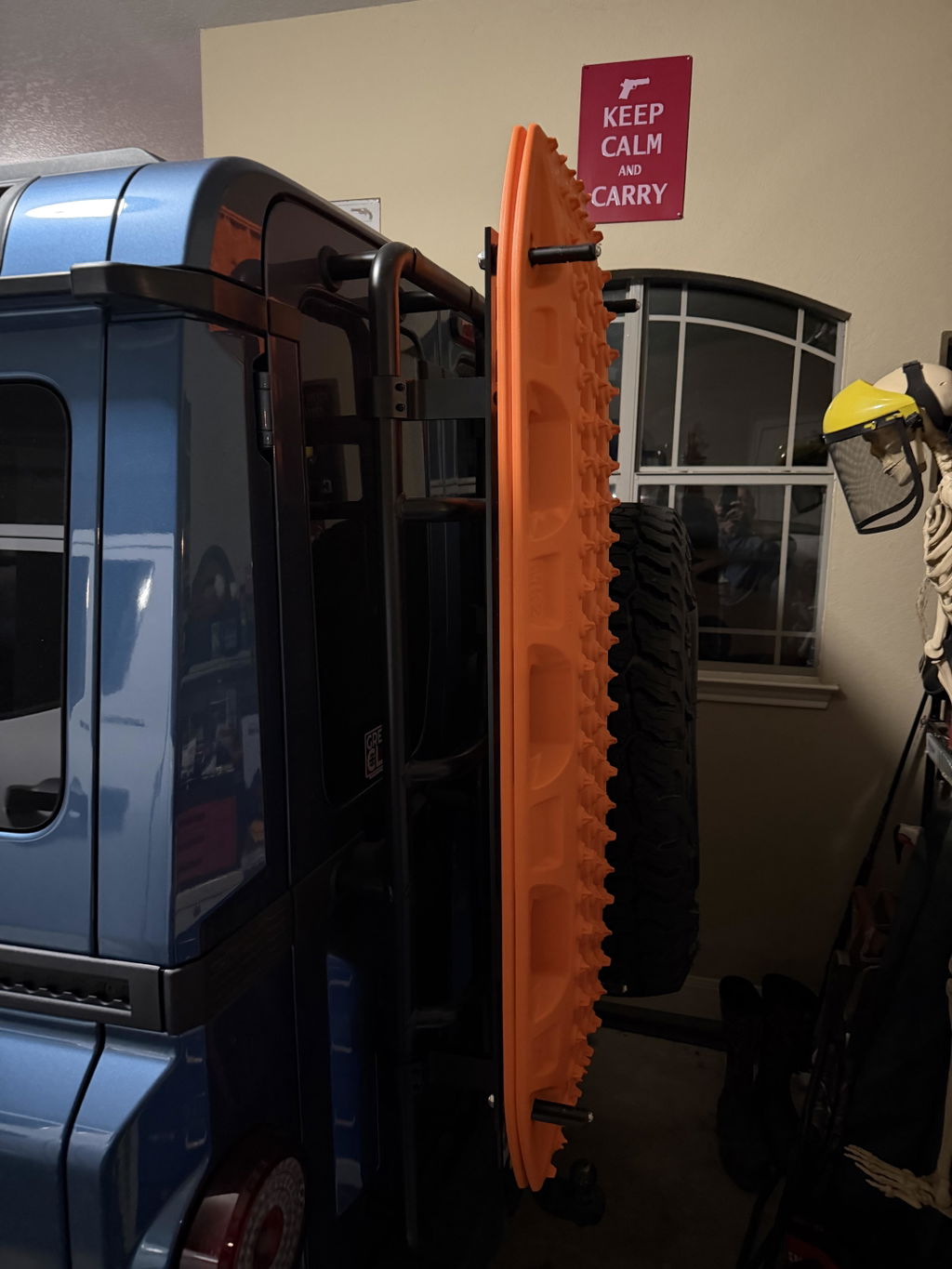
Airing down dramatically improves traction, but it also commits you. Without a compressor to re-inflate, you're stuck at low pressure — which limits your speed and increases sidewall vulnerability. Never air down unless you have a compressor, a rated recovery strap, and ideally a set of recovery boards. DVA's Grenadier Ladder-Mounted Recovery Board Carrier (MaxTrax MKII & Lite compatible) and Hi-Lift Jack Carrier keep recovery gear accessible and secure without consuming interior space — mounted directly to the OEM rear ladder.
Quick-Reference Cheat Sheet
Grenadier Off-Road Settings at a Glance
- Leaving sealed road? Lock the centre diff. Always.
- Sand? Centre diff locked, air down to 18-22 psi, manual gear selection, maintain momentum.
- Mud? Centre diff locked, keep tyre pressure relatively high, don't stop, use rear locker for cross-axle ruts.
- Rocks? Low range, centre diff locked, rear + front lockers engaged, slow and steady throttle, 20-25 psi.
- Water? Low range, centre diff locked, wading mode on, walk the crossing first, maintain a steady bow wave.
- Getting unstuck? Don't spin the wheels. Air down further, engage rear locker, try reversing first, use recovery boards if available.
- Back on sealed road? Unlock everything in reverse order: front locker → rear locker → centre diff. Air tyres back up to road pressure.
The Grenadier was designed as a tool, and like any tool, it works best when you understand its controls. The good news: the basics are simple. Lock the centre diff early. Air down for soft surfaces. Use the axle lockers proactively, not reactively. And when in doubt, walk the terrain first — it's faster than recovering a stuck vehicle.