Risk-based expedition planning framework with fuel range calculations, electrical power budgets, payload engineering, communication redundancy protocols, and pre-departure mechanical inspection procedures.
- Fuel: Standard 90L tank = 260–450 km in technical terrain. Calculate per-leg consumption, add 25% buffer, carry 2×20L jerry cans for remote routes (+160 km range, 34 kg payload).
- Power: Factory EFB provides ~37.5Ah usable (≈450Wh) — enough for ~15 hours of camp load. Multi-day trips require auxiliary battery, solar, or 45–60 min morning engine run.
- Payload: B57 diesel = 832 kg gross payload. Typical expedition stack (people + water + fuel + gear) consumes ~489 kg — leaving ~343 kg margin.
- Recovery: Tier 1 (recovery boards + shovel + tyre kit = 13 kg) solves 80% of stuck scenarios. Add Hi-Lift + kinetic rope for remote technical terrain.
- Communication: 4-layer minimum — satellite internet → satellite messenger → UHF radio → cell phone. All four systems independent; no single point of failure.
- Go/No-Go: Fuel ≥125% of longest leg, water ≥8L/person/day +20%, 2+ emergency comms tested, battery ≥12.6V. Any "no" means delay or modify the plan.
1. INEOS Grenadier Expedition Risk Engineering
Expedition preparation is risk engineering. Every system must function independently for the trip duration, with redundancy where failure has high consequences. The difference between recreational driving and expedition use isn't distance — it's the cost of failure.
Grenadier Platform Capabilities
| System | Baseline Specification | Expedition Limitation | Mitigation Strategy |
|---|---|---|---|
| Fuel Capacity | 90L standard, 189L maximum | Range limited by terrain consumption | Jerry cans, consumption analysis |
| Electrical Capacity | 80Ah EFB battery | 40Ah usable to 50% discharge | Auxiliary battery, solar, charge discipline |
| Payload Capacity | 680-760 kg (depending on config) | Water weight dominates budget | Consumption planning, weight distribution |
| Communication | Cell phone dependent | No coverage in remote areas | Satellite systems, radio redundancy |
| Recovery Capability | Factory recovery points | Self-recovery limited without equipment | Tiered recovery gear strategy |
2. INEOS Grenadier Fuel Range Engineering
Fuel planning separates successful expeditions from expensive rescues. The Grenadier's consumption varies dramatically by terrain — understanding this variance is essential for range calculations.
Real-World Consumption Data Analysis
Based on owner-reported data from The INEOS Forum and Reddit communities. All figures assume a loaded vehicle (2 occupants + expedition gear, ~300 kg payload). AC on adds approximately 5–10% to consumption. Figures are community-reported ranges, not controlled test results.
| Driving Condition | B57 Diesel (L/100km) | B58 Petrol (L/100km) | Range on 90L Tank |
|---|---|---|---|
| Highway (sealed, 100 km/h) | 10.5–12.2 | 14.9–16.8 | 740–850 km |
| Secondary Roads (sealed, varies) | 12–14 | 16–19 | 640–750 km |
| Gravel Roads (unsealed, moderate speed) | 15–18 | 19–23 | 470–600 km |
| Technical Off-Road (low range: 20 on hard-packed 4WD tracks/moderate gradient; 30 in soft sand, steep climbs, heavy low-range use) | 20–30 | 25–35 | 260–450 km |
| Sand Driving (4WD, aired-down) | 25–35 | 30–40 | 225–360 km |
| Recovery/Winching (stationary time) | 3–5 L/hour | 4–6 L/hour | N/A (time-based) |
Range Calculation Protocol
For expedition legs between confirmed fuel stops:
- Measure actual distance: Use GPS track data, not map estimates. Trail distances exceed straight-line distances by 15–30%.
- Analyze terrain composition: Percentage breakdown of highway, gravel, technical sections.
- Calculate segment consumption: Apply terrain-specific consumption rates to each segment.
- Add 25% safety margin: Required reserve for route deviations, weather delays, recovery scenarios.
- Verify tank capacity: Compare total required fuel to available capacity.
Range Extension Analysis
| Configuration | Total Fuel (L) | Technical Terrain Range (km) | Mixed Terrain Range (km) |
|---|---|---|---|
| Standard Tank (90L) | 90 | 260–450 | 470–750 |
| Enlarged Tank (145L) | 145 | 420–725 | 760–1,200 |
| Enlarged + Auxiliary (189L) | 189 | 540–945 | 990–1,565 |
| Standard + 2×20L Jerry Cans | 130 | 370–650 | 680–1,080 |
| Enlarged + 2×20L Jerry Cans | 185 | 530–925 | 970–1,535 |
Jerry can logistics: NATO 20L cans weigh 17 kg when full (fuel = 0.85 kg/L). Mounted on DVA side carriers or ladder carriers, two cans add 40L range extension with 34 kg payload penalty. At 25 L/100km technical driving, that's 160 km additional range — often the difference between reaching fuel and calling for extraction.
3. Electrical Power Budget
Modern expeditions operate on electricity. Every device draws from finite battery capacity that must sustain camp operations for days without engine runtime. Power planning prevents running out of power for essential devices.
Grenadier Electrical Architecture Analysis
| System Component | Specification | Practical Limitation | Engineering Implication |
|---|---|---|---|
| Factory Battery | 80Ah EFB chemistry | 80Ah × 50% max DoD = 40Ah usable → less ~6% reserve margin ≈ 37.5Ah available. The 50% DoD limit is standard EFB best practice to maximize cycle life; deeper discharge significantly reduces battery lifespan. LiFePO4 upgrades allow 80%+ DoD, which roughly doubles usable capacity. | 37.5Ah × 12V = 450Wh available for camp loads |
| Alternator Output | ~250A rated (output varies with RPM and electrical load) | Up to ~3,500W at operating speed | Substantial excess capacity during drive time |
| Auxiliary Switch Panel | 6 circuits, 40A per circuit | Total 240A maximum | Exceeds alternator capacity if all active |
| DTP Electrical System | 25A per contact continuous | Voltage drop over long cable runs | Cable gauge critical for high-current loads |
Camp Load Analysis Matrix
| Device | Power Draw (W) | Duty Cycle (%) | Daily Consumption (Wh) | 48-Hour Total (Wh) |
|---|---|---|---|---|
| 12V Compressor Fridge | 45W running, 5W standby | 40% compressor cycle | 360Wh | 720Wh |
| LED Camp Lighting (4 hours) | 30W active | 17% (4h/24h) | 120Wh | 240Wh |
| Starlink Mini (active 3h/idle 5h) | 30W active, 12.5W idle | 12.5% active, 21% idle | 153Wh (90 + 63) | 306Wh |
| Device Charging (phones, tablets) | 15W average | 25% (6h charging) | 90Wh | 180Wh |
| UHF/VHF Radio (standby) | 2W | 100% | 48Wh | 96Wh |
| Water Pump (intermittent) | 50W | 4% (1h total use) | 50Wh | 100Wh |
| Total Daily Load | Variable | — | 820Wh | 1,640Wh |
Power budget reality check: Factory battery usable capacity is 450Wh. Typical camp load is 820Wh daily. Without charging, the factory system provides ~15 hours of operation — barely a single night. Note: If using a 120V/240V inverter for laptops or other AC devices, add 12–15% to those devices' power draw to account for conversion losses.
Power System Solutions Engineering
Option 1: Drive-to-Charge Protocol
- Engine runtime: 45–60 minutes per morning
- Fuel cost: 1.5–2.0L per charge session
- Charge recovery: 60–90Ah (720–1,080Wh)
- Suitable for: 2–3 day expeditions, fuel-abundant areas
Option 2: Auxiliary Battery System
- LiFePO4 100Ah: 1,280Wh usable capacity (100% discharge safe)
- Combined capacity: 1,792Wh (factory + auxiliary)
- Autonomous operation: 2.2 days without charging
- Weight penalty: 12–15 kg for lithium system
Option 3: Solar Supplementation
- 100W panel output: 400–600Wh per day (6–8 peak sun hours)
- System efficiency: ~70% (charge controller losses)
- Net daily generation: 280–420Wh
- Extends battery life: 50–60% longer autonomous operation
4. Payload Engineering
Payload capacity is finite and non-negotiable. Exceeding GVM compromises braking, handling, and component longevity while voiding insurance coverage. Every kilogram must be planned, weighed, and justified.
Grenadier Payload Specifications
| Vehicle Configuration | GVM (kg) | Typical Kerb Weight (kg) | Available Payload (kg) |
|---|---|---|---|
| Station Wagon (B57 Diesel) | 3,550 | 2,718 | 832 |
| Station Wagon (B58 Petrol) | 3,550 | 2,643 | 907 |
| Quartermaster (Pickup) | 3,550 | 2,790 | 760 |
| GVM Upgraded (select markets) | 3,800 | 2,718 | 1,082 |
Payload figures are calculated as GVM minus kerb weight. Kerb weight varies by engine, trim level, and factory options installed. Verify your specific vehicle's kerb weight from your registration documents or INEOS specification sheet. The worked examples below use the B57 Diesel Station Wagon (832 kg payload) as the reference configuration.
Expedition Weight Stack Analysis
| Weight Category | Typical Mass (kg) | Payload Impact (%) | Optimization Strategy |
|---|---|---|---|
| Occupants (2 adults + personal gear) | 170 | 20.4% | Fixed (non-optimizable) |
| Water (8L/person/day × 5 days) | 80 | 9.6% | Consumption planning, resupply points |
| Fuel (2×20L jerry cans) | 34 | 4.1% | Route planning, tank upgrade |
| Food + Cooking Equipment | 40 | 4.8% | Dehydrated foods, efficient gear |
| Camping Equipment | 50 | 6.0% | Lightweight materials, dual-purpose items |
| Vehicle Accessories (permanent) | 60 | 7.2% | Aluminum vs steel, modular systems |
| Recovery Equipment | 35 | 4.2% | Tiered approach, exterior mounting |
| Tools + Spares | 15 | 1.8% | Essential-only approach |
| Communication Equipment | 5 | 0.6% | Integrated systems |
| Total Expedition Load | 489 | 58.8% | 343 kg margin remaining |
Water Planning: The Payload Dominator
Water consumption planning has the highest impact on expedition payload budget:
- Survival minimum: 3L per person per day in temperate conditions (WHO guideline). Increase to 5–8L/person/day in hot climates or at altitude.
- Basic expedition: 6L per person per day (drinking, minimal cooking)
- Comfortable expedition: 8–10L per person per day (drinking, cooking, washing)
- Weight impact: 1 kg per liter (water density)
5-day expedition, 2 people:
- Survival rate: 30L = 30 kg (3.6% payload)
- Basic rate: 60L = 60 kg (7.2% payload)
- Comfortable rate: 90L = 90 kg (10.8% payload)
5. Recovery Equipment Strategy
Recovery gear selection follows failure mode analysis. Different terrain creates different stuck scenarios requiring different extraction techniques. Carrying everything is weight-inefficient — carrying the right tools for expected terrain is smart planning.
Tier 1: Universal Recovery Equipment (Every Off-Pavement Trip)
| Equipment | Weight (kg) | Solves | Mounting Location |
|---|---|---|---|
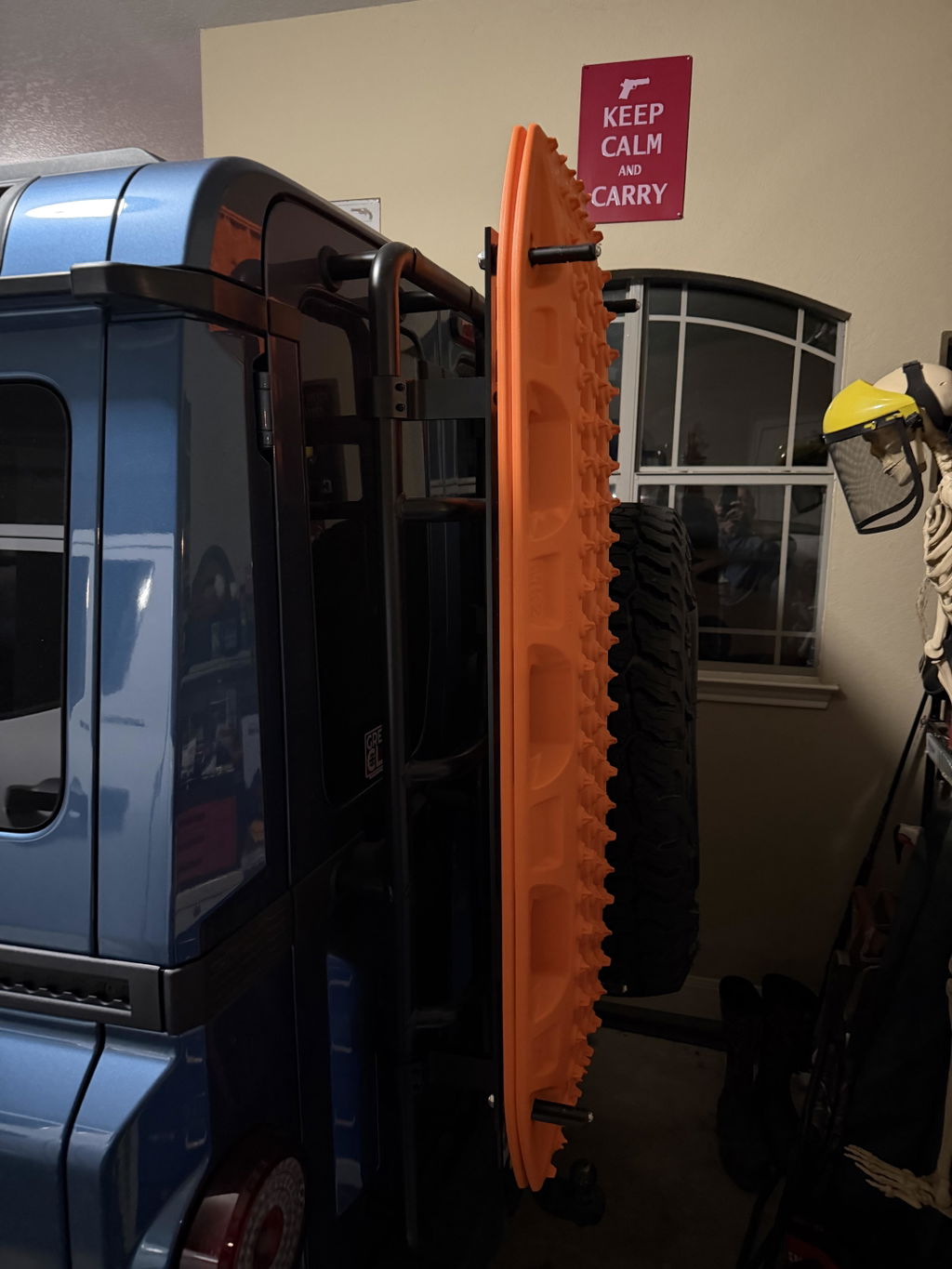
| Recovery Boards (pair) | 8 | 80% of stuck situations | DVA side carriers (quick access) |
| Folding Shovel | 2 | Clearance digging, camp leveling | Interior or ladder-mount |
| Tire Repair Kit + Compressor | 3 | Puncture repair (faster than spare change) | Interior storage |
| Basic Tool Kit | 5 | Field repairs, adjustments | Interior organized storage |
| Tier 1 Total | 18 | — | — |
Tier 2: Remote/Technical Terrain Equipment
| Equipment | Weight (kg) | Failure Mode Addressed | Technical Requirement |
|---|---|---|---|
| Hi-Lift Jack | 14 | Wheel change on uneven ground | DVA ladder mount for access |
| Kinetic Recovery Rope | 6 | Vehicle-to-vehicle extraction | Energy transfer, safer than static |
| Rated Shackles (pair) | 2 | Rope-to-vehicle connection | Minimum 4.75T WLL for loaded Grenadier |
| Snatch Block | 2 | Winch mechanical advantage | Doubles pulling force, redirects angle |
| Tree Trunk Protector | 2 | Winch anchor point protection | Environmental preservation requirement |
| Tier 2 Total | 26 | — | — |
Tier 3: Specialized/Group Recovery Equipment
Consider for extreme terrain or group expeditions:
- Winch (factory or aftermarket): Self-recovery capability, 30–35 kg weight penalty
- Sand ladders: Desert-specific, longer than standard boards, 6–8 kg per pair
- Come-along hand winch: Manual pulling power, 4–6 kg
- Exhaust jack: Pneumatic lifting for sand recovery, 3–4 kg
6. Communication Redundancy
Communication system failure in remote areas escalates minor problems into emergencies. Redundancy isn't optional — it's risk management for scenarios where self-extraction isn't possible.
Layer 1: Primary Communication (Starlink Mini)
- Capability: Full internet connectivity via satellite
- Power requirement: 20–40W continuous
- Limitations: Clear sky required, 60–90s boot time
- Applications: Weather data, route updates, messaging, email
- Installation: DVA roof mount with DTP power cable
Layer 2: Emergency Backup (Satellite Messenger)
- Devices: Personal satellite messenger with two-way SOS and GPS tracking (battery-operated, no vehicle power required)
- Capability: SOS function, GPS tracking, two-way text
- Power requirement: Battery-operated, multi-day operation
- Critical feature: Works under canopy where dish systems fail
- Carry protocol: Personal carry, not vehicle-mounted
Layer 3: Local Area Communication (UHF/VHF Radio)
| Radio Type | Range (km) | Power (W) | Applications |
|---|---|---|---|
| Handheld UHF | 2–15 | 5W | Camp-to-camp, short-range coordination |
| Vehicle UHF | 5–30 | 25–40W | Convoy communication, emergency repeaters |
| VHF Marine/Aviation | 10–50 | 25W | Emergency frequencies, maritime contact |
| HF/Shortwave | 100–1000+ | 100W | Long-distance emergency, specialist use |
Communication System Weight, Cost & Power Summary
| Communication Layer | Example Device | Weight (kg) | Approx. Cost (USD) | Power Draw (W) | Monthly Service |
|---|---|---|---|---|---|
| Layer 1: Satellite Internet | Starlink Mini | 1.1 | $599 | 20–40W active | $50–$150/mo |
| Layer 2: Satellite Messenger | Two-way SOS satellite messenger | ~0.1 | $300–$450 | Battery-operated (USB charge) | $15–$65/mo |
| Layer 3a: Handheld UHF Radio | GME TX6160 or equivalent | 0.3 | $100–$200 | 5W transmit | None (license may apply) |
| Layer 3b: Vehicle-mounted UHF | GME XRS-370C or equivalent | 1.5 (with antenna/mount) | $400–$600 | 25–40W transmit | None (license may apply) |
| Layer 4: Cell Phone | Smartphone + power bank | 0.5 | Existing | 5–15W charging | Existing plan |
| Full 4-Layer System Total | — | ~3.5 kg | ~$1,550–$1,800 | Variable | $65–$215/mo |
Costs are approximate retail prices as of early 2026. Service fees vary by plan tier and provider. Weight includes typical mounting hardware and cables.
Layer 4: Civilization Reentry (Cell Phone)
- Configuration: Airplane mode with offline maps pre-loaded
- Battery management: Power bank backup, USB charging from vehicle
- Data preparation: Download emergency contact numbers, medical information
- Physical protection: Waterproof case, separate from satellite messenger
7. Pre-Departure Vehicle Inspection
This inspection protocol prevents most expedition failures from mechanical neglect. Every item on this list has caused documented expedition issues when skipped.
Tire System Inspection
| Checkpoint | Specification | Failure Consequence | Inspection Method |
|---|---|---|---|
| Tire Pressure (all 5) | Terrain-appropriate pressure | Blowout, poor traction | Digital gauge, cold measurement |
| Tread Depth | 4mm minimum for off-road | Loss of traction, puncture risk | Tread depth gauge |
| Sidewall Integrity | No cuts, bulges, or cracking | Catastrophic failure | Visual inspection + manual feel |
| Lug Nut Torque | Factory specification ±5% | Wheel detachment | Torque wrench verification |
Fluid Systems Analysis
| Fluid | Normal Indication | Warning Signs | Action Required |
|---|---|---|---|
| Engine Oil | Between min/max, dark color normal | Milky appearance (coolant leak) | Do not depart — investigate leak |
| Coolant | At MAX when cold, clear color | Low level, contamination | Top up, inspect for leaks |
| Brake Fluid | Near MAX line, clear/amber color | Low level, dark color | Investigate brake wear/leaks |
| Power Steering | Between min/max (if equipped) | Low level, foaming | Check for leaks, air intrusion |
| Windshield Washer | Full reservoir | Empty (common oversight) | Refill — critical for dusty conditions |
Electrical System Verification
- Battery voltage: 12.6V minimum with engine off (fully charged state)
- Battery terminals: Clean, tight, no corrosion (clean with baking soda solution)
- Lighting systems: All functions — headlights, taillights, brake, reverse, indicators, auxiliary
- DTP connections: Physical verification of lock engagement on every connector
- Auxiliary power: Test all switches, verify LED indicators
Mechanical Systems Check
- Brake performance: Firm pedal, no pulling, parking brake holds on slope
- Suspension components: Visual check for leaking shocks, cracked bushings, broken springs
- Steering precision: Minimal play, no binding, returns to center
- Belt condition: No cracking, proper tension, no fraying
- Exhaust security: No loose heat shields, intact mounting
8. The 48-Hour Decision Protocol
Two days before departure, you must have definitive answers to five system-critical questions. If any answer is negative or uncertain, address the issue or modify the expedition plan.
Go/No-Go Decision Matrix
| System | Go Criteria | No-Go Triggers | Mitigation Options |
|---|---|---|---|
| Fuel System | Fuel capacity ≥125% of longest leg between confirmed fuel stops — "confirmed" means published operating hours verified within 30 days, not projected or seasonally assumed (e.g., 500 km leg requires 625 km range) | Fuel capacity <110% of longest leg, or fuel stop unconfirmed | Jerry cans, route modification, fuel staging |
| Water Supply | ≥8L/person/day + 20% margin for trip duration | Capacity below 6L/person/day, no resupply within 48 hours | Additional storage, consumption reduction |
| Power Budget | Battery + charging capacity ≥120% of daily load | Electrical deficit that cannot be recovered within 24 hours | Auxiliary battery, solar, charge discipline |
| Communication | 2+ independent emergency systems tested and functional | Any communication layer non-functional with no backup | Additional devices, backup power |
| Vehicle Condition | All inspection items green, battery ≥12.6V | Any critical system marginal, battery <12.4V | Repair, replacement, service |
Summary: Systems Engineering for Expedition Success
The INEOS Grenadier is a capable expedition platform with solid off-road capability, substantial payload capacity, and integrated power infrastructure. Success comes from understanding and respecting the platform's limitations while engineering solutions for expedition-specific requirements.
The Five Pillars of Expedition Preparation
- Fuel Range Management: Calculate consumption by terrain type, add 25% safety margin, verify capacity against longest leg between confirmed fuel stops.
- Power Budget Engineering: Quantify electrical loads, match to battery capacity, implement charging strategy (drive-discipline, auxiliary battery, or solar).
- Payload Optimization: Respect GVM limits, distribute weight for vehicle balance, optimize water planning as the largest variable cost.
- Recovery Equipment Strategy: Tier equipment by failure modes, mount for accessibility, avoid over-buying for unused scenarios.
- Communication Redundancy: Four-layer approach ensuring no single point of failure eliminates ability to request assistance.
The Grenadier rewards systematic preparation. Build your capability methodically, test your systems before depending on them, and remember that the wilderness grades on results, not intentions. Engineer your margins. Then go explore.
DVA Expedition Systems: Mapping Checklist to Hardware
Each pillar above maps to a specific DVA product engineered for the Grenadier's factory mounting architecture:
- Roof & Cargo: DualTrack Roof Rail System — 20 lb total (4-bar), 200 lb dynamic capacity, dual L-Track channels for infinite accessory positioning
- Lighting: Roof Pod Light Bar — LED scene lighting integrated with the EXT circuit architecture
- Power Distribution: DTP Power Cables — factory-spec connectors for clean accessory wiring through the Grenadier's EXT/INT circuits
- Recovery Mounting: Side Accessory Mounts — RotoPax, jerry cans, and recovery boards positioned for field accessibility
- Connectivity: Starlink Accessories — Starlink Mini roof mount for expedition communication redundancy
All DVA systems bolt to factory mounting points — no drilling, fully reversible, 20–60 minute installation with basic tools.
INEOS Grenadier Expedition FAQ: Preparation Questions
What is the INEOS Grenadier fuel range for expedition use?
With the standard 90L tank, INEOS Grenadier range varies by terrain: 740-850km highway, 470-600km gravel roads, 260-450km technical off-road. Adding auxiliary fuel tanks extends range to 189L maximum capacity for remote expeditions.
How much water should I carry in an INEOS Grenadier expedition?
Plan 4-6 liters per person per day in temperate climates, 6-8 liters in desert conditions. A 5-day expedition for 2 people requires 40-80 liters of water, weighing 40-80kg of your payload budget.
What electrical capacity does the INEOS Grenadier have for expedition accessories?
Standard 80Ah EFB auxiliary battery provides approximately 37.5Ah usable (80Ah × 50% max DoD, less reserve margin). Typical expedition electrical load of 18.6Ah daily requires dual battery systems or solar charging for multi-day independence.
How do I calculate payload for INEOS Grenadier expedition loading?
INEOS Grenadier payload is 680-760kg total including passengers. Subtract: people (160kg for 2 adults), water (40-80kg), food/gear (60kg), modifications (150-250kg). Remaining capacity determines expedition duration and equipment level.