The best roof rack alternative for the INEOS Grenadier is a low-profile L-Track crossbar system. The DVA DualTrack™ pair sits 0.5" above the roofline, weighs 12 lbs for the pair, bolts to existing factory mounting points without drilling, and lets you position any L-Track-compatible accessory anywhere along the rail length. No basket, no dead weight, no garage clearance penalty.
The standard approach — a steel basket or tube rack bolted six inches above your roofline — was engineered for utility, not for a vehicle like the Grenadier. It adds wind drag, kills garage clearance, and turns a purpose-built 4x4 into something that looks like it was assembled from a hardware catalogue. We built the DualTrack system because we were frustrated with that tradeoff.
- Profile height: DVA DualTrack™ sits 0.5" above the roofline vs 6–8" for standard basket racks — garage clearance and roofline silhouette both retained.
- Weight: 12 lbs for the rail pair vs 55–85 lbs for steel baskets — leaves 88% of your 165 lb dynamic rating for actual gear.
- Mounting flexibility: Infinite L-Track positions along the full rail length, tool-free repositioning in minutes vs unbolting basket hardware.
- Installation: Bolt-on to existing factory roof attachment points — no body drilling, no voided warranty.
What's Actually Wrong with Traditional Racks
Height is the obvious issue — a conventional rack adds 6–8" to your roofline, which matters both in multi-storey car parks and on tight trail lines. But the less-discussed problem is rigidity. A fixed basket forces you to commit to a load configuration before you leave. If your trip changes, your rack doesn't.
Wind noise is the other tax. At motorway speeds, an empty basket creates significant acoustic drag — a constant reminder that you're carrying dead weight you didn't need.
One Grenadier owner on The INEOS Forum described fitting a full basket rack and immediately noticing "a loud whistling beginning at 50 mph and significant wind noise at 70 mph" — a stark contrast to the cabin quiet he'd enjoyed before. Another forum member reported harsh vibrations flowing through the entire vehicle at speed, confirmed by GoPro footage showing visible crossbar deflection. On r/ineosgrenadier, one owner noted that a stock gutter-rail mount seemed "tailor made to cause a lot of wind noise and compromise the looks of the car."
— The INEOS Forum / r/ineosgrenadier
| Metric | Traditional Basket | DVA DualTrack™ |
|---|---|---|
| Profile height | +6–8" above roofline | +0.5" above roofline |
| Garage clearance | Compromised | Retained |
| Mount positions | Fixed | Infinite (L-Track standard) |
| Reconfigure time | Remove gear, rebolt | Tool-free, minutes |
| Wind noise (empty) | Significant drag | Negligible |
| Body drilling required | Often yes | No — existing attach points |
The Numbers: Weight, Drag, and Payload
The weight penalty of a traditional basket rack is rarely discussed in honest terms. A typical steel basket for an off-road vehicle weighs between 55 and 85 lbs before you put anything on it. Aluminum baskets are lighter — 30 to 45 lbs — but still represent dead weight that counts against your dynamic roof load rating every single mile.
The DVA DualTrack L-Track system weighs approximately 12 lbs for the pair. That's not a rounding error — it's 40 to 70 lbs of payload capacity returned to you. On a vehicle with a 165 lb dynamic roof rating, that difference is the margin between carrying what you need and making compromises.
Steel basket (70 lbs) + two crossbars (12 lbs) = 82 lbs of dead weight before cargo. On a 165 lb dynamic rating, you've consumed 50% of capacity on the rack itself. DualTrack rails (12 lbs) + crossbars (8 lbs) = 20 lbs — leaving 88% of rated capacity for actual gear.
Then there's aerodynamic drag. A 2016 Lawrence Berkeley National Laboratory study found that roof racks are responsible for up to a 25% fuel economy penalty on passenger vehicles at highway speeds. The key finding: even empty racks create substantial drag. A basket six inches above your roofline is a wall of turbulence at 70 mph. The researchers estimated roof racks account for nearly 1% of all U.S. light-duty fuel consumption — 100 million gallons annually.
A low-profile rail sitting 0.5" above the roofline generates negligible additional drag. There's no basket to catch wind, no crossbars standing proud when you don't need them.
| Factor | Steel Basket | Aluminium Basket | DVA DualTrack™ |
|---|---|---|---|
| System weight | 55–85 lbs | 30–45 lbs | ~12 lbs |
| Profile height | 6–8" above roof | 4–6" above roof | 0.5" above roof |
| Fuel penalty (highway) | 12–25% when empty | 8–15% when empty | Negligible |
| Usable payload (165 lb rating) | 80–110 lbs | 120–135 lbs | ~153 lbs |
| Load distribution | Perimeter frame only | Perimeter frame only | Full-length continuous |
The Engineering Case for L-Track
L-Track is an aerospace and commercial transport standard — the same mounting interface used in aircraft cargo holds and professional fleet vehicles. The slot accepts standardized fittings, which means any L-Track-compatible accessory locks in at any position along the rail. No drilling. No dedicated mounting points. No re-engineering for a different load.
0.5" profile. That's not a marketing number — it's a measured clearance that keeps your Grenadier within standard garage height and maintains the roofline silhouette the vehicle was designed with. Factory mounting points only — no body drilling, no warranty implications.
What You Can Mount
Because the system uses open L-Track, the mount configuration is entirely yours. Common setups include:
- Jerry cans
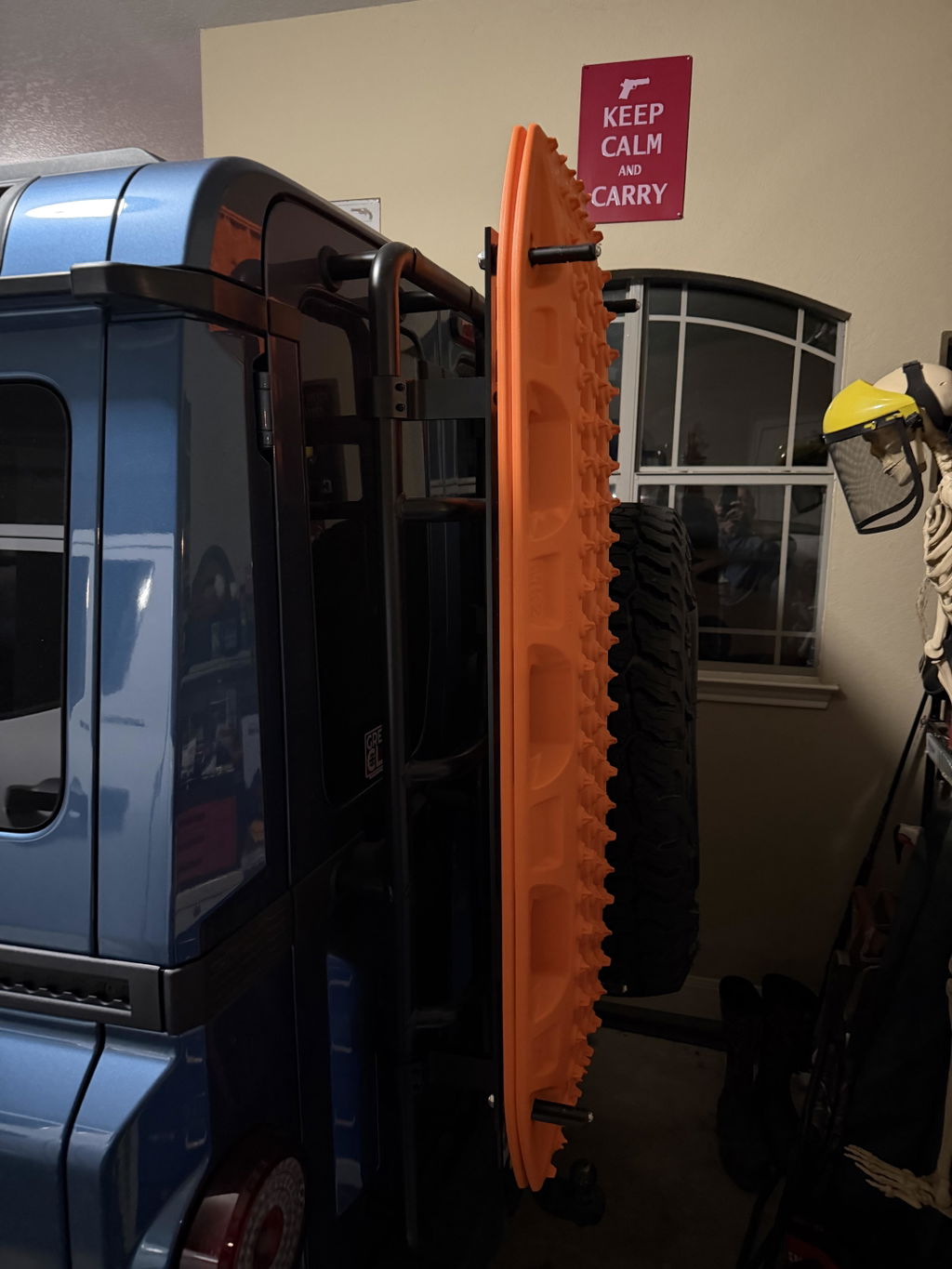
- Recovery boards
- Cargo bags
- Antenna mounts
- Light pods
- Shovel / hi-lift mounts
- Rooftop tent crossbars
Repositioned or removed in minutes without tools. A weekend overlanding build differs from a daily carry setup. With a basket rack, you reconfigure by removing gear. With DualTrack, you reconfigure the rack itself.
Real Load Budgets That Actually Work
Theory is useful. Practical load planning is what keeps your gear on the roof. Three common Grenadier roof configurations with honest weight budgets:
RTT: 120–160 lbs · Crossbars: 8 lbs · DualTrack rails: 12 lbs
Total: 140–180 lbs — at or near the dynamic limit, which is exactly why system weight matters. A basket eating 70 lbs before the tent goes up puts you over-limit before you add a sleeping bag. With DualTrack, the math works.
Rigid solar (200W): 25 lbs · Cargo box: 35 lbs · Contents: 40 lbs · Crossbars: 8 lbs · DualTrack rails: 12 lbs
Total: ~120 lbs — comfortably within limits. L-Track lets you slide the panel to an unshaded position and reposition the cargo box independently.
Recovery boards (pair): 15 lbs · Hi-lift jack: 28 lbs · Shovel: 5 lbs · Jerry can (empty): 5 lbs · DualTrack rails: 12 lbs
Total: ~65 lbs — light, fast to reconfigure, everything mounts directly to L-Track. When you're back on tarmac, the recovery gear slides off in minutes.
Built to OEM Standard
The rails are extruded aluminium, finished to match the Grenadier's factory aesthetic. No weld marks. No powder coat texture mismatches. The mounting hardware uses existing roof attachment points — no drilling into body panels.
This is what OEM+ means to us: better than stock in function, indistinguishable from factory in appearance.
What Owners Report After Switching
Garage clearance comes back. Multiple owners report that regaining the ability to park in their home garage — or in multi-storey car parks without the cringe — was the single biggest quality-of-life improvement. One owner measured 7.5 inches of clearance recovered. That's the difference between fitting and not fitting in a standard 7-foot residential garage.
Highway noise drops dramatically. Empty basket racks generate a low-frequency drone at highway speeds that most owners have simply accepted as part of ownership. After switching to low-profile rails, the most common reaction is surprise at how much quieter the vehicle is.
A Grenadier owner on The INEOS Forum measured the fuel penalty of a roof rack at roughly 1.5 litres per 100 km at highway speed — even with a relatively low-profile setup and wind deflector. A separate low-profile owner on the same thread reported no noticeable change in fuel economy and minimal wind noise below 70 mph. The pattern is consistent: the taller and bulkier the rack, the steeper the penalty.
— The INEOS Forum
One member of The INEOS Forum summed up the low-profile advantage simply: after switching from a traditional basket to a low-profile rail system, all factory mounting holes lined up perfectly and the engineering quality was immediately evident.
— The INEOS Forum
The "lazy Sunday" test. Several owners have told us the real test is whether they leave the rack system on for daily driving. With a basket, most remove it when not overlanding — which means reinstalling before every trip. With DualTrack, there's no penalty for leaving it on. No drag, no noise, no clearance issue. It stays on, which means it's always ready.
Resale consideration. A bolt-on system using factory mounting points with no drilling preserves the vehicle's original condition. Owners who plan to sell or trade their Grenadier note that a reversible, OEM-quality accessory adds value rather than creating a "modified vehicle" discount.
DVA Roof System Products for the Grenadier
The DualTrack™ ecosystem covers every low-profile mounting need — from the base rail system to purpose-built L-Track accessories:
- DualTrack™ Roof Crossbar System — the core low-profile crossbar pair, factory bolt-on, 165 lb dynamic rated
- LED Roof Light Bar — mounts directly to DualTrack™ crossbars via L-Track, DTP plug-in power
- Starlink Mini Roof Mount — L-Track-mounted, adjustable tilt, DTP power integration for off-grid connectivity
- L-Track Sliders — 900 lb WLL, slide-in positioning anywhere along the rail
- Browse all INEOS Grenadier accessories →
If you use your Grenadier in mixed environments — trail, tarmac, urban — and want a roof system that doesn't announce itself or compromise clearance, DualTrack is the right solution. If you need maximum fixed cargo area for long expeditions with consistent loads, a basket may still suit your use case. But for most owners, the payload, noise, and clearance math doesn't favour the basket.